
For decades, the academic consensus surrounding ADHD has been treated as a final, immutable truth: individuals with ADHD were diagnosed with poorer motor development compared to their neurotypical peers. Yet, this "consensus" is a classic example of what Dr. William Dodson describes as the hubris of an era that falsely believes it has reached the "end of knowledge". If you walk into any professional kitchen, climb into a high-stakes construction site, or stand behind a soccer goal, you will find the reality is quite different: ADHDers thrive in roles that demand extreme motor precision, physical improvisation, and rapid, high-dimensional responses.
How did the academic record get it so catastrophically wrong? The answer lies in the "metaphysical mumbo-jumbo" that occurs when we mistake limited behavioral observation for TRUTH.
The Behavioral Science Dead-End
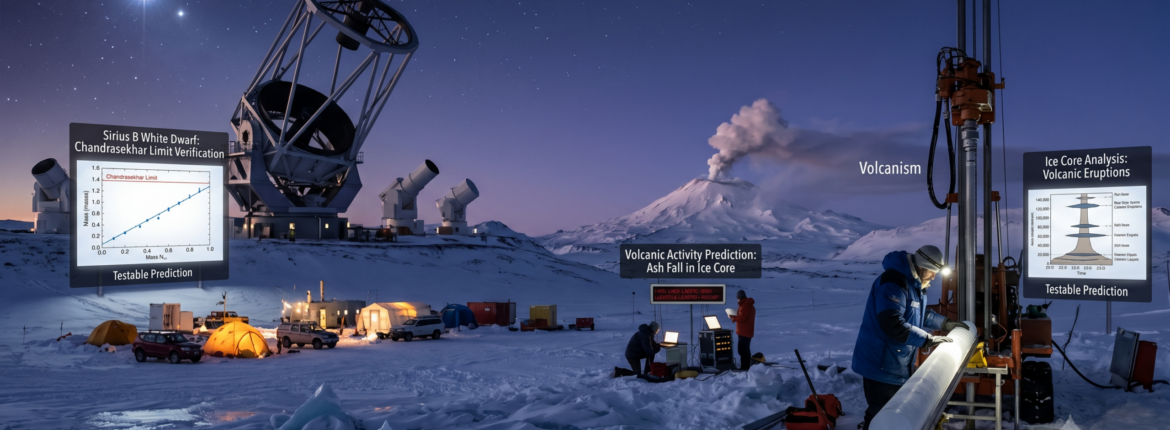
In hard sciences like geology or astrophysics, research is built on testable, predictive mechanisms. A volcanologist does not simply observe a mountain and guess its history; they use physical evidence, such as ice core samples, as a vehicle to pinpoint exactly when and where major volcanic eruptions occurred in the past. These predictions hold up under rigorous testing because they are based on physical reality.
In contrast, ADHD research is trapped in the "behavioral" descriptive loop. Because we cannot scan a living human brain at the individual cellular level—and because trying to do so with an electron microscope would destroy the very life we are attempting to study—we are forced to rely on inferences. We see the student "behaving" poorly in a classroom, and we postulate that they have a motor or executive deficit. We are describing a reaction to an environment, not a fundamental neurological law. Like trying to describe nuclear forces without ever detecting a quantum particle, we are building entire diagnostic frameworks based on "vapor trails" rather than the underlying mechanics.
The Validation of Silos: Hawkins Meets Dodson
This descriptive trap is reinforced by the way science is funded. Jeff Hawkins, in his critique of the NIH, identified that research funding is governed by committee consensus, creating a "veto culture" where anything radical or unproven—anything that challenges the status quo—is effectively shut down.
This validates Dr. Dodson’s frustration: because academics operate in these consensus-driven silos, they fail to talk to frontline practitioners—the clinicians, teachers, social workers, and athletic coaches who see ADHD performance in the real world. Had researchers consulted these experts, they would have realized that their "motor development" hypothesis was fruitless before they even applied for a grant. The grant process forces researchers to prioritize "safe" consensus over the practical, field-tested truths that practitioners witness daily.
The Path Forward: Where the Testable Predictions Lie
If we want to repair the scientific record, we must abandon the "lab-bench" isolationism and move research into the field, where the actual testable predictions lie. The frontline professionals—the clinicians, coaches, mentors, and masters of craft—are the true "data scientists" of human performance. They do not just observe behavior; they manipulate the variables of "engagement" and "scaffolding" to trigger specific outcomes.
- We must treat the field notes of these practitioners as our "core samples," using them to understand the composition and timing of past successes.
- We must shift from "behavioral description" to studying the specific environmental catalysts that trigger high-performance states in the ADHD brain.
- We must adopt a "Venture Capital" mindset for science that rewards radical, field-tested outcomes rather than safe, committee-approved incrementalism.
The era of pathologizing the "clumsy" ADHDer is coming to an end. It is time to stop fighting over outdated, consensus-driven beliefs and start focusing on the "things that matter"—treating the people we support well, and building a science that is finally as complex and dynamic as the brains it seeks to understand.