
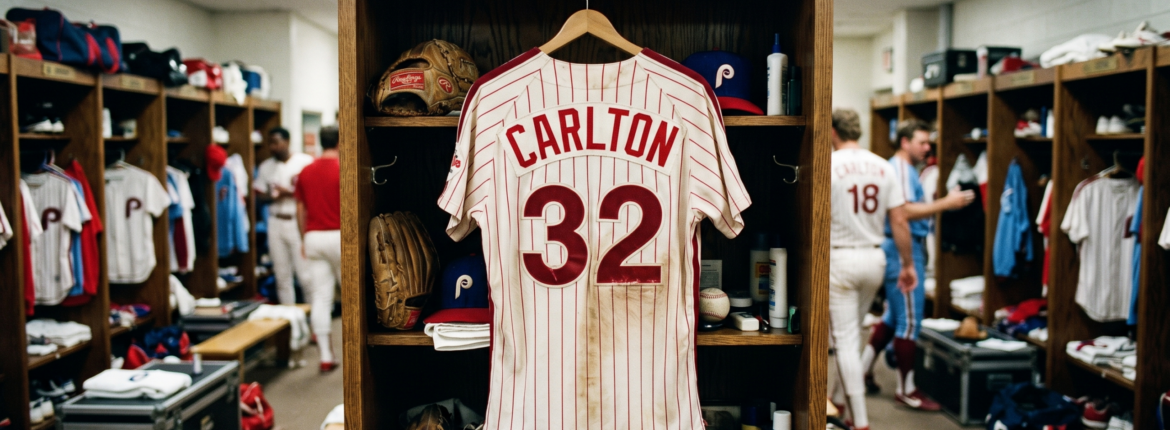
For athletes with Attention Deficit Hyperactivity Disorder (ADHD), the typical sports psychology advice can feel incredibly rigid. Being told to "just focus" or follow a strict, monotone routine often works against an ADHD brain, which naturally thrives on high stimulation, novelty, and intense shifts in energy.
That is why Hall of Fame pitcher Steve Carlton’s blueprint is so revolutionary.
As a four-time Cy Young winner who quietly practiced Taoist philosophy and mindfulness long before they became staples of sports psychology, "Lefty" cracked the code on how to balance extreme on-field hyperfocus with an off-field need for intense stimulation and play.
For an ADHD athlete, Carlton's career offers a masterclass in how to stop fighting your brain's natural chemistry and start using it to achieve "Flow."
1. Radical Compartmentalization (The "Wednesday" Effect)
One of the hallmarks of ADHD is an interest-driven attention system. If an ADHD brain isn't completely captured by the immediate relevance or high stakes of a situation, it wanders. Carlton hacked this by turning his start days into a high-visibility event he called "Win Day."
"Lefty was Lefty and his focus was his focus and on game day you absolutely left him alone... Before the game started, he put cotton in his ears... He'd be talking to himself, saying things like 'let your ability come through... let's go, let's go'—he'd be in a somewhat of a trance." — Tim McCarver [19:31, 20:17]
Why it works for ADHD:
Carlton didn't try to maintain a steady, moderate level of focus all week long—that is exhausting for an ADHD brain. Instead, he relied on radical transitions. By using physical cues (like literally stuffing cotton in his ears to block out external stimulation) and a mantra, he triggered an intentional state of hyperfocus. For ADHD athletes, trying to be "on" all the time leads to burnout. Creating intense, ritualized boundaries around game time allows you to flip the switch when it matters most.
2. Dopamine-Seeking as a Feature, Not a Flaw
Off the field, Carlton was a legendary, impulsive goofball. He memorized entire scripts of Caddyshack and Animal House[32:49], instigated chaotic locker room food fights [35:12], and once racked up a $1,600 team hotel bill by hitting golf balls down a 13th-floor hallway to see if he could strike a metal door without hitting the walls [33:31].
Why it works for ADHD:
An ADHD brain is chronically starving for dopamine—the neurotransmitter responsible for motivation, reward, and focus. If you try to force an ADHD athlete to be a quiet, stoic monk 24/7, their brain will seek out dopamine in ways that disrupt their training or mental health.
Carlton didn't suppress his high-energy, impulsive side; he used the road trips and clubhouse antics to let his brain run wild. By allowing himself to be a total goofball off the field, he cleared the "cognitive static," ensuring that when he stepped onto the mound, his brain was completely primed to lock in.
3. Physical Interventions Over Mental Stress: "Get Out of Your Own Way"
Standard sports psychology often tells athletes to analyze their performance, visualize mechanics, and think through their strategy mid-game. Carlton’s Taoist approach was the exact opposite: stop thinking entirely.
"One of the big obstacles in life is yourself... Biggest thing in your life is to get out of your own way and let your talent, which knows what it wants to do, do it." — Steve Carlton [28:18]
To achieve this, he partnered with martial artist and trainer Gus Hoefling, developing a brutal, non-traditional workout regimen centered around 360-degree range of motion, agility skills, and martial arts [26:07].
Why it works for ADHD:
ADHD athletes are prone to severe analysis paralysis and "working memory overload." If you have too many mechanical thoughts in your head, the ADHD brain short-circuits.
Carlton’s solution was to train so hard physically, and with such varied, dynamic movements (like martial arts), that his body internalized the mechanics completely. On the mound, he didn't "think" about how to throw his unhittable slider; as he famously told teammate Dick Ruthven, he just "held it like this and threw the shit out of it." [15:32] For ADHD athletes, heavy, varied physical training silences the mental chatter, allowing the body's natural instincts to take over.
4. Embracing the "Strange" and Shutting Out the Noise
Carlton famously stopped speaking to the media entirely during the height of his career [17:28]. He didn't care if teammates, fans, or reporters thought he was eccentric, detached, or flat-out "strange" [37:00]. He knew exactly what his mind needed to perform, and he ruthlessly protected his energy.
Why it works for ADHD:
ADHD individuals often experience "sensory overload" and carry a high emotional burden from masked symptoms or trying to fit into standard societal boxes. Carlton realized that satisfying the public's expectations was an unnecessary drain on his mental battery.
By eliminating the media noise and ignoring critics, he saved 100% of his cognitive energy for his craft. ADHD athletes need to realize that their optimal preparation might look weird to outsiders—whether that means listening to heavy metal, pacing, keeping a chaotic locker, or wearing earplugs—and that protecting those specific cognitive needs is a prerequisite for greatness.
The Takeaway for ADHD Athletes
Steve Carlton proved that you do not need a quiet, orderly mind to be an elite competitor. You can have a brain that wants to kick out bus windows [34:48], launch food across restaurants [35:12], and run around quoting comedies, and still be the most fiercely locked-in warrior on the field.
The trick isn't to fix your impulsivity; it's to build a stadium around it, channel it into hyperfocus when the whistle blows, and get completely out of your own way.