
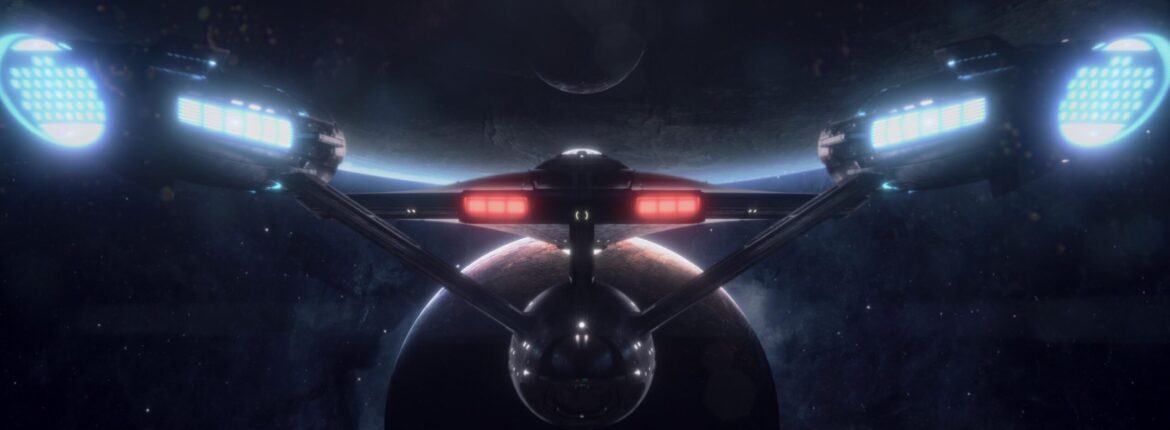
For nearly sixty years, Star Trek has invited audiences to look to the cosmos and imagine a better future. But for a vast contingent of the fandom, the starship Enterprise represents something far deeper than a vessel of exploration. It is a sanctuary.
Whether navigating an atypical brain—like an AuDHD profile or dyslexia—or carrying the suffocating weight of profound personal trauma, the bridge of the Enterprise stands as the ultimate psychological safe zone. It is a place where those who are broken or misunderstood by society aren’t just accommodated; they are essential.
The Neurodivergent Refuge: Where the Mask Drops
In the real world, neurodivergent individuals navigate an exhausting, invisible minefield of social subtext, sensory overload, and the relentless pressure to "mask" their true selves. The Enterprise flips this script entirely by operating on two foundational principles: radical transparency and explicit boundaries.
   [ THE NEUROTYPICAL WORLD ]               [ THE ENTERPRISE BRIDGE ]
 - Invisible, unwritten social rules      - Explicit Starfleet protocols
 - Constant pressure to "mask"            - Accommodation as standard architecture
 - Divergence viewed as a deficit         - Unique processing viewed as an asset
On the bridge, communication is direct, logical, and literal. Mr. Spock can process the universe through an hyper-focused, atypical lens, speaking with absolute candor without the fear of hurting feelings. Data can openly query the mechanics of human behavior, and instead of facing mockery, he is met with patient, structured explanations from peers like Geordi La Forge.
Furthermore, the physical architecture of the ship treats adaptation as a standard requirement, not an afterthought. Geordi’s sensory input via his VISOR is celebrated as a critical asset, and the chaotic, high-stimulation environment of a space crisis provides the perfect chemical trigger for an ADHD mind to lock into a brilliant state of hyperfocus. On this ship, you don't have to change your brain to be considered noble—you simply have to be yourself.
The Trauma Ward: Rebuilding on the Edge of the Void
While the Enterprise offers cognitive safety, it simultaneously serves as an emotional rehabilitation center for a crew fleeing immense psychological devastation. The universe is massive, silent, and empty—making it the perfect place to run to when the ground beneath your feet has turned into a graveyard of memories.
Dr. Leonard McCoy: Escaping the Ghosts of Earth
For Dr. Leonard "Bones" McCoy, the Enterprise is a life raft. On Earth, McCoy carried the crushing guilt of euthanizing his terminally ill father, only for a cure to be discovered months later. Add to that a devastating divorce that left him with nothing to his name, and Earth became unlivable.
Bones constantly gripes about the horrors of space, yet he never leaves. Why? Because Sickbay is his kingdom—a hyper-controlled, orderly environment where he possesses absolute agency to save lives, effectively counterbalancing the trauma he couldn't control in his past. Surrounded by the unshakeable loyalty of Jim Kirk and the predictable, emotionless stability of Spock, McCoy found a chosen family that fiercely insulated him from his ghosts.
Nyota Uhura: Finding Harmony in the Wake of Tragedy
The tragic backstory of Lieutenant Nyota Uhura further cements the ship as a refuge for the grieving. As a young woman, Uhura’s entire world was shattered when her parents and her brother were killed in a horrific shuttle accident. The sudden, violent loss left her adrift, untethered from her home and drowning in a sea of grief.
[ UHURA'S TRAUMA ] -> Loss of entire family in shuttle crash
       |
       v
[ THE ENTERPRISE ] -> Replaced chaotic grief with the orderly structure of subspace frequencies
       |
       v
[ THE RESULT ]     -> Substituted her lost family with a loyal, protective starship crew
Uhura didn't just join Starfleet to see the galaxy; she fled into the cold, structured reality of linguistics and communications because the noise of her grief was too loud. At the communications console, she found a profound sense of control. She mastered the chaos of the universe by sorting jumbled subspace frequencies, translating alien tongues, and bringing order to the void. The Enterprise crew didn't ask her to forget her family; they became her new one, fiercely protecting her as she knit her life back together through the literal act of connecting others.
"On This Ship, I Am Simply Spock"
Perhaps the entire philosophy of the Enterprise as a sanctuary is best captured by Spock himself in Star Trek: Strange New Worlds. Reflecting on his identity as a half-human, half-Vulcan child who struggled with L'tak Terai (the Vulcan equivalent of dyslexia), he notes:
"On Vulcan, I am half-human. On Earth, I am half-vulcan. On this ship, I am simply Spock."
That is the magic of the Enterprise. It is a world where a total dopamine-seeking goofball, a fiercely logical mind that processes data literally, a grieving daughter, and a broken divorcé can sit shoulder-to-shoulder. The starship proves a beautiful thesis: greatness doesn't require a quiet, trauma-free, neurotypical mind. It just requires an environment that stops trying to fix your differences, stands out of your way, and lets your talent shine.