
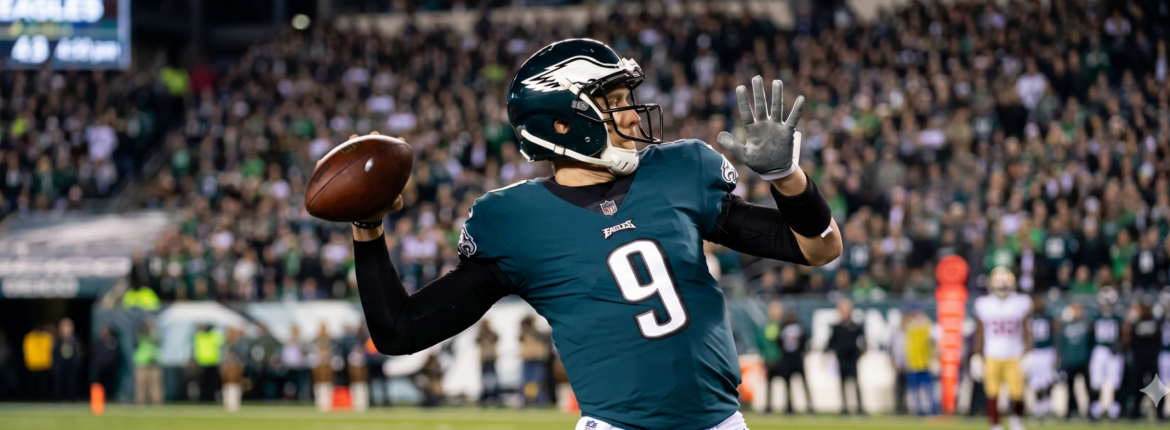
The complete narrative arc of Nick Foles is a brilliant testament to the power of the non-linear, multi-sport ADHD mind. In a league that systematically strips away athletic instinct in favor of rigid, robotic over-coaching, Foles succeeded because he treated the gridiron like a chaotic, cross-referenced playground. He didn't think like a conventional quarterback; he ran simulations across the biomechanics of basketball, the physics of ultimate frisbee, and the spatial dynamics of a point guard.
When you look at the entirety of his career, his peak moments weren't anomalies—they were the natural outputs of a hyper-focused, sensorimotor engine allowed to achieve absolute flow. But his story also exposes the fundamental psychological truth of the ADHD brain: without absolute passion, there is no flow. Ever.
1. The Austin Sandlot: Ultimate Frisbee and the 6'6" View of the Sky
To understand how Foles threw some of the most beautifully timed downfield touch passes in NFL history, you have to look at the offseasons he spent back home in Austin, Texas. Foles wasn't spending his summers solely inside a clinical quarterback laboratory counting his drop steps. He was out on the grass playing high-intensity ultimate frisbee.
       [ THE ULTIMATE FRISBEE TRAJECTORY MAP ]

         (The Discs Apex) ───► ☁️ [High Point Zone]
               ▲                     │
              ╱                      ▼
   [Flat Linear Launch]     [6'6" Foles Climbs Ladder]
         (The Throw)         (Internalizing the Catch)
At 6'6" with elite basketball hops, Foles wasn't just throwing the disc—he was running downfield as a primary target. In ultimate frisbee, a deep throw (a "huck") doesn't travel like a football. It lofts, catches the wind, hovers, and requires the receiver to perfectly track a floating object while running at full speed, ultimately timing their leap to pluck it at its absolute apex.
Foles spent hours on the receiving end of these passes, leaping over defenders and "climbing the ladder" to grab the disc out of the sky.
This did something profound to his brain’s predictive mapping. Most quarterbacks only understand the deep ball from the release side; they see a window and try to drive the ball through it. Foles, however, had deeply internalized what it felt liketo be the giant target. He understood the exact spatial geometry of how a high-pointing athlete tracks a looping trajectory against defensive momentum. He didn't just see his receivers—he lived in their skin.
2. The Translation: Throwing the Picture to Alshon Jeffery
When Foles paired up with wide receiver Alshon Jeffery in Philadelphia, his ultimate frisbee and basketball mapping instantly cross-referenced. Jeffery was a big, physical, former basketball player himself, possessing a legendary catch radius and an innate ability to shield off cornerbacks.
A traditional, mechanical quarterback looks downfield at Jeffery covered by a cornerback, runs a logical calculation, and thinks: He is covered. Do not throw.
But Foles’ non-linear brain bypassed the text. He didn't see "coverage." He saw a canvas for a "climb the ladder" throw.
                                [THE APEX]
                                   🏈 (Placed out of DB's reach)
                                  ╱  ╲
                                 ╱    ╲
 [FOLES' UNDER-THE-BALL RELEASE] ──    ▼ [ALSHON CLIMBS THE LADDER]
 (Flat-bottomed, lofted path)            (6'3" frame expands to 11 feet)
Because Foles had spent so much time catching floating discs in Austin, he knew how to throw a football with a unique, flat-bottomed loft. He would launch deep balls that seemed to defy traditional football trajectories—giving them just enough air to "hang" at the perfect apex, precisely where Jeffery could use his vertical leap to climb over a defender. Foles was throwing to a fluid, moving picture of body control that he had mastered himself on the frisbee fields of Texas. He knew exactly how much time a big man needed to elevate, adjust his hips, and extend his hands.
3. 2013: The Fast-Break Catalyst
This cross-sport synthesis was the secret fuel behind Foles’ magical, historic 2013 season, where he threw a mind-numbing 27 touchdowns and only 2 interceptions, posting a 119.2 passer rating.
That year, Chip Kelly introduced his hyper-uptempo, no-huddle offense to the NFL. While traditional quarterbacks struggled with the frantic pace and the lack of pre-snap micro-management, Foles thrived. Why? Because Kelly’s offense stripped away the administrative, analytical boardroom junk and turned football into a fast break.
                   [ CHIP KELLY'S NO-HUDDLE ENGINE ]
                                   │
         ┌─────────────────────────┴─────────────────────────┐
         ▼                                                   ▼
[Linear QBs: Panic Mode]                           [Nick Foles: Point Guard Flow]
Overwhelmed by lack of script.                     Tracks 11 moving vectors at once.
Stuck running diagnostics.                         Instinctual sensorimotor passing.
For a hyper-aware, non-linear ADHD mind, this was pure oxygen. Foles didn’t have time to sit under center and get trapped in an analytical loop of second-guessing. The ball was snapped every 20 seconds. He had to look at the field, instantly process 11 moving vectors, and react.
He played those games exactly like Steve Nash or Magic Johnson orchestrating a transition break. He read the shifting hips of defenders, sensed the open grass before his receivers turned around, and distributed the ball with total instinctual freedom. The moment the NFL tried to make him a stationary pocket calculator, his play dipped. But when the game became chaotic and fast, his brain lit up.
4. The Jeff Fisher Escape Room: Where Flow Goes to Die
The ultimate proof of Foles' instinctual nature is what happened when that flow was stripped away. During his 2015 season with Jeff Fisher and the St. Louis Rams, Foles was dragged kicking and screaming into a mechanical "puppet show." Fisher’s system was notoriously rigid, micro-managed, and built entirely around low-risk, linear formulas. Every single snap became a calculation: Don't make a mistake. Stick strictly to the checkdown. Protect the ball at all costs.
When a non-linear brain doesn't trust the protection or the rigid scheme, the diagnostic cortex completely takes over.Foles stopped anticipating and started second-guessing, causing his vision to shrink and his performance to plummet. He looked totally unrecognizable because he was forced to play with slow, analytical thought rather than fluid, instinctual reaction.
The corporate, micromanaged baseline of that system didn't just break his mechanics; it attacked his spirit. For the ADHD operating system, boredom and structural entrapment are literal physical pain. Foles became so completely disconnected from his instinctual self that he was ready to walk away from the game entirely.
5. The Rescue Dog and the Andy Reid Haven
Foles’ time with the Rams was an escape room. Bruised, exhausted, and completely detached from the joy of the game, he went on a camping and fly-fishing trip to contemplate retirement. He was done forcing himself to be an administrative, drop-back quarterback.
To save his career, he didn't need a mechanics guru; he needed a sanctuary. He found it by running straight back to his first NFL head coach, Andy Reid, signing with the Kansas City Chiefs in 2016.
 [THE COGNITIVE COUPLING REBOOT]

 (Jeff Fisher Era) ──► [Analytical Micro-Management] ──► Soul Crushed / Flow Dead
                                 │
                                 ▼ (The Camper/Fly-Fishing Trip)
                                 │
   (Andy Reid Haven) ──► [The "Rescue Dog" Release] ──► Passion Restored / Super Bowl Flow
The relationship between a non-linear ADHD athlete and a creative coach is exactly like a high-drive rescue working dog and its handler. If you take a Border Collie or a Belgian Malinois—dogs with a hyper-aware, intense internal engine—and force them to sit in a kennel or heel in a straight, boring line all day, they will destroy the house out of pure anxiety. They shut down. But if you give them a chaotic, high-stakes task—a mountain to search or a complex puzzle to decode—their hyper-focus locks in, and they achieve a state of genius execution.
Andy Reid understood this implicitly. He didn’t treat Foles like a broken machine that needed a software diagnostic. He treated him like a gifted, high-drive working dog that just needed to fall in love with the hunt again.
Reid opened up the cage. He allowed Foles to breathe, backup Alex Smith, play in a creative room, and simply enjoy the physical feedback of throwing a football without the constant threat of administrative execution hanging over his head. Reid restored the one ingredient required for the ADHD brain to function: passion. Because for minds wired this way, passion isn't a fluffy emotion; it is the baseline neurotransmitter requirement. Without passion, dopamine flatlines, the prefrontal cortex shuts down, and flow is impossible. By rebuilding that emotional sanctuary, Reid quietly loaded the chamber for the greatest postseason run in NFL history.
6. The NFC Championship: The Ultimate Trick-Play Matrix
Everything Foles had re-learned about joy, cross-sport intuition, and raw spatial awareness culminated when he returned to Philadelphia to back up Carson Wentz, eventually taking the reins under Doug Pederson—another disciple of the Andy Reid school of coaching trust.
In the 2017 NFC Championship Game against the top-ranked Minnesota Vikings, Pederson unleashed Foles' non-linear superpower by calling the first in-game flea flicker of his career.
A flea flicker is an inherently high-risk, slow-developing piece of trick theater. The quarterback hands off, the running back sweeps laterally, and then flips the ball back to the quarterback. By the time the ball gets back to the quarterback’s hands, the defensive line has recovered, the pocket is broken, and absolute chaos is unfolding downfield.
According to the rigid, analytical NFL textbook, Foles made the completely "wrong" decision:
- The Logical Checkdown: Nelson Agholor was breaking cleanly across the middle of the field, totally wide open. A standard, linear-thinking quarterback processes the safety rotation and checks it down for a safe, calculated first down.
- The "Double-Covered" Trap: Down the sideline, Torrey Smith was streaking toward the end zone, but he had two elite Minnesota defenders bracketing him. He was completely double-covered.
Foles completely bypassed the analytical text because his brain wasn’t calculating "open" vs. "covered" as static metrics. His ADHD advantage let him track the entire 53-yard width of the field as a shifting matrix of momentum, gravity, and speed. He didn't see the two defenders on Torrey Smith as barriers; his anticipation mapped their hip angles and their backward momentum. He instinctively sensed that because the defenders were running at a dead sprint with their backs to the ball, they were frozen in a diagnostic loop. They were thinking, trying to recover from the trick play, while Foles was entirely in a state of flow.
Instead of checking down, Foles cross-referenced his summers on the ultimate frisbee fields of Austin. He didn't fire a hard, linear bullet. He launched a high, flat-bottomed, lofted beauty that hung in the air—a classic "climb the ladder" throw. He threw the ball to a precise spatial coordinate where he knew the defenders' high-speed momentum would carry them right past the play, leaving Smith perfectly positioned to adjust his stride, leap, and pluck the ball out of the sky for a spectacular touchdown.
7. Super Bowl LII: The Masterpiece of Pure Flow
By the time he lined up against Bill Belichick’s New England Patriots in Super Bowl LII, Foles was operating in a steady state of organic previsualization. Belichick’s defense is specifically designed to introduce "thought" to a quarterback—to present confusing, shifting coverage looks that force the mind into a slow, cortical deliberation loop. It completely failed against Foles because Foles wasn't playing their game. He was throwing to the picture.
He saw the tiny window to Corey Clement in triple coverage and dropped a feather from heaven.
And on 4th and goal, with the game hanging in the balance, his passion, his comfort, and his pure point-guard gut took over entirely. He didn't look at a spreadsheet. He walked over to the sideline, looked Doug Pederson in the eye, and casually requested the Philly Special because he saw the shape of the future in his core. By stepping up out of the pocket and barking fake signals, Foles introduced a massive processing glitch to the Patriots' defense, freezing them in a diagnostic loop. Then, leaking out into the flat like a slashing basketball guard running a backdoor cut, his task became beautifully singular—find the open grass, track the ball from Trey Burton, and catch it.
The Ultimate Non-Linear Blueprint: From the playground frisbee fields of Austin to the therapeutic rehab under Andy Reid, the historic flea flicker against Minnesota, and ultimately to the turf of Super Bowl LII, Nick Foles proved that true elite performance isn't born from linear optimization or rigid checklists. It happens when a hyper-aware, multi-sport ADHD mind is anchored in absolute passion, allowed to break the rules of conventional logic, grab the ground, trust its gut, and confidently release the ball directly into the future.
To see the historical context and analysis of how his entire career built up to this instinctual peak, watch this Rich Eisen analysis of Nick Foles' career, which traces the long and winding football journey of a quarterback who went from the brink of retirement to a Super Bowl MVP by rediscovering his instinctual flow.