
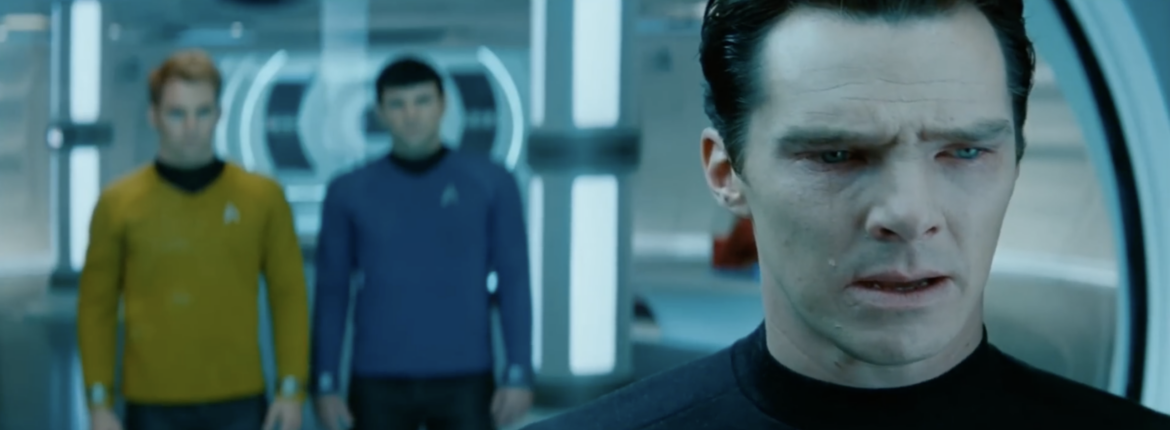
There is a moment in Star Trek Into Darkness that permanently altered how audiences viewed the iconic villain, Khan Noonien Singh. Locked inside a high-tech brig, framed by sterile glass, Khan delivers a monologue to Captain Kirk about the fate of his cryogenically frozen crew.
His posture is perfectly still. His voice is cold, measured, and terrifyingly controlled. But as he speaks of his family, a single, perfect tear spills instantly from his eye and tracks down his cheek.
It is a breathtaking piece of acting. It is also a textbook demonstration of what happens when an actor harnesses the raw, unfiltered architecture of an ADHD brain—specifically, the high-voltage currents of emotional dysregulation and Rejection Sensitive Dysphoria (RSD).
The Unfiltered Internal Library
In a neurotypical or highly regulated brain, emotional triggers undergo a process called habituation. If you experience a painful stimulus or a stressful scenario repeatedly, the brain learns to filter the intensity down over time. It builds a defense mechanism, smoothing out the peaks and valleys so you don’t live in a constant state of raw impact.
But for an individual navigating the world with ADHD—particularly during the formative, unmedicated years—the brain lacks the steady baseline of dopamine required to signal the prefrontal cortex to "stand down."
Instead, emotions hit like a literal taser, firing at the exact same full voltage every single time. A slight, a loss, or a moment of deep isolation doesn’t feel like a minor setback; it registers in the nervous system as an immediate, visceral crisis.
While this lack of a filter is exhausting in daily life, it acts as an elite creative incubator. It ensures that an actor's emotional pathways aren't faded memories or intellectual concepts; they are indelibly written into the somatic (body-based) memory in high definition.
Bypassing the Accelerator
When Benedict Cumberbatch—who has openly shared his own history with childhood focus struggles, classroom disruptions, and intense on-set emotional meltdowns—stepped into the shoes of Khan, he brought that high-definition library with him.
A standard acting approach to a crying scene usually requires a slow, manual buildup. An actor has to stoke their intellectual brain, trigger a sad memory, and wait for the nervous system to slowly catch up and produce physical tears.
An "emotional chameleon" with an ADHD wiring profile doesn't need a buildup. The barrier between an imaginative thought and a full-body physical response is paper-thin.
[Imaginative Objective: "My people are gone"]
                       │
                       ▼
         [Direct Route via ADHD Wiring]
                       │
                       ▼
 [Instant Somatic Flashback to Raw, Full-Voltage Grief]
                       │
                       ▼
  [Physical Execution: Instant Single Tear Falls]
Because the emotional reservoir is always resting just beneath the surface at maximum voltage, Cumberbatch didn't have to "fake" Khan's stakes. He simply opened the valve. The contrast is what makes the scene legendary: Khan’s engineered, hyper-logical intellect keeps his face frozen like stone, but his unfiltered neurodivergent biology forces the physical tear out of his eye in real time.
RSD as a Texturing Tool
This brings us to Rejection Sensitive Dysphoria (RSD)—the intense, agonizing emotional pain triggered by the perception of rejection, failure, or being cast out.
To a person with RSD, the threat of being disconnected from one's "tribe" or let down by those in authority feels completely catastrophic. Now look at Khan's narrative arc through that exact lens. Khan is a character defined entirely by the fierce, desperate protection of his chosen people, driven to madness by the ultimate rejection and betrayal by Starfleet's Admiral Marcus.
An actor intimately familiar with the sudden, blinding ache of RSD doesn't have to guess what motivates a tyrant like Khan. They understand the exact psychological anatomy of building a hyper-controlled, dangerous exterior ("masking") to shield an incredibly vulnerable, easily wounded interior.
Turning Vulnerability into Art
What the world so often labels a "deficit" or a "disorder" in a quiet classroom or a standard corporate office is actually a highly specialized artistic archetype.
When we watch Khan in the brig, we are not just watching a well-rehearsed performance. We are watching the magnificent alchemy of neurodiversity. Acting provides the safe, structured, and intentional laboratory where the "taser" of emotional dysregulation and the sharp edges of RSD can finally be organized, controlled, and weaponized into brilliant art.
Cumberbatch’s single tear didn't succeed despite his high-voltage wiring—it succeeded precisely because of it.