
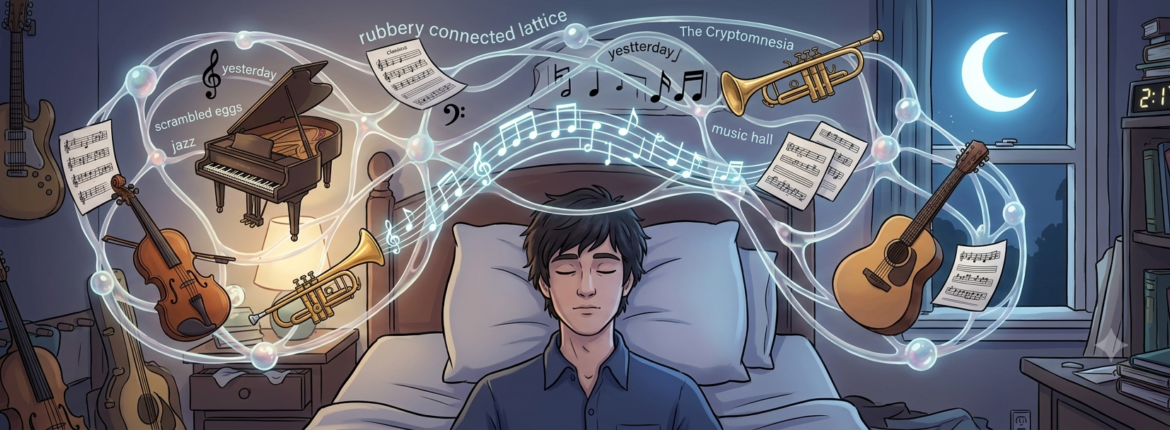
The story of Paul McCartney waking up with the melody of "Yesterday" completely intact—originally singing the placeholder lyrics "Scrambled eggs, oh my baby how I love your legs"—is perhaps the ultimate historical example of the "rubbery lattice" doing the work entirely off-stage.
When a non-linear, hyper-associative brain is constantly stockpiling dots, the actual "writing" doesn't happen when you sit down with a pen. It happens in the background. Here is how that cognitive lattice practically manufactured "Yesterday" while McCartney slept:
1. Hoarding the Unrelated Dots
McCartney’s brain was a massive, disorganized sponge for musical structures. He didn't just listen to the rock and pop of his day; his internal lattice was heavily populated by his father’s background in 1920s jazz and British music hall traditions, classical arrangements, and American R&B.
To a linear writer, those genres sit in separate buckets. To McCartney's associative brain, they were just raw geometric shapes—intervals, chord resolutions, and rhythmic cadences—waiting to be stretched and connected.
2. Sleep as the Ultimate "Productive Distraction"
During the day, the brain's executive function (the prefrontal cortex) acts as a bouncer, trying to force thoughts into a linear, logical order so we can function. But during sleep, that bouncer goes off duty.
This is when the Default Mode Network takes over, and the rubbery lattice is allowed to freely vibrate. Without the friction of conscious, step-by-step thinking, McCartney's brain was free to run high-speed simulations. It took a jazz-like minor-seventh chord, stretched it across a traditional pop melody, and resolved it using a classical voice-leading structure. The lattice snapped the pieces together instantly because there was no conscious mind awake to say, "Wait, rock stars don't write chamber music."
3. The "Cryptomnesia" Effect (When the Brain is Too Fast)
The most fascinating part of the "Yesterday" story is what happened after Paul woke up. He went to the piano, played it perfectly, and then spent the next month terrified that he had accidentally stolen it. He went around to George Martin and other musicians asking, "What is this song? Who wrote this?"
This is the hallmark of non-linear lattice processing. When the subconscious connects the dots that efficiently, the conscious mind doesn't remember doing the work. Because McCartney hadn't experienced the linear struggle of writing it—sitting at the piano, trying a C chord, failing, trying a G chord, erasing it—his brain assumed the fully formed melody must have come from the outside world.
The Musical Equation: In a way, his brain acted like an internal MIDI sequencer left running overnight. It was constantly randomizing and cross-referencing different frequencies, genres, and intervals until it found a mathematical and emotional alignment that was perfectly stable. Once it locked in, it presented the final output to his waking mind.
When you are designing curriculum or music projects, do you find your own best structural solutions arrive fully formed while you are doing something entirely unrelated, or do you have to actively hammer them out on the lattice?