
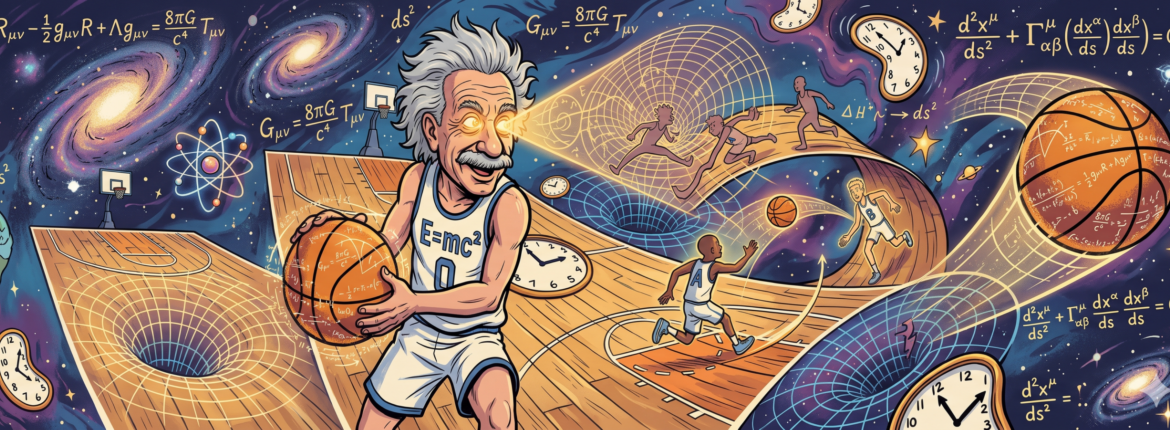
Comparing Magic Johnson’s court vision to Albert Einstein’s discovery of relativity reveals a fascinating parallel in how genius operates. Both men possessed a cognitive superpower: the ability to abandon rigid, linear viewpoints and instead map how space, time, and relative motion interact as a single fluid system.
Einstein didn't discover relativity through abstract math alone; he did it through Gedankenexperimenten (thought experiments)—visualizing physical scenarios that hadn't happened yet. Magic operated exactly the same way on the hardwood.
1. Dropping the Fixed Anchor: Relativity of Reference Frames
Before Einstein, physics assumed a "fixed background"—space and time were rigid, and objects just moved through them. Einstein realized everything is relative to the observer's frame of reference.
In basketball, traditional point guards played by a fixed system. They ran "plays" mapped out on a static whiteboard. Magic broke this down. He understood that a basketball court has no fixed frame of reference.
- A defender moving backward at 5 mph relative to the floor is moving at a completely different speed relative to James Worthy sprinting forward at 15 mph.
- Magic calculated these overlapping frames of reference instantly. He didn't pass to where a player was, or even where a standard play said they should be; he calculated the intersection of multiple moving bodies relative to one another.
2. Thought Experiments: "Seeing" the Future
Einstein famously formulated special relativity by visualizing what it would look like to ride alongside a beam of light. He discovered general relativity by imagining a man falling off a roof or standing in an accelerating elevator, visualizing how gravity would warp a beam of light before the physics math could ever prove it.
Magic operated with that exact same predictive, visual simulation engine. When conducting a fast break, Magic wasn't reacting to the present moment; he was living 2 seconds in the future.
- He could look at a defender's hip angle at half-court and visually simulate how that defender's body would tilt two steps later.
- By projecting that trajectory forward, Magic could throw a pass into an empty patch of hardwood. To the audience, it looked like a mistake—until a teammate miraculously intersected the ball a second later. He mathematically "solved" the play in his head before the physical reality caught up.
3. The Warping of Space: Spacetime vs. Spacing
Einstein’s ultimate breakthrough was that gravity isn’t a mysterious pulling force; it is massive objects warping the actual fabric of spacetime, forcing other objects to curve toward them.
On a basketball court, Magic used his physical presence and reputation to warp "court space" in the exact same way.
| Einsteinian Concept | Magic's Court Translation |
| Mass Warps Space | Magic’s 6'9" frame and lethal scoring threat drew defensive "mass" toward him. |
| Gravitational Pull | When Magic drove into the lane, defenders were pulled out of their positions like planets caught in a gravitational well. |
| Creating the Trajectory | By intentionally distorting the defense's spacing, Magic opened up completely clear "orbital paths" for his shooters on the perimeter. |
"A sports genius operates on a level of geometry that the rest of us can only see after the fact."
Ultimately, both Einstein and Magic shared a non-linear mastery over geometry. Einstein saw that space and time were woven together into a dynamic fabric. Magic saw that ten players, a basketball, and a 94-foot court were woven into a fluid equation. Both of them looked at a chaotic, moving universe, discarded the rigid rules of the past, and saw the elegant curvature of what was about to happen next.