
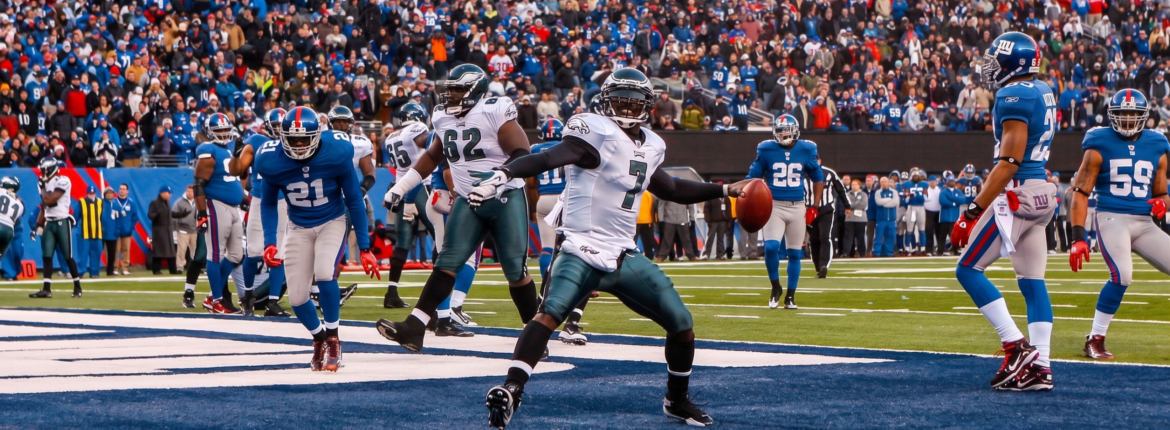
On December 19, 2010, the New York Giants had the Philadelphia Eagles buried. With just under eight minutes left in the fourth quarter, the Giants held a commanding 31-10 lead. The home crowd in East Rutherford was already celebrating.
Then, Michael Vick went completely nuclear.
What followed was eight minutes of pure, unadulterated sports sorcery. Vick didn’t just play quarterback; he manipulated time and space. He threw absolute lasers into tight windows, outran defensive backs who had distinct angle advantages, and single-handedly orchestrated a 28-point comeback, capped off by DeSean Jackson’s legendary walk-off punt return. It was dubbed the Miracle in the Meadowlands II. In that moment, Vick looked utterly indestructible—an athletic deity built of lightning and steel, operating at a speed the NFL had never seen.
But football traditionalists are historically terrified of lightning. They prefer structure.
Shortly after that legendary run, the football world did what it always does to anomalies: it tried to civilize him. Coaches and analysts decided that to prolong Vick's career, they needed to transition him into a traditional, stationary pocket passer. The logic seemed sound on paper—keep him behind a wall of 300-pound offensive linemen, and he will stay safe.
Instead, it backfired catastrophically. The attempt to force Michael Vick into a conventional pocket didn't save his career; it nearly ended it. It was a transition that turned a gridiron magician into a sitting duck, moving him rapidly from a miracle on the field to a miracle he's still alive.
The Neuro-Architecture of the Open Field
To understand why the pocket experiment failed, you have to understand how Michael Vick’s brain actually worked. Vick was the quintessential high-stimulation, hyper-reactive athlete. In psychological terms, his greatest performances occurred when he entered a state of pure flow—a cognitive zone where high-level skill meets unpredictable, high-stakes chaos.
For a hyper-reactive mind, a broken play isn’t a crisis; it’s a relief.
When the designed play dissolved and defensive linemen breached the line of scrimmage, Vick’s brain received a massive surge of dopamine. He wasn’t thinking; he was translating a massive influx of sensory data into immediate, physical reactions. He could spot a crashing linebacker, a closing lane, and a shifting safety simultaneously, calculating escape routes at a neurological level faster than defenders could sprint. Out in the open field, Vick was the predator. Because he dictated the terms of engagement, he could use his explosive acceleration to avoid maximum-velocity hits, sliding or stepping out of bounds on his own terms. Chaos was his home turf.
[The ADHD Flow State]
Unstructured Chaos ➔ Sensory Influx ➔ Instinctive Reflexes ➔ Indestructible in Space
Building the "Pocket" Escape Room
The tragedy of Vick’s later career is that coaches tried to take this wild, instinctive force and trap it inside a rigid, mental box. They built a "pocket" around him—a literal 6x6-foot square of colliding human bodies—and turned the game into a traditional escape room.
Except they locked the doors from the outside and forgot to give him the keys.
When the Eagles and later coaching staffs demanded Vick become a structured distributor, they forced him into a linear, sequential West Coast offense. The system required a strict rhythm: Take a 5-step drop. Scan Read 1. Scan Read 2. Check down to the running back. The entire process was designed to happen in under 2.5 seconds.
For an instinctive, non-linear thinker, this structural rigidity induced immediate analysis paralysis. Vick, who later admitted he rarely studied film early in his career, was suddenly forced to stand completely still in a collapsing pocket, attempting to decipher complex, shifting coverages using a rigid mental checklist.
Instead of letting his eyes glide across the field and reacting to space, he was forced to process an auditory-driven, slow-cooked playbook while static. The results were devastating:
- The Hesitation: Because he was trying to play the game "the right way," he stopped trusting his immediate reflexes. He held onto the football a split-second too long, waiting for concepts to develop rather than escaping.
- The Sacks: This indecision turned him into a stationary target. He was sacked a staggering 45 times in 2004, 45 times in 2006, and took merciless beatings throughout his years in Philadelphia.
The Physical Toll of Civilization
The great irony of the "Pocket Vick" experiment is that the very place meant to protect him became a execution chamber.
When Vick ran the ball downfield, hits were typically glancing blows from trailing defenders. But inside the pocket escape room, the hits changed entirely. He was now taking blindside, maximum-velocity collisions from 270-pound defensive ends while his cleats were firmly planted in the turf. Because he was locked into his progression reads, he never saw the hit coming and couldn't brace his body.
[The Pocket Escape Room]
Rigid Structure ➔ Analysis Paralysis ➔ Stationary Target ➔ Blindside Collisions
The human body simply isn't engineered to survive that kind of stationary punishment. The post-2010 era of Vick’s career became a horrific game of medical roulette. Every single dropback became a high-stakes thriller for fans. He would launch a breathtaking, flick-of-the-wrist 50-yard touchdown pass, but the television cameras couldn't follow the ball—they had to stay glued to the pocket, where Vick was buried beneath a mountain of defensive linemen, slowly trying to figure out if his ribs were still intact.
During his primary seasons in Philadelphia's structured system, he never managed to complete a full 16-game season. His medical charts read like a trauma ward report: cracked ribs, severe concussions, hand fractures, turf toe, and chronic hamstring tears.
"Coaches thought they were building a fortress to protect him, but they actually built an escape room he couldn't think his way out of. Out in the open, Vick was a ghost; inside the pocket, he was just a target."
The Legacy of the Anomaly
Ultimately, trying to turn Michael Vick into a traditional pocket passer was like trying to force a Ferrari to navigate a crowded, indoor parking garage. By stripping him of his mobility, coaches inadvertently stripped him of his primary self-defense mechanism.
Vick survived an era of football that was fundamentally at war with his natural biology as an athlete. He paved the way for the modern era of dual-threat quarterbacks—the Lamar Jacksons and Josh Allens of the world—who are finally allowed to blend pocket structure with unstructured flow.
Michael Vick's career remains a legendary, cautionary tale of NFL coaching philosophy. It proved once and for all that you cannot civilize lightning without drawing a storm—and it is a minor miracle that he managed to walk away from the game with his career, and his life, intact.