
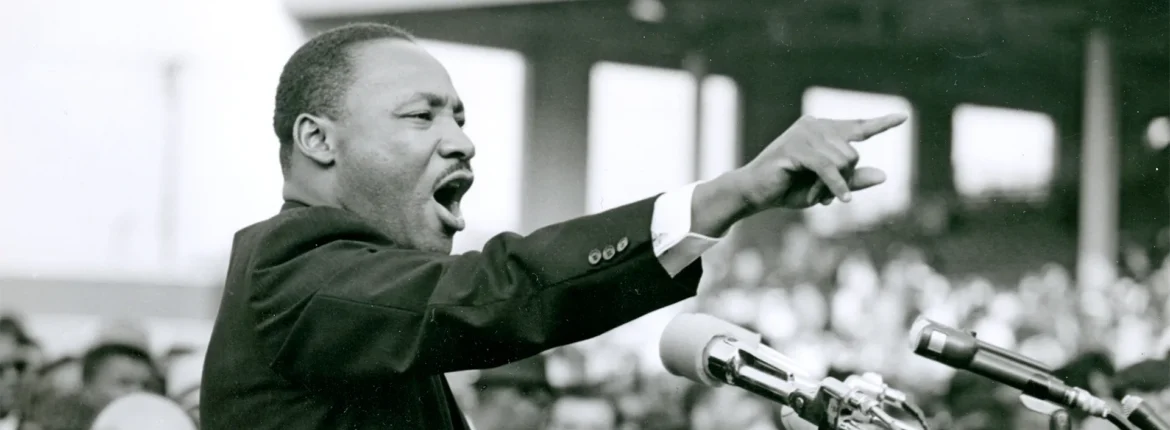
The concept of a "hyper-reactive, non-linear brain driven by extreme empathy" reaches its historical zenith in the ministry of Dr. Martin Luther King Jr.
If we look past the textbook caricature of King as a calm, statuesque monument and look instead at the chaotic, high-stress reality of how he actually operated, he fits the mold of a high-stimulation, non-linear emissary perfectly. He was a leader who rejected rigid, pre-packaged institutional scripts, thrived in the exhausting sensory overload of mass movements, and possessed an emotional volume knob turned so high that the pain of others acted as a direct, physical catalyst for action.
1. The Ultimate "Off-Script" Hack: The Dream Speech
The most famous moment in American oratory—the "I Have a Dream" section of the 1963 March on Washington—was entirely unscripted. It was a masterpiece born from an intuitive, non-linear pivot in a high-pressure environment.
- The Setup: King’s advisors had spent days meticulously drafting a linear, structured speech called "Normalcy, Never Again." It was designed to be a legally precise, carefully paced argument. King stood at the podium reading the text exactly as written for the first several minutes.
- The Pivot: Mahalia Jackson, standing nearby, shouted, "Tell 'em about the dream, Martin!" A linear thinker would have stuck to the script under the immense pressure of a live global broadcast. Instead, King’s brain pivoted instantly. He literally paused, moved his typed notes to the left side of the podium, looked out at the massive sea of 250,000 people, and began speaking entirely off-the-cuff.
- The Flow State: By abandoning the rigid structure, he entered a pure cognitive flow state. He tapped into a reservoir of raw, spontaneous inspiration, delivering an improvised sequence that changed history because it was driven by the immediate, electric energy of the crowd rather than a desk-written prompt.
2. Thriving in the Chaos of the Move
A traditional, linear organizer wants a sterile environment: clear timelines, predictable committees, and neatly mapped-out milestones. King’s entire life was an unending whirlwind of high-stimulation, ad-hoc triage.
- The Workspace: King rarely worked effectively in a quiet, isolated office. His "office" was a chaotic rotation of crowded church basements, packed mass meetings, transit stations, and jail cells. He operated in a constant state of motion, constantly traveling, dealing with competing factions, and absorbing massive amounts of real-time sensory data.
- The Urgency Machine: He had a notorious disregard for traditional schedules. He was chronically late because if he met someone who was hurting or needed to talk on the way to an event, his hyper-empathetic focus would lock entirely onto that single human being, completely obliterating any linear concept of time. He operated on a timeline of urgent human need, not a clock.
3. The Sensory Toll of Radical Empathy
For an emissary with this cognitive makeup, empathy isn't a passive emotion; it is an overwhelming, visceral force.
When King looked at the violence in Birmingham or the systemic humiliation of segregation, his brain didn’t process it as a political chess match to be solved with slow, incremental policy reforms. He felt the pain of the community as an immediate crisis that demanded a physical response right now.
[The Emissary's Cognitive Loop]
Visceral Empathy ➔ Rejection of Gradualism ➔ Spontaneous, High-Stakes Action ➔ Cultural Transformation
This intense emotional reactivity meant he could not tolerate the "bureaucratic escape room" of gradualism. When white moderate clergymen wrote a letter advising him to wait and let the courts slowly handle desegregation, King didn't wait for a desk to reply. Sitting in a dark, cramped Birmingham jail cell, his brain fired into hyper-focus. He began writing his response on the literal margins of a newspaper and on scraps of paper towels. The Letter from Birmingham Jail wasn't a calculated academic essay; it was an explosive, non-linear torrent of ideas captured on whatever physical medium was within arms' reach.
The Grand Synthesis:
Bureaucrats and institutions build walls to keep things orderly, predictable, and safe. But Martin Luther King Jr. operated like a lightning rod for human suffering. Powered by a non-linear mind that found its true genius when the script broke down, he refused to let the civil rights movement be tamed into a slow, comfortable checklist. He didn't change the world by following the protocol; he changed it because his empathy moved at a speed the establishment's structures simply couldn't contain.