
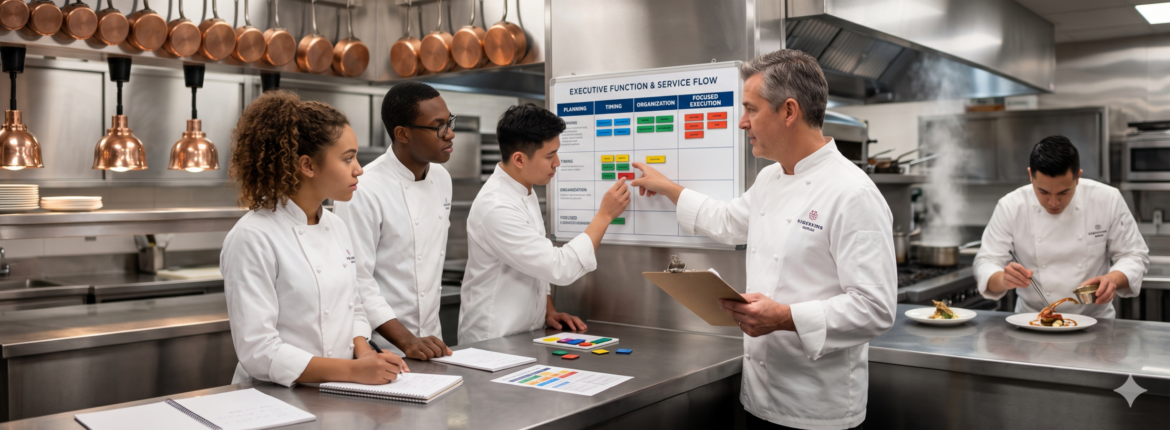
Walk into any Michelin-star kitchen during a weekend dinner rush, and you are witnessing a masterclass in executive functioning. You will see precise, down-to-the-second time management, flawless spatial organization, and an absolute obsession with mise-en-place—where every utensil and micro-green has a dedicated, non-negotiable home. Chefs treat their knives with a level of hyper-vigilant care that borders on the sacred.
Yet, if you look at the medical histories or K-12 report cards of most of these culinary masters, you will frequently find a recurring pattern: high IQ, low grades, and a trail of unresolved childhood trauma.
The professional kitchen is a sanctuary for the ADHD brain, operating as a high-stakes ecosystem that perfectly gamifies executive functions—even if those exact same skills completely vanish the moment the chef steps out the back door.
The Perfect Neurochemical Storm
Traditional school environments treat executive functions like abstract theories to be memorized, turning education into an uninspiring "escape room." A Michelin-star kitchen does the exact opposite. It aligns perfectly with the hyperarousal state of adult ADHD through three distinct mechanisms:
- Urgency as an Engine: In a kitchen, everything is immediate, tactile, and screaming for attention. The ADHD brain suffers from a chronic deficit of baseline dopamine; it requires high stakes to engage. The threat of a ruined $100 wagyu steak or a delayed table provides the exact neurochemical adrenaline spike needed to force the prefrontal cortex into alignment.
- The Miniature Classroom: Unlike a chaotic public school classroom of thirty or more students, a kitchen brigade operates in tight, highly collaborative stations. These small groups cut down on overwhelming sensory static and provide direct, localized accountability.
- Mandatory Novelty: While a corporate desk job demands monotonous repetition, a premier kitchen thrives on an experimental nature. With parts of the menu changing weekly, the test kitchen constantly dangles fresh novelty in front of the chef, keeping the brain's interest-based nervous system perpetually fired up.
Weaponizing RSD for "Customer Delight"
One of the most debilitating aspects of ADHD is Rejection Sensitive Dysphoria (RSD)—the intense, agonizing vulnerability to criticism or perceived failure. In ordinary life, RSD can paralyze an individual or manifest as defensive anger.
In a Michelin kitchen, however, RSD is weaponized into an elite compensation mechanism. The obsessive drive to ensure absolute customer delight is often fueled by a deep-seated need to outrun the pain of rejection. When a guest describes a dish as life-changing, it triggers a massive, immediate dopamine reward that temporarily quietens the internal critique. The kitchen transforms RSD from a emotional landmine into a metric of culinary perfection.
The Boundary of Generalization
The great paradox of the neurodivergent chef is that these brilliantly executed skills are entirely context-dependent.
A chef can flawlessly coordinate a twelve-course tasting menu for a dining room of a hundred people, yet return home to a sink full of moldy dishes and an utility bill that has been forgotten for three months.
Because these executive functions are forged in an environment of immediate consequence and high stress, they do not automatically generalize to private life. When the artificial urgency of the kitchen is removed, the dopamine drops, the structure vanishes, and the brain defaults right back to its baseline paralysis.
Michelin-star chefs don't lack the capacity for organization, planning, or focus. They possess it in spades. They have simply found a world where the brutal, high-stress parameters of the environment act as a temporary scaffolding for a brilliant, traumatized mind—proving that under the right lights, and with enough heat, a neurodivergent brain can cook up absolute genius.