
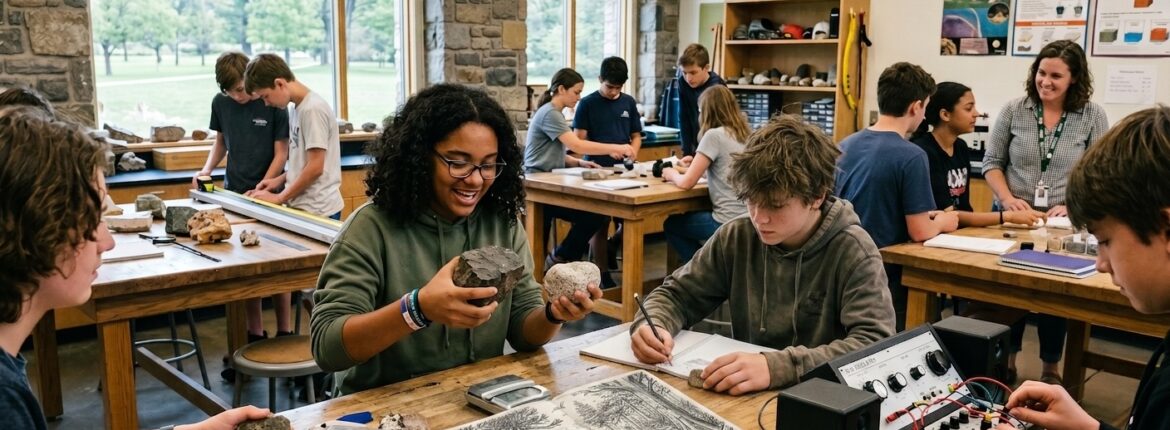
In the modern classroom, we have become experts at teaching the what while starving students of the how. We trap high schoolers behind screens, forcing them into a state of "fixed focus"—a narrow, passive digital tunnel vision that deadens curiosity.
We hand students the completed map of human knowledge and demand they memorize its coordinates. But true understanding doesn't come from staring at a map. It comes from walking the terrain.
To rebuild intellectual curiosity, we must shift from digital consumption to kinetic sensorimotor learning. Long before students ever open a formal textbook, they should be building intuitive, visceral reference frames for the physical world.
The "Load and Release" of Learning
In golf instruction, Shawn Clement famously has students toss a club down the line to help them discover the natural "load and release" of a swing. The power of this exercise lies in sensorimotor inference: the moment you target a throw, the conscious mind stops micromanaging mechanics, and the brain’s predictive motor loops take over. You stop thinking about the club and start interacting with the environment.
Education currently does the exact opposite. We force students to memorize mechanics—formulas, nomenclature, and abstract definitions—before they have ever felt the physical "heft" of the material.
To spark real engagement, we need to let students "throw the club" first. We must create learning environments where physical interaction precedes formal abstraction, allowing the brain to construct a multi-sensory mental model before we assign it technical vocabulary.
The Non-Linear CSI Model: Evidence Loops over Assembly Lines
A static lab setup loses its charge quickly, but a rigid, step-by-step experiment is just as artificial. Real science isn't an assembly line; it is an iterative web.
The Geology CSI framework turns the classroom into an active, non-linear crime scene. Instead of asking, "What rock is this?", the question becomes: "What environmental event happened here, and what evidence proves it?"
Rather than handing students a pre-packaged kit on day one, data is introduced through dynamic feedback loops that force continuous hypothesis revision:
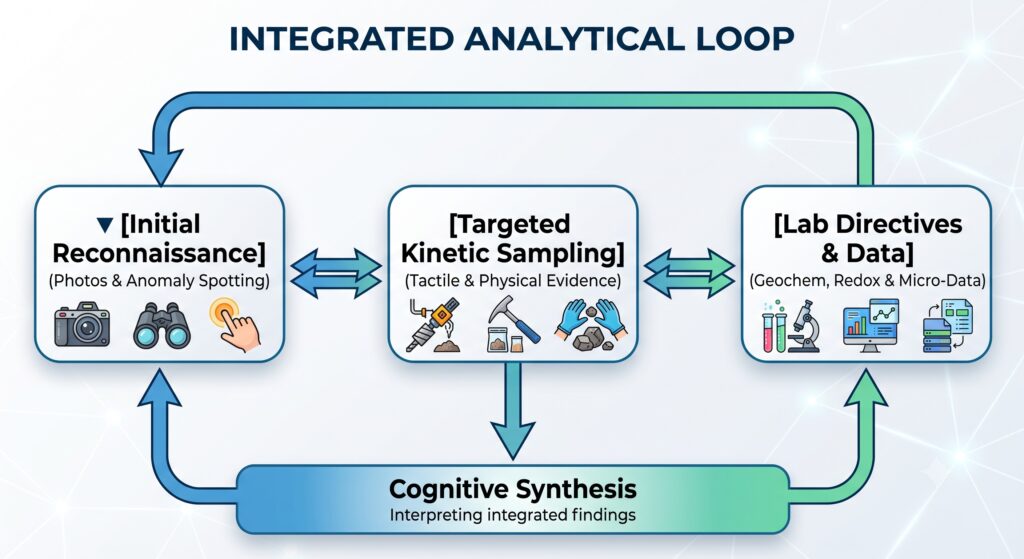
- Initial Reconnaissance & Anomaly Spotting: Students begin with macro-level context—high-resolution field photography (like the sweeping, multi-colored badlands of the Painted Desert) or partial site notes. The goal isn't to solve the scene immediately, but to spot anomalies and formulate initial questions.
- Targeted Kinetic Sampling (Feedback Loops): Rather than receiving a pre-set tray of specimens, students pull specific physical evidence based on their initial observations. Holding a dense, dark specimen or a lightweight, porous sample generates immediate physical feedback, prompting them to look back at the field photos and ask: "Where in this landscape could a formation like this actually occur?"
- Lab Directives & Hypothesis Disruption: As students build a tentative model, unpredictable "lab updates" drop—a sudden acid test reaction, a geochemical redox analysis, or a thin-section microscopy report. These updates act as disrupters. A single data point can invalidate an initial theory, forcing the team to re-examine early physical samples, re-evaluate spatial relationships in the photography, and test a new direction.
The Interdisciplinary Evidence Matrix: From Deep Time to Modern Enterprise
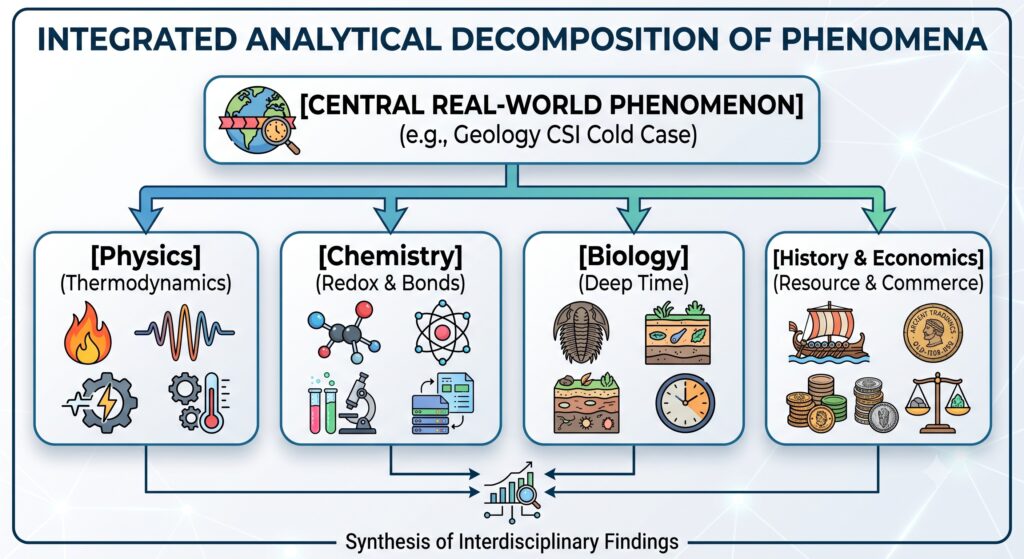
Under this non-linear approach, science does not live in an isolated silo. The geological record becomes the foundation for physics, chemistry, biology, human history, economics, and entrepreneurship.
- Physics & Thermodynamics: Students compare coarse-grained granite to fine-grained basalt, linking cooling rates ($\Delta T / \Delta t$) directly to crystal size. They evaluate how heat, pressure, and volatile retention dictate phase changes in hydrated, silica-rich magmas—understanding granite as the frozen state of a dynamic thermodynamic engine.
- Biological Forcing Functions: Holding a fragment of petrified wood, a student discovers how organic cellular structures act as a physical scaffolding, replacing decaying tissue molecule-by-molecule with silica-rich water. They trace how early life fundamentally rewrote earth's chemistry—from photosynthetic cyanobacteria precipitating global banded iron formations (BIFs) to vast Carboniferous forests storing solar energy into coal.
- Atmospheric Redox: Looking at field photos of the Painted Desert alongside evidence kits, students read environmental atmospheres directly from color—vibrant red bands marking ancient aerobic environments ($Fe^{3+}$) and grey-blue bands revealing anaerobic, waterlogged conditions ($Fe^{2+}$).
- Human History, Economics & Enterprise: Geologic CSI cold cases naturally spill into human civilization. Students analyze how ancient deposits dictated trade routes, resource scarcity, and geopolitical power—from the Industrial Revolution’s reliance on coal to the modern race for battery-grade copper. Given local environmental constraints, students ultimately pitch real-world entrepreneurial solutions, balancing capital investment, environmental stewardship, and material science.
The Scandinavian Paradigm: Phenomenon-Based Inquiry and Uteskole
This forensic, kinetic model finds its strongest real-world parallel in Scandinavian educational design—most notably Finland’s Phenomenon-Based Learning (PhBL) and the Norwegian tradition of Uteskole (Outdoor Schooling).
Scandinavian countries consistently rank among the highest in global education metrics not by increasing screen time or drill-and-kill testing, but by structuring learning around real-world phenomena rather than fragmented subjects.
In the Nordic approach:
- The Environment is the First Text: Uteskole recognizes that physical movement and real-world outdoor exposure aren't "recess"—they are essential cognitive triggers. Learning is intentionally rooted in physical landscapes, forcing students to engage their senses, observe seasonal transformations, and test theories against raw reality.
- Driven by Student Inquiry, Not Lecture: Rather than receiving answers to questions they never asked, students encounter an authentic anomaly and generate the investigative questions themselves. The curriculum moves outward from the phenomenon, drawing in physics, history, or mathematics as necessary tools to solve the problem.
- Trust, Agency, and Low Anxiety: In Scandinavian classrooms, error is treated as key diagnostic data rather than failure. By stepping into the role of independent investigators, students take agency over their learning, shifting the psychological state from passive anxiety to intrinsic drive.
The Teacher as Caddy, Producer, and Lead Investigator
This approach fundamentally shifts the role of the educator:
| Traditional Model | The Forensic / Nordic Model |
| Lecturer who delivers static conclusions. | Caddy who selects the right tool for the environment. |
| Focuses on avoiding student error. | Focuses on designing high-leverage investigative constraints. |
| Delivers all materials upfront in a linear lab. | Introduces data non-linearly to disrupt and refine hypotheses. |
| Teaches subjects in isolated academic silos. | Uses interdisciplinary phenomena to teach science, history, and economics. |
| Measures success by memorized vocabulary. | Measures success by the strength of evidence-based arguments. |
By acting as a producer or caddy, the instructor sets the scene, manages the flow of evidence, and steps back. When a student is locked into solving a complex physical and economic puzzle, performance anxiety vanishes. They aren't worrying about whether they are "good at science"—they are too busy evaluating the incoming data.
Breaking the Digital Stagnation
Screen-based education locks the head in place, constricts vision, and suppresses body movement—a recipe for intellectual fatigue and anxiety.
Reintroducing tangible, complex evidence into the classroom forces the eyes to shift focus, brings peripheral awareness back online, and grounds the nervous system in the physical present. We shift the student's inner focus away from self-conscious performance and outward toward the objective reality of the physical world.
By grounding science in direct sensorimotor experience and Nordic-style inquiry, we aren't just teaching geology or physics. We are training the brain to predict, hypothesize, and navigate reality.
It’s time to stop forcing students to memorize the map. Let's hand them the evidence, drop the lab results, and let them walk the terrain.