
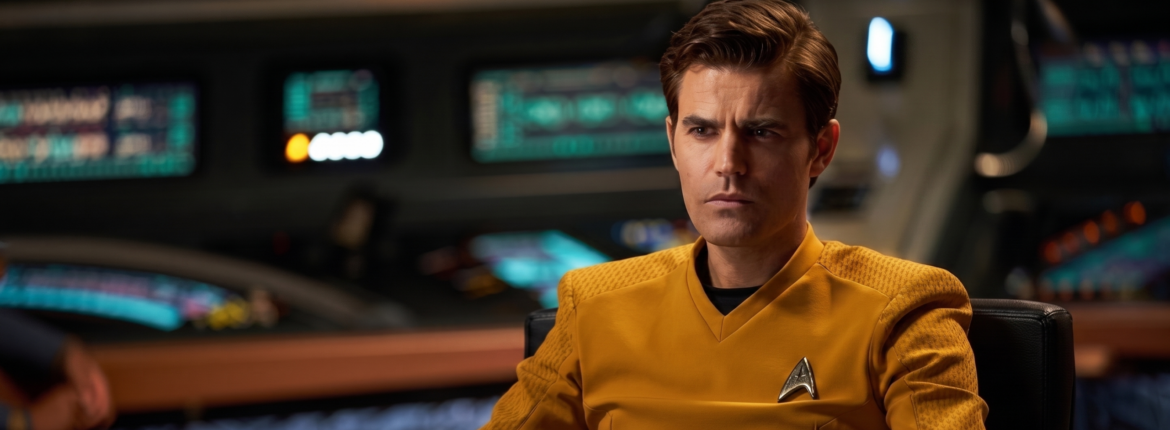
Looking at Captain James T. Kirk through a neurodivergent lens reveals a resounding yes. Kirk is a pop-culture blueprint for a high-functioning, Hyper-Focuser / Hunter archetype ADHDer.
While 1960s television framed him as a classic swashbuckling space hero, his command style, decision-making, and relationship to rules describe an ADHD mind thriving in its natural, high-stimulation habitat.
1. The Dopamine-Driven Command Style
The ADHD brain struggles with stagnation, routine, or long periods of under-stimulation. Kirk actively flees monotony. He didn't take a desk job at Starfleet Command; he took a five-year mission into the absolute unknown, where every single day brings a lethal crisis, a brand-new anomaly, or an immediate threat.
He thrives on the chaos of the present moment. When a crisis hits, his brain doesn't freeze; the high-stakes adrenaline spike provides the exact neurochemical stimulation his mind needs to achieve absolute, crystal-clear focus.
2. The Ultimate Escape Room Disruption: The Kobayashi Maru
The definitive proof of Kirk’s ADHD is how he handled the Kobayashi Maru—Starfleet’s infamous, unbeatable training simulation designed to test how officers handle a no-win scenario.
A neurotypical mind enters that simulation, accepts the rigid, linear rules of the puzzle, and undergoes the test as prescribed. Kirk took the test twice, failed, and faced intense frustration with the arbitrary parameters. So, before his third attempt, he did the ultimate lateral-thinking move: he broke into the mainframe and reprogrammed the simulation's code so it was possible to rescue the stranded ship.
Kirk fundamentally refuses to play by the rules of an Escape Room built by someone else. When faced with a rigid, bureaucratic system that says "you must lose," his brain finds an unconstrained, rule-breaking shortcut to completely blow the walls off the puzzle.
3. Spock and McCoy: The Outsourced Scaffolding
Just like the Beatles needed George Martin, or an ADHD athlete needs a team staff, Captain Kirk cannot function in isolation. He requires a highly specific, external scaffolding to balance his chaotic, impulsive processing style:
[ CAPTAIN KIRK ]
(Impulsive / Dopamine-Driven)
/ \
/ \
[ SPOCK ] [ DR. McCOY ]
(The Hyper-Rational Linear (The Emotional, Protective
Prefrontal Cortex) Grounding Anchor)
- Spock is his outsourced prefrontal cortex. Spock provides the rigid, linear, hyper-logical data and long-term risk assessment that Kirk’s impulsive brain wants to skip past.
- Bones McCoy is his RSD guardrail. McCoy provides the raw, immediate human empathy and grounded gut-checks, keeping Kirk's soaring ego and high-voltage impulses tethered to real human costs.
Kirk is the fast-acting decision-maker, but he needs that executive scaffolding sitting directly to his left and right on the bridge to manage his blind spots.
4. Chronic Rule-Breaking vs. The Prime Directive
Kirk violates Starfleet's supreme rule—the Prime Directive—constantly. To an ADHD mind, a rule is only valid if it makes sense in the immediate, active context. If a rigid bureaucratic directive stands in the way of a creative solution or saving a life, Kirk tosses the directive out the window without a second thought.
He isn't a bureaucrat. He is an explorer—a man who needs an entire starship just to give his mind "lot of room for doing."