
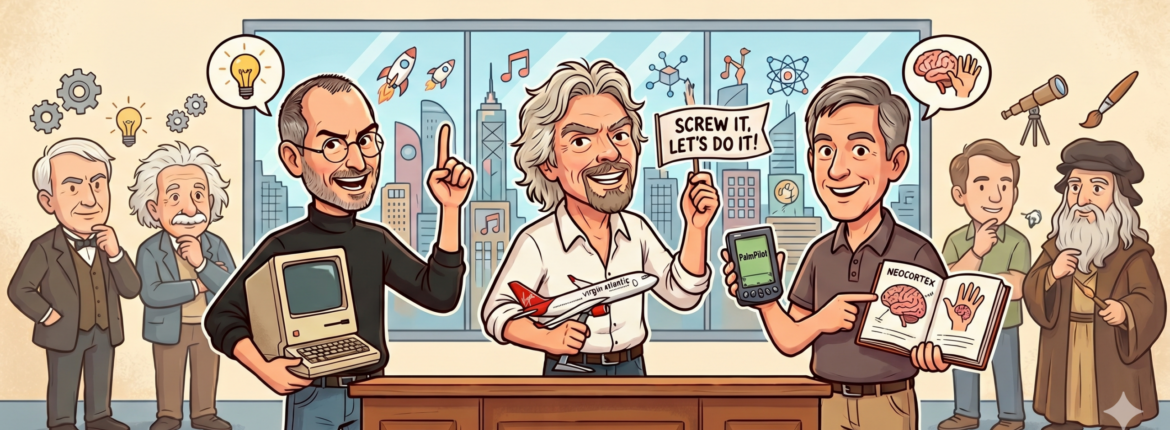
The real-world trajectories of iconic innovators provide the sharpest critique of Scott Galloway’s "Algebra." When we look at figures like Steve Jobs, Richard Branson, and Jeff Hawkins, we don’t just see successful people; we see individuals whose legendary breakthroughs were achieved by doing the exact opposite of what Galloway prescribes.
Their stories are the ultimate counter-examples, proving that for certain minds, passion isn't a byproduct of success—it is the operational prerequisite.
1. Steve Jobs: The Refusal to Settle for "Market Dynamics"
Galloway argues that you should ignore passion and strictly follow where the high-margin, institutional tailwinds are. Steve Jobs spent his entire life arguing the exact opposite. In his famous 2005 Stanford commencement address, Jobs stated:
"Your work is going to fill a large part of your life, and the only way to be truly satisfied is to do what you believe is great work. And the only way to do great work is to love what you do. If you haven't found it yet, keep looking. Don't settle."
The Counter-Example to Galloway:
If Jobs had followed Galloway's formula, he would have looked at the boring, stable, high-margin sectors of the late 1970s and stayed a corporate technician or focused strictly on B2B enterprise infrastructure. Instead, driven by an almost fanatical obsession with aesthetics, calligraphy, and personal empowerment, he forced a clunky, industrial computing market to bend to human intuition.
Jobs didn’t find a booming sector and try to fit in; he used his intense, hyper-focused passion to create a brand-new sector. His success proves that deep emotional alignment can rewrite market dynamics entirely, rather than just surviving them.
2. Richard Branson: "Screw It, Let's Do It" and Hyper-Atypical Execution
Richard Branson, who has been incredibly open about his severe dyslexia and ADHD-style traits, built the Virgin empire on a philosophy that reads like a direct parody of Galloway's stoic, risk-mitigated manual. Branson famously operates on a simple mantra: “Screw it, let’s do it,” and has frequently stated:
“Entrepreneurship is about turning what excites you in life into capital, so that you can do more of it and move forward with it... I can honestly say that I have never gone into any business purely to make money.”
The Counter-Example to Galloway:
Galloway emphasizes Focus and Diversification in a very traditional, slow-compounding asset sense. Branson did the absolute opposite: he aggressively diversified his actual operating businesses across completely unrelated fields (music, airlines, trains, mobile, space travel) purely because he found a new industry exciting or felt he could shake it up.
To a traditional corporate strategist, Branson’s rapid pivoting and pursuit of novelty look chaotic and undisciplined. Yet, by leveraging his passion as an energy source, Branson turned what Galloway would call a "lack of focus" into a multi-billion-dollar global ecosystem. He proved that an interest-driven nervous system can scale across entirely different industries if it is fueled by genuine excitement.
3. Jeff Hawkins: Sensorimotor Exploration vs. Institutional Compliance
Jeff Hawkins—the brilliant engineer who invented the PalmPilot and later pivoted to theoretical neuroscience, authoring A Thousand Brains—is perhaps the ultimate example of how an insatiable, curiosity-driven mind completely shatters Galloway's boring-is-better template. Hawkins has spent his career navigating two intense passions: mobile computing and reverse-engineering the human neocortex.
The Counter-Example to Galloway:
Galloway’s model demands finding a lane, gaining institutional credentials, and grinding linearly. When Hawkins wanted to develop his grand theory of how the brain builds models of the world using sensorimotor inference, the established academic institutions rejected him. His PhD proposal at UC Berkeley was turned down because it didn't fit into the narrow, existing lanes of the neuroscience department at the time.
Instead of complying with the sector's rules, Hawkins went back to the commercial world, built Palm and Handspring, and then used his wealth to found the Redwood Neuroscience Institute and Numenta to fund his own research.
Hawkins prioritized physical exploration, structural autonomy, and deep cognitive curiosity over digital compliance or institutional approval. His legacy proves that radical breakthroughs—whether in handheld devices or the frontiers of AI—require a willingness to abandon safe, high-margin lanes to solve the deep, high-stakes puzzles that your brain simply refuses to let go of.
The Core Defect in Galloway's Formula
When Galloway writes off "following your passion," he is optimizing for the median outcome—how to ensure a smart, compliant professional becomes a millionaire by age 50. It’s an effective playbook for risk minimization.
But the ultimate flaw in his narrative is that he mistakes the average path for the only path. For innovators like Jobs, Branson, and Hawkins, ignoring their internal spark to occupy a boring, high-margin corporate slot wouldn't have just made them unhappy—it would have choked out the exact cognitive variance that allowed them to change the world.