
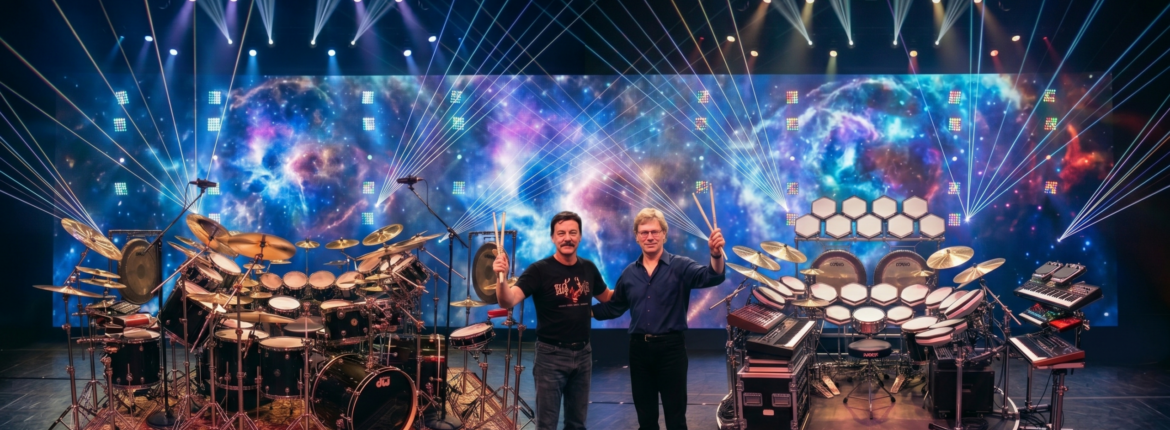
In the world of progressive rock, two names sit uncontested on the Mount Rushmore of percussion: Neil Peart of Rush and Bill Bruford of Yes and King Crimson. Both were absolute masters of mathematical complexity, polyrhythms, and impossible time signatures.
Yet, if you sit down and watch them play, their performances feel as though they are being driven by entirely different species of human.
They were. Peart and Bruford represent the ultimate musical case study in neurodivergent wiring. If you want to understand the profound difference between the intricate dualities of the AuDHD Mind and the hyper-nonlinear, Organic Perfection of ADHD, you don't need a clinical textbook. You just need to listen to the drums.
Neil Peart: The AuDHD Duality of the Clockwork Fortress
Neil Peart was affectionately dubbed "The Professor," a title that captured his legendary rigor. But looking at Peart through a purely autistic lens misses the agonizing internal friction that actually defined his genius. Peart wasn't just a rigid systemizer—he lived squarely within the exhausting paradox of the AuDHD profile.
The 360-Degree Cage: Sensory Defense and Restless Energy
Look at Peart’s legendary, massive rotating drum kit. It wasn't an act of rock-and-roll excess; it was a physical manifestation of an AuDHD boundary system. His brain processed the physical space around him as a flawless geometric grid, allowing him to execute blind, lightning-fast transitions with absolute spatial certainty.
But it was also a protective barrier. Peart carried an immense, profound empathy for the human condition, but it was matched with an intense autistic vulnerability to sensory and social overload—famously captured in his lyrics for "Limelight" ("I can't pretend a stranger is a long-awaited friend"). The massive kit was a fortress to hide behind, creating a tightly controlled micro-universe where he could process his overwhelming internal world.
The Unyielding Script Fueling a Restless Mind
Peart spent weeks painstakingly designing and hardcoding his drum parts to fit the exact narrative of a song. Once that script was perfected, it became an unalterable sensory routine. If you saw Rush play "Tom Sawyer" in 1981 or 2015, the snare cracks and tom cascades landed at the exact same millisecond.
Why such rigid structural perfection? Because it was the only way to anchor the restless, existential anxiety of his underlying ADHD track. His lyrics mapped out societal systems ("Subdivisions"), but his mind was constantly searching, traveling, and moving. When tragedy stripped away his structure in the late '90s, his response was a textbook AuDHD wandering: riding a motorcycle 55,000 miles in near-total isolation (Ghost Rider). He kept his external environment in constant, rapid-fire motion (ADHD) while holding his internal emotional processing entirely insulated and tightly locked down (Autism).
[The AuDHD Duality]
Restless Existential Anxiety (ADHD) ──> Channeled into ──> Ironclad Architectural Grid (Autism)
Bill Bruford: The ADHD Chameleon of Nonlinear, Organic Perfection
On the exact opposite end of the spectrum sits Bill Bruford. If Peart built towering, unbreakable monuments to contain his dualities, Bruford bypassed the grid entirely. He is the absolute embodiment of pure, hyper-nonlinear ADHD wiring pushed to a level of organic perfection.
The War on Routine and the Hunt for Dopamine
Bruford famously noted that the moment he figured out exactly what he was going to play, he got bored. The ADHD brain inherently craves stimulation, and repetition is its absolute kryptonite. If a song required a standard, predictable 4/4 backbeat, Bruford’s brain immediately revolted. He did not build a fortress; he kept his drum kit minimalist, translucent, and entirely open to the audience, constantly rearranging it specifically to destroy his own muscle memory.
Bruford's rejection of linear time signatures wasn't erratic chaos; it was an organic ecosystem of rhythm. He intentionally displaced snare hits to fractions of a second "late" or dropped them on completely unexpected beats. He was chasing a highly specific dopaminergic loop—shattering the expected pattern to shock the track back to life.
The Real-Time Mirror: Hyper-Reactive Synchronization
While Peart operated on a pre-written architectural script, Bruford operated entirely on an intuitive, hyper-reactive feedback loop. He was a sonic chameleon. When his bandmates threw out a chaotic, unpredictable guitar riff, Bruford’s brain absorbed that energy instantly and reflected it back with a syncopated, jazz-inflected response.
His playing unfolded like living, unrepeatable roots. He couldn't play a track the same way twice if he tried—and doing so would violate his pursuit of organic perfection. The moment a musical project became stable and predictable, his dopamine loop crashed, and he moved on to completely reinvent his style.
[The ADHD Organic Process]
Instant Situational Absorption ──> Real-Time Nonlinear Reflection ──> Unrepeatable Novelty
The Ultimate Contrast
The beauty of this comparison is that both men redefined what it meant to hold time, using completely opposite neurodivergent blueprints.
| Feature | Neil Peart (The AuDHD Duality) | Bill Bruford (The ADHD Organic) |
| The Kit | A massive, 360-degree protective fortress and geometric grid. | Minimalist, open, and constantly disrupted to break routine. |
| The Philosophy | Rigid Architecture. Structural engineering built to safely cage a restless mind. | Living Improvisation. A shifting, hyper-nonlinear conversation with the moment. |
| The Expression | Hidden from view, channeling deep empathy into perfect, clinical execution. | Entirely exposed, chasing real-time dopamine through spontaneous surprise. |
| Handling 7/8 Time | A gorgeous mathematical puzzle to be mastered and flawlessly replicated forever. | A chaotic, shifting playground where the rules are broken to find a deeper organic groove. |
The Generational Rhythm
When we listen to these two titans, we aren't just listening to different drumming techniques. We are listening to the two ways neurodivergent minds survive and thrive in a world not built for them.
Peart took the chaotic storm of an AuDHD internal life and built a magnificent, clockwork fortress of complexity where everything finally made sense. Bruford took the chaotic storm of an ADHD mind and leaned directly into it, proving that if you surrender to situational novelty with enough intent, the chaos transforms into an unrepeatable, breathtaking, organic perfection.