
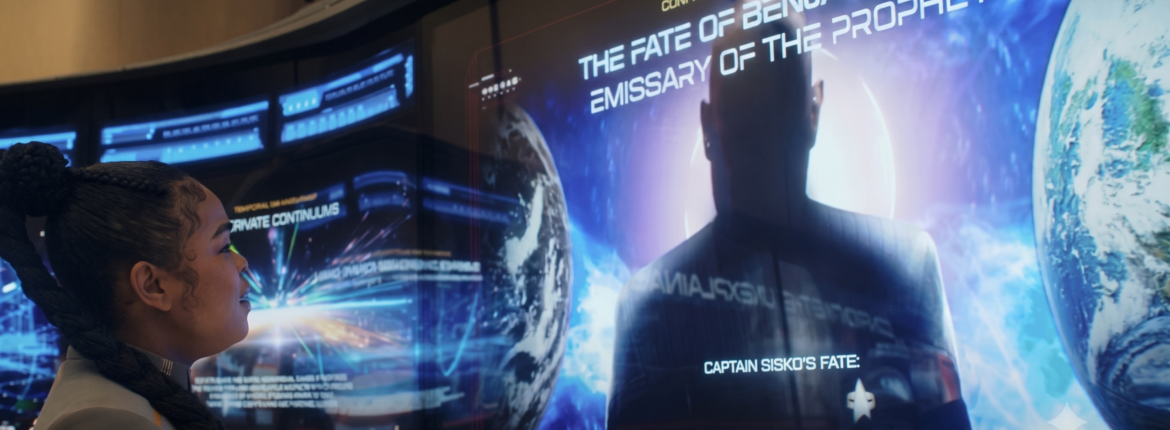
When Starfleet Command assigned Commander Benjamin Sisko to the backwater station of Deep Space Nine, they thought they were deploying a standard, bureaucratic manager to oversee an orderly transition. They wanted a bureaucrat to follow the playbook, check the boxes, and file the paperwork.
Instead, the universe gave them an Emissary.
If Starfleet’s rigid, rule-bound protocols represent the ultimate neurotypical "escape room," Benjamin Sisko spent seven seasons setting that room on fire. To understand his character—and the brilliant performance of the man who played him, Avery Brooks—you have to look past the conventional science fiction captain. Sisko was a masterclass in the non-linear, hyper-reactive mind. Driven by a visceral, emotional volume knob tuned to absolute maximum, he rejected the institutional script to operate in a state of pure, high-stakes improvisational flow.
1. The Anatomy of a Non-Linear Mind: Explaining Time to the Gods
The literal introduction of Sisko as the Emissary in the series premiere ("Emissary") serves as the ultimate metaphor for the non-linear mind trying to communicate with a structured universe. When Sisko enters the Bajoran wormhole and encounters the Prophets—aliens who exist outside of linear time—he is forced to explain the very concept of the human experience.
The cosmic irony, however, is that while Sisko explains linearity to the gods, he rejects it entirely when solving crises on the gridiron of the Alpha Quadrant.
A traditional Starfleet captain handles a crisis sequentially: analyze the sensor telemetry, consult the manual, form a away team, and seek consensus from Starfleet Command. Sisko’s brain bypasses the sequence entirely. He looks at a tactical grid the way a fast-scanning quarterback looks at a broken play. He sees the entire board at once, anticipating moves on raw instinct and emotional pressure. Where others see chaos, Sisko finds his focus.
2. Avery Brooks and the Rhythm of the Unscripted
This non-linear energy wasn’t just written into the script; it was baked into the very DNA of the actor portraying him. Avery Brooks is a trained jazz musician—a creative force who understands that the most profound breakthroughs occur when you throw away the sheet music and react to the immediate, organic stimulus of the moment.
Brooks brought that exact jazz sensibility to the director’s chair and the acting screen, most notably in the legendary 1998 episode, "Far Beyond the Stars."
[The Jazz/Emissary Loop]
Rigid Script ➔ Structural Breakdown ➔ Spontaneous Improvisation ➔ Historical Breakthrough
In the episode, Sisko experiences a non-linear psychic vision, stepping back in time to 1953 New York to live as Benny Russell, a brilliant Black science fiction writer fighting a soul-crushing wall of systemic racism. When Benny’s masterpiece story is rejected and destroyed purely because of the color of his skin, Brooks delivers an raw, unhinged, devastating emotional breakdown. It was an acting performance that felt entirely off-script—a torrential downpour of visceral pain, grief, and unyielding dignity that could not be contained by traditional network television editing.
3. A Time-Travel Precursor to the Dream
What makes "Far Beyond the Stars" a foundational text in the "Case of the Emissary" is how it functions as a literal, time-traveling precursor to the real-world ministry of Dr. Martin Luther King Jr.
Through the jazz-driven performance of Avery Brooks, Benny Russell became a mid-century echo of the Civil Rights movement. When Benny screams that his vision of a harmonious, integrated future is real and that “you can pulp a story, but you cannot destroy an idea,” he is operating on the exact same cognitive and emotional frequency that MLK tapped into on the steps of the Lincoln Memorial a decade later.
Just as MLK would famously cast aside his typed, linear notes for the "Normalcy, Never Again" speech to improvise the "I Have a Dream" sequence on pure, empathetic impulse, Benny Russell weaponized a non-linear creative vision to break through the rigid social boundaries of his era. Both the real-world Emissary and the fictional one proved that true cultural transformation cannot be achieved by following a polite, gradualist checklist. It requires a mind willing to channel raw, unfiltered human suffering into a disruptive force.
4. "In the Pale Moonlight": The Ultimate Non-Linear Hack
If you want the ultimate forensic evidence of Sisko's protocol-breaking, high-velocity mind, look no further than the masterpiece episode, "In the Pale Moonlight."
Faced with a conventional, linear war against the Dominion that the Federation is mathematically guaranteed to lose, Sisko realizes that following Starfleet’s standard playbook will result in total annihilation. So, he builds his own back-door hack. He completely bypasses Starfleet ethics, collaborates with an exiled Cardassian spy, fabricates a holographic data rod, bribes alien logicians, and indirectly causes the assassination of a Romulan senator to drag a neutral empire into the war.
[The Sisko Paradigm]
Linear Playbook (Guaranteed Loss) ➔ Throw Away Protocol ➔ High-Stakes Instinct ➔ Quadrant Saved
It was messy, it was unscripted, and it violated every single standing order in the Federation database. But it was a chaotic masterstroke that saved a galaxy because his brain refused to stay locked inside a losing box.
The Verdict
Starfleet wanted a desk manager to sit quietly on a mining station, preserve the status quo, and follow the chain of command. Instead, they got a jazz-fueled, boundary-pushing, non-linear force of nature.
Benjamin Sisko proved once and for all that when the universe is collapsing around you, a linear mind will simply document the descent. It takes an Emissary—a mind that thrives in the storm, tosses out the script, and listens to the rhythm of the chaos—to break through the walls and drag the future into the light.