
The modern educational landscape is not merely inefficient; it is biologically hostile to the human brain. By trapping students in a low-stimulation, screen-saturated, "fixed-focus" environment, we have systematically decoupled their cognitive development from the physical world. This has not only led to a decline in executive function—it has rendered the "legacy classroom" obsolete.
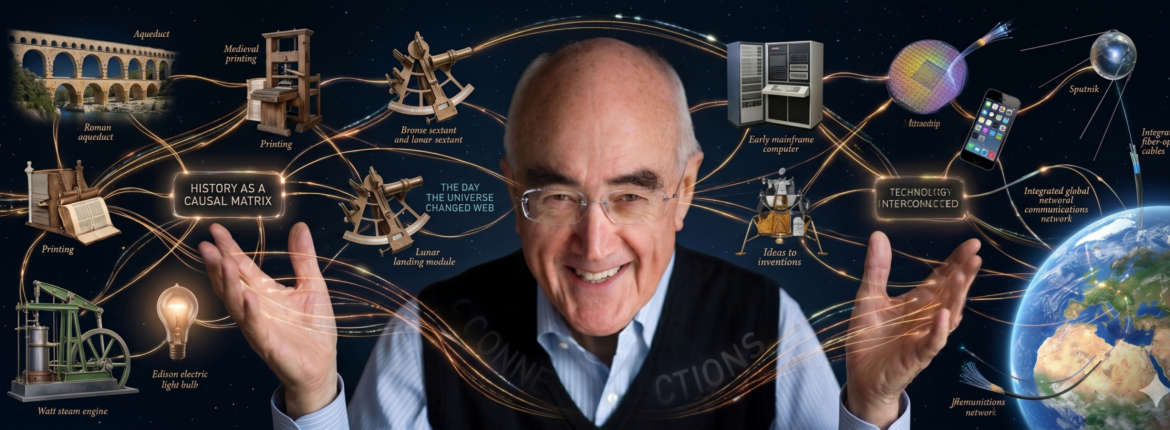
To reboot a generation, we must abandon the siloed, passive transfer of information. We need a pedagogical model that integrates the physical movement of golf instructor Shawn Clement, the neurobiological predictive architecture of Jeff Hawkins, and the interconnected technological history of James Burke.
The Neurobiology of the Crisis: The 1000-Brains Problem
Jeff Hawkins’ 1000-Brains Theory posits that intelligence is not a monolithic "center" in the brain, but the emergent property of thousands of individual cortical columns, each building independent, high-fidelity models of the world through sensorimotor inference.
When a student stares at a screen, those cortical columns are starved of essential sensory input—texture, weight, spatial orientation, and resistance. Their mental models of the world become "flat" and disconnected from reality. This is why "executive function" is failing: the brain lacks a robust, motor-based internal map upon which to hang abstract logical or mathematical concepts.
Kinetic Learning: The Clement "Load and Release"
Shawn Clement’s method of throwing golf clubs is a masterclass in bypassing the conscious, over-analytical "fixed-focus" brain to engage the intuitive, physical system. When a student throws a club, they are not "calculating" the velocity; they are performing a complex, multi-variable physics problem through their own nervous system.
We can apply this "load and release" to science. Instead of teaching an abstract formula for density or crystalline structure, we place physical samples in a student's hand. When they manipulate a mineral specimen, they are performing academic proprioception. The cortical columns receive data about mass, cleavage, and hardness. They are "loading" the sensory experience before the "release" of the formal scientific definition. The math, when it eventually arrives, is simply the language describing a reality they already know by feel.
The Burkean Cascade: Geology, History, and Culture
James Burke’s work demonstrated that history is not a series of isolated events, but a cascading network of inventions and discoveries where one innovation acts as the scaffold for the next.
In a "Geology CSI" curriculum, we use physical rock samples to bridge the gap between geology, history, and human culture. By analyzing these samples, students uncover the "Burkean" links that shaped civilization:
- Economic Drivers: Students trace how specific geological formations dictated resource availability, which directly influenced ancient trade routes and global economic structures.
- Cultural Foundations: By interacting with rock samples, students perceive how geography influenced the development of distinct cultures, architecture, and historical conflicts.
- The Connected Network: Students realize that a mineral isn't just a science object; it is the physical "node" that connects historical climate shifts to the rise and fall of empires, creating a unified web of knowledge.
The Geology Reboot: Why It Is Step One
Geology is the foundational science for this reboot because it is inherently deep-time and multi-scalar. It bridges the gap between the microscopic (molecular structure) and the massive (tectonic plates).
In a "Geology CSI" classroom, students don’t just read about plate tectonics; they examine the physical evidence of continental collisions in a sample of schist. They are engaged in active predictive coding. Their brains are constantly updating their mental map of the earth based on tactile feedback.
The Path Forward
To reboot this generation, we must transform every classroom into a laboratory of sensorimotor exploration. This means:
- Prioritizing Tactile Infrastructure: Replacing screen-based labs with physical "matrix kits" (like pillbox sorting kits for geology) that force interaction.
- Structuring for Flow: Treating the teacher as a "caddy" or "music producer" who designs the environment and sets the goal, but leaves the physical "swing"—the active discovery—to the student.
- Horizontal Curriculum Mapping: Teaching subjects as a unified web of connections rather than a vertical stack of discrete facts.
We are not just teaching science; we are rebuilding the brain’s ability to predict, to explore, and to function in a non-digital world. It is time to stop memorizing the map and start physically navigating the terrain.