
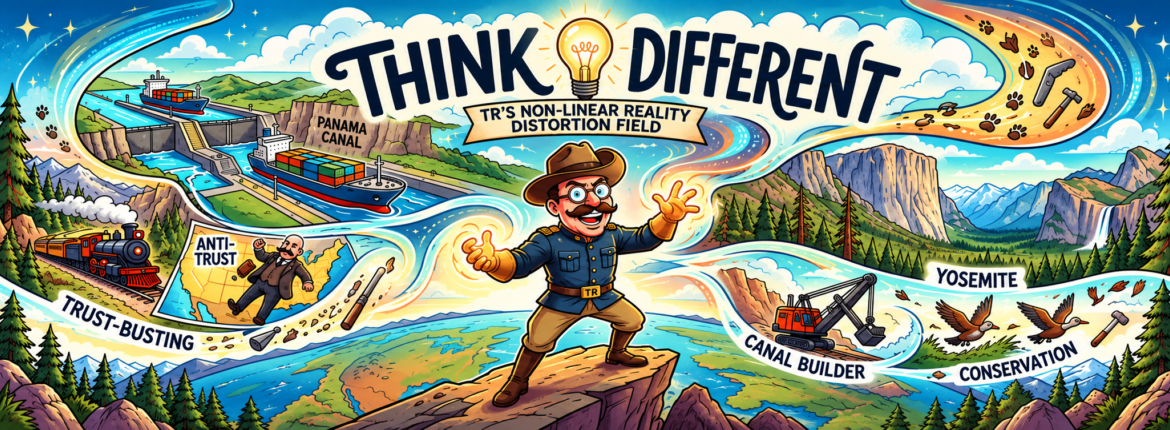
The President Who Refused to Sit Still
History books love to paint Theodore Roosevelt as a rugged cowboy, a monocled Rough Rider, or a booming voice shouting “Bully!” across the lawn. But look beyond the familiar caricature and something much more interesting emerges.
Roosevelt was a voracious reader, an obsessive naturalist, a boxer, a rancher, a writer, a soldier, and eventually the youngest president in American history. His intellectual appetite was extraordinary, his physical energy seemingly inexhaustible, and his tolerance for institutional inertia remarkably low.
He was also a man whose behavior has invited retrospective speculation about ADHD. Roosevelt belongs to a broader conversation about historical figures whose documented behaviors resemble characteristics associated with ADHD. Abraham Lincoln has appeared in similar speculation. These discussions exist because people recognize patterns in historical accounts that are familiar from contemporary experiences of ADHD.
Roosevelt gives us an unusually rich historical record to examine. His childhood interests, physical activity, intellectual intensity, unconventional problem-solving, and appetite for challenge are all documented. They also invite comparison with the motivational patterns described by Dr. William Dodson's Interest-Based Nervous System framework.
Roosevelt wasn't merely a politician who happened to have many interests. He organized his life around them, moving between intellectual and physical pursuits with an intensity that often astonished the people around him.
Long before Steve Jobs introduced the world to the Macintosh, Roosevelt was treating the executive branch of the federal government as an institution that could be redesigned.
He didn't invent the presidency. He changed how it operated.
The Reality Distortion Field and Hyperfocus
Steve Jobs became famous for his ability to persuade engineers that seemingly impossible technical challenges were achievable. His colleagues described an environment in which conventional assumptions about schedules, product design, and engineering limitations were constantly challenged.
Roosevelt brought a comparable intensity to politics, and his intellectual appetite began in childhood. Growing up in New York City, he developed a fascination with natural history that went far beyond casual childhood curiosity. He collected specimens, studied animals, maintained notebooks, and even established a small natural history museum within the family home.
At eight years old, Roosevelt became fascinated by a dead seal displayed in a Manhattan market. He repeatedly visited it, studied it, and eventually obtained its head for his growing natural history collection. What began as a childhood fascination became part of a lifelong commitment to understanding the natural world, eventually influencing the conservation policies of his presidency.
His reading habits were similarly extraordinary. Roosevelt was widely known for consuming books at a remarkable pace, sometimes reading several in a day. His interests ranged from history and military strategy to biology, geography, politics, and literature. He was also a prolific writer, publishing works on history, natural history, politics, and his own experiences.
What makes this particularly interesting through an ADHD lens is the combination of intellectual breadth and extraordinary depth.
ADHD is frequently characterized in popular discussions as an inability to pay attention. Yet many ADHD adults describe the opposite experience when something captures their interest: hours of sustained engagement, often accompanied by a diminished awareness of time and competing demands.
Roosevelt's intellectual life offers a striking historical example of intense engagement across multiple subjects. His attention was not confined to one lifelong specialty. He moved among interests, developed considerable expertise, and frequently connected what he learned to practical problems.
The comparison to Jobs is especially useful here. Jobs drew on calligraphy, industrial design, typography, electronics, and human behavior to develop his vision for personal computing. Roosevelt drew on natural history, military history, politics, and personal experience to shape his understanding of national leadership.
Both demonstrate how a wide intellectual landscape can become an advantage when someone recognizes connections between subjects that institutions ordinarily keep separate.
The Strenuous Life: Movement, Challenge, and Engagement
Roosevelt's childhood was marked by severe asthma. His father encouraged physical exercise, and young Theodore gradually developed a demanding regimen intended to strengthen his body. Physical activity eventually became a defining feature of his life.
He boxed, rode horses, hiked, hunted, and pursued strenuous outdoor adventures. During his presidency, he continued practicing demanding physical activities and became known for taking companions on difficult excursions through the countryside.
His famous point-to-point walks were particularly revealing. Rather than follow an established trail, Roosevelt and his companions would attempt to travel directly toward a destination, confronting whatever obstacles appeared along the way. A stream was something to cross, a steep embankment was something to climb, and the challenge itself was part of the attraction.
His commitment to physical exertion was so central to his philosophy that he delivered a speech titled The Strenuous Lifein 1899, presenting effort, courage, and active engagement as essential virtues.
Roosevelt's physical activity had many influences, including his childhood health, family encouragement, cultural expectations, and personal convictions. But the parallels with ADHD are worth exploring, particularly through Dr. William Dodson's description of how interest, novelty, challenge, and urgency can provide powerful routes to engagement for people with ADHD.
Roosevelt's life was saturated with those experiences. He didn't merely exercise for physical fitness. He sought activities that required immediate engagement, rapid adaptation, and direct responses to changing circumstances. The environment itself supplied the challenge.
There is an important distinction between the conventional understanding of exercise as a healthy habit and the role that physical activity can play in regulating attention, arousal, and emotional functioning. Research on exercise and ADHD suggests that physical activity can improve aspects of cognitive and behavioral functioning, although the size and durability of those benefits vary across studies.
Roosevelt's life invites an interesting question: could a demanding pattern of physical engagement help some people sustain the cognitive and emotional energy required for intense intellectual work?
His childhood asthma provides one explanation for the origins of his regimen, but it does not diminish the significance of how that regimen became integrated into his adult life.
The boy who had struggled to breathe became the president who rarely seemed willing to remain still.
The Bully Pulpit: Rewriting the Presidential Interface
When Roosevelt became president in September 1901 following William McKinley's assassination, he inherited an office whose practical authority had been shaped by decades of political conventions.
The Constitution established the presidency's formal powers, but it did not dictate every way those powers could be exercised. Roosevelt recognized opportunities within that distinction and believed the presidency could become an active instrument for directing public attention, challenging entrenched interests, and mobilizing political support. His famous bully pulpit was an expression of that philosophy.
Rather than rely exclusively on private negotiations with congressional leaders, Roosevelt used the visibility of the presidency to communicate directly with the American public. He understood that public attention could become a source of political leverage.
This is where the Steve Jobs comparison becomes especially compelling.
Jobs understood that a computer was more than its internal hardware. The interface determined how human beings interacted with the machine. Roosevelt approached the presidency as something whose relationship with the public could be redesigned.
He recognized that presidential influence was not limited to the formal powers listed in the Constitution. It also depended on communication, public trust, and the ability to persuade people that established practices could change. That required an unusual willingness to challenge expectations and an appetite for conflict.
Roosevelt did not avoid confrontation with powerful interests simply because those interests had traditionally exercised enormous influence over Washington. His administration's pursuit of the Northern Securities Company, a railroad holding company associated with J. P. Morgan and other financiers, demonstrated his willingness to use existing federal antitrust authority against concentrated corporate power.
He did not invent the Sherman Antitrust Act. It had existed since 1890, but Roosevelt recognized what could be accomplished by using it. The federal government already possessed a tool that could alter the relationship between business and public authority.
Roosevelt picked it up.
The Coal Strike: When Urgency Changes the Rules
The anthracite coal strike of 1902 offers one of the clearest examples of Roosevelt's approach to institutional problem-solving.
Approximately 147,000 miners and boys stopped working in Pennsylvania's coal fields, creating a confrontation between organized labor and mine owners. As the strike continued, the possibility of a winter coal shortage became increasingly serious. Homes, factories, schools, and businesses depended on anthracite coal for heat and energy.
Previous administrations had frequently intervened in major labor disputes on the side of employers. Roosevelt approached the crisis differently, inviting representatives of labor and management to Washington and attempting to broker a settlement. When negotiations failed, he considered increasingly aggressive measures, including the possibility of federal intervention to operate the mines.
His threatened intervention helped create pressure for a compromise, and the strike eventually ended through an agreement involving arbitration.
Roosevelt had confronted a problem in which established political expectations were failing to produce a solution, while the consequences of waiting were becoming increasingly immediate.
The ADHD parallel here is not simply impulsivity. It is the relationship between urgency, engagement, and unconventional problem-solving. A crisis creates immediate feedback, makes the stakes visible, and transforms an abstract challenge into something demanding a response. For some ADHD adults, those conditions can produce extraordinary levels of engagement.
Roosevelt's response also illustrates something important about creative problem-solving: he did not abandon the institutional tools available to him. He reconsidered how they could be used.
He consulted advisers, explored alternatives, attempted negotiation, and eventually applied presidential influence in ways that challenged existing expectations. His actions were controversial precisely because they questioned assumptions about the federal government's role in labor disputes.
The problem was not a lack of established procedures. It was that the established procedures were not adequately addressing the crisis, and Roosevelt was willing to change the approach.
Panama: The Nonlinear Solution and Its Consequences
The Panama Canal was one of the great engineering ambitions of the nineteenth century. For decades, governments and private enterprises struggled with the extraordinary technical, financial, and political obstacles involved in connecting the Atlantic and Pacific Oceans.
Roosevelt inherited the problem and approached it with characteristic urgency. When negotiations with Colombia failed to produce an acceptable agreement for constructing the canal through Colombian territory, Roosevelt supported the emergence of an independent Panama and quickly secured an agreement with its new government.
The result accelerated the canal project and dramatically expanded American influence in the region. It also generated enduring controversy concerning sovereignty, American intervention, and the legitimacy of the circumstances surrounding Panama's independence.
This is an important dimension of Roosevelt's story because unconventional problem-solving is not automatically beneficial simply because it produces results.
Roosevelt demonstrated a willingness to reconsider the problem itself rather than continue pursuing the same unsuccessful negotiations. His approach resembles a pattern familiar in creative engineering and product development: when a particular pathway becomes blocked, reconsider the architecture of the entire solution.
That is one reason the comparison to Steve Jobs is useful. Jobs frequently challenged engineering teams to reconsider assumptions that had become embedded in existing designs. Roosevelt challenged assumptions embedded in political and administrative processes.
But political institutions carry obligations that a technology company does not. Questions of sovereignty, constitutional authority, and international consequences cannot be reduced to the speed with which a project is completed.
Roosevelt's approach to Panama illustrates both the possibilities and the costs of disruptive leadership.
Conservation: When a Childhood Obsession Becomes National Policy
One of the most revealing elements of Roosevelt's life is the continuity between his childhood fascination with nature and his achievements as president. The boy who collected animal specimens and studied natural history eventually possessed the authority to protect enormous areas of the American landscape.
During his presidency, Roosevelt established the United States Forest Service, created 150 national forests, designated federal bird reserves, and used the Antiquities Act to protect national monuments. His administration protected approximately 230 million acres of public land through various conservation measures.
His childhood interest had become a national policy priority.
The relationship between intense personal interests and long-term achievement is particularly interesting in ADHD. Popular descriptions of ADHD often emphasize abandoned projects, unfinished assignments, and difficulty maintaining attention. Those experiences are real, but they do not describe every form of engagement available to the ADHD mind.
An intense interest can also become a durable source of learning, expertise, and motivation.
Roosevelt's fascination with nature began when he was young and continued throughout his life, although it evolved through different activities and responsibilities. Natural history became exploration, exploration informed conservation, and conservation became a central feature of his presidency. The same underlying interest connected activities that might otherwise appear unrelated.
This is especially relevant to education.
Imagine a student whose fascination with animals leads to reading scientific literature, learning geography, studying ecosystems, developing observational skills, and eventually engaging with environmental policy.
A conventional classroom might evaluate those activities as separate academic subjects. The student experiences them as one connected intellectual adventure.
Roosevelt's life illustrates how powerful that connection can become when an environment permits a sustained interest to develop.
The Roosevelt–Jobs Parallel: Designing Around Strengths
The comparison between Roosevelt and Steve Jobs is not based on the industries in which they worked. It concerns their relationship with established systems.
Both men operated in environments with deeply entrenched assumptions about how things should be done. Both were willing to challenge those assumptions, sometimes forcefully, and both exercised substantial authority over the organizations they led.
Jobs approached technology through the relationship between design, engineering, and human experience, while Roosevelt approached government through the relationship between political authority, public engagement, and institutional responsibility. Their methods frequently generated resistance, but they could also produce extraordinary changes.
There is another parallel that matters for ADHD Escape Room: neither man worked alone.
Jobs depended on engineers, designers, operational leaders, and colleagues who translated ambitious ideas into functioning products and organizations. Roosevelt depended on cabinet members, advisers, legislators, scientists, military officers, and administrators who transformed political ambitions into workable policy.
The familiar image of the solitary disruptive genius misses the importance of those relationships. An ambitious idea is not the same thing as successful implementation.
A person may excel at recognizing possibilities, generating unconventional solutions, or mobilizing people around a challenge while relying on others whose strengths lie in planning, administration, technical execution, or maintaining organizational continuity. The resulting collaboration can accomplish things that neither person could achieve independently.
For ADHD adults, this suggests a useful way to think about environmental fit. The objective is not necessarily to become equally skilled at every activity an institution demands. It is to build an environment in which different strengths can work together.
Roosevelt had the authority to influence that environment on an extraordinary scale. Most people do not, but the principle can apply in a classroom, a workplace, or a family.
The Historical ADHD Conversation
Roosevelt's name belongs in a conversation that extends beyond his presidency. Retrospective speculation about ADHD has included historical figures such as Roosevelt and Abraham Lincoln, although the evidentiary basis and credibility of individual claims vary considerably.
The broader scholarly conversation has an important foundation: ADHD-like behavioral patterns were being described long before modern diagnostic terminology existed.
Historical reviews have identified medical descriptions of inattention, overactivity, and impulsivity dating to the eighteenth century, including the writings of Melchior Adam Weikard and Alexander Crichton. Later descriptions contributed to the gradual development of the clinical concepts that eventually became ADHD.
It would be surprising if the underlying neurological variation suddenly appeared when modern psychiatry developed a name for it.
The people were already here.
They were growing up in homes, attending schools, entering professions, leading institutions, and navigating societies that had no contemporary language for their experiences. Some undoubtedly struggled. Others found environments that allowed them to develop extraordinary abilities. Many likely experienced both.
Roosevelt's historical record gives us an opportunity to examine a recognizable combination of intense intellectual engagement, physical activity, appetite for challenge, and unconventional leadership.
The discussion of Lincoln is somewhat different. His life has attracted numerous retrospective psychological interpretations, particularly concerning depression and temperament. Claims about ADHD require their own historical examination rather than simply borrowing credibility from the Roosevelt comparison.
For Roosevelt, the behavioral record itself is unusually extensive, making him an interesting subject for exploring how characteristics associated with ADHD might interact with education, opportunity, personal interests, and institutional authority.
These are questions that can be investigated scientifically.
Epistemic Status & Testable Predictions
The historical events and biographical characteristics discussed in this chapter are documented through Roosevelt's writings, archival collections, historical scholarship, and government records.
The central research question is whether the patterns illustrated by Roosevelt's life—intense interest, physical engagement, challenge-seeking, unconventional problem-solving, and institutional autonomy—can help explain differences in how people with ADHD function across environments.
1. Interest-Driven Expertise
Prediction: ADHD students who are permitted to develop academic skills through sustained personal interests will demonstrate greater engagement and deeper subject knowledge than comparable ADHD students receiving instruction disconnected from those interests.
A longitudinal study could compare interest-centered instruction with conventional instruction while controlling for instructional quality, teacher support, and prior academic achievement. Researchers could measure subject mastery, voluntary learning, retention, and the transfer of knowledge across academic disciplines.
The key question is whether personally meaningful interests can become pathways to broader intellectual development.
2. Physical Activity and Cognitive Engagement
Prediction: Structured physical activity incorporated into the daily routines of ADHD students and adults will improve subsequent task engagement and aspects of emotional regulation compared with otherwise comparable sedentary routines.
Studies could compare different forms of exercise, including aerobic activity, skill-based sports, and physically challenging outdoor activities. Researchers should examine both immediate effects and longer-term outcomes, distinguishing improvements in attention from changes in motivation, mood, and physiological arousal.
Roosevelt's strenuous life provides a historical illustration of the question, not the evidence needed to settle it.
3. Challenge and Complex Problem-Solving
Prediction: ADHD adults will show a greater relative improvement in engagement when moving from repetitive administrative tasks to meaningful, challenging problem-solving activities than adults without ADHD performing the same tasks.
Experimental designs could vary novelty, urgency, difficulty, and personal interest independently. Performance would be measured through accuracy, persistence, creative solution generation, and completion rates.
This would help investigate whether the motivational conditions described by Dodson produce measurable differences in engagement.
4. Autonomy and Institutional Innovation
Prediction: ADHD adults with meaningful decision-making autonomy will demonstrate higher rates of useful innovation than comparable ADHD adults whose work is governed by rigid procedural constraints.
A workplace study could examine employees in organizations offering different degrees of discretion, while controlling for occupational demands and management quality. Measures would include successful innovations, implementation quality, employee satisfaction, and unintended consequences.
The distinction between generating an unconventional idea and successfully implementing it would be especially important.
5. Complementary Strengths and Collaborative Performance
Prediction: Teams that deliberately combine individuals with strengths in idea generation, creative problem-solving, planning, and implementation will outperform otherwise comparable teams whose members are required to perform every function independently.
Researchers could examine teams with and without ADHD members, comparing collaboration patterns, task completion, innovation quality, and organizational outcomes.
The question is whether complementary strengths and appropriate support structures improve performance, particularly for individuals whose abilities vary substantially across different task demands.
The Executive Disruptor
Theodore Roosevelt died in 1919, long before the modern diagnostic language of ADHD existed. He left behind a remarkable historical record: an intellectually voracious child who became a naturalist, a physically active young man who became a soldier, and a political reformer who became president.
His accomplishments were inseparable from his opportunities, education, family resources, collaborators, and the political circumstances of his time. But his life also presents a fascinating collection of behavioral characteristics that resonate with contemporary descriptions of ADHD.
His intellectual interests were expansive, his engagement could be extraordinarily intense, and physical activity was woven into his daily life. He sought challenge, resisted institutional inertia, and frequently approached problems from unexpected directions. He was not universally successful, and his willingness to challenge established boundaries sometimes produced controversial consequences.
Roosevelt did not spend his life trying to become a conventional administrator. He developed his interests, pursued demanding experiences, and eventually occupied a position where his unusual approach to leadership could influence an entire nation.
That brings us back to the comparison with Steve Jobs. Both men recognized possibilities within institutions that others had accepted as fixed. Both pursued ambitious changes, depended on collaborators, and generated resistance along the way.
Their stories illustrate something that ADHD Escape Room keeps returning to: the same characteristics that create friction in one environment may become valuable in another.
For someone whose attention follows intense interests, whose energy demands movement, or whose mind continually searches for new challenges, the conventional response is often to insist on greater conformity. Roosevelt's story invites a different question: what might happen if we began by recognizing those strengths and then built the supports needed to develop them?
Somewhere in Roosevelt's story, a person with ADHD might recognize a part of themselves for the first time—something that had always been there, but that they had never been able to access before.
References
1. National Park Service. Theodore Roosevelt Biography. Historical overview of Roosevelt's childhood, intellectual interests, political career, and conservation achievements.
2. National Park Service. The Life of Theodore Roosevelt. Includes historical background on Roosevelt's presidency, trust regulation, and intervention in the 1902 coal strike.
3. Smithsonian Institution. Theodore Roosevelt: Adventurer, Conservationist, Reformer. Overview of Roosevelt's public career, conservation work, and expeditions.
4. Smithsonian Magazine. (2024). How a Dead Seal Sparked Theodore Roosevelt's Lifelong Passion for Conservation. Documents Roosevelt's early natural history interests and their relationship to his later conservation work.
5. Berfield, S. (2020). The Coal Strike That Defined Theodore Roosevelt's Presidency. Smithsonian Magazine. Historical account of the 1902 anthracite coal strike and Roosevelt's intervention.
6. Library of Congress. (2018). New Online: Theodore Roosevelt Papers. Introduction to Roosevelt's archival papers, including correspondence, speeches, diaries, and executive records.
7. Roosevelt, T. (1899). The Strenuous Life. Speech delivered at the Hamilton Club, Chicago. Primary historical source for Roosevelt's philosophy of effort, physical activity, and public service.
8. Dodson, W. The Interest-Based Nervous System. Clinical framework describing interest, novelty, challenge, and urgency as important conditions for ADHD engagement.
9. Lange, K. W., et al. (2010). Antecedents of ADHD: A Historical Account of Diagnostic Concepts. Historical review of the development of ADHD-related clinical descriptions.
10. Who Says This Is a Modern Disorder? The Early History of Attention Deficit Hyperactivity Disorder. (2015). Full research article. Review of ADHD-like descriptions in historical medical literature.
11. Mahone, E. M., & Denckla, M. B. (2017). Attention-Deficit/Hyperactivity Disorder: A Historical Neuropsychological Perspective. Review of the development of ADHD concepts and neuropsychological research.
12. Roosevelt, T. (1913). An Autobiography. Primary autobiographical account of Roosevelt's upbringing, interests, political development, and experiences.