
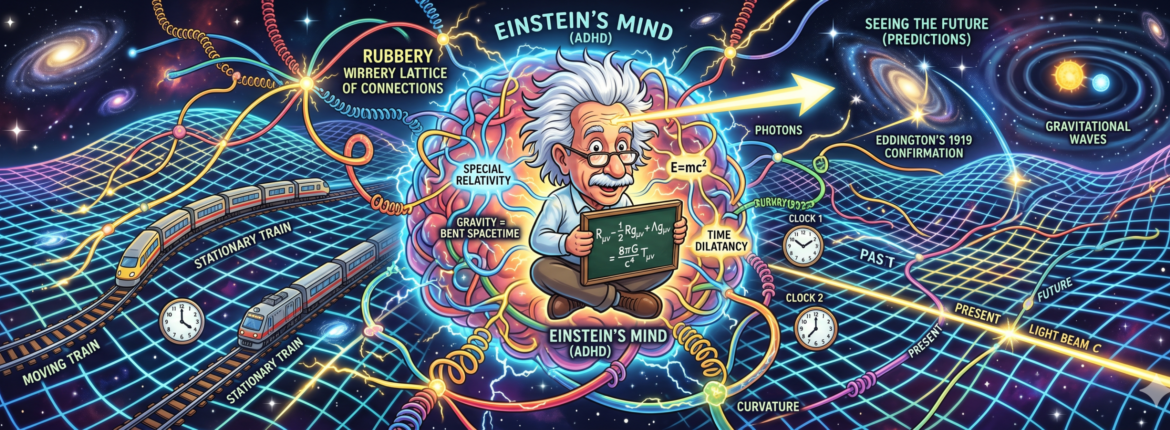
The imagery of trains, stations, and moving clocks is famously at the heart of how Albert Einstein revolutionized our understanding of physics. While the idea of a "rubbery, wirery lattice" sounds like a vivid way to picture the interconnected web of space and time, the actual thought experiments that led to relativity were rooted in a profound paradox about light, motion, and what it means for two events to happen at the same time.
Here is how those train thought experiments fundamentally rewired our concept of reality and gave birth to relativity.
The Illusion of Motion: Standing on the Platform
Einstein’s breakthrough didn't come from a literal physical structure in his brain, but from his incredible ability to run Gedankenexperimenten (thought experiments).
Imagine you are sitting on a completely smooth, silent train at a station. You look out the window and see another train next to you. Suddenly, the other train appears to slide backward. For a split second, your brain experiences a jolt of confusion: Are they moving backward, or are you moving forward? Without looking at the stationary platform or the ground, there is no physical experiment you can do inside your uniform, smoothly moving train to prove whether you are moving or at rest. This is classical relativity, an idea going back to Galileo: all uniform motion is relative.
The Speed of Light Paradox
Einstein took this basic concept and collided it with the laws of electromagnetism. According to physics, the speed of light ($c$) is an absolute constant—it is always about 300,000 kilometers per second, no matter how fast you are moving toward or away from its source.
This created a massive contradiction in classical physics:
- If you run alongside a speeding car, the car appears to move away from you more slowly.
- If you "run" alongside a beam of light, the light doesn't slow down relative to you; it still races away at exactly $c$.
To reconcile this, Einstein realized something radical had to give. If the speed of light is absolute, then space and time themselves cannot be absolute. They must be flexible.
The Thought Experiment: The Train and the Lightning Bolts
To prove that time is elastic, Einstein imagined a speeding train and an observer standing still on the station platform.
Imagine two bolts of lightning strike opposite ends of the train track (Point A and Point B) at the exact same moment according to the observer on the platform.
- From the Platform: The observer stands exactly halfway between Point A and Point B. Because the light from both flashes travels the same distance at the same speed, the light reaches their eyes at the exact same instant. To them, the strikes are simultaneous.
- From the Train: Now imagine an observer riding in the middle of a super-fast train moving toward Point B. As the lightning strikes, the train carries the passenger toward the light coming from Point B and away from the light coming from Point A.
- Because the speed of light is constant, the passenger will see the flash from Point B first, before the flash from Point A reaches them. To the passenger, the lightning bolts did not happen at the same time.
The Big Realization
Einstein concluded that simultaneity is relative. Two events that happen at the same time for one person do not happen at the same time for someone moving at a different speed. Because time is bound to your frame of reference, there is no universal "now."
The "Rubbery" Fabric of Spacetime
This insight cracked open the rigid, clockwork universe that Isaac Newton had envisioned. Einstein realized that space and time are not separate, independent backdrops where events happen. Instead, they are woven together into a single, dynamic, four-dimensional fabric: Spacetime.
When you move through space, you alter how you move through time.
- If you are stationary relative to someone else, your clocks tick at the same rate.
- If you speed up, your time stretches out (time dilation) and your space contracts (length contraction) relative to them.
This became the foundation of Special Relativity (1905). A decade later, in General Relativity (1915), Einstein showed that this spacetime fabric isn't just a passive grid—it is malleable and "rubbery." Heavy objects like the Earth and the Sun warp and bend this lattice, and we perceive that warping as the force of gravity.