

For over a decade, Scandinavia was celebrated as the vanguard of digital education. Classrooms across Sweden, Norway, and Finland aggressively swapped paper workbooks for tablets, standardized laptops, and cloud-based learning management platforms. Math instruction shifted from pencil-and-paper scratchpads toward keyboards, equation editors, and interactive user interfaces.
Then the data arrived.
Across successive rounds of the Program for International Student Assessment (PISA) and national evaluations, foundational reading and mathematical performance declined. By 2023, Sweden had begun a substantial reinvestment in printed textbooks and physical learning materials, while neighboring Nordic countries were also reconsidering the role of screens in classrooms.
The easiest explanation was screen time and attention fragmentation. But there may be a deeper problem hiding inside the interface itself. When schools replaced handwriting with keyboards, they did not simply replace one input device with another. They changed the relationship between movement, sensation, vision, and the spatial structure of what students were learning.
And mathematics is profoundly spatial.
The Motor Decoupling of the Keyboard
Consider what happens when a student writes an equation by hand. An exponent belongs above and to the right of its base. A denominator belongs beneath a fraction bar. A radical encloses an expression. Parentheses establish boundaries. An algebraic derivation unfolds downward through physical space, with each line maintaining a spatial relationship to the line before it.
When those structures are constructed by hand, the movement of the hand itself contains information about the mathematical structure being created. To write an exponent such as \(x^3\), the hand leaves the baseline and moves upward and to the right. To construct a fraction such as\[ \frac{x+y}{z} \]
the hand writes the numerator, travels across the page to establish the fraction bar, and then moves downward to position the denominator beneath it. To write\[ \sqrt{x+y} \]
the hand creates the radical and physically extends its enclosure across the expression that belongs inside it.
Something important happens during that process. The hand is constructing a spatial map through movement, and the finished mathematical expression preserves that same map visually.
Move the hand upward to create an exponent and the eye later encounters the exponent above the baseline. Move downward to construct the denominator and the eye later encounters the denominator beneath the fraction bar. Extend the hand across an expression to create the roof of a radical and the visual expression preserves precisely that enclosure.
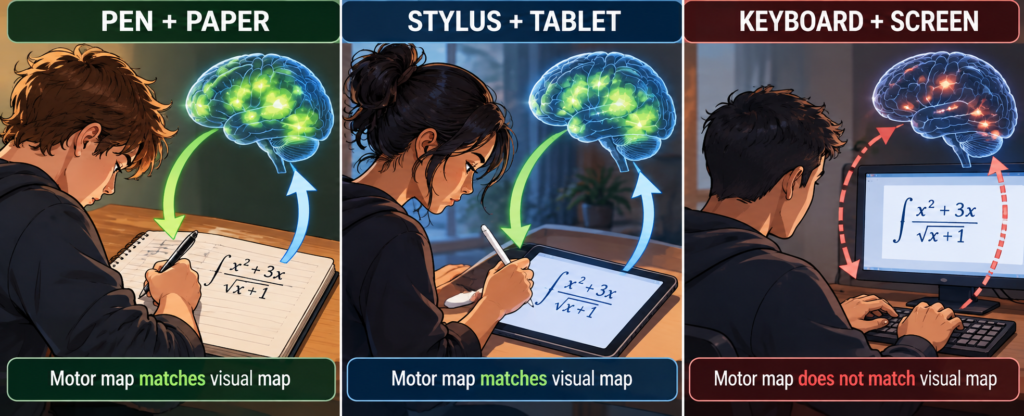
The motor map and the visual map correspond.
This relationship is not exclusive to mathematics. Even ordinary handwriting requires the hand to construct letters through distinct trajectories, move across a line, return to the left, and move downward to begin the next line. The spatial organization produced by the movement remains in the visual organization of the finished writing.
Mathematics adds another layer because those spatial relationships themselves carry conceptual meaning.
Now compare that with a keyboard.
Whether the student intends an exponent, denominator, radical, variable, operator, or parenthesis, the fundamental motor action is nearly identical: depress a key. The fingers move around an arbitrary QWERTY grid while the resulting symbols appear within a different spatial system on the screen. Even when software eventually renders a mathematically correct expression, the spatial map created by the movement of the hands bears little relationship to the visual map being constructed.
The motor map and the visual map have been decoupled.
That is the spatial deficit.
Jeff Hawkins and the Construction of Reference Frames
In A Thousand Brains: A New Theory of Intelligence, Jeff Hawkins proposes that the neocortex does not understand the world by simply storing static representations of things. It constructs models using reference frames, continuously integrating sensory information with information about movement.
When a finger moves across an object or the eyes move across a scene, the brain does not merely register the next sensory input. Information about the movement allows the brain to predict where the sensory system has moved within a reference frame and what it should encounter next. In simplified form, the system is continuously solving a related set of problems: Where am I? Where did I move? What should I sense next?
That sensorimotor loop allows the brain to construct models of objects and spaces. Hawkins's larger proposal is that the neocortex repurposes these reference-frame mechanisms for abstract knowledge as well.
Hawkins and his research team developed the theory from the biology of the neocortex and then used mathematics to describe how the mechanism could work. That was unusual in neuroscience when the work began more than two decades ago.
Mathematics provides an unusually interesting application of the theory because mathematical notation embeds conceptual meaning directly into spatial relationships. An exponent is not simply the semantic idea of exponentiation; it occupies a location relative to another mathematical object. A denominator exists beneath a boundary. A radical creates an enclosure. The arrangement itself carries information.
When the student writes those relationships by hand, movement and visual consequence occupy the same reference frame. The hand constructs the map that the eyes see.
The keyboard largely breaks that correspondence.
The Norwegian Experiment: The Screen Wasn't the Problem
Research from the Norwegian University of Science and Technology provides an important piece of this argument because it allows us to separate two technologies that are too often treated as cognitively equivalent: the screen and the keyboard.
Audrey van der Meer and Ruud van der Weel used a 256-channel high-density EEG to examine functional brain connectivity while participants either wrote by hand or typed. Critically, the handwriting condition did not involve pencil and paper. Participants wrote with a digital pen on a touchscreen.
That detail changes the interpretation of the experiment.
The researchers found substantially more elaborate patterns of functional connectivity during handwriting than during typing, including widespread theta- and alpha-band connectivity across central and parietal regions. These frequency ranges and networks are associated with processes involved in learning and memory. The keyboard condition did not produce the same widespread connectivity pattern.
This was not paper versus computer.
The screen remained. What changed was what the hand was doing.
With the stylus, participants still had to construct every letter through continuous movement in space. Every line, curve, directional change, acceleration, and stopping point required a different motor trajectory. At the same time, the visual mark emerged from those movements within the same spatial field.
The hand created a map through movement. The screen preserved that map visually.
Typing was fundamentally different. The fingers moved through the spatial arrangement of a keyboard while the resulting letters appeared somewhere else, organized according to a different spatial arrangement. The movement of the fingers across QWERTY did not describe the shape, location, or relationship of the symbols appearing on the screen.
The motor map no longer matched the visual map.
And the widespread functional connectivity seen during stylus handwriting was significantly diminished during keyboard typing.
Paper, Stylus, and Keyboard: What Is Actually Being Lost?
Pen and paper still provide something that a stylus moving across smooth glass does not provide as richly: friction. A pencil or pen encounters resistance, texture, and microscopic changes at the contact surface. Those forces contribute tactile and proprioceptive information about pressure, velocity, direction, and movement.
That makes pen and paper the richer sensory environment. But the difference between paper and a stylus should not be confused with the much more substantial architectural change introduced by the keyboard.
With pen and paper, the student receives a spatial motor trajectory, corresponding visual feedback, and rich haptic feedback. With a stylus and tablet, the student retains the spatial motor trajectory and corresponding visual feedback while receiving less haptic information from the writing surface. With keyboard and screen, much of the meaningful spatial motor trajectory itself disappears, and the remaining movement occurs within a spatial map that does not correspond to the visual map appearing on the screen.
The move from paper to glass therefore weakens part of the sensory side of sensorimotor inference. Reduced friction means reduced tactile information returning from the surface. But that is not the same as breaking the correspondence between movement and visual consequence.
With a stylus, the hand still moves through space. The motor system still generates a trajectory, and vision still observes a mark emerging from that trajectory in the corresponding location. Movement and consequence remain coupled.
This is what makes the Norwegian experiment so important. Even after removing the richer friction and texture provided by paper, handwriting with a stylus still produced dramatically richer patterns of functional connectivity than typing.
The stylus does not reproduce every sensory property of paper. Apparently, it doesn't have to.
The map is still there.
Why Mathematics May Magnify the Difference
Mathematical notation uses space to encode meaning to a degree ordinary alphabetic writing does not. That makes the Norwegian findings particularly interesting when we move from writing prose to constructing mathematical relationships.
Consider a fraction:
When a student constructs that fraction by hand, the hand establishes the entire spatial relationship. It positions one mathematical object above another and physically creates the boundary separating them. The numerator and denominator are not simply encountered sequentially; their locations relative to the fraction bar are part of what makes the expression mean what it means.
The motor map constructed by the hand and the mathematical map subsequently encountered by the eyes are the same map.
The same thing occurs with an exponent:
The hand leaves the baseline and enters a different region of the writing space. The finished expression preserves that movement as a visual relationship between the base and exponent.
With a radical,
the physical extent of the hand's movement determines which terms belong within the operation. More complex mathematics compounds these relationships:
The student is no longer merely writing symbols. The student is constructing a spatial hierarchy in which location, enclosure, vertical position, boundaries, and relationships all carry mathematical information.
On a keyboard, much of that correspondence disappears. The student may type a slash, caret, parentheses, or commands into an equation editor. The software can ultimately produce an identical visual expression, but the movement of the hands did not construct the spatial relationships contained within it.
The computer builds the visual map.
The hands moved through a different one.
The Hawkins Connection
This is where the Norwegian findings and Hawkins's theory become particularly interesting together.
Hawkins and his research team developed the theory from the biology of the neocortex, then used mathematics to describe how the mechanism could work. At the center of that model is the relationship between movement, sensory input, and location within a reference frame.
The Norwegian researchers approached the problem from a different direction and found something strikingly consistent with it. Preserve continuous, spatially meaningful movement with a stylus, where the motor map corresponds to the visual map, and widespread brain connectivity remains. Replace that movement with discrete keyboard presses occurring within a spatial map unrelated to the visual output, and that connectivity is significantly diminished.
Paper adds richer sensory information through friction, texture, and resistance. A stylus loses some of that information but preserves the correspondence between movement and visual space. The keyboard removes much of the meaningful trajectory and decouples the spatial organization of the movement from the spatial organization of the result.
The distinction is therefore not simply analog versus digital. The Norwegian experiment was digital in both conditions.
The difference was whether the hand and the eye were operating on the same map.
Mathematics gives us the obvious place to test what happens next.
Now run the experiment.
The Policy Turnaround
The Scandinavian retreat from digital-first education should therefore not be reduced to a story about children spending too much time staring at screens. Screen exposure and attention may matter, but the handwriting research raises another question that education has barely begun to investigate: What happens when a biological learning system built around movement, sensation, prediction, and spatial reference frames is asked to learn increasingly abstract mathematics through an interface in which the movement no longer corresponds to the spatial structure being learned?
That question does not require abandoning technology. In fact, the Norwegian experiment points toward a more useful distinction. A tablet with a stylus can preserve much of the spatial motor relationship that a keyboard removes. Paper may provide an even richer sensory environment because of friction, texture, and resistance, but the stylus evidence tells us that the important boundary is not simply analog versus digital.
It is the architecture of the interaction.
The pencil provides the richest sensory signal. The stylus reduces some of that sensory richness while preserving the correspondence between the motor and visual maps. The keyboard is where that correspondence is substantially lost.
And if mathematics depends upon building internal maps of relationships, that loss deserves considerably more attention than we have given it.
Epistemic Status & Testable Predictions
The Norwegian research established something narrower, but extraordinarily important for this argument: handwriting with a stylus on a tablet produced far greater widespread functional brain connectivity than typing on a keyboard. The subject being written was not mathematics, which makes the finding more fundamental rather than less relevant. The difference appeared at the level of the physical interaction itself.
Hawkins and his research team developed their theory from the biology of the neocortex and then used mathematics to describe how that biological mechanism could work. The Norwegian researchers came at the question from another direction and found a pronounced neurological difference between two forms of interaction: continuous spatial movement in which the motor map corresponds to the visual map, and keyboard movement in which it does not.
Now mathematics gives us a place to test where those findings intersect.
1. Mathematical Connectivity Prediction
Students constructing mathematical expressions by hand should exhibit broader functional connectivity than students entering equivalent expressions through a keyboard. A stylus condition should produce connectivity patterns substantially closer to pen-and-paper handwriting than to keyboard entry if continuous spatial motor movement and correspondence between motor and visual maps are major contributors to the effect.
2. Spatial Complexity Prediction
The difference between handwriting and keyboard entry should increase as mathematical notation becomes more spatially structured. The effect should therefore become more pronounced as students progress from simple arithmetic toward fractions, exponents, radicals, matrices, multilevel algebraic expressions, geometry, and calculus notation.
3. Friction Prediction
Pen and paper should produce measurable differences from handwriting on a smooth tablet surface in tasks sensitive to fine sensorimotor feedback, but those differences should be smaller than the differences between either handwriting condition and keyboard entry.
This prediction separates the additional sensory information created by friction from the spatial correspondence preserved by both forms of handwriting.
4. Motor-Visual Map Prediction
If correspondence between the motor and visual maps matters, deliberately disrupting that correspondence should reduce the handwriting advantage even when the student performs continuous hand movements and sees an identical finished expression.
Conversely, a digital interface designed so that movement more closely corresponds to mathematical position should preserve more of the effect than conventional keyboard entry.
5. Reference-Frame Transfer Prediction
If Hawkins's reference-frame model applies to mathematical learning, students learning unfamiliar mathematical structures through handwriting should demonstrate stronger transfer when those relationships appear in novel configurations. The advantage should become especially visible when students must manipulate spatial relationships rather than simply recognize previously encountered symbols.
These predictions can fail. If they do, the spatial-deficit hypothesis needs to change. But if they survive, education has a much larger problem than screen time.
We may have spent decades optimizing mathematical interfaces for the efficiency of computers while quietly removing information the human neocortex uses to build the map.
References
Hawkins, J. (2021). A Thousand Brains: A New Theory of Intelligence. Basic Books.
Van der Weel, F. R., & Van der Meer, A. L. H. (2024). Handwriting but not typewriting leads to widespread brain connectivity: A high-density EEG study with implications for the classroom. Frontiers in Psychology, 14, 1219945. Full study and DOI