
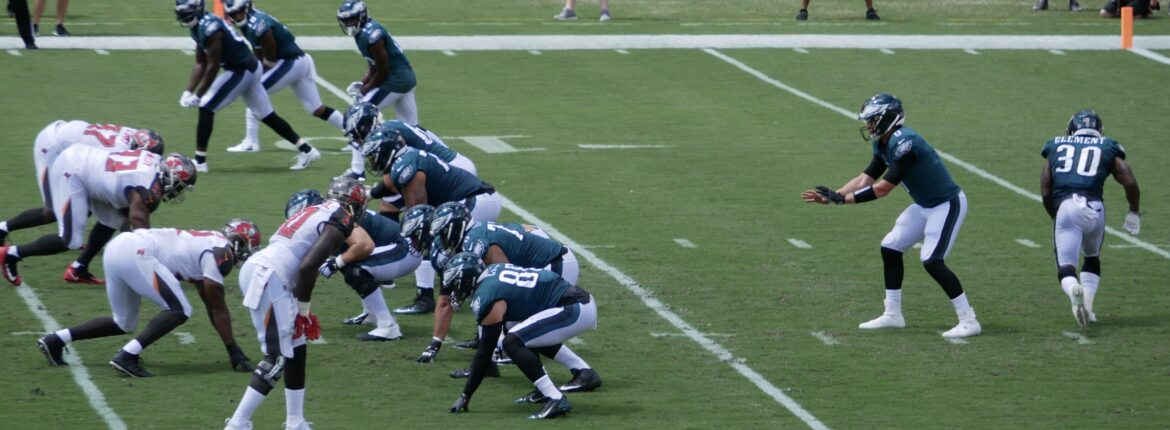
Finding a Well-Scaffolded Home
Nick Foles should not make sense.
If you look at his NFL career as a conventional quarterback-evaluation problem, the pieces refuse to fit together. He produced one of the most efficient regular seasons in NFL history, continued winning the following year until an injury ended his season, deteriorated badly enough in another organization that he nearly walked away from football, became a backup, returned to his original team, and then produced a postseason run containing performances and statistical outliers that belong beside quarterbacks with careers nothing like his own. When Philadelphia desperately needed him again the following season, some of the statistical absurdity came back.
It is tempting to explain this with one of sports’ favorite words: magic. Maybe it was. But magic has a mechanism, and the case of Nick Foles suggests something much more interesting than a journeyman quarterback inexplicably getting hot at exactly the right time.
Foles appears to have been extraordinarily sensitive to environment. Put him in the wrong environment and his abilities became difficult to access. Put him inside a trusted scaffold—coaches who understood him, teammates who believed in him, an organization in which he felt he belonged, and an offense increasingly designed around the way he actually processed the game—and something remarkable repeatedly happened.
Nick Foles became accessible to Nick Foles.
Before the Super Bowl, There Was 2013
The Super Bowl story makes more sense if we begin several years earlier. Foles was drafted by Philadelphia in the third round in 2012. Andy Reid was the head coach, Doug Pederson was Foles’s first NFL quarterbacks coach, and Howie Roseman was part of the organization that selected him. These were not simply names on an organizational chart. They were part of Foles’s first professional football home.
Then came 2013 under Chip Kelly. Whatever one thinks about Kelly’s tenure in Philadelphia as a whole, something worked spectacularly well with this particular quarterback. Foles threw 27 touchdown passes against only two interceptions and posted a 119.2 passer rating. Against Oakland, he tied the NFL record with seven touchdown passes—and did it in three quarters.
More important for what would happen years later, Kelly’s offense gave Foles opportunities to make fast reads and react to what the defense presented. When Philadelphia later had to rebuild its offense around Foles during the 2017 playoffs, the coaching staff went back and studied that earlier tape. They were not trying to invent another quarterback. They were looking for the quarterback they already knew existed.
And contrary to the convenient story that 2013 was simply a freak season followed immediately by collapse, Philadelphia kept winning with Foles in 2014. His individual numbers came back toward Earth, but the Eagles were 6–2 in his eight starts before he broke his collarbone against Houston. That is a .750 winning percentage—the pace of a 12-win season.
Then came Mark Sanchez.
Yes, Mr. Butt Fumble himself.
To be fair to Sanchez, Philadelphia did not immediately implode. The Eagles reached 9–3 before losing three consecutive games late in the season. They eventually finished 10–6 and missed the playoffs in an unusually strong NFC wild-card field. Sanchez went 4–4 in his eight starts; Foles had gone 6–2 in his eight.
We cannot simply project Foles’s 6–2 record across another eight games and declare that Philadelphia would have finished 12–4. Football does not work that way, and neither does evidence. We also do not need to.
Across Foles’s final 18 regular-season starts during that first Philadelphia period, the Eagles went 14–4. The important observation is not that Foles was guaranteed to take Philadelphia to the playoffs in 2014. It is that the extraordinary 2013 season was followed by another substantial period in which Philadelphia continued winning football games with Nick Foles as its quarterback.
Then the environment changed.
The Rams: When the Wheels Came Off
Foles was traded to the St. Louis Rams in 2015, and his performance collapsed. He completed 56.4 percent of his passes, threw seven touchdowns against ten interceptions and finished with a 69.0 passer rating. Eventually he lost his starting job.
But the most important part of the Rams period is not a statistic. Foles has subsequently talked about how close he came to walking away from football altogether. A quarterback who had already demonstrated extraordinary NFL ability had reached a point where the game itself was becoming inaccessible.
That creates a much more interesting question than whether Nick Foles was “really” a good quarterback. We had already watched extraordinary quarterback performance come out of him, and we had watched Philadelphia continue winning with him the following season. The question was why that performance could become so dramatically inaccessible somewhere else.
When Foles finally had the freedom to choose what happened next, his decision provided a clue. He went looking for someone who already knew him.
He went looking for Andy Reid.
Find Someone Who Already Knows You
After leaving the Rams, Foles did not simply search for the easiest route to a starting job. He wanted Reid. Foles said explicitly that he wanted to be somewhere with “respect and love.” Other teams were calling, but Reid was the person he wanted to play for.
And Kansas City was not merely Andy Reid. When Foles arrived, former Eagles trainer Rick Burkholder picked him up at the airport. Foles went to Matt Nagy’s house. Numerous members of the Chiefs staff had been with him during his rookie season in Philadelphia. Foles was moving back toward a human environment in which he had previously felt understood.
The sequence is difficult to miss:
Philadelphia >> success >> Rams >> collapse >> Reid and familiar people >> recovery
Kansas City did not transform Foles into an elite starting quarterback. It did something that may have been more important at that moment.
It gave football back to him.
Philadelphia Was a Human Ecosystem
In 2017, Foles returned to Philadelphia as Carson Wentz’s backup. He was not arriving as the savior of the franchise, and nobody was constructing a championship team around the expectation that Nick Foles would eventually have to win the Super Bowl. That makes what Philadelphia had assembled around him more interesting.
Doug Pederson, his first NFL quarterbacks coach, was now the head coach. Howie Roseman was again running personnel. Familiar players remained throughout the organization. Frank Reich was the offensive coordinator. Carson Wentz was the young franchise quarterback with whom Foles developed a good working relationship.
Foles also seems unusually capable of forming genuine relationships with people who are very different from him. His Christian faith is central to the way he understands his life, yet it does not appear to require that the people around him become copies of Nick Foles before he can trust them, care about them or become their friend.
That matters to the scaffolding hypothesis because being seen does not require being the same. A useful scaffold cannot consist only of people who share your worldview, personality, cognitive style and life history. It requires people capable of establishing trust across those differences.
Philadelphia gave Foles something more complicated and valuable than familiarity. It gave him a heterogeneous collection of human beings with different personalities, responsibilities, backgrounds and ways of seeing the world who nevertheless knew him, valued him and believed he could play.
The Eagles were not merely a football organization he remembered fondly.
They were a human ecosystem.
A Multitude of Caddies
Golf gives us a useful metaphor for what Philadelphia had constructed around Foles. A caddie does not hit the golf ball. The caddie knows the player, manages information and uncertainty, recognizes when to challenge and when to reassure, and helps prevent one bad shot from contaminating the next three. The golfer still has to make the shot, but the caddie helps create the conditions under which the golfer’s best shot remains accessible.
Nick Foles did not have one caddie. He had a multitude of them, each carrying a different part of the bag.
Pederson carried one part. Reich carried another. Roseman supplied organizational continuity. Familiar teammates supplied belonging and belief. His wife, Tori, provided another kind of stability entirely. None of these people needed to perform Foles’s job for him. Their value was precisely that they didn't.
Chris Long provides a particularly interesting example because he had been Foles’s teammate with the Rams before becoming his teammate again in Philadelphia. Long had therefore seen Foles in both environments. He knew the quarterback who struggled in St. Louis and the quarterback who emerged in Philadelphia were the same human being.
That makes Long something like a witness from the control condition. He had seen the wheels come off, yet he still believed in the guy underneath.
The talent wasn't manufactured by the scaffold. The scaffold helped make the talent accessible.
When the Starter Became the Caddie
There was another member of Foles’s collective caddie who is easy to overlook precisely because he was the man Foles replaced: Carson Wentz.
When Wentz tore his ACL, he lost an MVP-caliber season and had to watch another quarterback finish the championship run he had largely built. That could have produced one of the most poisonous relationships imaginable inside a locker room. Instead, Wentz became part of Foles’s scaffold.
He continued participating in the quarterback environment, helping with preparation and providing another set of eyes and another trusted voice. Foles had spent the season supporting Wentz as his backup; after the injury, the relationship reversed. Wentz could now help the quarterback standing where he had stood only weeks earlier.
That matters beyond X’s and O’s. Wentz knew the offense, knew the game plan and understood what defenses were trying to do, but he also understood the psychological pressure attached to that position. A trusted teammate on the sideline can help a quarterback process what just happened, prepare for what comes next, prevent one bad play from contaminating the next series, and keep his head where it needs to be.
That is caddying.
Foles had supported Wentz. Wentz supported Foles. The quarterback room wasn't merely a depth chart. It was a scaffold.
Then Carson Wentz Went Down
Philadelphia had built an extraordinary 2017 season around Wentz. Then he tore his ACL with the Eagles sitting at 11–2, and suddenly all of this human infrastructure mattered.
Foles initially struggled. That part of the story is essential because the transformation was not instantaneous. Philadelphia did not insert the backup, sprinkle some magic dust on him and discover Super Bowl Nick. The coaches went searching for the quarterback they already knew existed.
During playoff preparation, Pederson and his staff studied Foles’s earlier career, including that remarkable 2013 season under Kelly. They brought back more run-pass options and increasingly shaped the offense around what Foles naturally did well.
Frank Reich supplied perhaps the best metaphor for understanding why: Foles was a point guard.
Reich knew Foles’s basketball background and recognized the feel involved in his game: distributing, changing angles, seeing openings and reacting. That spatial, improvisational quality translated particularly well to the RPO game. It is also a much better description of Foles than simply calling him a pocket quarterback. He was never Michael Vick, and his mobility was not primarily about escaping for 20 yards. Foles could move behind the line, alter the geometry, create a passing lane and deliver while the play was changing.
see >> move >> create angle >> react >> throw
Give the point guard a floor he can see.
And then let him play.
The Extended Now
This is where the Foles case becomes particularly interesting for an ADHD website.
I am not claiming that Nick Foles has ADHD. There is no public basis on which I would make that diagnosis, nor does the argument require one. I am calling him a person of interest because his career contains an unusually rich collection of characteristics relevant to the questions we investigate here: extreme performance variability, apparent sensitivity to environmental fit, the importance of trusted relationships, read-and-react processing, extraordinary performance under intense urgency and challenge, and prolonged periods in which conscious interference appears to recede while fluid performance takes its place.
The NFC Championship Game against Minnesota and Super Bowl LII are especially fascinating. My hypothesis is that during those games we may be looking at something functionally similar to hyperfocus—the extended now sustained across an entire performance.
Think of a method actor who stays in character throughout the shooting day. He does not perform a scene, become himself again, wander around for twenty minutes and then consciously reconstruct the character for the next take. He remains inside the world of the character so thoroughly that the next response emerges naturally from the state he is already occupying.
That is what Foles looked like. The point guard stayed on the floor. The read-and-react quarterback stayed in read-and-react mode. One play flowed into another without the visible return of the quarterback who could sometimes become trapped inside his own processing.
Read. React. Throw. Read. React. Throw. Read. React. Throw.
Land.
And the environment kept feeding the state: urgency, challenge, competition, creativity, immediate feedback and constantly changing information, all occurring inside a trusted human scaffold.
When the Numbers Became Ridiculous
During the 2017 postseason, Foles completed 77 of 106 passes—72.6 percent—for 971 yards, six touchdowns, one interception and a 115.7 passer rating. Against Minnesota in the NFC Championship Game, he completed 26 of 33 passes for 352 yards, three touchdowns and no interceptions, producing a 141.4 passer rating. Against New England in Super Bowl LII, he threw for 373 yards and three touchdowns, caught another touchdown on the Philly Special, and left Minneapolis as Super Bowl MVP.
The numbers matter, but not because statistics can tell us what was happening neurologically inside Nick Foles. They cannot. They matter because they give us observable markers of an extraordinary sustained performance state.
Foles completed his final 15 passes against Minnesota and his first three against New England: 18 consecutive completions across the two championship games. Because the streak crossed games, it is not an official single-game NFL record. But for the question we are asking, crossing games arguably makes it more interesting.
The NFC Championship Game ended. There was celebration, media, recovery, preparation and an entire week of Super Bowl insanity. Then the biggest football game on Earth began, and Foles completed his first three passes.
The method actor was still in character.
Across his first four career playoff starts, Foles posted passer ratings above 100 each time. This was not the statistical profile of a quarterback who had performed at this level every Sunday for a decade. It was the journeyman, the backup, the quarterback who had nearly walked away from football.
And then he did it again.
The Pattern Reappeared
December 2018 gave Philadelphia another version of the experiment. The Eagles were fighting for their postseason lives, Wentz was again unavailable, and Foles stepped back into an environment saturated with urgency.
Against Houston, he threw for a franchise-record 471 yards and four touchdowns in a 32–30 victory. The following week, with Philadelphia still needing a win and help elsewhere to reach the playoffs, Foles completed 25 consecutive passesagainst Washington, tying the NFL record at the time. He finished 28 of 33, Philadelphia won 24–0, and the Eagles reached the postseason.
Different season, same human. Same familiar organization, trusted relationships and enormous urgency.
Statistical-outlier Nick Foles appeared again.
Nick Foles Was Situationally Extraordinary
Nick Foles was not consistently great. That may be precisely the point.
He was situationally extraordinary.
Traditional player evaluation asks, How good is Nick Foles? That question assumes we can compress a dynamic human being into a relatively stable number. A different question may be much more revealing: Under what conditions does Nick Foles become extraordinarily good?
That distinction matters far beyond football, particularly when thinking about ADHD and other forms of highly variable human performance. We routinely assume ability resides entirely inside the person, which makes inconsistent performance look like inconsistent effort, inadequate discipline or unreliable talent. But if accessible ability is partly relational and environmental, the same human can produce radically different observable outcomes depending upon whether the surrounding environment facilitates or obstructs access to that ability.
Foles gives us something resembling a longitudinal natural experiment:
Philadelphia >> extraordinary performance >> Rams >> collapse >> Kansas City and trusted relationships >> recovery >> Philadelphia and individualized scaffolding >> extraordinary performance >> renewed urgency in 2018 >> extraordinary performance again
There are hundreds of uncontrolled variables across those years. This is not a laboratory experiment.
But it is one hell of a pattern.
The Surgeon Does Not Operate Alone
There is another reason the scaffolding around Foles should not be dismissed as some unusual accommodation for a struggling performer.
We do this with elite performers everywhere.
Consider an orthopedic surgeon with ADHD. Put that surgeon into a two-hour operation involving a difficult procedure and sustained concentration may not be the problem at all. Surgery can provide complexity, hands-on manipulation, immediate sensory feedback, constantly changing information, consequential decisions and an unmistakable objective. There is plenty for an ADHD nervous system to engage with.
But the surgeon also does not walk into the operating room alone. There is an entire team, and among the people protecting the surgeon’s ability to remain focused on the work is the nurse. Instruments are anticipated and handed over. Equipment and materials are organized. Counts and protocols are managed. Information arrives when it is needed. The surgeon does not stop operating every three minutes to find another instrument, organize the room, handle every peripheral task and then attempt to reconstruct the cognitive state required for surgery.
We deliberately scaffold the expert.
Nobody walks into an operating room, sees a scrub nurse handing an instrument to the surgeon and says, Eventually we really need to fade this scaffold so the surgeon can learn independence.
That would be absurd. We understand instinctively that removing the scaffold could make the expert worse at the thing we actually need the expert to do.
surgeon >> operating room >> trusted team >> protected attention >> extended now
Foles >> tailored offense >> trusted team >> collective caddie >> protected attention >> extended now
The people around the performer are not evidence that the performer cannot perform. They may be part of the architecture that makes exceptional performance possible.
Mrs. Hill and Steve Jobs
Steve Jobs told a remarkably similar story from an entirely different world. By third grade, Jobs described himself as deeply disengaged from school and repeatedly getting into trouble. In fourth grade he encountered Mrs. Hill, a teacher he later called one of the “saints” of his life.
She watched him, figured out what might reach him, and initially bribed him back into learning with five dollars and a giant sucker. But the reward quickly became something larger. Jobs said he developed such respect for her that she reignited his desire to learn. She brought him hands-on kits; he ground a lens and built a camera. Jobs later said he probably learned more academically that year than during any other year of his life.
Mrs. Hill did not create Steve Jobs’s intelligence or creativity.
She found the receptor.
The mechanism is recognizable:
find receptor >> establish engagement >> build relationship >> introduce richer experiences >> intrinsic motivation
The superficial differences between a fourth grader and an NFL quarterback are enormous, but the developmental architecture rhymes. Mrs. Hill did not simply ask why Jobs couldn't behave like the children who were already responding to the classroom. She figured out how to reach the particular child standing in front of her.
Decades later, Philadelphia effectively asked the same question about Foles. Instead of endlessly asking how to make him execute somebody else’s idealized conception of quarterback play, Pederson and Reich went looking for what Nick saw, what he naturally did well, what had previously worked and how an offense could be constructed around those answers.
Mrs. Hill bent the educational environment toward Steve Jobs. Philadelphia bent the football environment toward Nick Foles.
Neither manufactured the ability. The environment made the ability accessible.
You Don't Graduate From Scaffolding
Jobs’s story exposes one of our strangest assumptions about scaffolding. Mrs. Hill was not supposed to remain beside Steve Jobs for the rest of his life. The scaffold changed because the problems changed.
As an adult, Jobs surrounded himself with different forms of complementary human support. Tim Cook is an obvious business example. Cook joined Apple to run operations, eventually becoming COO and later CEO. Jobs and Cook were not duplicates, and their different strengths were precisely the point. Jobs did not need to spend his life becoming excellent at everything Steve Jobs wasn't. He needed enough complementary excellence around him that he could devote enormous attention to the things Steve Jobs was unusually good at.
The architecture was not Steve Jobs >> become excellent at everything Steve Jobs isn't. It was Jobs >> vision + product + integration, complemented by Cook >> operations + execution + organizational machinery. The result was complementary strengths, reduced peripheral load and greater accessible performance.
The scaffold did not disappear as the stakes increased.
It became more sophisticated.
Elite athletics works the same way. Professional athletes are among the most accomplished human beings on Earth at what they do, yet we surround them with increasingly specialized support. Football subdivides coaching into offense, defense, positions and even assistants within position groups. Basketball surrounds a tiny roster with assistant coaches and player-development specialists. Soccer goalkeepers work with specialist coaches in tiny groups. Golfers may employ swing coaches, putting coaches, trainers, sports psychologists and literal caddies.
They don't do this out of charity.
They do it because it works.
Nobody asks why an NFL quarterback still needs a quarterbacks coach. Nobody worries that a golfer’s caddie is preventing the golfer from developing independence. Nobody looks at an elite basketball player working individually with a development coach and concludes that the athlete should have learned to do this alone by now.
At the highest levels of human performance, we understand something education too often forgets: the scaffold is not evidence that the performer is deficient. The scaffold is infrastructure for excellence.
And strangely, the better the performer becomes, the scaffold frequently becomes more specialized.
Connection Comes First
Dr. William Dodson captures the human principle underneath all of this:
"A child’s worst fears are that they are unlovable (because they are broken in some way) and they are going to be abandoned with a problem they cannot fix, no matter how hard they try. If a child knows that you see the potential for greatness in them, they will walk through Hell for you to deliver that greatness."
Dr. William Dodson LF-APA
That is not generic encouragement. It describes a relationship that changes what challenge means.
When someone knows that you see them, understand them, value what is different about them and are not trying to convert them into somebody else, they no longer have to spend as much energy defending themselves from you. The trusted coach can therefore push harder than the untrusted coach. A trusted friend can challenge and trigger competition because the challenge occurs inside belonging rather than judgment.
The same words—Come on, you can do better than that—can therefore produce entirely different responses depending upon who says them and what that relationship means. From the wrong person, they can become judgment, threat and anxiety. From someone you trust, the identical challenge can ignite competition: You think I can do better? Watch this.
The words barely changed.
The relationship changed what they did.
That is why connection and scaffolding cannot really be separated:
safe environment + trusted person >> permission to fail and experiment >> challenge + competition + creativity >> engagement >> sustained effort >> development
The trusted person is not standing outside the performance mechanism cheering.
The trusted person is part of the mechanism.
The Collective Caddie
Maybe that is ultimately what Nick Foles found in Philadelphia: not one caddie, but a collective caddie.
His wife anchored one part of his life. Pederson carried another. Reich carried another. Roseman, Wentz, Long and familiar teammates supplied still others. They did not need to resemble one another, believe the same things or perform the same functions. Foles's apparent ability to form relationships across those differences may have made the scaffold stronger rather than weaker.
Each person carried a different club.
Together they created something larger: a trusted cloud of human scaffolding around a performer who had already demonstrated that his accessible performance could vary enormously with circumstances. Then Philadelphia added an offense adapted to the way he naturally processed the field. The playoffs supplied interest, novelty, challenge, competition, creativity and almost unimaginable urgency.
The result gives us a remarkably coherent proposed mechanism:
trusted relationships + individualized scaffolding >> safety + reduced interference
interest + novelty + challenge + competition + creativity + urgency >> engagement
engagement + protected attention >> read and react >> extended now >> accessible ability
Sometimes the observable result looks like magic.
Finding a Well-Scaffolded Home
Nick Foles’s journey to Super Bowl LII was not simply the story of a backup quarterback getting his opportunity. It was also the story of a human being discovering what the wrong environment could do to him, nearly walking away, and then deliberately moving back toward people he trusted.
First came Andy Reid and Kansas City. Then Philadelphia brought Pederson and Reich, Wentz and Long, Roseman and familiar teammates back around him, while his wife and family provided another kind of stability. Different human beings carried different parts of the bag.
When Philadelphia finally needed Foles, the scaffold was already standing.
That may be the most important part of the story because Philadelphia did not manufacture greatness in January 2018. The greatness had appeared years earlier. We saw it in 2013. We saw Philadelphia continue winning with Foles in 2014. We watched it become almost completely inaccessible elsewhere. Then we watched it reappear under remarkably different circumstances when Foles returned home.
That lesson extends far beyond football.
We spend enormous amounts of energy asking ADHD children, and eventually ADHD adults, to become less dependent upon scaffolding. Independence becomes synonymous with needing fewer people, less individualized support and fewer accommodations. At precisely the same time, our highest-performing institutions frequently do the opposite. They find the right coach, teammate, specialist, partner, nurse or caddie. They surround extraordinary performers with people who understand what those performers do exceptionally well and where somebody else can carry part of the load.
Perhaps independence has been badly defined.
Maybe independence is not proving that you can carry every club yourself. Maybe it is understanding yourself well enough to know which clubs you should carry, which ones someone else can carry better, and which people you want walking beside you while you play.
Nick Foles found those people. He found his caddies. He found a well-scaffolded home.
And when everything aligned, magic happened.
Epistemic Status & Testable Predictions
This article does not claim that Nick Foles has ADHD. There is no public basis on which I would make that diagnosis, and none is necessary for the argument. Foles is instead a person of interest for an ADHD-focused investigation because his career contains an unusually striking pattern involving variable performance, environmental fit, trusted relationships, individualized scaffolding, read-and-react processing and exceptional performance under conditions of enormous engagement and urgency.
The documented observations and the proposed explanation should remain distinct. Foles’s performances, career transitions, relationships, comments about trust, Philadelphia’s adaptation of its offense and the statistical outliers are observations. The claim that these variables interacted to produce something functionally similar to ADHD hyperfocus or an extended now is a working hypothesis.
That hypothesis makes predictions. If the mechanism is meaningful, we should find other people whose access to existing abilities changes substantially with trusted scaffolding and environmental fit. We should find individuals who perform inconsistently in conventional environments yet access the same skills far more reliably when interest, novelty, challenge, competition, creativity, urgency and immediate feedback are present. Changing the environment while leaving the person essentially unchanged should sometimes produce surprisingly large changes in observable performance.
The hypothesis also predicts something more specific than simply “better performance.” Under sufficiently powerful engagement conditions, we should occasionally see a change in the temporal structure of performance itself:
ordinary engagement >> repeated attentional exits and reentries >> variable performance
deep engagement + trusted scaffold >> sustained extended now >> fewer exits >> unusually long coherent performance sequences
That is what makes Foles’s completion streaks so interesting. Eighteen consecutive completions across the NFC Championship Game and Super Bowl, followed the next season by a 25-consecutive-completion game during another desperate playoff push, do not establish hyperfocus. They do, however, provide precisely the kind of observable performance pattern the hypothesis tells us to look for.
The model makes another prediction about scaffolding. Individualized support should sometimes improve performance without teaching the person a fundamentally new skill. The scaffold may instead make an existing skill more consistently accessible. Remove useful scaffolding in the name of independence, and performance may actually deteriorate.
That prediction is not exotic. Elite sports already organizes itself around it. Operating rooms organize themselves around it. Successful businesses organize themselves around it.
Perhaps the strange place is the classroom, where we sometimes look at the human being who benefits most from scaffolding and decide that the ultimate objective should be to take the scaffolding away.
The predictions here can fail. They can be challenged, measured and tested. That is precisely why Nick Foles is more interesting as a case study than as a fairy tale.
References
Nick Foles career and postseason statistics, including his 2013 season, 2014 starts and 2017 postseason: Pro Football Reference — Nick Foles
Philadelphia's 2014 season record and game results: Pro Football Reference — 2014 Philadelphia Eagles
Foles on choosing Kansas City, Andy Reid, and wanting an environment of “respect and love”: Kansas City Chiefs — What We Learned From Friday's Media Availability
Foles's broader network of familiar relationships in Kansas City, including Rick Burkholder and Matt Nagy: Kansas City Chiefs — Nick Foles' Connection With Chiefs Goes Beyond Andy Reid
Philadelphia's return to concepts from Foles's earlier career and Frank Reich's point-guard description of his game: NFL — Nick Foles' Comfort Level and Philadelphia's Offensive Adaptation
Foles discussing Frank Reich, quarterback collaboration and the importance of playing through read-and-react processing: Jacksonville Jaguars — Nick Foles, September 5, 2019
Foles discussing his earlier film, “gut reaction,” and read-and-react quarterbacking: Jacksonville Jaguars — Nick Foles, March 14, 2019
NFL statistical notes documenting Foles's exceptional early postseason passer-rating sequence: NFL — Wild Card Weekend Statistical Notes
Philadelphia Eagles coverage of Foles's 25 consecutive completions against Washington during the 2018 playoff push: Philadelphia Eagles — The Leftovers: News and Notes From Eagles' Win
Steve Jobs's account of Mrs. Hill and his fourth-grade transformation: Smithsonian National Museum of American History — Oral History Interview With Steve Jobs
Tim Cook's operational role at Apple and appointment as COO: Apple — Tim Cook Named COO of Apple