
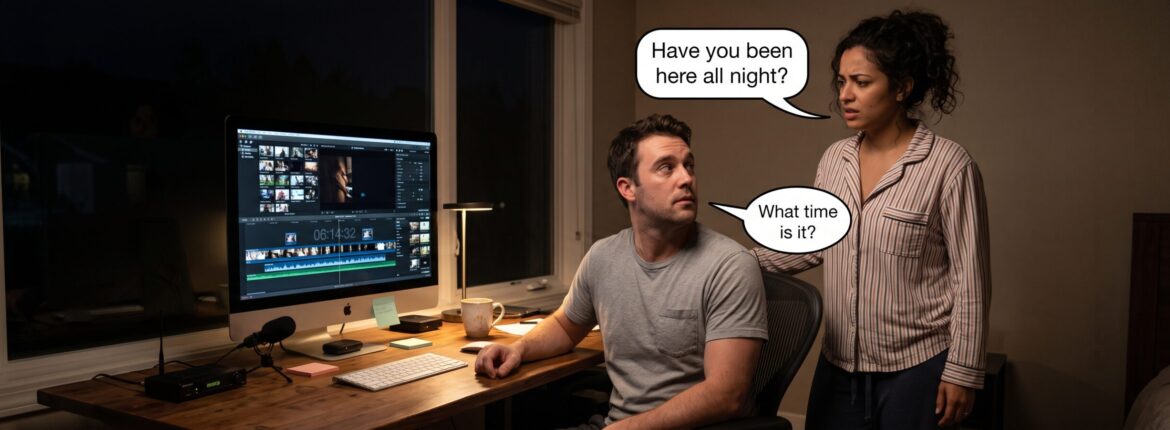
At eleven o’clock one night, I sat down to edit seventy-two testimonial videos for the graduating eighth graders at Kids Community College.
We had recorded each student with a lavalier microphone and a shotgun microphone. There were multiple takes and a second camera for cutaways. Each finished testimonial would run roughly one to two minutes. I had a draft due the next day.
So I started editing.
The next thing I remember clearly is my wife coming into the room. She asked me if I had been sitting there all night.
I looked at her and asked, “What time is it?”
“Six o’clock in the morning.”
Seven hours had passed.
I had not even gotten up to pee. My knees were locked and stiff from sitting there for so long. I had no concept that seven hours had passed.
That is my account of what happened. It matters that the observation and the interpretation remain separate because what follows is a hypothesis about the neurological mechanism that might explain the experience.
Behavioral science already has a familiar term for what happened to me: time blindness.
The term describes something real. Research has repeatedly found differences in time perception among people with ADHD across tasks involving time estimation, reproduction, production, and discrimination. Meta-analyses have found measurable differences between ADHD and comparison groups, although their size and character depend on the particular timing task and population being studied.
But “time blindness” describes the phenomenon from the outside. It does not necessarily tell us what produced it.
Modern computational theories of the neocortex give us another possibility.
I call it the Extended Now.
What If Now Is Not a Fixed-Sized Window?
One of the most useful behavioral descriptions of ADHD has been the distinction between things experienced as “Now” and “Not Now.” But there is another question underneath that description:
How big is Now?
We ordinarily talk about the present as though it were a tiny moving point traveling through time. The past sits behind it, the future sits ahead, and the present is the boundary between them. That may work perfectly well for clock time, but experienced time is something different.
Our experience is organized partly through events. Cognitive research shows that humans automatically divide continuous experience into meaningful events and subevents. Those boundaries can be influenced by changes in movement, goals, location, causal relationships, and other contextual information. An event representation can remain relatively stable through considerable moment-to-moment change and then update when something happens that creates a meaningful boundary.
Research on subjective duration gives us another important piece. Event boundaries and event density can alter temporal judgments. The internal structure of an experience influences how long that experience seems to have lasted.
That raises a different question about ADHD time blindness.
What if the ADHD brain can sometimes remain inside the same higher-order event representation for an unusually long period, not because nothing is changing, but because everything that is changing continues to belong to the same thing?
That is the beginning of the Extended Now.
Temporal Pooling Gives Us a Candidate Mechanism
Jeff Hawkins and colleagues have proposed computational models of neocortical processing in which cortical networks learn sequences, maintain contextual information, and use that context to predict what is likely to occur next.
In the sequence-memory model developed by Hawkins and Subutai Ahmad, pyramidal neurons can represent current input while distal dendritic activity places cells into predictive states based upon prior context. The resulting network learns temporal sequences through repeated cycles of activation and prediction. Hawkins and Ahmad proposed something especially important for the argument here: because similar excitatory neurons and circuitry occur throughout the neocortex, sequence memory may represent a general property of neocortical tissue rather than a computation restricted to one specialized region.
That gives us a candidate mechanism for thinking differently about subjective time.
The important unit of experience may not be every individual sensory or cognitive change occurring inside the system. Thousands of lower-level states can change while a higher-order representation remains stable.
Go back to my editing session.
During those seven hours, the clips changed. The students changed. Camera angles changed. Audio changed. I made cuts, transitions, corrections, and editorial decisions. I moved from one student to another and solved one production problem after another.
There was an enormous amount of change.
Yet all of it remained nested inside one persistent higher-order representation:
Finish the videos.
The lower levels were changing constantly while the larger event remained stable.
This is the role temporal pooling plays in the Extended Now hypothesis. Many changing lower-order states can remain bound within a persistent higher-order representation. If experienced duration depends partly upon changes in meaningful event structure rather than simply upon the passage of clock time, something remarkable follows.
Seven hours containing thousands of operations do not necessarily have to become seven hours of subjective experience.
They can remain one extraordinarily long Now.
Spatial Pooling: What Exists Inside the Now?
Temporal pooling tells only part of the story because a persistent representation still has to contain something. This is where spatial pooling and modern reference-frame theories of the neocortex become important.
Hawkins and colleagues have proposed models in which cortical columns represent information within reference frames, allowing sensory features, locations, movement, and changing input to be integrated into coherent representations. Rather than perception being a series of disconnected snapshots, the representation can persist and update as the organism moves and new information arrives.
I can describe what that feels like from a completely different domain: playing goalkeeper.
On a three-on-two break, I could be locked onto the player carrying the ball while still using peripheral vision and small side glances—saccadic eye movements—to sample what was happening around him. But I was not consciously keeping track of where everybody was.
I was anticipating where everybody was going.
That is a critical distinction.
The attack was a developing pattern. The direction and speed of a runner, his relationship to the defenders, and the available space gave me information about where he was likely to go. Meanwhile, the ball carrier was providing another stream of information.
If a player on the wing was preparing to shoot firmly, he needed to maintain the body angles necessary to release that shot. If those angles changed and his shoulders came up, I had learned that as a tell. He was less likely to be driving the ball at me. A pass or chip became more likely.
A tiny change in the focal subject changed my prediction for the larger attack.
I was not consciously narrating any of this. There was no internal monologue saying: His shoulders have risen, therefore he is less likely to shoot, therefore I should locate the runner.
By then, the play would be over.
It was predictive pattern recognition.
My peripheral vision and rapid eye movements provided snapshots of the larger attack. Experience transformed those snapshots into anticipated trajectories. Information from the focal player continuously modified the prediction.
The representation was dynamic, but the larger event remained coherent:
Stop the attack.
Spatially, the representation contained players, trajectories, body mechanics, passing lanes, and multiple possible futures. Temporally, all of those changing states remained part of one event.
That is why temporal and spatial pooling belong together in the Extended Now hypothesis.
The brain does not have to stop processing information for time to disappear. It may be processing enormous amounts of information while remaining inside a remarkably stable higher-order representation.
The Extended Now Hypothesis
This leads to the central proposal:
The Extended Now Hypothesis predicts that ADHD time blindness is not fundamentally an executive-function failure. It can emerge from distributed neocortical processing in which higher-order representations persist across large numbers of lower-order spatial and temporal state changes, reducing the number of meaningful event boundaries available for constructing experienced duration.
Time blindness, in this model, is not the mechanism. It is one behavioral manifestation of something deeper.
The deeper phenomenon is the Extended Now.
This gives us a different way of interpreting what happened during those seven hours of video editing. My brain was not doing nothing. It was not failing to process information. It was processing an enormous amount of information while maintaining one coherent higher-order state.
The clock continued moving.
The representation continued changing internally.
But the higher-order boundary did not arrive.
Moving Time Blindness Beyond the Prefrontal Cortex
This changes where we should look for the source of the phenomenon.
Executive-function accounts naturally emphasize systems involving the prefrontal cortex. Working memory, inhibition, planning, attention, and self-monitoring can certainly affect performance on timing tasks, and contemporary ADHD timing research has found relationships between timing performance and some of these measures.
Those relationships matter. The Extended Now does not require us to discard them.
It asks a different causal question.
A traditional interpretation can be represented roughly as:
Executive-function impairment → poor monitoring of time → time blindness.
The Extended Now proposes another possible architecture:
Distributed neocortical representation → temporal and spatial pooling → persistent event state → altered subjective duration → behavior described as time blindness.
That does not remove the prefrontal cortex from the process. The prefrontal cortex is part of the neocortex and can participate in the system.
What it removes is the requirement that the phenomenon originate as a prefrontal executive-function failure.
That is the important distinction.
If the computations that create and maintain these representations are distributed throughout cortical circuitry, then the mechanism underlying the Extended Now would also be distributed. Time blindness could emerge downstream from that distributed process rather than beginning with a broken executive controller.
My editing experience makes that possibility especially interesting because my performance during those seven hours does not look much like an executive system that had simply stopped functioning.
I was sequencing clips, comparing takes, synchronizing audio, choosing camera angles, correcting errors, managing files, making editorial decisions, and maintaining the objective of completing seventy-two individual videos.
Yet I had no concept that seven hours had passed.
That dissociation is important.
It gives us something to test.
Time Blindness May Be the Shadow, Not the Object
Behavioral science has given us useful ways to measure ADHD from the outside: time estimation, time reproduction, working memory, inhibition, task initiation, sustained attention, and many others. Those constructs have identified real differences and helped establish that ADHD involves more than simply being distracted.
The Extended Now does not require throwing away those observations. It asks whether some of them have been placed at the wrong point in the causal chain.
Time blindness may be what the Extended Now looks like from outside the brain.
If that is true, asking someone to estimate five seconds, thirty seconds, or ten minutes captures only part of the phenomenon. The deeper question becomes:
How long does the brain maintain the current event as the same event?
That changes the direction of inquiry. Instead of beginning with the assumption that an executive-function deficit produces poor time perception, we can investigate whether the temporal organization of distributed cortical representations produces the altered experience of time and some of the behaviors subsequently classified as executive-function problems.
The observations do not have to disappear.
The mechanism underneath them may change.
Time Is Not One Thing
This hypothesis may also help explain why ADHD timing research does not always produce one simple pattern. Time perception itself is not one thing.
Researchers distinguish duration discrimination, interval timing, temporal ordering, time estimation, time reproduction, prospective timing, retrospective timing, and higher-order concepts of time. ADHD studies find differences across several of these domains, but not always in the same direction or under the same conditions.
The broader neuroscience of time perception also does not point toward one universal internal stopwatch. Different temporal judgments can dissociate experimentally, and multiple neural systems contribute to temporal experience.
The Extended Now does not need to explain every one of those systems.
Its prediction is narrower.
During states of deep engagement, the persistence and boundary structure of distributed cortical representations should help determine experienced duration.
That is something we can test.
Hyperfocus Makes the Prediction Stronger
Altered time perception is already associated with deeply absorbed and flow-like states. People can become so immersed in an activity that their awareness of elapsed time changes dramatically.
ADHD gives us an especially interesting population in which to investigate this because profound absorption can coexist with extraordinary difficulty engaging with activities that do not capture the nervous system.
My video-editing session was not a failure to remain engaged.
It was extraordinary engagement.
For seven hours I remained inside the problem, moving through enormous amounts of information while the higher-order representation stayed intact.
Finish the videos.
So perhaps the better research question is not simply, “Why can't this person keep track of time?”
It is:
What happens to experienced time when a predictive cortical system remains inside one coherent representation for hours?
That is the question the Extended Now is designed to answer.
Epistemic Status & Testable Predictions
The Extended Now is a mechanistic hypothesis. It connects several bodies of research that already exist, but the connection proposed here has not been demonstrated experimentally.
The behavioral foundation is substantial. ADHD is associated with measurable differences in multiple forms of time perception. Research on event cognition shows that continuous experience is divided into meaningful events and that those event representations can remain stable before being updated at contextual boundaries. Research on subjective duration also shows that event structure can influence experienced time.
The computational foundation is promising but remains theoretical. Hawkins and colleagues have developed biologically motivated models of sequence memory, cortical prediction, spatial representation, and reference frames, and they propose that related computational principles may operate broadly across the neocortex. Those models were not developed to explain ADHD time blindness, and they do not establish the Extended Now.
The new proposal is the bridge between them:
Temporal and spatial pooling may allow distributed neocortical representations to remain coherent across enormous numbers of lower-order changes. The resulting persistence of the higher-order event may alter experienced duration, producing the phenomenon behavioral science describes as time blindness.
That mechanism has not been demonstrated.
But it makes predictions.
Prediction 1: Representational Persistence Should Predict Temporal Distortion
As the persistence of a higher-order representation increases, subjective elapsed time should become increasingly decoupled from objective clock time.
Researchers should therefore be able to measure the stability or persistence of task representations independently from participants' estimates of elapsed duration. The Extended Now predicts that greater representational persistence will be associated with greater temporal distortion.
If representational persistence has no meaningful relationship to subjective duration, the central mechanism takes a direct hit.
Prediction 2: Event Boundaries Should Predict Experienced Duration Better Than Clock Time Alone
Two tasks lasting exactly the same objective duration should not necessarily produce equivalent subjective durations.
A task organized around one highly coherent and persistent objective should produce greater temporal compression than a task containing frequent meaningful contextual resets, even when objective duration is identical.
Existing event-cognition research already gives us reason to expect event structure to influence temporal experience. The Extended Now predicts that this relationship should become particularly pronounced during ADHD hyperfocus.
Prediction 3: Temporal Distortion Should Dissociate From Executive Performance
This may be the most consequential prediction of the model.
If profound temporal distortion is fundamentally the product of executive dysfunction, we would expect that distortion to track deterioration in executive performance.
The Extended Now predicts that it does not have to.
A person may demonstrate excellent sequencing, error correction, decision-making, maintenance of task goals, and management of complex information while simultaneously showing profound distortion of elapsed time. Under some conditions, performance could remain excellent while awareness of clock time becomes dramatically worse.
My editing session is a naturalistic example of exactly that dissociation.
It needs to be tested experimentally.
Prediction 4: Contextual Resets Should Interrupt the Extended Now
If a persistent higher-order representation is producing temporal compression, sufficiently strong contextual discontinuities should interrupt it.
Someone entering the room, a telephone call, a major task transition, a change of physical environment, or another event that requires construction of a new representation may function as an event boundary.
The Extended Now therefore predicts that meaningful contextual resets should interrupt temporal compression more effectively than the simple passage of additional clock time.
My wife coming into the room may have provided exactly such a boundary.
Prediction 5: Distributed Cortical Dynamics Should Explain Variance Beyond Executive-Function Measures
This is the prediction that most directly distinguishes the Extended Now from a purely executive-function account.
If the underlying phenomenon is distributed across the neocortex, measures of representational persistence, event-boundary frequency, and contextual stability should predict subjective temporal distortion beyond what can be explained by conventional measures of working memory, inhibition, or executive control.
If conventional executive-function measures fully explain the effect and measures of distributed representational dynamics add nothing, this hypothesis loses much of its reason for existing.
If representational persistence predicts temporal distortion while executive performance remains intact, however, that would be evidence that time blindness is downstream from a deeper cortical process.
Prediction 6: Spatial Complexity Can Increase Without Breaking Temporal Unity
A persistent higher-order event should be capable of containing enormous internal spatial and informational complexity without becoming a new event every time one of its components changes.
The goalkeeper example illustrates the prediction. Eye movements can change, peripheral information can update, players can change trajectories, the ball can move, and predictions about the attack can be continuously revised while the higher-order event remains coherent:
Stop the attack.
The Extended Now therefore predicts that the number of lower-level representational changes will not necessarily determine experienced duration. What should matter more is whether those changes remain nested within the same higher-order representation or repeatedly force construction of a new one.
Prediction 7: ADHD and Autism Provide an Important Comparative Test
Autism research also reports differences in temporal experience, although findings vary depending upon the type of timing being measured. That makes autism an important comparative population for testing the Extended Now rather than something that needs to be forced into the same explanatory box.
If ADHD and autistic hyperfocus both involve unusually persistent higher-order representations, both populations should show a relationship between representational persistence and temporal distortion during genuine hyperfocus.
Whether the spatial organization of those representations differs is another hypothesis. There may be important differences in how information is sampled and how broadly the active representation is maintained, but that deserves its own treatment.
For the Extended Now, the temporal prediction comes first.
The Clock Never Stopped
At six in the morning, seven hours had passed since I sat down to edit those videos. My knees were locked and stiff. I had not even gotten up to pee. When my wife asked if I had been sitting there all night, I had to ask her what time it was.
I had no concept that seven hours had passed.
Yet during those seven hours, I had been working. I was making decisions, solving problems, sequencing material, evaluating performances, correcting errors, and moving through seventy-two individual student videos. An enormous number of lower-level states had changed while one higher-order representation remained remarkably stable:
Finish the videos.
Behavioral science has a useful name for what the outside observer sees when this happens: time blindness.
The Extended Now asks what is happening underneath it.
Perhaps the ADHD brain is not simply failing to monitor time. Perhaps, under certain conditions, distributed neocortical representations remain coherent across so many lower-level spatial and temporal changes that the experienced present expands far beyond the boundaries we would predict from the clock.
If that is correct, time blindness is not fundamentally about failing to see time. It is a consequence of how the brain constructs and maintains the present.
The clock never stopped.
The boundaries did.
References
Hawkins, J., & Ahmad, S. (2016). Why Neurons Have Thousands of Synapses, a Theory of Sequence Memory in Neocortex. Frontiers in Neural Circuits, 10, 23. The authors propose a biologically motivated sequence-memory model based on active dendrites and sparse distributed activity and propose that this form of sequence memory may be a widespread property of neocortical tissue.
Hawkins, J., Lewis, M., Klukas, M., Purdy, S., & Ahmad, S. (2019). A Framework for Intelligence and Cortical Function Based on Grid Cells in the Neocortex. Frontiers in Neural Circuits, 12, 121. Develops a framework in which cortical columns construct models using reference-frame-like representations.
Lewis, M., Purdy, S., Ahmad, S., & Hawkins, J. (2019). Locations in the Neocortex: A Theory of Sensorimotor Object Recognition Using Cortical Grid Cells. Frontiers in Neural Circuits, 13, 22. Presents a model integrating sensory input, movement, location, and prediction within object-centered cortical reference frames.
Metcalfe, K. B., McFeaters, C. D., & Voyer, D. (2024). Time-Perception Deficits in Attention-Deficit/Hyperactivity Disorder: A Systematic Review and Meta-Analysis. Applied Neuropsychology: Child. The meta-analysis included 824 effect sizes and found an overall ADHD difference in time-perception performance, with age and working memory among the moderators examined.
Zheng, Q., et al. (2021). Time Perception Deficits in Children and Adolescents with ADHD: A Meta-analysis. Journal of Attention Disorders. Across 27 studies, the authors found differences in timing accuracy and precision between ADHD and comparison groups.
Zacks, J. M., Speer, N. K., Swallow, K. M., Braver, T. S., & Reynolds, J. R. (2007). Event Perception: A Mind-Brain Perspective. Psychological Bulletin, 133(2), 273–293. Reviews evidence that ongoing experience is spontaneously segmented into hierarchically organized events and that event boundaries are associated with updating current representations.
Wen, C., Yousif, S. R., & Sherman, B. E. (2026). Unfolding Event Structure Distorts Subjective Time. Cognition, 267, 106354. Across four experiments, internal event structure systematically altered subjective duration.
Martin, J. S., Poirier, M., & Bowler, D. M. (2019). Time Perception and Autistic Spectrum Condition: A Systematic Review. Autism Research, 12, 1440–1462. Reviews evidence concerning timing and temporal processing in autism and finds substantial variation across different forms of temporal judgment.