
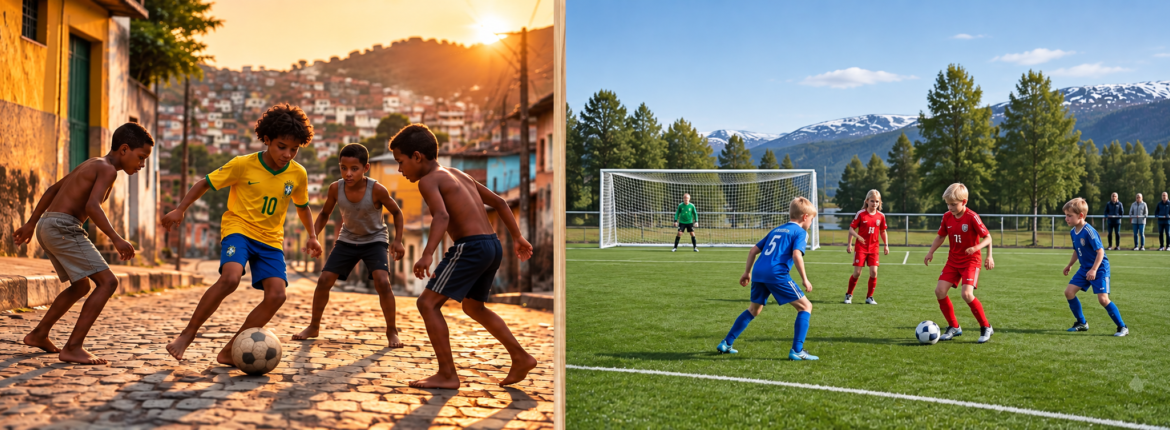
The Country That Refused to Rush Childhood
In the 2026 World Cup, Norway's meeting with Brazil provided a remarkable opportunity to examine two very different histories of childhood athletic development. The most interesting part of the comparison, however, began decades before either country's players stepped onto the field.
Brazil has approximately 213 million people. Norway has about 5.6 million. That is a population disparity of nearly 38 to 1. Norway has roughly the population of the Philadelphia metropolitan area, while Brazil has won five World Cups and spent generations producing some of the most gifted soccer players in history.
There is a fascinating irony behind this contrast. For generations, Brazil possessed a developmental advantage that the rest of the soccer world struggled to reproduce. It wasn't simply superior coaching, better facilities, or a more sophisticated system for identifying young talent. Much of that advantage emerged from children playing soccer wherever they could find space, inventing games, negotiating rules, and experimenting with the ball for hours without adults organizing every minute.
Brazil had futebol de rua—street soccer.
Norway eventually built a national youth sports philosophy around protecting many of the same developmental conditions. Rather than rushing children into formal rankings, championship structures, and early selection, Norwegian sports organizations deliberately emphasize participation, enjoyment, varied experiences, and the freedom to make mistakes.
Norway did not eliminate organized sports or competition. Children participate in clubs from an early age, receive coaching, practice regularly, and compete enthusiastically. What Norway did was place limits on how quickly adults could transform childhood participation into a system of public judgment. Some children want to keep score. Others couldn't care less. Some want to win every game, while others are fascinated by learning a new move, playing a different position, or inventing an entirely different game.
The point is not to eliminate competition. It is to preserve the child's freedom to discover what makes playing meaningful.
The contrast between Norway and Brazil challenges an assumption that has shaped youth athletics and education for generations: that identifying, ranking, and pressuring children earlier necessarily produces better developmental outcomes.
Norway offers a different possibility. What if protecting childhood experimentation is one of the most effective ways to develop extraordinary adult capabilities?
Brazil's Original Advantage: The Street as a Laboratory
Brazilian street soccer was never a carefully designed educational intervention. It emerged from culture, geography, available space, and children's desire to play. A ball, a few friends, and almost any open surface could become a soccer field. Children played on beaches, in alleys, on rough pavement, and in crowded neighborhoods where the physical environment demanded constant adaptation.
There were no standardized field dimensions, no carefully maintained playing surfaces, and frequently no adult referees. Children negotiated disagreements, changed teams, invented rules, and solved problems as they arose. The environment provided something that structured instruction cannot always reproduce: an enormous number of immediate, meaningful feedback loops.
A child attempting to dribble through a narrow space learns how the ball responds to pressure, angle, speed, and surface. A failed attempt is not necessarily the end of the experiment. It becomes information for the next attempt. A child who discovers a successful move tries it again, modifies it, and eventually incorporates it into a growing repertoire of motor skills.
The learning process is continuous. Perception, movement, prediction, and correction are integrated into the activity itself. And critically, the child wants to be there. Nobody needs to explain why improving ball control matters. The importance of the skill is embedded in the experience, and the next opportunity to use it might arrive seconds later.
That is an extraordinarily powerful learning environment. It also creates a question that reaches far beyond athletics. If children can develop sophisticated motor planning, spatial awareness, anticipation, decision-making, and social negotiation through engaging experiences, what does that tell us about how those capabilities develop in the first place?
The street was not merely producing soccer players. It was providing children with an environment in which they could repeatedly exercise the cognitive and motor capabilities that organized instruction often attempts to teach separately.
Norway's Innovation: Protecting the Conditions Instead of Manufacturing the Talent
Norway approached childhood athletics from a different direction. Rather than attempting to reproduce Brazilian street soccer, its sports organizations established rules and principles designed to preserve participation, enjoyment, exploration, and development.
The Norwegian Olympic and Paralympic Committee and Confederation of Sports adopted its children's sports provisions in 1987. The framework was subsequently expanded through formal children's rights in sports, adopted in 2007.
The principles are remarkably straightforward. Children should experience safety, friendship, enjoyment, mastery, participation, and opportunities to influence their own activities. Sports should be adapted to children's developmental needs rather than treating them as miniature adults.
Norway's national framework generally restricts published results and rankings for children younger than eleven, permits their use from the year children turn eleven when appropriate, and prohibits national and comparable championships through the year children turn twelve. Individual sports federations can establish additional restrictions. These are organized-sport regulations, not a prohibition against children counting goals or competing with their friends.
The philosophy is often associated with idrettsglede, the joy of sport.
Children can belong to clubs, practice, compete, learn techniques, and experience the excitement of winning. As they grow older, more formal competitive structures become available. What the system attempts to prevent is premature adult control over the meaning of those experiences.
A child who wants to compete can compete. A child who wants to experiment has room to experiment. A child who is developing more slowly is not automatically excluded because another child matured earlier.
Norway's sports federation explicitly recognizes that early physical maturity can be mistaken for superior talent. Children who develop earlier often outperform their peers, but that does not necessarily mean they possess greater long-term potential. Early rankings can reward biological timing rather than developmental capacity.
The implications are profound. An eight-year-old who struggles today may become an extraordinary athlete at sixteen. But that possibility disappears if the child leaves the sport at nine because adults have already decided who belongs on the best team.
Norway's approach protects more than enjoyment. It attempts to preserve the developmental opportunities that make later excellence possible.
Coaching Without Taking Ownership of the Child's Motivation
Norway's approach does not mean children are left without coaching or organized practice until age thirteen. Quite the opposite. The Norwegian Football Federation recommends structured training beginning at age six, with two weekly team practices for six- and seven-year-olds, increasing to three by ages ten and eleven. Additional voluntary training opportunities are encouraged, and clubs are expected to provide developmentally appropriate instruction.
The distinction is not between structured practice and unfettered play. It is about preserving the child's motivation within an environment where both can coexist. Coaches teach techniques, introduce challenges, and help children develop their skills, but the federation also cautions against organizing so much training that children lose their desire or opportunity to play independently.
That distinction is fundamental to the Norwegian philosophy. Children benefit from knowledgeable adults who understand how to teach, but they also need opportunities to experiment without every movement being directed, corrected, or evaluated. The objective is not to eliminate instruction or competition. It is to prevent adult expectations from overwhelming the experiences that make children want to participate in the first place.
Norway has not chosen play over practice. It has attempted to construct a developmental environment in which coaching supports the child's curiosity rather than replacing it. A child can learn proper technique during an organized session and spend the afternoon experimenting with that technique in a game of their own invention. Both experiences contribute to development, but they do not serve identical purposes.
The adult provides expertise. The child retains ownership of the experience.
This is precisely the distinction Neil deGrasse Tyson illustrates with his muddy puddle. The problem was never that adults possess knowledge children lack. The problem arises when adults become so concerned with controlling the outcome that they interrupt the child's opportunity to discover something independently.
Neil deGrasse Tyson and the Muddy Puddle
Neil deGrasse Tyson has spent years explaining that children are natural scientists. They touch things, drop things, break things, mix things, climb things, and ask questions that adults have stopped asking. Their curiosity is not an extracurricular activity. It is how they investigate the physical world.
In a memorable discussion about childhood learning, Tyson describes watching a toddler wearing rain boots approach a large muddy puddle in Central Park. The child is fascinated. The puddle presents an opportunity to discover what happens when a small body moves through water and mud.
But before the experiment can begin, the mother pulls the child away. Her concern is understandable. She wants to keep the child clean.
Tyson sees something else. The child was about to conduct an experiment involving fluid dynamics, force, and the physical behavior of water. The adult saw a mess. The child saw an opportunity to discover something. The same event had two completely different meanings.
Tyson's larger observation is that adults routinely interrupt children's natural investigations because the experiments conflict with adult priorities. We want clean houses, orderly classrooms, predictable schedules, and children who behave according to our expectations. Children want to discover what happens next.
The tragedy is not that adults occasionally prevent children from jumping into puddles. There are legitimate reasons to intervene, including safety and the needs of others. The tragedy emerges when adult intervention becomes the organizing principle of childhood.
When we constantly interrupt exploration, correct experimentation, or impose our preferred outcomes, we may deprive children of precisely the experiences through which they learn.
And that brings us back to Norway.
The Cost of a Clean House
Traditional youth sports can become the institutional equivalent of Tyson's mother pulling the child away from the puddle. The child wants to experiment. The adult wants a clean result.
A young soccer player attempts an unfamiliar move during a game. The move fails, and the opposing team scores. For the child, the attempt may have been a valuable experiment. They discovered something about timing, ball control, or the defender's movement.
For an adult focused exclusively on winning, the same attempt may represent an unacceptable mistake. The coach yells. The parent complains. The child is benched. Instead of learning how to improve the move, the child learns that attempting it carries an emotional cost.
Repeated often enough, that experience can change what the child is willing to try. The problem is not correction itself. Good coaching can provide valuable feedback, and children can benefit enormously from knowledgeable adults who understand their development.
The problem arises when correction becomes judgment, when mistakes become evidence of inadequacy, and when the adult's desire for an orderly outcome overrides the child's need to experiment.
Norway's model attempts to reduce that pressure during the years when children are developing foundational capabilities. The Norwegian sports federation describes the purpose directly: children should feel safe, want to try new things, and not be afraid of making mistakes.
That is not an argument against competition. It is an argument for protecting the conditions under which learning can occur. A child can compete intensely without being publicly ranked against every other child in the region. A child can experience disappointment without being treated as a failure. A child can take risks without worrying that one mistake will determine whether they belong.
The distinction is between experiencing the consequences of an experiment and experiencing the judgment of an adult.
And the distinction becomes particularly important when we examine ADHD.
ADHD, Engagement, and the Development of Executive Functions
For children with ADHD, the difference between child-directed engagement and adult-imposed performance expectations may be especially consequential.
Dr. William Dodson's Interest-Based Nervous System framework describes how interest, novelty, challenge, and urgency can influence engagement in ADHD. Rather than responding consistently to externally assigned importance, an ADHD child may become deeply engaged when an activity captures their attention through one or more of those conditions.
Athletics can provide all four. A game is interesting because the outcome is uncertain. It is novel because situations constantly change. It presents challenges that require immediate decisions. And the urgency is built into the activity: the ball is arriving now, the opponent is moving now, and the opportunity to respond exists for only a moment.
The feedback loop is immediate. A child attempts a movement, observes the result, and adjusts. Success creates opportunities for repetition. Failure provides information for the next attempt. Through these experiences, children practice planning, anticipation, working memory, emotional regulation, motor coordination, and flexible decision-making.
This does not establish that every child with ADHD will learn these capabilities equally well through sports, nor does it mean that athletic success eliminates ADHD-related impairments. The question is whether the conditions that produce engagement influence how effectively these capabilities are practiced and developed.
That question is central to the experiential model I have been developing. If executive functions are shaped in part through repeated experience, then the environment determines how frequently a child has meaningful opportunities to exercise them.
An ADHD child who struggles to organize a worksheet may demonstrate remarkable anticipation, strategic thinking, and behavioral flexibility during an engaging game. Those differences deserve investigation rather than dismissal.
And they raise a more fundamental question. When researchers observe poor performance on an executive function task, how much of the measured difficulty reflects the underlying capability, and how much reflects the child's inability to engage consistently with the task?
That distinction has enormous implications for how we understand ADHD development. Norway's youth sports philosophy offers a natural setting in which to investigate it, not because Norway designed its policies specifically for ADHD children, but because the policies attempt to preserve conditions that may be especially valuable for children whose engagement is strongly influenced by interest, novelty, challenge, and immediate feedback.
The Executive Functions Nobody Sees Developing
Consider what happens when a group of children organizes its own soccer game. Before anyone kicks the ball, they must decide where to play, who participates, how teams are selected, what counts as a goal, and how disagreements will be resolved.
During the game, they continuously adjust to changing circumstances. A child learns that a teammate is faster, another is more accurate, and a third needs additional support. They modify their own behavior accordingly. When an argument develops, the children must negotiate. When one team dominates, they may reorganize the teams or change the rules to keep the game interesting.
These are not incidental activities occurring alongside learning. They are opportunities to practice executive functions within an experience that matters to the children. The consequences are immediate, the feedback is understandable, and the motivation to continue comes from the activity itself.
Adults can certainly help children develop these capabilities. But when adults make every decision, settle every disagreement, and organize every movement, they may also remove opportunities for children to practice those skills independently.
A perfectly organized activity is not necessarily a better developmental activity. Sometimes the disorder is where the learning occurs, and sometimes the child who appears disorganized in a classroom is demonstrating sophisticated organizational capabilities in an environment that actually engages them.
The challenge for educators and researchers is to understand that difference.
The Thousand Brains Connection: Learning Through Movement
Jeff Hawkins's Thousand Brains Theory provides another perspective on why these experiences may matter.
Hawkins proposes that the neocortex learns models of the world through distributed representations that integrate sensory information, movement, and prediction. Rather than treating intelligence as a collection of isolated responses, his framework emphasizes the brain's capacity to construct and update models through experience.
Consider a child playing soccer on an uneven surface. The ball strikes a curb and changes direction. The child must anticipate where it will travel, reposition their body, and adjust the movement of their foot.
A moment later, an opponent approaches from an unfamiliar angle. The child predicts the opponent's movement, changes direction, and attempts to create space. Every encounter provides information that can refine the child's expectations.
Through Hawkins's theoretical lens, these experiences may contribute to increasingly sophisticated internal models of the environment and the body's interactions with it. This is a plausible connection, not a demonstrated application of Thousand Brains Theory to Norwegian youth sports. The specific neural mechanisms remain hypotheses that require investigation.
But the developmental question is compelling. What happens when children experience thousands of varied, self-directed interactions with their environment, compared with children who spend much of their practice repeating adult-prescribed movements?
Structured drills can be valuable, particularly when teaching specific techniques. The concern is not that instruction prevents learning, but that excessive structure may narrow the variety of experiences available to the learner.
Brazilian street soccer historically offered enormous environmental variation. Norway's philosophy attempts to preserve room for experimentation within organized athletics. The environments are not identical, but both suggest that children may benefit from opportunities to solve movement problems rather than merely reproduce solutions provided by adults.
And that principle may apply just as powerfully to a mathematics classroom as it does to a soccer field.
The Classroom Has Its Own Scoreboards
Schools have their own versions of the youth sports ranking system. Grades, standardized tests, timed assignments, behavioral charts, and public comparisons can become the educational equivalents of adult-controlled scoreboards.
These tools are not inherently harmful. Assessment can provide valuable feedback, identify learning needs, and help teachers improve instruction. But assessment becomes problematic when the measurement replaces the learning experience as the primary objective.
A child who is fascinated by a mathematical problem may explore several unsuccessful approaches before discovering a solution. Those attempts can develop understanding that simply memorizing the correct procedure does not provide.
Yet if the classroom emphasizes speed, compliance, and immediate correctness, the child may learn that experimentation is inefficient or dangerous. The student who asks an unexpected question may be told to stay on task. The student who approaches a problem differently may be redirected toward the approved method. The student who needs movement or discussion to remain engaged may be judged according to behavioral expectations rather than the quality of their thinking.
The classroom becomes the clean house.
The teacher is expected to maintain order, cover the curriculum, prepare students for assessments, and demonstrate measurable progress. Those are real institutional responsibilities, and teachers frequently have little control over the pressures imposed upon them.
But the developmental cost deserves examination. If the institution values orderly performance more than the processes through which children develop understanding, it may unintentionally suppress some of the very capabilities education is supposed to cultivate.
The child who wants to investigate is told to complete the worksheet. The child who wants to experiment is told to follow the procedure. The child who learns through movement is told to sit still.
And eventually, the institution may conclude that the child has an executive function deficit without adequately examining whether the environment provided meaningful opportunities to develop and demonstrate those functions.
This is not an argument for eliminating academic standards or abandoning structured instruction. It is an argument for distinguishing between measuring development and creating the conditions that make development possible.
Norway's youth sports philosophy offers an example of an institution attempting to make that distinction.
The Irony of Norway and Brazil
The comparison between Norway and Brazil is especially fascinating because of the countries' contrasting histories.
Brazil became synonymous with creative soccer through generations of players whose skills were shaped partly by informal play. Norway, a small northern European country with a very different climate and sporting culture, developed a framework intended to protect enjoyment, broad participation, and age-appropriate competition.
Brazil's street soccer tradition emerged organically. Norway's protections emerged institutionally. The contrast raises an important question about institutional design: if informal childhood play helped develop extraordinary athletes, why would we assume that increasingly formalized childhood instruction must necessarily produce better ones?
Norway's approach offers a different hypothesis: institutions may be most effective when they protect the developmental conditions that children naturally seek rather than attempting to control every aspect of the developmental process.
The Norwegian sports federation itself has emphasized this philosophy in 2026, arguing for broad participation, varied experiences, reduced early selection, and opportunities for children to make mistakes without fear.
There is something wonderfully counterintuitive about that. One of the world's smaller countries has made a deliberate institutional commitment to giving children room to play, while many larger sporting systems continue to debate how early they should identify, rank, and specialize their most promising young athletes.
Norway's international athletic success invites us to investigate whether protecting the developmental process may sometimes be more productive than accelerating the selection process.
Epistemic Status & Testable Predictions
The central argument of this article is that childhood play provides meaningful opportunities for experiential learning, and that environments preserving engagement, experimentation, and developmental flexibility may produce advantages that conventional performance measures fail to capture.
Norway's children's sports policies are documented institutional practices. Its international athletic accomplishments are observable outcomes. The historical importance of Brazilian street soccer and Tyson's observations about childhood curiosity provide additional context.
The proposed connection among these observations, ADHD engagement, executive function development, and Hawkins's Thousand Brains Theory is a theoretical framework that can be investigated empirically.
The predictions below identify ways to distinguish this framework from alternative explanations, including maturation, coaching quality, family resources, and preexisting differences in athletic ability.
Prediction 1: The Unfettered Play Advantage
Children participating in environments that provide substantial opportunities for self-directed play will demonstrate greater improvement in adaptive problem-solving and flexible movement strategies than children whose training consists predominantly of standardized, adult-directed drills.
This prediction can be tested through longitudinal comparisons using novel movement challenges that neither group has specifically practiced.
Prediction 2: Engagement-Dependent Executive Function Performance
Children with ADHD will demonstrate meaningful differences in executive function performance across activities that vary in personal interest, novelty, challenge, and immediacy of feedback, even when the underlying cognitive demands are comparable.
If engagement substantially influences observed performance, measurements taken exclusively in low-engagement environments may underestimate capabilities demonstrated elsewhere.
Prediction 3: The Developmental Cost of Premature Ranking
Children exposed to frequent public rankings and early performance-based selection will, on average, show lower willingness to attempt unfamiliar skills than comparable children participating in environments that emphasize mastery and experimentation.
This prediction should be examined separately from the effects of ordinary competition, because voluntary competition and externally imposed evaluation are not equivalent experiences.
Prediction 4: The Delayed Selection Advantage
Youth sports systems that maintain broad participation and delay exclusionary talent selection will retain a greater proportion of late-maturing children who eventually achieve high levels of athletic performance.
Testing this prediction would require accounting for relative age, biological maturation, access to coaching, socioeconomic resources, and differences among sports.
Prediction 5: The Executive Function Developmental Arc
Children receiving sustained opportunities to practice planning, adaptation, emotional regulation, and decision-making through engaging activities will demonstrate measurable changes in those capabilities over time.
For children with ADHD, the magnitude of improvement may depend partly on the extent to which activities consistently engage their attention and motivation. Longitudinal research should examine whether improvements generalize beyond the original activities rather than assuming that athletic competence automatically transfers to classroom executive functioning.
Prediction 6: The Adult Intervention Effect
During otherwise comparable learning activities, children given appropriate autonomy to experiment, negotiate, and correct mistakes will demonstrate greater independent problem-solving behavior than children whose decisions and errors are continuously managed by adults.
The prediction concerns unnecessary adult intervention, not the removal of safety protections, skilled instruction, or supportive guidance.
Prediction 7: Environmental Variability and Sensorimotor Learning
Children exposed to varied movement environments will demonstrate stronger transfer to unfamiliar motor challenges than children trained primarily under highly standardized conditions, even when total practice time is comparable.
Hawkins's Thousand Brains Theory offers one possible interpretation of this effect, but the behavioral prediction can be tested independently of that theory.
Prediction 8: The Classroom Scoreboard Effect
Classrooms that emphasize formative feedback, experimentation, and opportunities to revise unsuccessful attempts will produce greater willingness to explore alternative problem-solving strategies than otherwise comparable classrooms dominated by speed, ranking, and immediate correctness.
The prediction does not require eliminating grades or academic standards. It concerns the relationship between evaluative pressure and opportunities for exploratory learning.
Prediction 9: The Engagement Opportunity Gap
Among children with ADHD, the quantity and quality of sustained engagement opportunities across childhood will predict aspects of later executive function performance, even after accounting for baseline symptoms, cognitive ability, treatment, family circumstances, and trauma exposure.
This prediction directly tests whether developmental experience contributes explanatory power beyond models focused primarily on stable individual deficits.
The Scientist Inside Every Child
Neil deGrasse Tyson's muddy puddle provides a fitting conclusion to this story.
The child approaching the puddle is not thinking about a developmental milestone, a standardized assessment, or the scientific principles governing the behavior of fluids. The child is curious. The experiment matters because the child wants to know what happens next.
Brazilian children playing street soccer were not attempting to construct sophisticated internal models of movement. They were playing because soccer was engaging, challenging, social, and enjoyable.
Norwegian children do not need to understand the philosophy behind their country's sports policies. They simply need opportunities to participate, experiment, compete when they choose, and discover what they enjoy.
The adults have a different responsibility. We construct the environments in which children grow. We decide how much freedom they receive, how mistakes are treated, how performance is measured, and how quickly childhood activities become exercises in adult judgment.
Those decisions influence which experiences remain available to children. And if experience contributes to the development of executive functions, those decisions may have consequences extending far beyond the playing field.
A country with approximately 5.6 million people has developed an athletic culture capable of competing at the highest international levels. Perhaps the most important question is not simply how Norway produces exceptional athletes, but what happens when a society deliberately protects children's opportunities to discover what they can become.
The child doesn't need a scoreboard to know whether the puddle was worth jumping into.
References
1. Norwegian Olympic and Paralympic Committee and Confederation of Sports. (2020). Children's Rights in Sports and Provisions on Children's Sports. Official English-language document.
2. Norwegian Olympic and Paralympic Committee and Confederation of Sports. Children's Rights, Provisions and Safeguarding in Sports. Official policy overview.
3. Norwegian Olympic and Paralympic Committee and Confederation of Sports. Bestemmelser om barneidrett. Children's sports regulations.
4. Norwegian Olympic and Paralympic Committee and Confederation of Sports, Troms Sports District. (2026). La barn og ungdom bli verdensmestere i sine egne liv. Official discussion of the Norwegian youth sports model.
5. Norwegian Football Federation. Retningslinjer for barne- og ungdomsfotball (Guidelines for Children's and Youth Football). Official federation guidelines.
6. Tyson, N. deGrasse. Discussion of childhood curiosity, experimentation, and the muddy puddle. YouTube video.
7. Hawkins, J. (2021). A Thousand Brains: A New Theory of Intelligence. Basic Books.
8. Dodson, W. The Interest-Based Nervous System and ADHD. Clinical and educational discussions published through ADDitude Magazine.
9. Deci, E. L., & Ryan, R. M. (2000). The "what" and "why" of goal pursuits: Human needs and the self-determination of behavior. Psychological Inquiry, 11(4), 227–268. https://doi.org/10.1207/S15327965PLI1104_01
10. Côté, J., Baker, J., & Abernethy, B. (2007). Practice and play in the development of sport expertise. In G. Tenenbaum & R. C. Eklund (Eds.), Handbook of Sport Psychology (3rd ed.). Wiley.
11. Breen, M. (2026, April 7). Norway Banned Scores in Kids' Sport Until Age 13 — Then Won the Olympics. Natural Born Running. Article.