
The Problem With “Can't”
Dr. William Dodson has spent decades helping people understand an ADHD nervous system that conventional medical and educational frameworks have frequently misunderstood. His description of the interest-based nervous system has been particularly valuable to me, both as someone with ADHD and as an educator and mentor who has worked extensively with ADHD and AuDHD youngsters.
His work helped explain behaviors that traditional models of motivation, discipline, and executive functioning often failed to address. But one aspect of his explanation of ADHD impulsivity, time perception, and learning from experience deserves a closer examination.
In a recorded presentation about ADHD and the perception of time, Dodson describes people with ADHD as having only two times: now and not now. He explains that they struggle to anticipate future consequences, retrieve lessons from past experiences, and recognize how their immediate actions might unfold.
His central assertion is particularly provocative:
“Most of the problem comes from they can't learn from experience.”
I understand the clinical observation behind that statement. I've witnessed ADHD students repeat behaviors despite experiencing negative consequences, and I've certainly done the same myself.
But I have a problem with one word: can't.
There's an enormous difference between being neurologically incapable of performing a cognitive function and being able to perform that function under particular conditions. My experiences as a Division I soccer goalkeeper, competitive golfer, mathematics educator, and volunteer street-hockey coach suggest an alternative worth investigating.
What if people with ADHD can learn from experience, anticipate future consequences, regulate their behavior, and plan extensively—but access those abilities differently depending on interest, emotional significance, and the conditions of engagement?
More importantly, what if we're examining ADHD self-awareness through the wrong framework? Perhaps the issue isn't necessarily a generalized absence of self-awareness. Perhaps some of us develop extraordinary self-awareness within activities that capture our interest while struggling to demonstrate comparable awareness elsewhere.
I call this interest-based self-awareness, and I suspect it is closely connected to another cognitive process that deserves considerably more attention in ADHD research: visualization.
But visualization is only part of the story. Auditory imagery, affirmations, emotional preparation, and learning by feel may also contribute to how some ADHD individuals prepare for situations that conventional executive-function models would describe as requiring deliberate planning.
The result may be a form of preparation that looks nothing like a corporate checklist or a classroom assignment. And when that preparation works, the objective is often to make conscious thinking unnecessary.
The Goalkeeper Who Could See the Future Without Thinking
As a goalkeeper, I spent years playing in an environment where anticipating consequences wasn't optional. It was the difference between making a save and watching the ball hit the back of the net.
But here's something that might surprise people unfamiliar with high-level goalkeeping: during a match, I'm not consciously thinking about what opposing players might do next. I'm not asking myself where the next pass is going, whether an attacker is preparing to shoot, or where I should position myself.
I'm not asking myself anything.
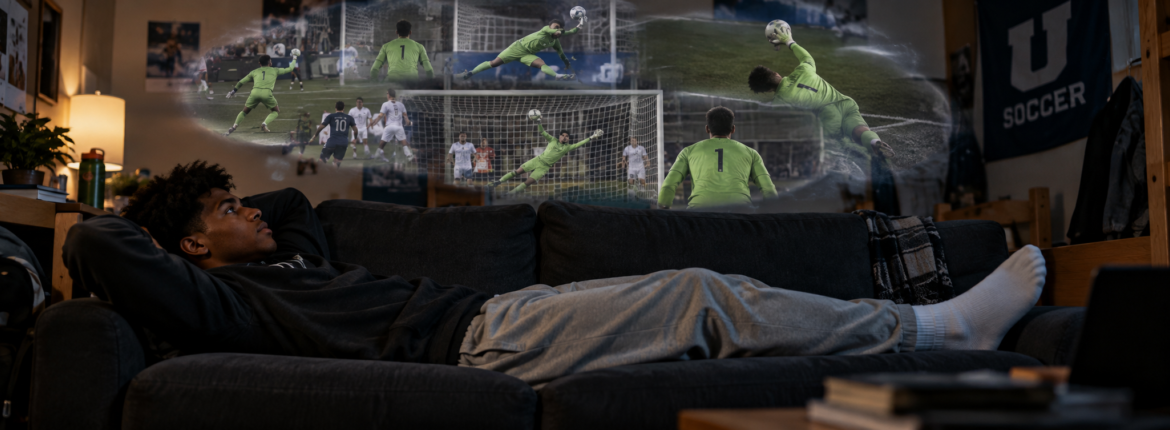
All that work happened before the game, through years of experience and countless hours of mentally replaying previous competitions. After matches, I would reconstruct situations, revisit mistakes, imagine different decisions, and visualize myself executing them correctly. I rehearsed those scenarios repeatedly until recognizing patterns and responding to them became increasingly automatic.
During competition, my brain was anticipating events based on previous experiences. When something developed that I hadn't anticipated, I reacted. I wasn't consciously searching my memory for the appropriate response or working through a sequence of possible decisions.
The purpose of all that visualization was to eliminate the need to think during the game.
That's where flow enters the picture. In my experience, conscious analysis interrupts the very processes that allow an athlete to perform at their highest level. Years of practice, experience, and mental rehearsal prepare the brain to anticipate and respond without deliberate thought.
Thinking is the death of flow.
And for an ADHD goalkeeper, that creates a fascinating contradiction with the assertion that people with ADHD cannot learn from experience or anticipate future consequences.
My entire preparation was built around learning from previous experiences so that I wouldn't have to consciously consider those experiences during competition. I wasn't consciously thinking about the future. My brain was anticipating it, and when anticipation wasn't possible, I reacted.
This doesn't mean the brain literally stops processing information or that the prefrontal cortex becomes inactive. It means that performance no longer depends on consciously constructing and evaluating every response.
Visualization wasn't something I did to help myself think during competition. It was something I did so I wouldn't have to.
The Goalkeeper's Paradox: Extraordinary Awareness and Extraordinary Obliviousness
There's another apparent contradiction.
When an attacker prepares a point-blank one-timer, and I come off my line to smother a ball traveling perhaps 80 miles per hour, I know intellectually that I'm putting myself in danger. The attacker's follow-through might strike my head, shoulder, or chest. I could suffer a serious injury.
Yet in that moment, the possibility of personal injury barely registers because I'm extraordinarily aware of another consequence: the ball going into the net.
My attention is organized around preventing that outcome, and almost everything else becomes secondary, including my personal safety.
At 62, I'm living with the physical consequences of decades of those decisions. My joints have experienced more punishment than I care to inventory. I probably have more joint problems than people who've attended a Woody Harrelson party and a Grateful Dead concert on the same weekend.
But I'd make those saves all over again.
Some of the most meaningful moments of my athletic life occurred when my teammates depended on me, I recognized the developing threat, and I prevented the goal—even when I absorbed a painful collision.
The interesting question is whether my behavior demonstrates an inability to anticipate consequences or an extraordinarily selective awareness of them. I could anticipate what an attacker might do several movements into the future while giving almost no consideration to what the resulting collision might do to my body.
I wasn't incapable of seeing the future. I was intensely focused on one particular future.
And the consequences that mattered weren't necessarily limited to the score. They included my teammates.
The Yellow Card That Turned On My Self-Regulation
My behavior toward opposing players introduces another dimension.
I was quite willing to engage in psychological warfare. If I could get into an opponent's head, disrupt his concentration, or make him hesitate before shooting, I considered that part of my competitive toolkit.
Whether my comments were appropriate wasn't necessarily something I considered in the moment. But several referees noticed something interesting about me: once I received a yellow card, I generally shut up.
One referee in particular, Rusty Crutchfield, understood this so well that he once gave me a yellow card before the match even started. His explanation was wonderfully simple: once I had my yellow card, I would shut up.
And he was right.
Why did that work?
Because the yellow card introduced a consequence directly connected to my passion. Another serious infraction could result in my dismissal, leaving my team without its goalkeeper.
My thinking wasn't complicated.
Without me in the game, who's going to stop the effing ball?
Suddenly, I could regulate behavior that had seemed almost automatic moments earlier. I didn't require continuous reminders, a lecture about sportsmanship, or someone explaining that my language might be inappropriate.
I understood the consequences, and those consequences now mattered.
Rusty had identified the conditions under which my self-regulation became reliably accessible. That's very different from describing me as neurologically incapable of anticipating consequences or inhibiting impulsive behavior.
And it introduces another important distinction: I wasn't necessarily afraid of disappointing the referee. I was concerned about disappointing my teammates.
The Emotional Dimension: Passion, RSD, and Teammate-Pleasing
Rejection-sensitive dysphoria, or RSD, describes the intense emotional pain some individuals report in response to perceived rejection, criticism, or disappointment. Dodson's clinical writing has been particularly influential in bringing attention to these experiences.
Although RSD is not an independently established DSM diagnosis, the emotional experiences it describes are familiar to many people with ADHD.
My motivation as a goalkeeper wasn't simply personal achievement. I didn't want to disappoint my teammates.
That emotional investment could become extraordinarily powerful. It helped explain why I would willingly absorb a painful collision to prevent a goal and why the threat of being removed from the game could suddenly make me regulate my behavior.
The responsibility to my teammates intensified the meaning of the game. I suspect that for some ADHD athletes, rejection sensitivity and the desire not to disappoint others can amplify an existing passion, making the consequences of failure unusually emotionally significant.
The same phenomenon has appeared in my educational work.
I've mentored students who initially appeared oppositional, resistant, or indifferent to academic consequences. Once they established a trusting relationship with me, however, their behavior sometimes changed dramatically.
They wanted to please someone who believed in them.
I call this mentor-pleasing, a compensation strategy that can transform a student's relationship with learning. Instead of seeking approval from someone who continually criticizes them, the student becomes motivated by the relationship with someone who recognizes their abilities and wants to help them become the best version of themselves.
On the soccer field, I experienced something similar: teammate-pleasing.
Passion may direct attention toward an activity, while the emotional significance of the people involved may intensify the desire to examine one's own performance. Those motivations can reinforce one another, although emotional investment can also create competing priorities that sometimes override self-regulation.
My goalkeeping career provided examples of both.
When Consequence Awareness Becomes Selective
Two incidents from my soccer years illustrate how selective consequence awareness can produce decisions that might seem contradictory to an outside observer. They also demonstrate why it is insufficient to describe impulsivity simply as acting without thinking.
The Charlotte Clothesline
During an outdoor soccer match in a Charlotte league, an opposing player deliberately kicked me in the face after I had already stopped a breakaway. The ball was elsewhere, and the kick had nothing to do with a legitimate attempt to play it.
I remembered his number.
Late in the match, we were leading 4–1 with approximately three minutes remaining. During a corner kick, I recognized the same player coming through the area, stepped into his path, and clotheslined him.
I told him that was for kicking me in the face.
Our league normally had two referees, but one hadn't shown up. The remaining official wasn't positioned properly to observe the entire penalty area during the corner kick, and he never saw what happened.
I escaped a red card.
Someone on the opposing sideline certainly saw it, however. The girlfriend of one of the opposing players began screaming at the referee that I should be thrown out of the game.
That's when my then-girlfriend, attending her first soccer match and later to become my wife and the mother of my children, shouted right back at her:
“I would have done the same thing if I got kicked in the face!”
I remember thinking, Oh, I love you.
She had just witnessed a particularly intense side of my competitive personality, yet she was publicly defending me against someone demanding my ejection.
But afterward, she had another observation.
She was a nurse, and she understood something about the physical consequences that hadn't entered my thinking. She explained that the clothesline could have cracked the player's trachea. If I had struck him differently, he potentially could have died.
My response?
Well, I guess I didn't think things all the way through.
And I hadn't.
I had remembered the original offense, identified the player, considered the score and time remaining, and decided to retaliate. I understood several possible consequences, including the risk of being ejected.
But I had never considered that I might kill someone.
My awareness wasn't absent. It was selective, organized around the consequences that mattered to me at that moment, and that selectivity created a dangerous blind spot.
Nate Pfeiffer: When the Mama Bear Takes Over
A separate incident occurred during an indoor soccer match.
With fewer than two minutes remaining, I made a save near the boards. I had secured the ball with my knees, my head close to the boards, and my back exposed to the play.
An opposing player named Nate Pfeiffer shoved me from behind, driving my head into the boards.
Having previously suffered two concussions, I reacted intensely to another player deliberately endangering my head.
But Nate wasn't simply someone who had committed one dangerous foul. I'd seen him engage in dirty play against my teammates in previous games. In my experience, he had a recurring pattern of behavior that endangered people I cared about.
And I've always had something of a mama-bear instinct when it comes to my teammates.
I didn't initiate dirty play, but when someone repeatedly endangered the people I was responsible for protecting, my protective instincts could become extraordinarily intense.
Nate received a two-minute penalty.
My team was leading by a goal, and fewer than two minutes remained. His penalty left his team shorthanded when it desperately needed to score.
I understood immediately what that meant: he had effectively cost his team the game. And I wasn't going to cost mine the game by retaliating before it ended.
So I finished the match.
Afterward, while everyone else was exchanging handshakes, I walked directly toward the penalty box where Nate was standing. I confronted him, and he laughed at me.
I grabbed him by the throat, slammed his head against the wall, and said:
“If you ever fucking do that to me again, I'll fucking kill you.”
I turned to walk away. Nate punched me in the back of the head, and the confrontation escalated into a fight.
We both received red cards.
I knew that a red card meant missing the next match. Ordinarily, that consequence would have been more than sufficient to make me control my behavior, but not that evening.
I was prepared to accept the disciplinary consequence because I had assigned greater importance to confronting someone I believed was repeatedly endangering my teammates.
I didn't consider Nate's behavior an isolated accident, and I don't look back on the incident as though my anger were inexplicable. My response came from a fiercely protective instinct that had shaped much of my goalkeeping career.
Others may judge the confrontation differently, particularly given the danger of serious injury. But the neurological question I'm exploring isn't whether someone approves of my behavior. It's what my behavior reveals about anticipation, motivation, and the consequences I was willing to accept.
I understood that I could miss the next match. I wasn't willing to jeopardize the match we were still playing.
And the timing wasn't something I needed to calculate consciously. It came from years of experience and mentally rehearsing competitive situations.
When Visualization Becomes Instinctive Planning
As a goalkeeper, I didn't consciously calculate every consequence before making a decision. Years of experience and mental visualization had already established patterns that influenced my behavior.
I understood where a foul could create a dangerous scoring opportunity. I understood that timing mattered, that protecting a lead mattered, and that my responsibility to my teammates didn't end with making saves.
If an opponent committed a foul against one of my teammates, I might confront him or respond physically. But I was acutely aware that the location of a foul mattered.
A free kick awarded near my own penalty area could create an immediate scoring opportunity for the opposition. A foul elsewhere on the field might carry very different competitive consequences, and the time remaining in the match mattered, too.
These considerations became part of my instinctive competitive awareness. I had mentally rehearsed similar scenarios so frequently that I didn't necessarily need to construct a conscious, step-by-step plan.
The behavior was influenced by what I'd already experienced and imagined.
My planning had become embedded in my anticipation.
That doesn't mean the resulting decisions were always wise or that the instinctive response was automatically the best response. But it means that automatic behavior shouldn't automatically be mistaken for behavior uninformed by past experience.
What if repeated visualization allows some ADHD individuals to develop sophisticated, experience-based patterns of anticipation that eventually operate without deliberate, sequential reasoning?
The more often we visualize a scenario, the more familiar its sequence may become. When an actual situation resembles something we've mentally rehearsed, our response may feel almost instinctive.
That's consistent with the broader neuroscience of automaticity, motor learning, and predictive processing, although it doesn't establish a distinctive ADHD-specific mechanism.
And it leads to another important question: what if visualization isn't merely something ADHD athletes do when they aren't playing? What if it is one of the ways we plan?
The Movies That Keep Playing in Our Heads
Throughout my athletic life, I've replayed entire competitions in my head.
After a soccer match, I could mentally revisit the game, reconstruct sequences, reconsider positioning, and examine decisions. When I played tournament golf, I often replayed the entire round.
Not merely the highlights. The entire movie.
I wasn't necessarily forcing myself to conduct a formal performance review. I was revisiting something I cared about deeply, and the experience continued to occupy my attention long after the competition ended.
Years later, while volunteering as a roving street-hockey coach with the Tampa Bay Lightning's youth programs, I began recognizing something remarkably familiar in some of the ADHD youngsters who became passionate about playing.
I asked Chris Harris whether he replayed the entire game in his head afterward.
He said yes.
I asked Eric Hernandez the same question.
Again, yes.
And I realized they were describing something I'd been doing for decades. Neither needed me to teach him how to replay the game. They were already doing it.
What I taught them was how to use that visualization more constructively, and that distinction is central to my argument.
Sam Snead, Mental Replay, and Replacing the Miss
I explained to the youngsters that they shouldn't attach overwhelming negative emotions to missed opportunities or mistakes. Instead, they should examine what happened matter-of-factly.
What went wrong? What could they have done differently? Was there a better position to take, a different decision to make, or another technique to use?
If they didn't know the answer, they could talk to Coach Ose. Then they should visualize themselves executing the play correctly.
Not simply remember the mistake.
Replace the unsuccessful execution in their next mental rehearsal with an image of doing it right.
I told them about legendary golfer Sam Snead, who was known for mentally replaying entire rounds of golf.
Sports psychologist Bob Rotella recounted Snead describing how he would take long showers after tournament rounds and mentally revisit each shot. When a shot hadn't gone the way he wanted, Snead would imagine executing it correctly.
Rotella also recounted Snead's later difficulties when memories and expectations of failure began dominating his thinking instead.
That was exactly the distinction I wanted the youngsters to understand.
Don't attach such powerful shame or disappointment to the miss that it becomes the dominant image you carry into the next game. Examine it, learn from it, and visualize a better execution.
The objective isn't to falsify what happened. It's to use the information from the mistake to rehearse a better future response.
And there is meaningful research supporting athletic mental imagery. A 2025 meta-analysis involving 86 studies and 3,593 athletes found that imagery practice improved athletic performance across several domains, with benefits influenced by how imagery was combined with other psychological training techniques.
These findings don't establish that all athletes benefit equally, nor that imagined success can overwrite an actual memory. But they support the value of properly structured mental rehearsal.
And they raise a fascinating question about ADHD: what happens when someone who already spontaneously replays entire games learns how to direct that replay toward improving future performance?
I wasn't creating an interest in visualization. I was teaching the youngsters how to take advantage of an interest-driven process that was already occurring.
Interest-Based Self-Awareness Is Not Generalized Self-Awareness
This is the central distinction I believe is missing from many conventional explanations of ADHD.
Self-awareness isn't necessarily a uniform ability that operates equally across every aspect of a person's life. In my experience, it can become highly developed within activities that command passionate engagement.
Chris Harris and Eric Hernandez weren't merely remembering hockey games. They were mentally examining performances in an activity that mattered deeply to them.
They could replay decisions, revisit mistakes, and imagine alternative outcomes. And because they cared about hockey, those experiences continued to occupy their thoughts without anyone assigning them homework.
They were already performing a form of spontaneous self-reflection.
I call this interest-based self-awareness.
It isn't necessarily the same as generalized self-awareness, where someone consistently monitors behavior, evaluates consequences, and regulates actions across many unrelated situations.
An ADHD youngster might struggle to explain what happened during an ordinary classroom assignment yet reconstruct a complex series of events from a hockey game. The same youngster might have difficulty producing a conventional written plan but vividly imagine the next game, including where to position themselves and how to respond to familiar situations.
That difference doesn't establish superior athletic cognition. It suggests that the conditions under which self-awareness becomes accessible may matter enormously.
And another factor may reinforce the process.
Teammate-Pleasing Self-Awareness
When those youngsters replayed their games, they weren't necessarily thinking only about their individual performance. They were members of teams who wanted to become better players, contribute more effectively, and avoid disappointing the people depending on them.
For some ADHD youngsters, the emotional importance of those relationships may make the review of mistakes especially compelling.
This is where rejection-sensitive dysphoria may enter the picture.
If the prospect of disappointing a teammate carries unusually intense emotional significance, that sensitivity could amplify the desire to understand mistakes and rehearse better outcomes.
The youngster isn't simply thinking, I want to execute that play correctly. They may also be thinking, I don't want to let my teammates down next time.
Those motivations can reinforce each other. The first is driven by interest in the activity, while the second is driven by emotional investment in the people participating in it.
Interest-based self-awareness may be amplified by teammate-pleasing self-awareness.
I would distinguish this proposed RSD mechanism from ordinary loyalty, conscientiousness, and team commitment. Not every athlete who wants to avoid disappointing teammates experiences rejection-sensitive dysphoria.
But in an individual who does experience intense rejection sensitivity, the interpersonal component may be especially powerful.
This suggests that self-awareness in ADHD might sometimes be organized around two interacting sources of motivation: the passion for the activity and the emotional importance of the people connected to that passion.
Neither requires assuming that the individual possesses equally developed self-awareness in every other area of life, and neither supports a categorical assertion that the individual cannot learn from experience.
Jack Nicklaus and Learning by Feel Rather Than Process
Dr. Dodson has emphasized that conventional verbal explanations and appeals to importance often have little motivational power for people with ADHD. Being told something matters does not necessarily make the task engaging.
In my experience, many ADHD youngsters need to be shown rather than merely told.
But what happens when they begin showing themselves?
Legendary golfer Jack Nicklaus described visualization as an essential part of his preparation.
In a 2010 Golf Digest article, Nicklaus recalled his longstanding practice of creating a sharp mental picture before striking a shot. He described it as watching a color movie, mentally seeing the intended outcome and then assembling the swing necessary to produce it.
And he emphasized that the process had become natural. He wasn't consciously narrating every step to himself.
That description is remarkably familiar to me.
A golfer may visualize the ball's flight, landing area, bounce, and roll before making a swing. A goalkeeper may mentally rehearse a breakaway, recognizing the attacker's positioning and anticipating when to leave the goal line.
These aren't simply memories or fantasies. They are mental simulations of possible futures.
Nicklaus's example doesn't establish anything about ADHD. I am not suggesting he had ADHD, nor that visualization is exclusive to neurodivergent athletes.
The relevance is that one of golf's greatest players recognized the value of mentally experiencing an action before performing it, decades before modern neuroscience could identify many of the networks involved.
But his longtime instructor, Jim Flick, made an observation that deserves particular attention.
Flick distinguished between practicing mechanics and playing by feel. The range was where a golfer could work on the mechanical details. On the course, however, the objective was to trust the feel of the practiced swing rather than consciously direct every movement.
That is precisely how I approached goalkeeping.
Learning by process teaches you the steps. Learning by feel teaches you to recognize and execute the appropriate response without consciously reconstructing those steps.
The two aren't mutually exclusive. Deliberate instruction, practice, feedback, and technical understanding can all contribute to developing an intuitive sense of correct execution.
But during competition, consciously examining the process can interfere with the automatic responses that practice was intended to develop.
That's why the distinction matters for ADHD.
An individual may struggle with conventional sequential planning while demonstrating extraordinary anticipation through learned patterns, visualization, and automatic responses.
Perhaps the planning never appears on paper because it occurs through internal simulation. And perhaps the individual isn't failing to think about the future but has already rehearsed it so extensively that the response has become familiar.
Nick Foles, Frank Reich, and the Art of Playing Unconscious
A fascinating professional-football example comes from Nick Foles and the Philadelphia Eagles' championship season.
In a February 3, 2026, episode of The SZN with Nick Foles & Evan Moore, featuring former Eagles head coach Doug Pederson, Foles revisited the preparation that helped the Eagles win Super Bowl LII.
The conversation included the NFC Championship Game against the Minnesota Vikings, when Foles escaped the pocket and delivered a remarkable throw on the run down the sideline to Nelson Agholor.
Foles recalled that offensive coordinator Frank Reich turned to backup quarterback Nate Sudfeld and exclaimed:
“He's unconscious. He's unconscious.”
Foles then explained why that was exactly the state he wanted.
“Well, thank goodness I was unconscious, man. You don't want to be conscious and thinking.”
The exchange occurs approximately 31 minutes into the February 3, 2026, podcast episode.
That statement captures almost perfectly what I experienced as a goalkeeper. But the rest of the interview makes the example even more compelling.
Pederson explained that Reich had reviewed Foles's previous performances, including his earlier success under Chip Kelly, identifying plays Foles understood and executed naturally.
Foles wanted familiar plays called repeatedly because he already understood the different possibilities those plays presented against different defensive formations.
He didn't need a completely different play for every situation. He needed the freedom to recognize what the defense was giving him and execute the appropriate response.
This wasn't a rejection of preparation. It was preparation designed around the athlete's existing experience.
Reich and Pederson weren't merely teaching Foles a process. They were helping him trust a process that had become familiar through years of learning and execution.
And the Eagles practiced game situations extensively, creating repeated opportunities for players to recognize patterns, make decisions, and execute under competitive pressure.
The preparation was deliberate. The performance became automatic.
There is no reason to infer that Foles has ADHD from this example. The value of his experience is that it illustrates a general athletic principle that may have particular relevance to the interest-based self-awareness hypothesis.
Learning from experience doesn't always result in conscious recollection of the experience. Sometimes it results in automatic anticipation.
And when that happens, the athlete's best performance may emerge precisely because conscious analysis is no longer interfering.
Nick Foles and Preparing the Emotional Environment
There's another dimension to Foles's preparation that deserves attention.
In Peter King's account of the Eagles' Super Bowl season, Foles deliberately managed his emotional and sensory environment before the championship game. His Christian faith, religious music, journaling, and efforts to avoid distracting or negative thoughts helped him prepare for the pressure of competing on football's largest stage.
This is a different type of preparation from memorizing plays or studying defensive coverages. Foles was preparing his mental state.
The objective wasn't to construct a detailed sequence of thoughts to consult during the game. It was to enter competition with a sense of confidence, emotional stability, and familiarity.
Auditory experience played a role in that preparation.
We can distinguish between auditory imagery, the internal experience of sounds or music, and actually listening to music as a way of influencing emotional state. Both may be useful, but they aren't neurologically identical.
Foles's religious music also had personal meaning. It wasn't simply background sound. It was connected to his faith, values, and sense of identity, making it part of a broader preparation routine.
And that's an important distinction for the ADHD hypothesis.
If an activity or experience carries powerful personal meaning, it may be especially effective at capturing attention and influencing emotional engagement.
For some athletes, that preparation involves mentally seeing a successful performance. For others, it involves music, familiar routines, affirmations, or emotionally meaningful practices.
These approaches aren't identical, but they share a purpose: preparing the internal conditions under which practiced abilities can emerge without unnecessary conscious interference.
That is planning, even though it may look nothing like a conventional project plan.
Steve Carlton: Visualization, Affirmations, and Preparing the Mind
Few athletes illustrate this broader approach to mental preparation better than Steve Carlton.
Carlton, the legendary Philadelphia Phillies pitcher, developed an extraordinary approach to physical and mental preparation that incorporated visualization, affirmations, martial arts, and Eastern philosophical influences.
In a documentary profile of Carlton, teammates describe a pitcher who possessed remarkable concentration and seemed to know precisely how he wanted to approach a game before taking the mound.
One teammate recalled Carlton sitting on the bench with cotton in his ears, talking to himself and repeating affirmations encouraging his abilities to emerge naturally. Another described how Carlton mentally reviewed opposing hitters before games and anticipated where he wanted his fielders positioned.
Carlton wasn't merely thinking positively. He was deliberately preparing his mind for performance.
Affirmations as Emotional Rehearsal
The affirmation component is especially important because it introduces another form of preparation.
Visualization rehearses what the athlete wants to execute.
Affirmations can rehearse how the athlete wants to respond emotionally when execution doesn't go according to plan.
Consider what happens when a pitcher gives up a home run. He can become consumed by the mistake, allowing frustration and self-criticism to influence the next batter. Or he can acknowledge what happened, regain his composure, and return his attention to executing the next pitch.
Affirmations offer one way to establish a preferred mental response before the adversity occurs.
That's closely related to principles used in cognitive behavioral therapy, or CBT. CBT helps individuals recognize unhelpful patterns of interpretation, evaluate those patterns, and develop more constructive responses.
Affirmations aren't equivalent to the full therapeutic process of CBT, but deliberate self-talk can serve a similar function in athletic preparation.
The objective isn't to pretend mistakes never occur or deny the emotions that accompany failure. It's to develop a familiar response that prevents the negative experience from dominating subsequent performance.
This is exactly what I tried to teach my ADHD street-hockey youngsters when I encouraged them to examine mistakes matter-of-factly and visualize corrected execution.
We weren't trying to erase the miss. We were trying to prevent the miss from becoming the dominant emotional experience that influenced the next play.
Carlton's Visualization and Sensory Filtering
Carlton's teammates also described his extraordinary ability to prepare for opposing hitters.
Before games, he would mentally review individual batters and anticipate how he wanted to pitch to them. His infielders understood that Carlton had already thought through where he expected the ball to be hit and how they should position themselves.
In that sense, his preparation extended beyond his own physical execution. He was anticipating an entire competitive situation.
But once the game began, Carlton sought to eliminate distractions.
He sometimes placed cotton in his ears, limited conversation, and maintained a highly consistent routine. His teammates understood that pitching days were different and that his concentration was something to respect.
These behaviors reflect deliberate sensory filtering. Carlton was attempting to control which external stimuli could influence his attention and emotional state.
And this introduces another useful distinction for our argument.
Preparation may involve not only rehearsing the relevant information but also reducing the influence of irrelevant information.
For a goalkeeper, the relevant information may be an attacker's movement, the ball's trajectory, and the developing geometry of the play. For a pitcher, it may be the hitter's tendencies, the count, the pitch location, and the catcher's target.
Everything else can become interference.
Taoism, Chan Buddhism, and Effortless Action
Carlton's interest in Eastern philosophy and martial arts adds another dimension to this approach.
Taoist philosophy emphasizes living and acting in accordance with natural processes rather than forcing outcomes through unnecessary effort. One relevant concept is wu wei, often translated as non-forcing or effortless action.
This doesn't mean doing nothing. It describes action that emerges naturally, without excessive struggle or interference.
The historical development of Chan Buddhism in China, later transmitted to Japan as Zen, also involved substantial interaction between Buddhist traditions and Chinese philosophical thought, including Taoism.
Chan and Zen emphasize disciplined practice, direct experience, and forms of awareness that aren't reducible to verbal instruction alone.
Modern mindfulness practices have multiple historical influences, with particularly important roots in Buddhist contemplative traditions. The relationship between Taoism and Chan/Zen is more complex than simply identifying one tradition as the exclusive origin of mindfulness.
But for our purposes, the philosophical connection is striking.
Prepare thoroughly. Practice deliberately. Develop familiarity. Then allow the learned response to emerge without forcing it through conscious analysis.
That resembles how Carlton approached pitching, how Nicklaus approached golf, how Foles described his best quarterbacking, and how I approached goalkeeping.
These aren't necessarily identical neurological states, and none of these athletes should be assigned an ADHD diagnosis simply because their preparation resembles aspects of the ADHD experience.
But they illustrate an important principle: the purpose of mental preparation isn't always to produce more conscious thought. Sometimes it's to eliminate the need for it.
Learning by Feel Versus Learning by Process
This is where the athletic examples converge.
Conventional planning often emphasizes consciously organizing actions into a sequence: define the objective, determine the steps, allocate resources, establish deadlines, and monitor progress.
That approach is extremely valuable in business, engineering, education, and organizational management. But it isn't the only way humans prepare for future events.
Elite athletes frequently employ a different combination of processes: visualization, auditory experiences, affirmations, emotional preparation, physical rehearsal, pattern recognition, and repeated exposure to familiar situations.
The result can be a form of learning that eventually feels intuitive.
I call the distinction learning by feel versus learning by process.
Learning by process emphasizes understanding and consciously applying the steps required to complete an activity.
Learning by feel emphasizes developing such familiarity with the activity that the individual can recognize and execute an appropriate response without consciously reconstructing every step.
Neither is inherently superior. In fact, they often complement one another.
The athlete may study mechanics during practice, identify errors through feedback, and use visualization to rehearse corrected execution. But the objective during competition is to trust the practiced response.
Practice is where I examine the process. Visualization is where I rehearse the possibilities. Competition is where I trust the feel.
That is the distinction I believe conventional ADHD discussions sometimes overlook.
A student who struggles to construct a conventional written plan may nevertheless be capable of imagining an entire sequence of events. An athlete who has difficulty organizing ordinary daily activities may demonstrate extraordinary anticipation during competition.
A youngster who has trouble remembering routine verbal instructions may spontaneously replay an entire hockey game, reconstructing decisions and imagining corrected executions.
These abilities don't eliminate ADHD-related difficulties. They suggest that planning and learning may become accessible through different cognitive pathways under different conditions of engagement.
The Neuroscience: Is the ADHD Brain Built Differently for Visualization?
This is where recent neuroscience makes the hypothesis particularly interesting.
ADHD is associated with differences in executive functioning, including processes involving the prefrontal cortex. But the prefrontal cortex isn't a single functional unit, and ADHD doesn't produce uniform impairments across every prefrontal region or every individual.
Different forms of planning recruit overlapping but distinguishable neural networks.
Conventional sequential planning may place substantial demands on executive-control networks, particularly those involving the dorsolateral prefrontal cortex.
But autobiographical memory, imagined future experiences, and mental simulation also involve the hippocampus, medial prefrontal cortex, posterior cingulate, parietal regions, and other structures. Motor imagery additionally recruits areas involved in movement preparation and coordination.
Visualization doesn't bypass the prefrontal cortex altogether. Instead, it can involve regions and networks different from those most heavily recruited during consciously directed, sequential planning.
And an intriguing 2026 neuroimaging study raises a question worth investigating.
The 2026 Cortical Thickness Findings
A January 2026 mega-analysis, Cortical Thickness and Curvature in Autism and ADHD, examined brain-imaging data from 9,647 individuals, including 1,533 participants with ADHD.
The researchers reported regionally greater cortical thickness in ADHD participants, particularly within the default mode and somatomotor networks.
More specifically, they identified ADHD-associated thickening in areas including the right orbitofrontal cortex, left ventromedial prefrontal cortex, and left anterior rostral prefrontal cortex.
The study was released as a preprint and has not yet undergone journal peer review, so its findings should be regarded as provisional.
But the anatomical locations are interesting.
The default mode network participates in processes relevant to autobiographical memory, self-referential thinking, and constructing imagined experiences. The ventromedial prefrontal cortex also participates in emotional valuation and aspects of personally meaningful decision-making.
Those functions overlap conceptually with two elements of my hypothesis: interest-based mental simulation and emotionally significant self-awareness.
Greater cortical thickness doesn't automatically mean greater capability. It doesn't establish superior visualization, better memory, or more effective planning, because cortical thickness can reflect multiple developmental processes and the relationship between brain anatomy and cognitive performance is complex.
Nevertheless, the overlap creates a testable possibility.
If portions of the default mode network differ structurally in ADHD, and those regions participate in constructing imagined experiences, could the relationship between interest, spontaneous visualization, and future-oriented planning also differ in ADHD?
And could the emotional significance of an experience, including the desire not to disappoint teammates, influence how persistently those experiences are mentally rehearsed?
Those questions deserve investigation.
The Prospective Brain: Using the Past to Imagine the Future
In 2007, neuroscientists Daniel Schacter, Donna Rose Addis, and Randy Buckner published Remembering the Past to Imagine the Future: The Prospective Brain in Nature Reviews Neuroscience.
Their central argument was that remembering personal experiences and imagining future events depend on substantially overlapping neural systems. Memory isn't exclusively a record of what happened; it also provides material from which the brain can construct and simulate what might happen next.
This is directly relevant to visualization as planning.
When I replay an entire golf round, I am retrieving and reconstructing previous experiences. When I imagine hitting a missed shot correctly, I'm taking elements of that experience and constructing a different possible outcome.
And when I visualize a future competitive situation, I'm using information from previous experiences to anticipate what might happen.
The past becomes a resource for simulating the future.
This doesn't mean that recollections are perfectly accurate or that imagined scenarios necessarily predict actual events. Memories are reconstructive, and mental simulations can omit important possibilities.
But it establishes that remembering and imagining are closely connected cognitive functions, not entirely separate activities.
What if some ADHD individuals spontaneously engage these processes particularly frequently when the underlying subject becomes a passionate interest? That would provide a plausible route through which interest-dependent memory reconstruction could support future-oriented planning.
From Visualization to Automaticity
There is another important neurological distinction.
Mental simulation, motor learning, and automatic execution aren't identical processes, but they can interact.
Motor practice and imagery may influence the networks involved in preparing and coordinating movement. Repeated performance can also support increasingly automatic responses, reducing the need for deliberate conscious control.
This doesn't mean all automatic actions come from visualization or that the brain stores exact recordings of rehearsed experiences. It means that previous learning can influence behavior without requiring the individual to consciously retrieve and analyze every earlier experience.
That is precisely what I was describing when I explained my goalkeeping.
I wasn't consciously remembering every previous breakaway or reviewing a checklist of possible movements. My brain was recognizing familiar patterns and anticipating what might happen next.
And when it couldn't anticipate, I reacted.
An impairment in deliberate sequential planning doesn't establish an impairment in every form of future-oriented preparation.
And perhaps the same is true of self-awareness.
The Extended Now: When Passion Changes the Boundaries of Time
Dodson's description of now and not now captures an important aspect of ADHD.
Research supports the presence of timing difficulties in ADHD populations. A 2024 systematic review and meta-analysis by Metcalfe, McFeaters, and Voyer identified significant differences in time-perception performance between ADHD and comparison groups.
But difficulty estimating the passage of clock time isn't synonymous with an inability to anticipate future events or draw on past experience.
I believe there may be another phenomenon worth investigating. I call it the extended now.
During an intensely engaging activity, the present moment may incorporate patterns learned from past experiences and anticipated future events.
A goalkeeper isn't simply responding to the ball's current position. His brain is anticipating what will happen next, drawing on patterns developed through previous games.
A golfer isn't merely standing over a ball. He may already have mentally experienced the flight, landing, bounce, and roll of the shot before swinging.
And when the competition ends, the mental activity may continue. The goalkeeper replays the game, the golfer reconstructs the round, and the street-hockey youngster mentally revisits an unsuccessful play, imagines an improved decision, and prepares for a future encounter.
The experience remains mentally active because the interest remains active.
This isn't necessarily an extension of objective clock time. It is a proposed way of describing how personally meaningful past experiences and imagined future events can become incorporated into ongoing engagement.
And there is another distinction worth making.
The mental replay need not be confined to the immediate athletic objective. It may also encompass teammates, relationships, responsibilities, and emotional consequences.
A player who repeatedly imagines performing better may be doing so not only because the sport is fascinating but because the player's teammates matter.
That's where interest-based self-awareness and teammate-pleasing self-awareness may converge.
The past and future aren't necessarily inaccessible to the ADHD mind. They may become extraordinarily compelling when they are attached to something—or someone—the individual cares about deeply.
That offers a different interpretation of the ADHD relationship with time.
Perhaps some people with ADHD struggle to maintain awareness of future consequences when those consequences have little immediate emotional or motivational significance. Yet under conditions of passionate engagement, they may repeatedly simulate future scenarios and retrieve detailed memories of past experiences.
The challenge isn't necessarily an inability to imagine the future. It may be the inconsistent accessibility of future-oriented thinking across different contexts.
The Educational Implications: Eliminate the Cause of the Behavior
My experiences mentoring ADHD and AuDHD youngsters have repeatedly reinforced one principle.
When a student struggles with a behavior, my first question isn't how to correct it.
It's what's driving it.
A student who appears indifferent to consequences may understand those consequences perfectly well but find little emotional or motivational significance in them.
Another student may struggle to organize conventional plans while demonstrating remarkable ability to mentally rehearse an activity that captures their interest. A third may possess considerable self-awareness within a passionate activity yet have difficulty transferring that awareness to an ordinary classroom task.
The educational response shouldn't automatically be more punishment, more reminders, or more lectures about responsibility. It should begin by identifying the conditions under which the student already demonstrates the desired ability.
Rusty Crutchfield recognized that a yellow card could change my behavior because remaining in the game mattered enormously to me. My street-hockey players were already mentally replaying games because they were passionate about the sport, and I taught them how to use that visualization to improve future performance.
The examples of Jack Nicklaus, Nick Foles, and Steve Carlton suggest another dimension. Sometimes the most effective preparation involves teaching someone how to establish the mental conditions in which their practiced abilities can emerge.
That may include demonstration, visualization, corrective mental rehearsal, constructive self-talk, predictable routines, and emotional regulation.
For the hockey youngsters, the process involved more than reviewing mistakes. It required examining errors without reinforcing shame, identifying better alternatives, and visualizing correct execution.
And when they couldn't identify the right solution themselves, they could consult Coach Ose.
The combination of interest, visualization, supportive coaching, and emotional investment created opportunities for learning.
That doesn't mean we should exploit a student's fear of disappointing others or deliberately amplify rejection sensitivity. The objective is to create safe, trusting relationships and meaningful opportunities for engagement, not to weaponize emotional vulnerability.
It also doesn't mean that interest alone resolves every ADHD-related difficulty. But it suggests an educational question that deserves considerably more attention.
Instead of repeatedly asking why an ADHD student cannot demonstrate a particular ability, why aren't we asking when that student already demonstrates it—and what makes those circumstances different?
That's where some of the most promising compensation strategies may begin.
Testable Predictions
Interest-based self-awareness is a hypothesis informed by my personal experiences and observations across years of athletics, education, and mentoring. Its proposed neurological mechanisms and relationship with rejection-sensitive dysphoria require independent investigation.
The framework nevertheless produces several predictions that could be examined experimentally.
1. Interest-Dependent Self-Awareness. Individuals with ADHD will demonstrate more detailed spontaneous reconstruction of decisions, actions, and errors in personally compelling activities than in comparably complex activities they find uninteresting. Researchers should compare the size of this effect with that observed in non-ADHD participants.
2. Visualization as an Alternative Planning Pathway. Some individuals with ADHD who struggle with conventional sequential planning will demonstrate relatively stronger future-oriented planning through visual scenario construction, particularly when the scenarios involve passionate interests.
3. Learning by Feel and Automaticity. ADHD athletes trained through demonstration, corrective visualization, and repeated practice will demonstrate improved automatic responses in familiar competitive situations compared with athletes receiving equivalent verbal instruction alone.
4. Corrective Visualization and Learning. ADHD youngsters taught to examine mistakes without excessive negative emotional reinforcement, identify better alternatives, and visualize successful execution will demonstrate greater subsequent performance improvement than comparable youngsters receiving conventional corrective feedback alone.
5. Teammate-Pleasing Self-Awareness. Stronger emotional investment in teammates will be associated with greater spontaneous postgame reflection and corrective mental rehearsal. Measures of rejection sensitivity may help determine whether this association is amplified in individuals reporting intense distress at the prospect of disappointing teammates.
6. Consequence Relevance and Self-Regulation. Individuals with ADHD will demonstrate stronger inhibition of certain impulsive behaviors when consequences are directly connected to a personally important objective, compared with otherwise similar situations where consequences lack that connection.
7. Default Mode Network Involvement. Individual differences in functional connectivity and cortical thickness within regions associated with internally generated simulation, including medial prefrontal areas, will correlate with measures of spontaneous visualization and episodic future thinking. The direction and magnitude of those relationships should be established experimentally rather than assumed.
8. Showing Versus Telling. ADHD youngsters receiving verbal instruction supplemented by guided visualization of correct execution will demonstrate better retention or skill transfer than youngsters receiving equivalent verbal instruction alone. Researchers should examine whether personal interest moderates the benefit.
9. Affirmations and Emotional Preparation. ADHD individuals trained to combine credible, constructive self-talk with corrective visualization will demonstrate improved emotional recovery and subsequent performance after mistakes compared with individuals receiving technical feedback alone.
10. Personally Meaningful Auditory Preparation. Familiar music or other personally meaningful auditory experiences may improve emotional readiness and reduce distracting self-monitoring in some ADHD individuals. Researchers should distinguish the effects of auditory stimulation, personal meaning, and individual sensory preferences.
11. The Extended Now. During highly engaging activities, ADHD participants will demonstrate greater access to task-relevant past experiences and anticipated future scenarios than during low-interest activities, even when their conventional clock-time estimation remains impaired.
12. Selective Consequence Awareness. In emotionally intense or highly engaging situations, ADHD participants may demonstrate sophisticated anticipation of task-relevant consequences while overlooking consequences outside the immediate motivational objective. Researchers could measure both accurate task-specific predictions and omissions involving unrelated risks.
These predictions should be evaluated against non-ADHD comparison groups. Interest, visualization, team loyalty, affirmations, emotional preparation, and automaticity are not exclusive to ADHD. The question is whether their relationships to planning, self-awareness, and self-regulation differ meaningfully in ADHD populations.
The distinction between spontaneous mental replay and productive learning is especially important. Repeatedly remembering a performance doesn't guarantee that someone reconstructs the event accurately or develops a better future response, but it may provide an opportunity for structured learning that conventional assessments overlook.
Conclusion: We Can, Under the Right Circumstances
I have enormous respect for Dr. William Dodson and the contribution he has made to understanding ADHD. His description of the interest-based nervous system helped explain the experiences of countless people who struggled under conventional expectations of motivation and executive functioning.
But I believe the next step is to investigate the implications of that insight more deeply.
If interest fundamentally changes how an ADHD nervous system engages with the world, why should we assume that self-awareness, planning, anticipation, and learning from experience operate independently of that engagement?
My experiences suggest that they may not.
I could anticipate the developing geometry of a soccer match without consciously thinking through every developing situation, while overlooking serious dangers to my own body. I could regulate my behavior after receiving a yellow card because continuing to protect my teammates mattered more than provoking an opponent.
I could understand the consequences of a red card and still decide that another emotional objective mattered more. I could replay entire athletic competitions in my head, reconstructing decisions and imagining alternative outcomes, while struggling with considerably more ordinary forms of planning.
And when I began coaching ADHD street-hockey youngsters, I discovered that some of them were doing the same thing. They were watching the movies in their heads, revisiting the past and imagining the future.
My contribution wasn't teaching them that they needed to become self-aware. It was helping them direct the self-awareness they were already demonstrating toward constructive learning.
Their motivation may also have extended beyond the pleasure of playing hockey. They cared about their teammates, wanted to contribute, improve, and avoid disappointing the people depending on them. For some, rejection sensitivity may have intensified that emotional investment.
The resulting self-awareness wasn't necessarily generalized. It was interest-based, potentially amplified by teammate-pleasing, and expressed through repeated mental visualization.
The experiences of Jack Nicklaus, Nick Foles, and Steve Carlton add another dimension.
Nicklaus visualized the outcome before executing the shot. Foles described the importance of playing unconsciously, supported by preparation that included technical familiarity, faith, and emotional regulation. Carlton used visualization, affirmations, sensory filtering, and disciplined routines to prepare himself for competition.
Each illustrates a form of preparation directed toward making performance feel natural rather than requiring conscious control of every action.
And that's the distinction between learning by process and learning by feel.
Recent neuroscience makes this possibility even more interesting. Researchers have identified structural differences in regions of the ADHD brain that participate in self-referential thinking, emotional valuation, and internally generated mental experiences.
We don't yet know whether those differences support the particular visualization patterns I'm describing. But their existence raises questions worth investigating rather than dismissing.
Perhaps visualization provides a neurological route through which some ADHD individuals can transform passionate interest into mental rehearsal, anticipation, and learned responses. Perhaps affirmations and emotionally meaningful sensory experiences offer additional ways to prepare the mental environment in which those responses become accessible.
Perhaps the individual who struggles with a conventional written plan is already constructing elaborate simulations of the future when the subject becomes sufficiently engaging. And perhaps the person who appears unaware of consequences in one setting can demonstrate extraordinary awareness of consequences in another.
That doesn't eliminate ADHD-related impairments. It challenges us to understand the circumstances under which those impairments change—and the abilities that may emerge when engagement becomes powerful enough.
This is the alternative I want to offer to Dodson's categorical language.
I'm not suggesting that ADHD individuals always anticipate consequences correctly, that impulsivity is harmless, that visualization eliminates executive-function difficulties, or that decades of clinical observations should be dismissed.
I'm suggesting that we distinguish an inability to perform a function from difficulty accessing that function reliably across circumstances.
Because those are not the same thing.
The question isn't merely whether someone with ADHD can look into the past, anticipate the future, or learn from experience. It's what conditions make those abilities available, what determines which consequences command attention, and whether passionate interest can recruit forms of self-awareness and planning that conventional assessments fail to recognize.
We can. And understanding when, how, and why we can may be the key to helping ADHD individuals become the best version of themselves.
References
1. Dodson, W. W. (n.d.). Recorded discussion of ADHD, time perception, learning from experience, and impulsivity [Video]. YouTube. https://www.youtube.com/watch?v=sdv8BV5cPYQ
2. Dodson, W. W. Secrets of Your ADHD Brain. ADDitude Magazine. https://www.additudemag.com/secrets-of-the-adhd-brain/
3. Metcalfe, K. B., McFeaters, C. D., & Voyer, D. (2024). Time-perception deficits in attention-deficit/hyperactivity disorder: A systematic review and meta-analysis. Developmental Neuropsychology. https://doi.org/10.1080/87565641.2023.2293712
4. Liu, Y., Zhao, S., Zhang, X., Zhang, X., Liang, T., & Ning, Z. (2025). The effects of imagery practice on athletes' performance: A multilevel meta-analysis with systematic review. Behavioral Sciences, 15(5), 685. https://doi.org/10.3390/bs15050685
5. Schacter, D. L., Addis, D. R., & Buckner, R. L. (2007). Remembering the past to imagine the future: The prospective brain. Nature Reviews Neuroscience, 8, 657–661. https://doi.org/10.1038/nrn2213
6. Addis, D. R., Wong, A. T., & Schacter, D. L. (2007). Remembering the past and imagining the future: Common and distinct neural substrates during event construction and elaboration. Neuropsychologia, 45(7), 1363–1377. https://doi.org/10.1016/j.neuropsychologia.2006.10.016
7. Mahmoudi, M., Moore, L. A., Lundquist, J., et al. (2026). Cortical thickness and curvature in autism and ADHD: A mega-analysis. bioRxiv [Preprint]. https://doi.org/10.64898/2026.01.05.697782
8. Nicklaus, J., & Flick, J. (2010, April 27). Jim Flick and Jack Nicklaus: Go to the movies. Golf Digest. https://www.golfdigest.com/story/flick-nicklaus-film
9. Golf psychology: Focus factors. Golf Digest. Includes Bob Rotella's account of Sam Snead's mental replay and visualization. https://www.golfdigest.com/story/gwar-golf-psychology-feature-1111
10. Foles, N., Moore, E., & Pederson, D. (2026, February 3). Doug Pederson discusses Philly Special and Super Bowl 60 [Podcast episode]. The SZN with Nick Foles & Evan Moore. https://www.youtube.com/watch?v=pYP39HXWYmI
11. King, P. (2026). The Game. Account of Nick Foles's preparation for Super Bowl LII, including faith, Christian music, journaling, and mental focus.
12. Steve Carlton documentary profile [Video transcript supplied by the author]. Interviews with Carlton, teammates, coaches, and colleagues discussing visualization, affirmations, concentration, martial arts, and pitching preparation.
13. Hatzigeorgiadis, A., Zourbanos, N., Galanis, E., & Theodorakis, Y. (2011). Self-talk and sports performance: A meta-analysis. Perspectives on Psychological Science, 6(4), 348–356. https://doi.org/10.1177/1745691611413136