
Rebooting Education

The Art of the “Landing Strip”: Why Honoring the Master Doodler Saves the Classroom
In the traditional "legacy" classroom, a student with a pencil moving across the margin of a worksheet is often flagged as a problem. They are seen as "disengaged," "distracted," or worse, "defiant." The standard pedagogical response is to rip the pencil away, command attention, and demand immediate compliance. But for the neurodivergent brain—particularly for the […]

Electronic Devices and The Loss of Formative Play
Early childhood exposure to two-dimensional digital devices as primary caregivers generates a compounding developmental debt. Between the critical window of ages 4 and 8, the human brain relies on three-dimensional physical exploration and dynamic social reciprocity ("serve-and-return" interactions) to calibrate parietal and prefrontal architectures. By substituting physical trial and error with flat glass interaction, early […]
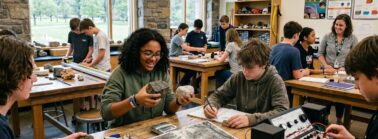
The Forensic Classroom: Why Science Education Must Reclaim the Kinetic Brain
In the modern classroom, we have become experts at teaching the what while starving students of the how. We trap high schoolers behind screens, forcing them into a state of "fixed focus"—a narrow, passive digital tunnel vision that deadens curiosity. We hand students the completed map of human knowledge and demand they memorize its coordinates. But true understanding […]