
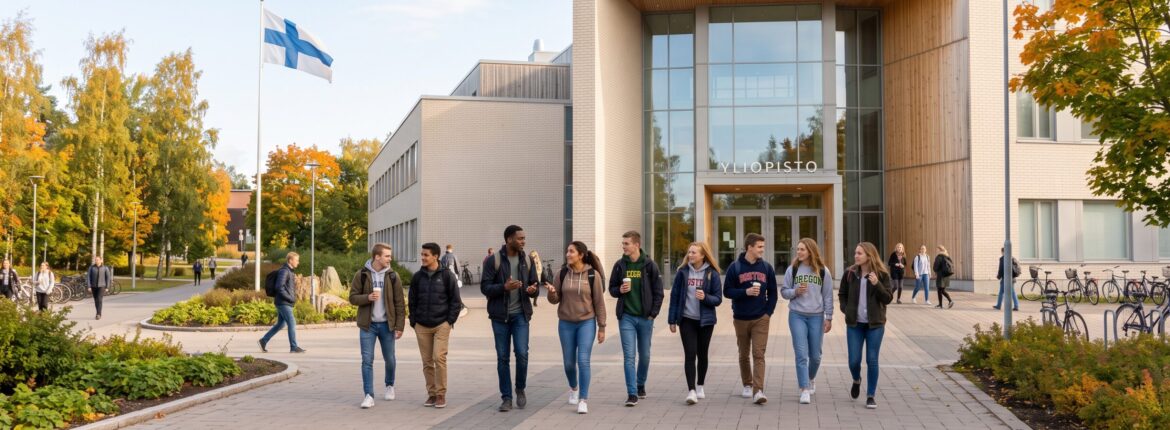
We keep talking about the cost of college in the United States as though the problem begins when a kid turns eighteen.
It doesn't.
By then, we've already spent thirteen years building the road that delivered the kid to that bill. So let's ask a different question: What if we built a different road?
Finland currently charges students from outside the European Union, European Economic Area, and Switzerland tuition for English-taught bachelor's and master's programs. Those tuition charges generally range from €8,000 to €20,000 per year.
But here's the interesting part: degree programs taught in Finland's national languages, Finnish or Swedish, do not charge tuition. That exemption isn't limited to undergraduate education. Finnish- and Swedish-taught bachelor's and master's programs are tuition-free regardless of nationality, and doctoral programs are tuition-free regardless of nationality or language of instruction.
So we're not merely talking about a possible road to a tuition-free bachelor's degree. We're potentially talking about a road through graduate school.
Which leaves me with a pretty obvious question:
Why the hell aren't we teaching some American kids Finnish?
Stop Teaching a Language Just to Check a Box
Think about the way we usually approach foreign-language education in American schools. Take two years of Spanish. Take two years of French. Maybe take German. Get your credits, check the box, graduate.
I'm not criticizing learning Spanish. I'm half Cuban. Learning Spanish in the United States can obviously be enormously valuable.
I'm criticizing the absence of a destination.
What if we started with the destination and worked backward?
Suppose a public school system began teaching Finnish in kindergarten or first grade—not Finnish as an elective, and not Finnish I and Finnish II so somebody can satisfy a graduation requirement, but Finnish with a purpose.
Build oral language in elementary school and develop literacy alongside it. Increase proficiency through middle school. By high school, begin teaching portions of mathematics, science, technology, literature, or other subjects through Finnish.
The goal would be genuine academic proficiency, and sitting at the end of that road would be something a seventeen-year-old can understand: learn this language well enough, meet the university's admission requirements, get accepted into an eligible Finnish-language degree program, and the tuition bill can be zero.
If that student continues through an eligible Finnish-language master's program, the tuition can remain zero. If that student eventually pursues a doctorate, Finland's doctoral programs are tuition-free regardless of nationality.
Admission isn't automatic. Students still have to satisfy the requirements of the university and degree program they want to enter. Living in Finland isn't free, either. Finland currently recommends that international students budget approximately €900–€1,200 per month for living expenses.
Fine. Those are real problems, so let's solve them with housing grants, international student residences, state scholarships, work-study arrangements, exchange programs, partnerships with Finnish universities, public-private funding, summer immersion programs, and whatever else turns out to be necessary.
Those are solvable engineering problems, and a $150,000 college bill is also an engineering problem. We've just gotten so accustomed to it that we stopped treating it like one.
What Is a Charter School Actually For?
This is where charter schools should be incredibly useful—not because this idea belongs exclusively in charter schools. It doesn't. Every public school should be asking questions like this.
But charter schools were supposed to give educators room to experiment with different ways of building schools. So let's actually experiment.
Don't give me essentially the same school with a different polo shirt, the same worksheets, the same bells, the same homework, the same standardized-test obsession, the same language requirement, and the same college pipeline—and call it innovation because the school's name has the word “Academy” in it.
Build something.
Imagine a Finnish-American public charter school whose stated mission is that graduates will leave academically bilingual and prepared to apply to universities in Finland. Now the language isn't merely a class. It's infrastructure.
And once somebody demonstrates that the model works, why should it remain a charter-school experiment? Put it in a traditional public school. Create a Finnish academy inside a comprehensive high school or build a Finnish-language magnet program. Create a district pathway. Let several districts share Finnish teachers remotely where staffing is difficult. Develop summer immersion partnerships in Finland and let American high-school students take courses remotely with Finnish educators.
Build the damn road.
Finland Is Already Standing Partway Across the Bridge
Here's where this idea gets even more interesting.
We wouldn't be calling a country that has shown no interest in teaching its language internationally. The Finnish National Agency for Education already supports Finnish-language and cultural education outside Finland, including at universities around the world. Finland has also supported teachers, curriculum development, digital instruction, assessment, student and teacher mobility, and cooperation between Finnish and foreign universities.
In other words, some of the pieces already exist. Nobody has assembled them into this particular machine.
So assemble them.
I would love to see an American governor call Finland and say: We have 100 kids, and you have universities. Let's try something. We'll build the K–12 language pipeline. You help us figure out what academic Finnish those students actually need. Bring Finnish educators into the design, connect our teachers with yours, develop summer programs and exchanges, and help us establish assessments so that a kid doesn't arrive in Helsinki believing they're fluent because they got an A in Finnish IV.
Then follow the students and measure what actually happens.
And Why Stop With Finland?
Finland is the obvious example because its current tuition structure creates this extraordinary opportunity. Sweden doesn't presently provide the same pathway for most American students; non-EU/EEA students are generally subject to Swedish tuition rules. So don't pretend the systems are identical.
Instead, pick up the phone and ask Sweden whether it wants to build something too. Ask other countries and find out what would make participation worthwhile for them.
Perhaps they want students proficient in their language. Perhaps universities want stronger international enrollment in particular disciplines. Perhaps regions with declining populations want educated young adults who might remain after graduation. Perhaps countries want stronger cultural and economic relationships with American states.
Find the overlapping interests and negotiate.
This doesn't have to become a federal program involving 47 committees and a 900-page implementation document. California could try it. Texas could try it. North Carolina could try it. A school district could begin exploring it, or a charter network could build the prototype.
One school can start with one cohort of twenty-five kids and see what happens.
And There May Be Another Door at the End of the Road
Here's the really fun part: for some students, the road doesn't necessarily have to end with graduation.
An American student who becomes academically proficient in Finnish, attends university in Finland, completes a degree, and decides that Finland is where they want to build a life may have created an immigration pathway as well as an educational one.
Finland changed its permanent-residence rules in January 2026. Under one current pathway, a person who completes certain Finnish higher-education degrees can qualify for permanent residence without satisfying the ordinary four- or six-year residence requirement, provided the person satisfies the other conditions. Qualifying degrees include a bachelor's degree from a Finnish university, a master's degree from a university or university of applied sciences, and licentiate or doctoral degrees. Developing Finnish or Swedish proficiency is also required.
Permanent residence is not citizenship, and graduating from a Finnish university does not automatically make an American student Finnish. Under Finland's current general citizenship rule, an applicant ordinarily must have lived legally in Finland for eight years, although shorter periods apply in some circumstances. Citizenship also carries additional requirements.
But think about the potential trajectory we're creating.
A child begins learning Finnish in an American public school. That child eventually becomes academically proficient, attends university in Finland, perhaps continues through graduate school, establishes a career and life there, satisfies Finland's residence and other citizenship requirements, and eventually becomes eligible to apply for Finnish citizenship.
If that happens, the playing field gets much bigger again because a Finnish citizen is also a citizen of the European Union. EU citizenship carries rights to move, live, work, and study throughout the European Union, subject to the applicable conditions for longer-term residence.
Think about where we started: a six-year-old learning Finnish in an American public-school classroom.
And think about where that road could eventually lead. We're no longer talking merely about a foreign-language credit, a diploma, or potentially tuition-free undergraduate and graduate education. We're talking about a pathway that could eventually give that young adult another country to call home and an entire continent across which to build a life.
None of that is guaranteed, and that's precisely the point. Education shouldn't guarantee a child's destination. It should dramatically increase the number of destinations available.
The Playing Field Has a Destination
This is the larger problem I have with so much of American education.
We build escape rooms and then congratulate children who figure out how to escape them. Sit here, memorize this, complete this, take this test, earn this credit, take these two language courses, get this GPA, get into college, and borrow this money.
At remarkably few points do we stop and ask the child:
Where are you trying to go?
That's backward.
A playing field has a destination.
The kid learning Finnish at eight years old doesn't need to understand international higher-education finance or European immigration law. They're learning another language, another culture, another way of seeing the world.
But by fourteen, fifteen, sixteen, that road becomes visible. Finland is no longer a picture on a classroom wall. It's a possibility, and the work means something.
That's what we keep missing when we talk about motivation in education. We keep asking children to become more motivated while giving them work disconnected from destinations they care about, and then we diagnose their failure to care.
Give the work somewhere to go.
This Is What Public Education Should Be Doing
I don't want this mistaken for an argument that every American child should learn Finnish. That would be just as stupid as insisting every American child follow any other single pathway.
The Finnish school is an example of a much larger idea: every public school should be able to answer the question, What becomes possible for this child because this school exists?
Maybe one pathway leads to Finland, while another leads directly into engineering, filmmaking, nursing, advanced manufacturing, an apprenticeship, agriculture, computer science, music, or a university down the street.
Another kid may not know where the hell they're going yet. Good. Give that kid room to explore, because that's what childhood is for.
The point isn't to determine a six-year-old's career. The point is to stop pretending that giving every six-year-old essentially the same educational journey for the next twelve years constitutes choice.
Reboot the Damn Thing
We have spent decades arguing about how to make American college cheaper through loan forgiveness, tax credits, 529 plans, scholarships, community college, income-driven repayment, and countless other programs. Every one of those conversations may have value.
But they're conversations about what happens after the bill exists.
I'm asking why we aren't also building pathways around the bill.
Finland has already created one peculiar opening. Finnish- and Swedish-taught bachelor's and master's programs currently carry no tuition charge regardless of nationality, and doctoral programs are tuition-free as well.
We have public schools, twelve or thirteen years, and children capable of learning languages. Finland already has infrastructure devoted to expanding Finnish-language education internationally.
So put those facts on a table, get educators from both countries around that table, and ask:
Can we build a road from an American kindergarten classroom to a Finnish university?
Maybe the answer is yes. Maybe parts of the idea fail spectacularly. Maybe Finnish proves too difficult to bring enough students to university-level proficiency at scale. Maybe the number of suitable Finnish-language degree programs becomes the bottleneck. Maybe living expenses wipe out too much of the tuition advantage. Maybe twenty things I haven't thought about yet turn out to be enormous problems.
Excellent. Those are testable questions, so run the experiment. That's what educational innovation is supposed to mean—not another fucking app, another dashboard, or another standardized assessment telling us which children are behind.
Build something that wasn't there before. Build a door, or better yet, build a playing field.
And give the kid somewhere worth playing toward.
Epistemic Status & Testable Predictions
This is a proposal, not evidence that a Finnish-American K–12 pathway will work at scale. The tuition opportunity described here exists under Finland's current rules, as do the current post-degree permanent-residence pathways. Immigration, tuition, admissions, and citizenship laws can change, so any actual program would need to work from the rules in effect when its students apply.
Successful implementation would require language acquisition, university admission, immigration compliance, living-cost financing, sufficient Finnish-language degree choices, teacher recruitment, curriculum development, and cooperation between American and Finnish institutions. Those aren't reasons to dismiss the idea. They're variables we can measure.
Testable Prediction 1: Purpose Changes Language Persistence
Students enrolled in a long-term language pathway attached to a concrete educational destination should demonstrate greater persistence and proficiency than comparable students taking a language primarily to satisfy graduation requirements.
Build matched cohorts, measure retention and proficiency over time, and see whether having somewhere for the language to go actually changes learning.
Testable Prediction 2: Academic Finnish Can Be Built in American Public Schools
Start with a small K–12 cohort and establish proficiency benchmarks with Finnish partners. Measure speaking, reading, writing, listening, and eventually the ability to learn academic content through Finnish.
If the students can't reach the necessary level, the hypothesis takes a hit. Test it.
Testable Prediction 3: The Economics Can Beat the American Pathway
Track the complete cost—not merely tuition—of students who eventually study in Finland, including language-program costs, travel, housing, food, insurance, residence requirements, and other expenses. Compare that total with realistic American higher-education alternatives for the same students.
And don't stop the comparison at the bachelor's degree. Follow students who continue into master's and doctoral education and compare the total cost of the entire educational pathway. Don't advertise “free college” and hide everything else; run the numbers.
Testable Prediction 4: Destination-Based Schools Change Engagement
Compare students in pathways with visible destinations—international university, apprenticeship, industry credential, conservatory, engineering pipeline—with comparable students completing conventional graduation requirements.
Measure attendance, persistence, course completion, student-reported purpose, postsecondary enrollment, and postsecondary completion. Then follow them long enough to find out whether the playing field actually led somewhere.
Testable Prediction 5: Does the Pathway Create Long-Term Mobility?
Follow the students after graduation and find out how many return to the United States, remain in Finland, qualify for permanent residence, eventually become eligible for and choose to pursue Finnish citizenship, or build careers elsewhere in Europe.
Don't assume international mobility is a benefit every student will want. Measure whether having the option changes what becomes possible in their lives.
Testable Prediction 6: Start Small Before Scaling
Start with one school, one cohort, and one Finnish partner, then follow those students for years. If twenty-five students teach us something important, run it again with a hundred. If it works, expand it; if it doesn't, find out why.
That's what experimentation means.
References
Study in Finland. “Fees and Cost of Living.” Finnish National Agency for Education.
Study in Finland. “Admissions.” Finnish National Agency for Education.
Finnish National Agency for Education. “Finnish Language and Culture Studies Outside Finland.”
Finnish National Agency for Education. “Universities Outside Finland in Which You Can Study Finnish Language and Culture.”
Finnish National Agency for Education. “Financial Support for Cooperation Projects in Finnish Language and Culture.”
Finnish National Agency for Education. “Financial Support for Teaching Finnish Language and Culture at Universities Outside Finland.”
Finnish Immigration Service. “Permanent Residence: Period of Residence Requirement.”
Finnish Immigration Service. “Degree Completed in Finland.”
Finnish Immigration Service. “Citizenship: Period of Residence.”
Finnish Immigration Service. “Citizenship Application for Adults.”
European Union. “Residence Rights When Living Abroad in the EU.”
European Union. “Working in the EU.”