
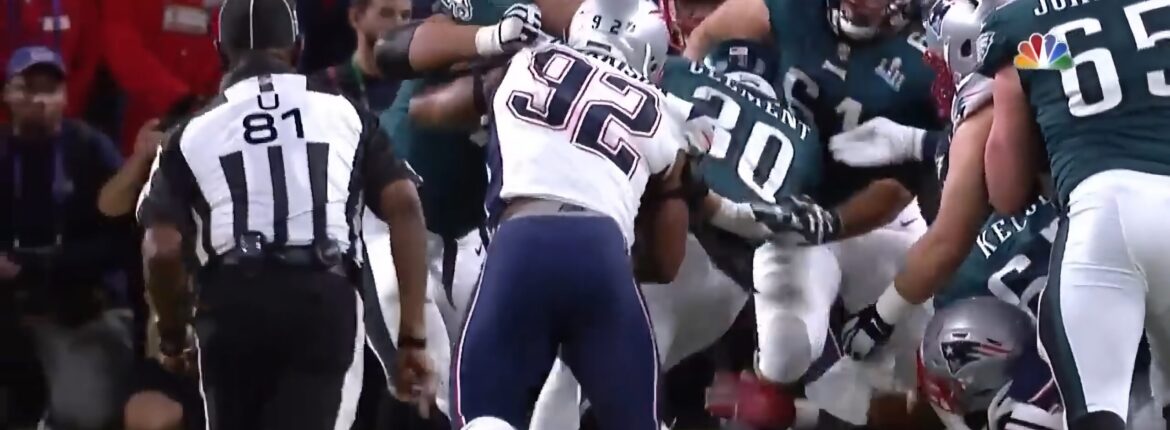
What an Undrafted Rookie, a Super Bowl, and One Defender Following Him Can Teach Us About State-Dependent Performance
Nick Foles won the MVP of Super Bowl LII. Doug Pederson called one of the great offensive games in Super Bowl history. Zach Ertz caught the go-ahead touchdown, Nelson Agholor caught nine passes, Alshon Jeffery made one of the most spectacular touchdown catches of the night, and Philadelphia's offensive line helped the Eagles accumulate 538 yards against Bill Belichick's New England Patriots.
Underneath that entire offensive architecture, however, was an undrafted rookie running back who had caught only ten passes during the regular season: Corey Clement.
Clement finished Super Bowl LII with four receptions for exactly 100 yards and a touchdown. Those numbers are remarkable for a rookie running back who had barely participated in the regular-season passing game, but they still don't describe what Clement actually did to New England. He didn't merely accumulate receiving yards. He changed what the Patriots believed they had to defend, and once that happened, Doug Pederson and Nick Foles could use New England's perfectly rational concern about Corey Clement to create opportunities for everybody else.
That is why Clement is such an interesting case for ADHD Escape Room. I am not diagnosing Corey Clement with ADHD. I am interested in something broader: what happens when the performance environment changes and a human being suddenly performs far beyond what his previous statistical profile would predict?
Clinicians should be fascinated by those moments.
Too often, they aren't.
The Hole Darren Sproles Left Behind
Philadelphia hadn't planned the 2017 season around Corey Clement becoming a Super Bowl receiving weapon. Darren Sproles was supposed to occupy much of that territory. Sproles was one of the most dangerous receiving backs of his generation, capable of turning the running-back position into a matchup problem anywhere on the field.
Then, in Week 3, Sproles tore his ACL and broke his forearm on the same play. His season was over.
Philadelphia couldn't replace Darren Sproles with another Darren Sproles, so it redistributed the problem. LeGarrette Blount remained the physical hammer, Jay Ajayi arrived during the season and added another dimension to the running game, while running backs coach Duce Staley continued developing Clement as a receiving and red-zone weapon.
The rookie's role grew, and then the playoffs arrived. During sixteen regular-season games, Clement caught 10 passes for 123 yards. During three postseason games, he caught 10 passes for 139 yards. In the Super Bowl alone, he caught four passes for exactly 100 yards.
That's an extraordinary change in production. It doesn't tell us why it happened.
It tells us where to start looking.
The Mother of All Interest Triggers
Dr. William Dodson has spent years describing an ADHD nervous system whose engagement is powerfully driven by interest, challenge, novelty and urgency. That framework immediately raises an interesting question when we look at Corey Clement.
Clement grew up in Glassboro, New Jersey, in Philadelphia's backyard. He grew up an Eagles fan. He entered the NFL undrafted and then fought his way onto the roster of the team he had rooted for as a kid.
Now follow the escalation: an undrafted rookie becomes a Philadelphia Eagle, Darren Sproles is lost for the season and Clement's responsibilities expand, Philadelphia reaches the playoffs and keeps winning, and eventually that childhood Eagles fan finds himself playing an important role in the Super Bowl for the team he grew up loving.
Childhood team + undrafted rookie + Super Bowl + championship stakes
If you're looking for interest, novelty, challenge and urgency, you could hardly manufacture a more concentrated environment.
That's the mother of all interest triggers.
This does not establish that Clement has ADHD, nor does it prove that hyperfocus caused his performance. Clement gives us something different: a spectacular natural example of what can happen when personal meaning, challenge, novelty and urgency converge around the same person at the same time.
And those variables weren't operating alone.
Clement Had Caddies
During Super Bowl week, Jay Ajayi was dealing with an ankle issue and was limited in practice. Whatever role Clement ultimately played on Sunday, Philadelphia had every reason to make sure its rookie running back was prepared.
He wasn't preparing alone. Doug Pederson, offensive coordinator Frank Reich, running backs coach Duce Staley and his teammates each occupied a different role in an unusually supportive football environment preparing an undrafted rookie for the largest game of his life.
Golf originally taught me to recognize this kind of architecture.
While trying to use golf to help my son better regulate after the worst day of bullying he had experienced, I began watching what actually surrounded elite golfers. I saw individual swing coaches and putting coaches, other golfers functioning as natural body doubles, sports psychologists occasionally walking practice rounds with players, and caddies helping manage the performance environment across an entire tournament week.
Then it hit me.
It's the fucking caddy.
That realization eventually changed how I taught. A great caddy doesn't hit the shot. The golfer still has to execute it. The caddy helps create the conditions under which the golfer can access the ability required to execute it.
The larger implications of that deserve their own article. For this one, the principle is enough.
Clement had caddies.
And one of the most important people in that environment was Nick Foles.
I Get You
One of the most important ideas I took from Dr. Dodson's work wasn't about attention at all. It was about the importance of finding another human being whose relationship communicates something like: I get you. I understand you. I don't want to change you. I'm here to help you become the best version of you possible.
The 2017 Eagles had an extraordinary amount of that architecture, and Nick Foles seemed particularly good at creating it.
Foles's value to that locker room wasn't confined to reading defenses and throwing footballs. He connected with people. He had spent much of the season as Carson Wentz's backup without poisoning that relationship, and when the team became his, he didn't suddenly behave as though everyone else existed to support the quarterback.
He trusted them.
Now imagine what that means for Corey Clement. You're an undrafted rookie playing for the team you grew up loving, preparing for the Super Bowl, and the quarterback responsible for deciding where the football goes is communicating through words and behavior: I see you. I trust you. I believe you can do this.
Then he throws you the football.
Interest wasn't operating alone.
interest + novelty + urgency + preparation + trust >> access to performance
That's an ecology. Clement still had to perform.
And he did.
The 55-Yard Warning
Late in the second quarter of Super Bowl LII, Philadelphia faced second-and-8 from its own 43. Foles found Clement down the right sideline on a wheel route. Clement caught the ball, broke through contact, stiff-armed a defender and turned the play into a 55-yard gain.
Suddenly Philadelphia was at the New England 2. On the next play, Clement took the handoff and fought through contact near the goal line. In consecutive plays, the Patriots had now received two pieces of information about an undrafted rookie they could no longer treat as peripheral: Clement could hurt them through the air, and Clement could hurt them with the football in his hands.
A few plays later, Philadelphia faced fourth-and-goal. Foles drifted toward the right side of the formation, the snap went directly to Clement, Clement moved left and pitched to Trey Burton, Burton rolled right, and the quarterback everyone had temporarily forgotten about was standing alone in the end zone.
The Philly Special.
The genius wasn't merely that a tight end threw a touchdown pass to a quarterback. Each successive movement gave New England something plausible that demanded attention, and the first player entrusted with the football was the player who had just exploded for 55 yards.
55-yard reception >> goal-line run >> direct snap to Clement >> defense honors Clement >> pitch to Burton >> Foles disappears >> touchdown
The Eagles weren't merely fooling New England.
They were teaching New England where to look.
Clement Becomes a Receiving Problem
Philadelphia wasn't finished building him into a threat. In the third quarter, Foles dropped a pass into Clement for a spectacular 22-yard touchdown. Clement had now done something more consequential than accumulate receiving statistics: he had punished New England for the way it allocated defensive attention.
That's what makes offensive football so fascinating. There are only eleven defenders, and every defender committed to solving one problem is a defender who cannot simultaneously solve another.
Great offensive football therefore isn't simply about finding an open receiver.
It is about manufacturing one.
Clement had demonstrated that allocating defensive resources elsewhere could leave New England vulnerable to a running back the Patriots had little reason, based upon his regular-season receiving numbers, to consider a primary receiving weapon.
Now he was one.
Ertz demands attention >> Clement gets an opportunity >> Clement punishes the allocation >> New England adjusts
Once New England adjusts, somebody else becomes more available.
That's the feedback loop.
The Keystone Is Not Necessarily the Biggest Stone
A keystone isn't the largest stone in an arch. It is the stone whose position allows the rest of the structure to carry its load.
That's a better way to understand Clement's Super Bowl.
Foles was the quarterback. Pederson designed the architecture. Ertz, Jeffery, Agholor, Torrey Smith, Jay Ajayi and the offensive line were indispensable pieces. But Clement became the player who made New England's allocation of defensive resources increasingly difficult.
Ignore Ertz and Ertz can beat you. Commit additional resources to Ertz and somebody else becomes available. Ignore Jeffery and he can beat you vertically. Worry about Jeffery and Agholor starts working underneath.
Then the guy who caught ten passes during the entire regular season becomes a 100-yard Super Bowl receiver.
That's not merely production.
That's the creation of a new defensive obligation.
And defensive obligations are expensive.
The Most Important Play Clement Made Without Touching the Football
Late in the fourth quarter, Philadelphia trailed 33–32. The Eagles drove inside the New England 15, and the entire season had been compressed into a handful of plays.
Zach Ertz was about to catch the touchdown that would put Philadelphia ahead for good, but watch Corey Clement.
Clement goes into motion, and New England reacts.
The Patriots had spent the evening learning that Clement could hurt them. They had watched him explode for 55 yards, watched the direct snap to Clement initiate the Philly Special, and watched him beat their coverage for a touchdown. Clement was no longer background noise. He was dangerous.
So when Clement moved, New England had to honor the possibility that the football might move with him. Defensive attention followed, helping create the matchup Philadelphia wanted with Ertz.
Foles saw it, Ertz won it, and Foles delivered it.
Touchdown.
The touchdown belongs to Zach Ertz in the record book, but part of the reason the opportunity existed was moving away from him.
Corey Clement.
The Defense Learned Exactly What Philadelphia Wanted It to Learn
This is where Super Bowl LII becomes much more interesting than a collection of spectacular plays.
At its highest level, offensive football is the manipulation of another intelligent system. You show the defense something, the defense learns from it, you punish its response, and the defense adapts.
Then you punish the adaptation.
Philadelphia spent an entire game manufacturing credible threats until New England could no longer allocate enough defenders to all of them. Clement may have been particularly disruptive precisely because he wasn't supposed to be one of the primary threats.
A defense expects Zach Ertz to matter. It expects Alshon Jeffery to matter. It expects Nick Foles to matter. But when an undrafted rookie with ten regular-season receptions becomes somebody Bill Belichick's defense must account for with the Super Bowl on the line, the architecture has changed.
That is what a keystone does.
Nick Foles Helped Create the Monster
None of this diminishes Nick Foles. It helps explain why Foles was so extraordinary that night.
Foles didn't treat Philadelphia's offense as a hierarchy in which the football belonged primarily to established stars. He distributed it according to what the defense gave him, and every successful distribution potentially changed what New England could give him next.
Agholor caught nine passes, Ertz seven, Smith five, Clement four and Jeffery three. Clement's four produced 100 yards because Foles and Pederson were perfectly willing to make an undrafted rookie part of the problem Belichick had to solve.
Distribution compounds.
Find the available player >> establish him as dangerous >> force the defense to account for him >> create space elsewhere
Then do it again, and eventually there aren't enough defenders.
We explore Foles much more deeply in the separate ADHD Escape Room article The Case of Nick Foles: The ADHD Quarterback. His ADHD, anxiety, extraordinary performance variability, relationship with Pederson and remarkable postseason transformations deserve their own examination.
That's another article. Here, Foles matters because he helped create Corey Clement as a defensive problem.
And Clement returned the favor.
Sports Taught Me What to Look For
My interest in these state changes didn't begin when I started mentoring children.
It began with sports.
I had started looking closely at golf because I was trying to use the sport as a tool to help my son better self-regulate after the worst day of bullying he had experienced. I wasn't trying to build an academic theory of ADHD. I was trying to help my kid.
But once I started looking at golf through that lens, I saw something academic descriptions of ADHD hadn't prepared me to see: there were ADHD people all over sports performing extraordinarily well.
So instead of asking only what is wrong with the ADHD nervous system?, I began asking another question:
What is this environment doing right?
That question followed me into teaching and mentoring.
Sports taught me to look at performance ecologically. Don't look only at the person. Look at the environment surrounding the person: the scaffolding, immediate feedback, interest, urgency, relationships, structure and conditions under which the person's abilities become accessible.
Sports taught me to be the caddy.
Interest Was My Entry Point
By the time I was mentoring ADHD children, I was already looking for the environment that focused the child.
When a child was drowning in anxiety, rejection-sensitive distress, shame or negative self-talk, I didn't wait for the child to become regulated before trying to engage him. I used engagement as my entry point, every time.
Sometimes it was music or another creative outlet. Very often, though, I found what I came to think of as the master doodler: the kid constantly drawing in margins, covering notebooks with characters and creating elaborate little worlds while everyone else mostly saw a child who wasn't paying attention.
I saw information.
Many of these children attended a Title I school, and some didn't have access at home to expensive creative technology. When I found a master doodler, I would pull out my iPad, open Procreate and show the child what was possible. Suddenly the pencil could become a hundred pencils. There were layers, brushes, colors, transformations and an entire professional-quality visual studio underneath a fingertip.
Then I handed over the iPad.
I wasn't waiting for regulation before introducing the interest. The interest was part of how I created the pivot.
existing interest + novelty >> HYPERFOCUS >> state transition
The Kid His Social Worker Had Never Seen
One child remains burned into my memory because the transition happened in roughly twenty seconds.
He went from Eeyore to Tigger.
The kid who had been swallowed by negative emotional material suddenly became animated, curious, engaged and creative. The transition was so dramatic that I called his social worker, who had been working with him for three years.
She told me she had never seen him like that before.
How does nobody know this?
She knew his history and his struggles. She had spent years seeing him in the environments in which adults normally evaluated him. But I had changed one enormously important variable: I changed the engagement architecture.
Twenty seconds isn't enough time to acquire a new skill or substantially increase intelligence. It isn't enough time to resolve severe trauma, repair years of accumulated shame, rebuild self-esteem or methodically reason a child out of entrenched negative self-talk.
Yet his functional state changed anyway.
The trauma hadn't disappeared. His history hadn't disappeared. Whatever had produced his distress remained real, but it wasn't controlling that moment anymore.
Hyperfocus had caught, and suddenly I was seeing a child that a professional who had known him for three years told me she had never seen.
That shouldn't be treated as a cute mentoring story.
That should be a research question.
Hyperfocus Creates the Transition
This distinction is critical to what I am proposing.
Hyperfocus isn't what happens after an ADHD child gradually transitions from reverse into fourth gear.
Hyperfocus creates the transition.
Before it catches, the child may be occupied by everything that came before: criticism, failure, fear of another failure, negative self-talk and the accumulated expectation that this probably won't go well either.
Then interest and novelty catch the nervous system strongly enough to trigger hyperfocus.
Whatever happened before hasn't literally disappeared. The memories remain, the history remains, and trauma certainly hasn't been cured. But for the task now occupying the nervous system, that previous material can temporarily lose its functional control over the present.
There is no necessary first gear, second gear and third gear.
Reverse >> HYPERFOCUS >> FOURTH
That's why the speed matters. The ability didn't develop in twenty seconds.
Access to it changed.
What If the Assessment Environment Is Hiding the Child?
If a professional can know a child for three years and never see a state that can emerge in twenty seconds when the engagement conditions change, what exactly are we measuring when we describe that child's normal functioning?
Maybe we're describing the child, but maybe we're also describing the environments in which we keep observing the child.
A classroom, counseling office or standardized assessment doesn't provide a neutral window into a nervous system. It creates conditions. Those conditions contain more or less interest, novelty, urgency, challenge, autonomy, movement, immediate feedback and personal meaning. Then we observe the behavior produced inside those conditions and attribute almost all of it to the child.
environment >> nervous-system state >> observable performance
If we never substantially vary the first variable, we may never discover the range of the second or third.
That child taught me this in twenty seconds.
Sports had already taught me where to look.
The Science of Half-Truths
This is where my frustration with academic ADHD research becomes something stronger than frustration.
I understand why a clinical field studies pathology. People come to clinicians because something isn't working, so researchers quite reasonably study impairment: failure to initiate, inability to sustain attention, impulsivity, emotional dysregulation, working-memory problems and the countless ways ADHD can interfere with someone's life.
That research matters.
But if you study only the conditions under which a nervous system fails, you haven't described the nervous system.
You've described half of it.
Where is the corresponding research program asking when this same nervous system performs extraordinarily well? What environmental conditions maximize its functioning? What happens when interest, novelty, urgency and challenge converge? What role does trust play? What happens when another human being provides external executive scaffolding? What happens to working memory, emotional regulation, causal learning and temporal perception once hyperfocus catches?
Those aren't questions about whether ADHD has cute little “superpowers.” They are questions about maximizing human development and performance.
And this is where I believe academic psychology has left an enormous hole.
Sports Psychology Already Turned the Coin Over
Sports psychologists haven't had the luxury of ignoring the other side of performance. Their job isn't merely to diagnose why an athlete failed. Their job is to understand how a human being accesses his or her capabilities reliably, including under enormous pressure.
So sports psychology has spent decades wrestling with flow, arousal, confidence, attentional control, performance routines, coaching relationships, recovery from mistakes and the conditions surrounding optimal execution.
Academic ADHD psychology should be talking to these people.
Instead, when I began raising sports in online discussions about ADHD, I repeatedly encountered an attitude that athletics somehow weren't serious enough for a discussion about a serious disorder.
That response still amazes me.
We're talking about human performance.
A classroom is a performance environment. A workplace is a performance environment. An operating room is a performance environment. Parenting, relationships, driving, creating and regulating yourself under pressure all require performance.
Life is a performance art.
Sports simply make performance unusually visible. The golfer stands over the ball and we can see what happens. The quarterback receives the snap and we can see what happens. Change the coach, teammate, caddy, opponent, stakes or environment and we can watch what happens to the same person.
Then we record almost everything.
If ADHD research studies primarily where the nervous system fails while neglecting the environments in which that same nervous system thrives, its findings may be individually true.
But collectively they risk becoming a science of half-truths.
Turn the coin over.
Sports psychology already has.
Stop Averaging Away the Interesting Part
This matters because human performance is variable, and ADHD performance may be extraordinarily so.
When someone usually performs at one level and occasionally performs far above it, the instinct is often to treat the exceptional performance as noise surrounding the person's “real” average.
I think that may sometimes be exactly backward.
The variability may be the signal.
If a person repeatedly performs at one level under low-engagement conditions and another under high-interest, high-urgency conditions, averaging those performances together may produce a wonderfully precise description of a person who never actually exists.
Study the transition instead.
What happened immediately before engagement changed? Did initiation latency collapse? Did negative self-talk diminish? Did persistence increase abruptly or gradually? Did working-memory performance change? Did error recovery improve? Did temporal perception change while engagement remained intact?
Those are measurable questions.
My master doodler gives us another. I watched a child carrying enormous emotional baggage move from what I call Eeyore to Tigger in roughly twenty seconds after introducing an existing creative interest plus extraordinary novelty through Procreate.
That observation proves almost nothing by itself, but twenty seconds imposes constraints on plausible explanations. The child didn't become more intelligent in twenty seconds. He didn't acquire years of missing skills, resolve severe trauma, rebuild his self-concept or complete a therapeutic process.
Something changed.
What?
That is precisely what research is supposed to find out.
The Extended Now
This also leads to what I call the Extended Now Hypothesis.
Hyperfocus may not simply be a state sitting inside an already-established period of concentration. It may create a temporal compartment, weakening the functional grip of what came before while expanding the boundaries of the psychologically meaningful present ahead.
engagement trigger >> HYPERFOCUS >> previous state drops from functional now >> Extended Now forms >> causal continuity is preserved >> sustained execution
That could help explain why the ADHD child who couldn't get started can suddenly work for an astonishing length of time, why an athlete can become locked into a game, why a musician can remain inside a performance, and why a mathematician can remain inside a proof while each transformation creates the conditions for the next.
The clock continues moving.
But psychologically, the person may still be inside the same now.
That hypothesis generates predictions.
So test them.
Epistemic Status, Testable Predictions—and a Research Blind Spot
Let me be precise about what I am claiming.
I am not diagnosing Corey Clement with ADHD. I cannot demonstrate retrospectively that he was hyperfocused during Super Bowl LII. My Extended Now model is a hypothesis. My observations of ADHD children moving from profound emotional distress into intensely engaged performance within seconds are frontline mentoring observations, not controlled experiments.
Fine.
Now investigate them.
Because at some point scientific caution can become an excuse for scientific incuriosity.
Start with strong pre-existing interests in ADHD participants. Manipulate interest and novelty independently, then together:
interest alone >> ?
novelty alone >> ?
interest + novelty >> ?
Measure initiation latency, persistence, error rate, response speed, affect and working-memory performance continuously rather than simply comparing averages before and after a long task. Then add urgency, challenge, immediate feedback, external scaffolding and interpersonal trust. Look for interactions instead of assuming each variable contributes independently.
Most importantly, look for thresholds.
If my reverse-to-fourth-gear observation points toward something real, engagement may not always increase performance smoothly. There may be circumstances in which relatively little happens until some threshold is crossed and then the functional state reorganizes remarkably quickly.
reverse + engagement trigger >> HYPERFOCUS >> FOURTH
That's testable.
The Extended Now Hypothesis generates another prediction. If hyperfocus expands the psychologically functional present, ADHD participants should become better at connecting temporally separated actions and consequences while uninterrupted engagement persists. Break the engagement between action and consequence, and causal integration should deteriorate even when the objective delay remains identical.
That's testable too.
Disprove it. Modify it. Replace it with something better.
But look.
This Article Is an Ice Core
I have described sports archives as behavioral ice cores, but in a smaller sense this article is one too.
Corey Clement doesn't prove my hypothesis. Nick Foles doesn't prove it. The master doodler who went from Eeyore to Tigger in twenty seconds doesn't prove it. My experiences as a teacher, father and mentor don't prove it.
That's not what an ice core does.
An ice core preserves a pattern that gives somebody a reason to drill deeper.
Clement catches ten passes during an entire regular season and then ten more during three postseason games. The undrafted kid from Philadelphia's backyard reaches the Super Bowl with the team he grew up loving and produces 100 receiving yards. Nick Foles displays extraordinary state-dependent swings in performance. An ADHD child carrying severe emotional baggage encounters interest plus novelty and presents so differently twenty seconds later that a social worker who has known him for three years says she has never seen him like that.
Maybe my proposed mechanism is wrong.
Good.
Explain the pattern better.
The purpose of assembling these cases isn't to declare victory for a theory. It is to make the pattern interesting enough that somebody with the training, laboratory and resources to investigate it stops and says:
Hey. We should research this.
The Testable Prediction Before All the Others
There is therefore a prediction underneath every other prediction in this article.
If ADHD performance is strongly state- and environment-dependent, then a research program deliberately studying conditions of optimal ADHD performance should discover systematic differences that deficit-centered research alone cannot reveal.
Recruit ADHD participants and stop asking only how to make them fail less. Ask how to help them perform better.
Identify their strongest interests. Manipulate novelty, urgency, challenge, immediate feedback, autonomy, movement, external scaffolding and interpersonal trust. Measure cognition and behavior continuously as those variables change. Compare low-engagement states with optimal-engagement states within the same person.
Then look at the variance everybody has been averaging away.
If nothing systematic appears, my argument takes a serious hit. But if predictable combinations of environment and engagement repeatedly produce large within-person changes in executive performance, emotional regulation, persistence, working memory or temporal integration, then the field has been leaving important information on the table.
A science that investigates primarily how a nervous system malfunctions can become extraordinarily sophisticated about dysfunction while remaining surprisingly ignorant about the conditions under which that same nervous system thrives.
Its individual findings may be perfectly true.
But half the coin produces a science of half-truths.
The Laboratory Has Been Running for Decades
This is ultimately why Corey Clement belongs on an ADHD website even though I am making no claim that Corey Clement has ADHD.
He is standing inside an enormous behavioral archive that psychology has not exploited nearly enough. Nick Foles is in there. Golfers are in there. Musicians are in there. Athletes who suddenly reverse years of baseline performance are in there. Coaches, caddies and teammates who construct external performance systems around them are in there.
Outside sports, children like the ones I mentored are showing us related state changes without stadium cameras recording them.
I am not asking academic psychology to accept my explanation.
I am sounding the alarm that there is something here worth explaining.
Professional sports have been preserving behavioral ice cores for generations. The transitions are recorded, the outliers are identifiable, the hypotheses can be generated, and the predictions can be tested. Sports psychologists have spent decades studying the other side of the performance equation because maximizing performance is part of their job.
ADHD research needs to look.
If my explanation is wrong, excellent. Find the better one.
But after watching a child become almost behaviorally unrecognizable to a social worker who had known him for three years because I changed the engagement architecture for twenty seconds, I am no longer satisfied with being told what his average performance looks like. And after watching sports display dramatic state-dependent performance shifts again and again, I am no longer satisfied with treating those performances as scientifically uninteresting because they happened on a field instead of in a laboratory.
The laboratory has been running for decades.
Someone needs to start studying the film.
Corey Clement's Play Without the Football
Corey Clement caught ten passes during the 2017 regular season. Then Philadelphia needed him.
Darren Sproles was gone, Clement's responsibilities expanded, and the playoffs arrived. The undrafted kid from Glassboro was suddenly playing for the team he had grown up rooting for, for a championship, on the largest stage his sport could provide.
He caught ten more passes in three postseason games, with four of them producing 100 yards in the Super Bowl.
But Clement's most beautiful contribution may have produced none.
Philadelphia had spent the evening turning an undrafted rookie into something Bill Belichick's defense could no longer ignore. Every catch added evidence, every successful touch increased the defensive cost of treating Clement as somebody else's problem, and every adjustment New England made created another opportunity somewhere else.
Then, with Philadelphia's first Super Bowl championship hanging in the balance, Corey Clement moved.
New England moved with him.
The geometry changed.
Foles found Ertz.
Touchdown.
Corey Clement's final great contribution to Super Bowl LII wasn't catching the football.
It was becoming dangerous enough that he no longer had to.
References
Dodson, William W. Clinical and educational work describing the interest-based ADHD nervous system, including the roles of interest, challenge, novelty and urgency in engagement.
Philadelphia Eagles. Contemporary and retrospective coverage and film analysis of Super Bowl LII, including Corey Clement's 55-yard reception, the Philly Special, Clement's touchdown reception and Philadelphia's fourth-quarter offensive design.
Philadelphia-area and national sports reporting. Contemporary profiles documenting Clement's Glassboro, New Jersey upbringing, childhood Eagles fandom, undrafted entry into the NFL and description of reaching the Super Bowl with Philadelphia as the realization of a childhood dream.
Philadelphia Eagles. Coverage of Darren Sproles' Week 3 season-ending injuries and Philadelphia's redistribution of running-back responsibilities following his loss.
Contemporary Super Bowl LII practice reports. Coverage of Jay Ajayi's ankle issue and limited practice participation during Super Bowl week.
Pro Football Reference. Corey Clement Career Statistics. Regular-season and postseason performance data, including Clement's 2017 receiving production.
Pro Football Reference. Super Bowl LII: Philadelphia Eagles 41, New England Patriots 33. Team and individual statistics.
Pro Football Reference. Nick Foles Career Statistics and Game Logs. Career, regular-season and postseason performance data documenting substantial variation across competitive environments.
NFL and Philadelphia Eagles historical coverage. Nick Foles's 2017 postseason run and Super Bowl LII MVP performance.