
In the landscape of modern neuropsychology, Dr. Russell Barkley’s model of Attention Deficit Hyperactivity Disorder stands as a dominant paradigm. Barkley defines ADHD not as a knowledge deficit, but as a chronic, pervasive failure of executive functioning (EF) and self-regulation. In his view, the ADHD brain is biologically incapable of reliably holding onto working memory, planning for the future, organizing tasks, or managing time without a "prosthetic environment"—external scaffolds, timers, and artificial rewards intentionally built by others to keep the individual on track.
But this model contains a profound structural oversight: it treats executive functions as static, internal mechanisms that simply fail to load.
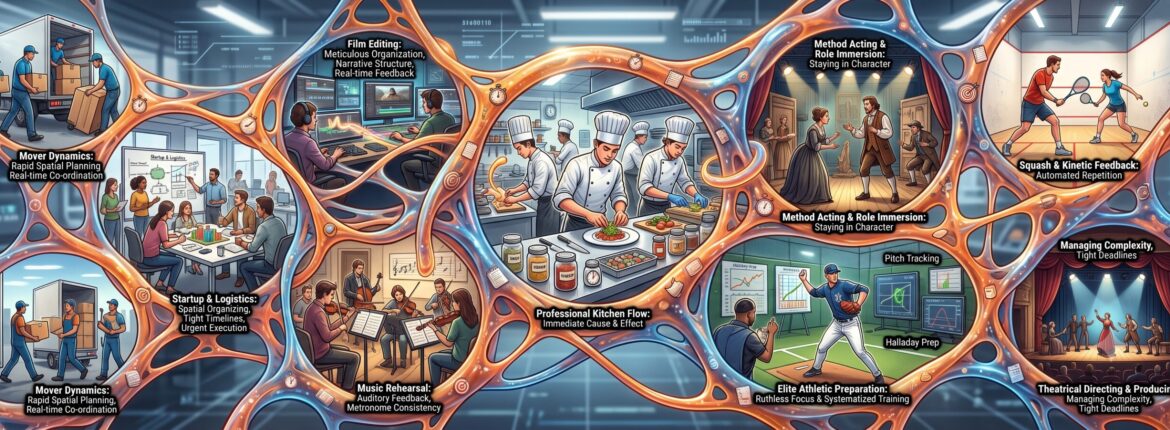
When we observe ADHD individuals operating in high-stakes, fast-moving, and visceral environments, a massive counter-evidence emerges. Under fire, the supposed "deficit" completely dissolves. In the right arenas, ADHDers do not merely survive; they master complex executive functions—planning, deep organization, immaculate preparation, and chronological precision—entirely on their own, driven by the immediate physics of the task. They don't need a contrived prosthetic environment built for them; they organically conquer EF when the environment itself provides immediate cause, effect, and consequence.
The Physics of Engagement: Why High-Stakes Environments Unlock EF
To understand why an ADHD individual can struggle to organize a bedroom but flawlessly coordinate a multi-million dollar film production or a chaotic dinner service, we have to look at the latency of the feedback loop.
For the neurotypical brain, abstract, delayed consequences (e.g., "If I study this text today, I will pass an exam next month") are enough to trigger executive control. For the ADHD brain, delayed rewards are a dopaminergic dead zone. However, when the time interval between an action and its structural consequence approaches zero ($\Delta t \to 0$), the executive centers of the ADHD mind are shocked awake.
Under fire, the environment itself becomes the scaffold. The organization becomes a physical requirement of survival, forcing the mind to plan, organize, and execute with military efficiency.
The Film Editing Suite: Systemic Organization Born of Necessity
The technical reality of film and television editing provides a flawless counter-example to the static deficit theory. Non-scripted editing—such as trailers and documentaries—begins as a massive, unstructured mountain of raw footage. To an outside observer, resolving this chaos requires immense, sustained executive functioning: mapping out narrative arcs, maintaining a vast mental catalog of assets, and systematically sorting through data.
An undiagnosed ADHD editor doesn't wait for someone to build a prosthetic schedule for them; they build rigorous organizational hygiene because the work demands it. If an editor is unorganized, the work quickly becomes impossible. The question of "Where do you find that missing five-frame trim?" forces the immediate development of an airtight organizational system.
The editing suite is an arena of absolute control and immediate sensory feedback. Every tiny micro-adjustment—cutting a frame, shifting an audio beat—yields an instantaneous visual and auditory consequence. The editor constantly pivots focus between the macro-structure of the film and the micro-beats of a scene, adjusting their strategy in real time based on what is happening on screen. The immediate dopaminergic reward of seeing a chaotic puzzle snap into musical, dramatic harmony unlocks deep, sustained executive mastery.
The Dynamic Feedback Matrix: Squash and Instrumental Mastery
The rapid cultivation of executive skill through immediate consequence is beautifully illustrated in individual athletics and music practice. Consider the mechanics of learning an instrument like the trumpet or mastering a sport like squash:
- The Musical Feedback Loop: Practicing an instrument requires highly methodical, structured repetition. For an ADHD mind, this is unlocked because an instrument offers instantaneous acoustic feedback. A misplaced finger or a dropped embouchure results in an immediate discordant note. The feedback is automated and undeniable, training the individual to self-correct and organize their practice routines without relying on dry, internal verbal instructions.
- The Physics of Squash: Unlike team sports with complex, delayed spatial plays, squash offers an immediate physical dialogue. You hit a ball against a wall, and it returns at a velocity and angle entirely determined by your own strike. This compressed, zero-delay loop allows an ADHD individual to teach themselves to become an exceptional athlete. The immediate kinetic feedback bypasses abstract planning and forces the brain into automated, rapid spatial-temporal organization.
The Culinary Line: The High-Velocity Prosthetic Matrix
Step into a high-end restaurant kitchen during the dinner rush. A line cook or chef is responsible for managing a staggering array of moving parts: fluctuating cooking times, synchronized plating, ingredient inventory, tool maintenance, and incoming tickets. According to traditional deficit models, this level of multi-tasking and time management should cause an immediate executive crash.
Instead, professional kitchens are filled with brilliant ADHD individuals functioning as masters of execution.
A commercial kitchen is the ultimate organic realization of an immediate consequence environment. The organizational system is entirely externalized through mise en place (everything in its place). If a chef fails to organize their station, prep their reductions, or care for their tools beforehand, the penalty is public, visceral, and instantaneous: the food burns, order tickets pile up, and the entire line collapses. Time management is not an abstract concept tracked on a clock; it is tracked by the sensory crackle of searing proteins and the physical momentum of the room. The absolute immediacy of the stakes forces flawless planning and organization.
The Roy Halladay Paradigm: Meticulous Preparation as Tactical Survival
In elite professional sports, the legendary Major League Baseball pitcher Roy Halladay serves as an extraordinary counter-example to "time blindness" and executive failure. Halladay was renowned for his near-robotic devotion to structural training regimens and exhaustive game-day preparation. He routinely arrived at the ballpark at 4:30 AM for evening games, executing a meticulous, multi-hour checklist of physical conditioning, video analysis, and tactical mapping.
For an ADHD mind operating at this level, extreme preparation is not a rigid chore—it is an act of proactive tactical survival. In professional athletics, the consequences of a single lapse in executive focus are immediate and devastating—a home run surrendered, a game lost, a career altered. The sheer gravity of the immediate game-time environment acts as an intense behavioral constraint. The athlete organizes, plans, and prepares with elite precision because the arena transforms abstract future goals into an urgent, hyper-focused reality.
Deep Containment: Extreme Method Acting and Rehearsals
The performing arts offer two distinct environments where the ADHD brain bypasses traditional executive deficits by altering the cognitive landscape:
- Extreme Method Acting: Standard acting requires memorizing lines and hitting marks while managing one's personal life off-camera—a constant shifting of focus that can exhaust an ADHD individual's working memory. Extreme method acting, where a performer stays in character for weeks or months on end, eliminates this cognitive friction. By narrowing their entire reality down to a single, deeply defined character script, they create a protective container. The character’s motives, posture, and rules become an automated operating system. The executive function is simplified because the actor no longer has to choose how to behave; the role dictates the organization.
- The Collaborative Rehearsal: The rehearsal process in music and theatre acts as a physical externalization of working memory. A script or a musical score is a visual, step-by-step map of execution. During a rehearsal block, an artist iterates a single scene or movement pattern over and over. If an actor misses a cue or a musician drops a beat, the ensemble immediately grinds to a halt. This immediate interruption provides a high-contrast behavioral consequence that grounds attention in the tangible present, allowing complex structural plans to be absorbed directly into motor memory.
The Chaos Engines: Startups and the Mover Industry
Traditional corporate positions often demand navigating slow, bureaucratic processes with delayed rewards—an absolute dead zone for ADHD dopamine regulation that frequently leads to executive paralysis.
In contrast, high-velocity startups and the fast-paced worlds of logistics and independent moving companies offer an immediate, high-stakes puzzle every single hour. In a moving operation, spatial and logistical planning is entirely physical: fitting an entire house of diverse items into a fixed truck volume requires real-time, non-linear geometric problem-solving.
The consequences here are immediate—an item breaks if improperly packed, a truck overflows if poorly organized, a client complains on the spot if the arrival is delayed. The constant, unpredictable influx of novel problems keeps the ADHD brain in a state of high arousal. Because the stakes are immediate and the feedback is visceral, the entrepreneur or logistics manager effortlessly coordinates schedules, delegates tasks, and optimizes resource allocation with fluid ease.
Conclusion: Turning Barkley On His Head
Dr. Russell Barkley is correct that ADHD is a performance deficit rather than a knowledge deficit, and he is correct that the environment plays a massive role in dictating an ADHD individual's success. But the conclusion that ADHDers possess an immutable deficiency in executive function is fundamentally wrong.
As demonstrated by master film editors, elite athletes, chefs, musicians, and entrepreneurs, the ADHD brain does not lack the capacity to plan, organize, schedule, or prepare. Rather, it rejects abstract, low-stakes, delayed environments. When we move away from dry verbal instructions and long-delayed rewards, and instead place the individual into domains featuring rapid sensory feedback, high immediate stakes, and tangible, non-linear puzzles, executive function ceases to be a barrier. In these arenas of immediate consequence, the alleged disorder transforms into an unparalleled engine of high-velocity problem solving and absolute mastery. what was once diagnosed as a cognitive disorder transforms into an unparalleled engine of creative problem-solving and absolute mastery.