

Early childhood exposure to two-dimensional digital devices as primary caregivers generates a compounding developmental debt. Between the critical window of ages 4 and 8, the human brain relies on three-dimensional physical exploration and dynamic social reciprocity ("serve-and-return" interactions) to calibrate parietal and prefrontal architectures. By substituting physical trial and error with flat glass interaction, early digital device overuse induces two foundational deficits: spatial reasoning degradation and social literacy impairment. Drawing on neocortical framework models—such as Hawkins’s Thousand Brains Theory—and empirical evidence from recent Scandinavian pedagogical and cognitive reassessments, this article explores the physiological mechanisms behind this time theft and details how these early deficits manifest during high school as severe academic bottlenecks in advanced mathematics and clinical challenges in executive function and peer collaboration.
1. The Spatial Deficit: From Sensorimotor Engagement to Abstract Geometry Failures
Spatial intelligence—the neural capacity to mentally manipulate shapes, perceive depth, and map coordinate planes—is constructed through fine motor engagement, proprioceptive feedback, and visual accommodation.
Sensorimotor Reference Frames & Cortical Mapping
In a physical environment, moving an object requires the neocortex to continuously calculate complex environmental variables using spatial reference frames:
- Weight and mass distribution
- Frictional resistance and surface texture
- Gravitational force and balance
- Three-dimensional depth and volumetric spatial relations
As outlined by Jeff Hawkins and the Numenta research team, cortical columns learn models of objects by observing how sensory inputs change as we move and interact with our environment. Swiping a uniform glass surface replaces these dynamic calculations with an invariant, two-dimensional gesture. This severely restricts sensorimotor feedback loops, preventing the proper establishment of 3D reference frames within cortical columns and the parietal lobe.
Ocular-Motor Restriction
Real-world play trains the ocular motor system to perform saccadic eye movements (rapid, precise visual re-fixations) across dynamic distance planes:
Constant screen immersion locks visual focus at a static, short-distance focal length. This restricts the development of saccadic control, impairing the scanning mechanics essential for interpreting geometric coordinate grids and multi-line equations.
High School Academic Impact: When affected students reach high school mathematics (Geometry, Algebra II, Calculus, Physics), they encounter a structural cognitive wall. Lacking foundational 3D sensorimotor scaffolding, they struggle to execute abstract mental rotations, visualize transformations on a Cartesian plane, or model spatial systems in physics.
2. The Social Deficit: From Algorithmic Pacification to Executive Dysfunction
Social intelligence and emotional self-regulation are learned data-processing capabilities formed through real-time interpersonal reciprocity.
| Domain | Physical / Interpersonal Play | 2D Screen Saturation |
| Relational Mechanism | Serve-and-Return: Synchronous micro-expression and tone matching | One-Way Stream: Non-reciprocal, hyper-stimulating media |
| Neurodevelopmental Target | Prefrontal cortex wiring for empathy and impulse regulation | Dopaminergic reward loops driven by immediate gratification |
| Conflict Resolution | Shared play negotiation, compromise, and tolerance of boredom | Interest-Based Trap: Instant escape via algorithmic customization |
Disruption of the Serve-and-Return Loop
Healthy emotional development depends on reciprocal "serve-and-return" interactions: a child initiates a vocalization or facial gesture, and a caregiver or peer responds in real time. This loop trains the prefrontal cortex to read subtle vocal inflections, process body language, and modulate emotional intensity. Flat screens offer zero social reciprocity, bypassing these developmental circuits entirely.
Algorithmic Entrapment and Frustration Tolerance
Algorithms deliver instant, custom rewards designed to captivate short attention spans. This deprives young children of natural opportunities to build frustration tolerance, tolerate boredom, or negotiate shared rules during unstructured play.
High School Behavioral Impact: In adolescence, this deficit manifests as compromised social literacy and pronounced executive dysfunction. Students struggle with collaborative tasks, miss subtle peer social cues, and exhibit heightened anxiety or defensive avoidance when confronted with slow-moving, non-interactive, or sustained cognitive effort.
3. Empirical Validation: The Scandinavian Pedagogical Reversal
Scandinavian countries—early pioneers in the 1:1 digitisation of early childhood classrooms—have recently provided critical, population-scale empirical data validating the existence of this developmental debt.
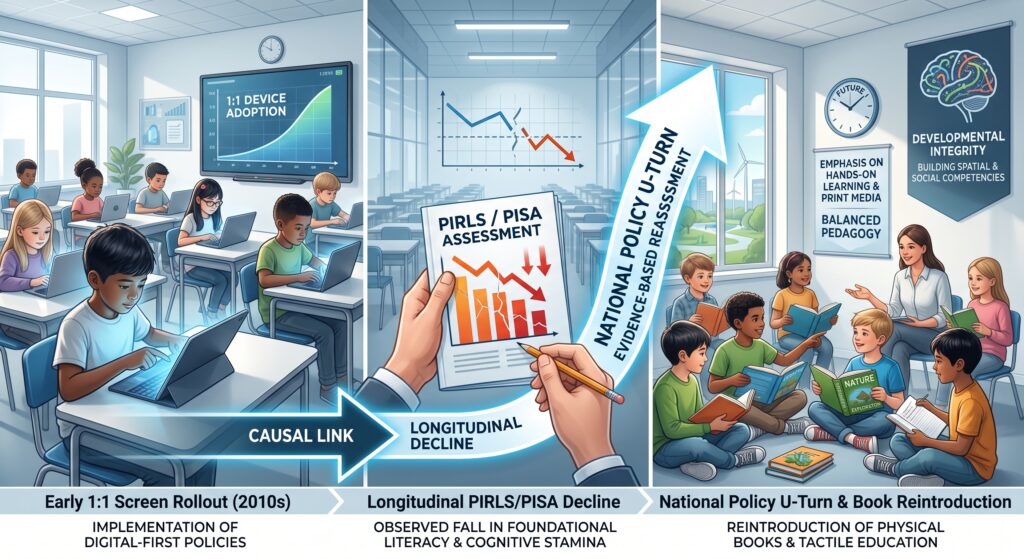
- Sweden’s Karolinska Institute Warnings and Curricular Reversal: In response to declining foundational literacy and cognitive stamina observed in the Progress in International Reading Literacy Study (PIRLS), Sweden’s National Agency for Education (Skolverket) and the Karolinska Institute issued formal directives to halt digital device integration for children under age six. The institute concluded that digital tools impair active physical exploration, reduce linguistic depth, and compromise the tactile motor feedback required for early cognitive wiring.
- The Norwegian Screen Use Committee (Skjermbrukutvalget): National findings in Norway highlighted an inverse correlation between early-grade screen saturation and executive function development. Norwegian cohorts demonstrated reduced stamina for sustained, non-gamified cognitive tasks and poorer spatial working memory compared to cohorts trained primarily with physical, print-based media.
- Denmark’s Danish Health Authority Guidelines: Denmark issued strict limits on early-years educational screen exposure following longitudinal observations that early screen ubiquity degraded classroom social fabric, reduced collaborative physical play, and increased symptoms of emotional dysregulation among primary school pupils.
These natural experiments demonstrate that digitizing the early learning environment accelerates cognitive fragmentation rather than modern academic readiness.
4. The Compounding Developmental Debt
Human neurodevelopment is fundamentally iterative: higher-order cognitive functions rely on the structural integrity of basic sensorimotor pathways built in early childhood.
When digital devices supplant formative physical play between ages 4 and 8, the baseline biological sandbox for spatial reasoning and human connection is fundamentally altered. The resulting debt is not merely lost time—it represents a structural deficiency that limits secondary academic achievement and social integration.
Key Academic Concepts
- Opportunity Cost via Time Theft: The developmental scaffolding lost when digital pacification replaces essential physical and social experiences.
- Sensorimotor Reference Frames: Neocortical mechanisms that utilize physical movement and location-based coordinates to learn 3D structures and concepts (Hawkins et al.).
- Serve-and-Return: Interpersonal feedback loops between child and caregiver essential for prefrontal cortex development.
- Interest-Based Cognitive Profile: A state where an individual struggles to focus or regulate behavior unless content offers immediate, high-dopamine engagement.
- Tactile-Proprioceptive Scaffolding: Physical interactions with physical matter that ground the neural basis for high-order abstraction.
Scholarly References & Theoretical Foundations
- Baillargeon, R. (2002). Physical Reasoning in Infancy. Visual Cognition, 9(1-2), 160–215.
- Center on the Developing Child at Harvard University. (2007). InBrief: The Science of Early Childhood Development.
- Christakis, D. A. (2014). Interactive Media Use in Early Childhood: Learning from Dysfunctional Deficits. JAMA Pediatrics, 168(5), 399–400.
- Danish Health Authority / Sundhedsstyrelsen. (2023). Recommendations on Screen Use Among Children and Adolescents. Copenhagen.
- Gopnik, A., Meltzoff, A. N., & Kuhl, P. K. (1999). The Scientist in the Crib: What Early Learning Tells Us About the Mind. William Morrow & Co.
- Hawkins, J., & Blakeslee, S. (2004). On Intelligence. Times Books.
- Hawkins, J., Ahmad, S., & Cui, Y. (2017). A Framework for Intelligence and Cortical Function Based on Grid Cells in the Neocortex. Frontiers in Neural Circuits, 12, 121.
- Hawkins, J. (2021). A Thousand Brains: A New Theory of Intelligence. Basic Books.
- Karolinska Institutet. (2023). Remissvar angående Skolverkets förslag till nationell digitaliseringsstrategi för skolväsendet 2023–2027 [Official Response to the National Digitalisation Strategy]. Stockholm.
- Newcombe, N. S. (2010). Picture This: Increasing Spatial Reasoning to Boost Math and Science Skills. American Educator, 34(1), 29–35.
- Norwegian Ministry of Education and Research / Skjermbrukutvalget. (2024). Screen Use in Children and Young People: A Comprehensive Review of Cognitive and Social Outcomes. Oslo.
- Swedish Ministry of Education / Skolverket. (2023). Return to the Printed Word: Policy Shift on Digital Learning Tools in Early Primary Education. Stockholm.
- Twenge, J. M., & Campbell, W. K. (2018). Associations Between Screen Time and Lower Psychological Well-Being Among Children and Adolescents. Preventive Medicine Reports, 12, 271–283.