
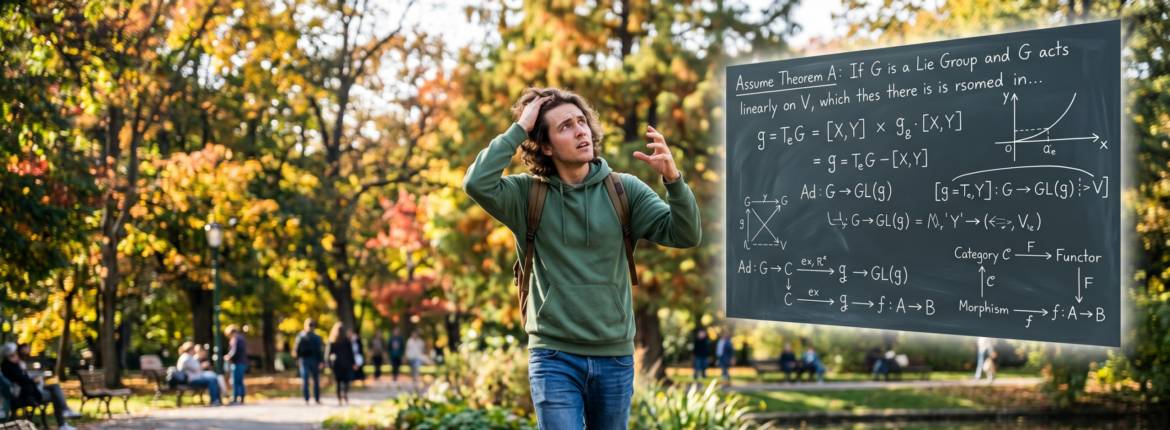
In the popular imagination, mathematical genius is almost always depicted the same way: a quiet, intensely focused individual staring at a chalkboard, instantly computing multi-digit primes or recalling flawless strings of numerical data. This is the classic trope of the Autistic Spectrum Disorder (ASD) savant—a mind resembling a high-powered, hyper-optimized linear algorithm.
But there is an entirely different species of mathematical brilliance, one that looks less like a supercomputer and more like a high-speed explorer navigating a shifting terrain. This is the domain of the twice-exceptional (2e) thinker: individuals uniquely gifted in mathematics who also carry the neurological blueprint of Attention Deficit Hyperactivity Disorder (ADHD).
Where the ASD savant constructs a flawless, rigid crystal lattice of facts, the ADHD-mathematical mind navigates a fluid, continuously deforming topological manifold. Understanding the profound structural difference between these two cognitive architectures changes how we view not just neurodiversity, but the very nature of mathematical intuition.
1. The Navigational Style: Local Algorithms vs. Global Geodesics
The distinction between the ASD savant and the ADHD-gifted mathematician lies in how their neural networks traverse information space.
ASD Savant Architecture (Deterministic Pathfinding)
[Input] ───► [Step A] ───► [Step B] ───► [Step C] ───► [Exact Output]

ADHD-Gifted Manifold (Topological Collapse / Jump)
  Sheet 1: [Algebraic Invariant] ──(Deformation)──┐
                                                  ▼ (The "Aha!" Fold)
  Sheet 2: [Geometric Structure] ─────────────────┴───► [Deep Intuition]
The ASD Savant: Deep Linear Search
The mathematical savant typically excels at exceptional depth within structured, deterministic rule sets. Their cognitive style is profoundly algorithmic. If you ask an arithmetic savant to calculate $23^{7}$, their brain executes a hyper-fast, low-latency search through a highly organized, literal filing system of numerical properties. The path is linear, predictable, and incredibly robust. It relies on a pristine local architecture where rules are absolute and boundaries are sharp.
The ADHD-Math Mind: High-Dimensional Surfing
The ADHD-mathematical brain operates on a completely different network topology. Because of a baseline deficit in tonic dopamine, the ADHD brain cannot easily sustain energy on a single, static linear path. To survive, it adapts by zooming out. It becomes a global pattern-matcher.
Instead of walking step-by-step down a single algebraic hallway, the ADHD mind treats disparate fields of mathematics as a continuous, deformable landscape. It relies heavily on sensorimotor inference—mentally pushing, pulling, and deforming abstract structures to see what remains invariant. When an ADHD thinker solves a problem, they don't trace the linear algorithmic line; they induce a global current across the manifold, allowing two seemingly unrelated "sheets" of math (like Measure Theory and Probability) to fold over, touch, and collapse the distance to the answer into a single point of intersection.
2. Working Memory: The Pristine Ledger vs. The Homotopic Squeeze
One of the most stark neurological divergences between these two profiles is the use of working memory.
The ASD Savant possesses an expanded, incredibly stable working memory buffer. They can hold massive, complex matrices or endless digits of Pi in active consciousness without a single bit flipping. Their mental chalkboard never smudges.
The ADHD-Gifted Thinker, by contrast, usually possesses a highly volatile, easily disrupted working memory. If they try to hold a long string of meticulous arithmetic steps in their head, the system crashes.
To compensate for this "leaky buffer," the ADHD-mathematical brain develops a brilliant defense mechanism: Homotopy.
Instead of carrying heavy, encumbering notation through a proof, the ADHD mind continuously deforms the problem, stripping away the surface-level Euclidean fluff and notation until only the core topological connectivity remains. They don't remember the numbers; they remember the structural skeleton—the invariants and symmetries.
An ADHD mathematician might struggle to accurately compute a tedious matrix multiplication without making a sign error, yet they can instantly perceive why that same matrix represents a specific rotational symmetry on a Lie Group manifold. They don't manipulate the data; they manipulate the shape of the data.
3. The Fuel of Discovery: Predictability vs. Divergent Novelty
The creative impulse driving these two minds stems from opposite neurological needs.
- The ASD Savant seeks the safety of the Invariant. For the autistic mind, mathematics offers a beautiful, comforting sanctuary of absolute predictability. The rules do not lie. The system is closed, elegant, and perfectly ordered. Excellence comes from exploring the infinite depth of this perfect order.
- The ADHD Mind seeks the spark of the Isomorphism. The ADHD brain is a novelty-seeking engine. It is inherently fatigued by repetitive, localized execution (which is why gifted ADHD kids dread mindless arithmetic worksheets). The ADHD mind catches fire when it discovers a hidden relationship—a functor that maps an object from the dry country of Algebra into the lush landscape of Topology. The thrill is in the bridge-building, the conceptual leaps, and the sudden, chaotic synthesis of disparate universes.
Conclusion: Two Ways to Map the Cosmos
The ASD savant is a master cartographer of the crystal city—documenting its streets, measuring its heights, and calculating its trajectories with flawless, breathtaking precision. They show us how far a mind can go when it masters the absolute depth of a system.
But the ADHD-gifted mathematician is a deep-space navigator of a fluid universe. Driven by a restless need for stimulation and a cognitive architecture that favors global geometry over local arithmetic, they remind us that mathematics is not a cold, rigid filing cabinet of formulas. It is a living, bending, breathing manifold—and sometimes, the best way to find your keys in that vast landscape is not to search every room, but to bend the house until the keys slide right into your hand.