

Traditional school systems are fundamentally built around a structural model that rewards sequential processing, compliance, delayed payoff, and relatively uniform pacing. For a student with a highly active, nonlinear ADHD brain, that environment can become a friction machine rather than a learning machine. Sit here. Do this now. Stop doing that. Hand this in Tuesday. Show your work this way.
For some students, twelve years of that structure works reasonably well. For others, particularly bright ADHD students whose attention is driven by interest, challenge, urgency, novelty, or immediate consequence, school can become an extended exercise in being corrected for the way their brain naturally operates. Eventually, some stop trying.
That moment is usually interpreted as failure.
Sometimes it is the beginning of something else.
Jennifer Lawrence and the Script That Changed the Measurement
Jennifer Lawrence's childhood is a particularly useful place to begin because what happened to her was not a gradual improvement in conventional academic performance. She didn't finally discover the study technique that made school work, become more compliant, or suddenly learn to tolerate an environment that had been telling her, directly and indirectly, that she wasn't very good at being a student.
She found a different environment.
Lawrence has described struggling badly in school, feeling lost, and believing she wasn't smart. As she famously confessed to Bill Whitaker in her 60 Minutes interview, she is actually a middle school dropout who never obtained a GED or high school diploma, bluntly describing herself as entirely self-educated. She was energetic, socially unusual, imaginative, and capable of the kind of elaborate behavior that can become a problem when a classroom's principal demand is predictable conformity.
One of the funniest examples is also revealing. As a child, she developed an elaborate story that she had a wooden leg and reportedly became so convincing with the accompanying limp that people believed her. From the perspective of a classroom, that is ridiculous behavior. From the perspective of an actor, however, look at what the child was actually doing: she created a character, constructed a backstory, physically embodied it, monitored how other people responded, and adjusted the performance sufficiently well to preserve the illusion.
The ability was already there. It simply had no recognized academic value.
That is one of the recurring problems with nonlinear children. Adults often evaluate a behavior according to whether it serves the environment the adults have constructed rather than asking what cognitive ability the behavior might reveal. A kid who cannot stop telling elaborate stories is disruptive until storytelling becomes the job. A kid who constantly reads other people's emotions is overly sensitive until emotional perception becomes the instrument. A kid whose body seems incapable of remaining still is hyperactive until physical expression becomes part of the craft.
Lawrence's turning point came at fourteen when she encountered a script and discovered something startling about herself. She could read the character and intuitively understand the person underneath the words—how that person would feel, how she would move, how she would react, and how the emotional logic of the character fit together.
The child who had believed she wasn't smart suddenly encountered a task capable of measuring an intelligence that school had barely noticed.
Nothing fundamental happened to her brain. The measurement changed.
Traditional curricula tend to separate knowledge into subjects, lessons, assignments, and predetermined sequences. Acting asked Lawrence to integrate information simultaneously: language, emotion, movement, facial expression, memory, perspective-taking, timing, physical space, and the reactions of another human being. For a nonlinear mind, that can be an entirely different cognitive proposition.
The classroom was asking her to constrain herself sufficiently to receive information in the prescribed sequence. Acting was asking her to use more of herself at once.
Traditional schooling >> compliance + abstraction + imposed sequence + delayed payoff
Acting >> empathy + embodiment + imagination + immediate feedback
Suddenly, many of the characteristics that had generated friction were no longer things to suppress. They were tools.
Lawrence eventually left formal schooling entirely without following the conventional diploma-to-college pipeline. Her parents—whose steady, behind-the-scenes backing and willingness to pivot when conventional structures failed provided the crucial safety net highlighted in her interviews and media profiles (such as her discussions on balancing family foundations and personal drive, echoed in features tracking her early trajectory)—saw something important: when she encountered acting, the scattered, struggling kid wasn't scattered in the same way anymore. There was direction, engagement, and something capable of pulling enormous effort out of her rather than requiring adults to continually push effort into her.
That difference is central to understanding ADHD. It is easy to look at a student who performs inconsistently and conclude that the student lacks discipline, motivation, maturity, or ability. But inconsistent performance can conceal enormous capacity when the environment is poorly matched to the mechanisms that recruit that person's attention.
Lawrence didn't need someone to convince her to work harder at acting. The work pulled her toward it.
By her late teens, the girl who had felt intellectually inadequate in school was establishing herself professionally in one of the most competitive industries in the world. Soon afterward came major roles, international recognition, and an Academy Award. That doesn't prove that school was unnecessary. It proves something much narrower and much more important.
School had been a terrible instrument for measuring Jennifer Lawrence.
And she was extraordinarily fortunate to discover another instrument at fourteen.
André Bormanis and the Intelligence That Builds Things
The same basic pattern becomes more interesting when we move away from celebrity and into a single intellectually accomplished family.
Science consultant and writer André Bormanis followed the kind of pathway our educational system readily recognizes as evidence of intelligence. He studied physics and astronomy and ultimately brought that scientific knowledge into television and science communication, drawing on the deep technical and creative perspectives he frequently articulates on creator deep-dive spaces like The D-Con Chamber (formerly Shuttlepod Show).
His older brother's intelligence expressed itself differently. After briefly pursuing formal biology, he discovered that the conventional academic pipeline wasn't where he belonged. His abilities were spatial, tactile, and environmental. He became an exceptionally accomplished landscaper, gardener, woodworker, and builder—a person capable of looking at a physical system and understanding how to manipulate it. When he opted out of the traditional academic track, his parents provided a vital layer of support, understanding that his divergence wasn't a failure of character. That ability then appeared again in the next generation, with his son developing similar gifts as a builder.
These are not consolation-prize intelligences. A master carpenter is continuously performing geometry. A builder is running physical simulations before committing material. A landscaper is reasoning about biological systems unfolding across space and time. A fabricator is simultaneously thinking about materials, tolerances, forces, sequence, tools, and the consequences of the next cut.
School tends to extract those components from their environments and present them symbolically.
The trade puts them back together.
For some nonlinear minds, putting them back together changes everything.
Mover and Shaker
At sixteen, he was done—not intellectually done, incapable of learning, or incapable of work. He was done with school.
By eleventh grade, this still-undiagnosed ADHDer had spent years being corrected, scolded, redirected, and told in a hundred different ways that the way he naturally operated was the problem. Eventually, he reached the point many ADHD students reach privately but few are allowed to act upon: I'm sick and tired of school. I just want to start a moving business.
His parents did something enormously important.
They listened.
They didn't interpret his rejection of school as a rejection of work or confuse institutional disengagement with laziness. They saw a good kid struggling inside an environment that was shutting him down, and they helped him build a bridge toward an environment in which he believed he could function.
There was a condition: he had to get his GED. He did. His parents bought him a truck, and the business began in their garage.
There is something wonderfully Silicon Valley about that image, not because a moving company resembles a computer company, but because the developmental mechanism does.
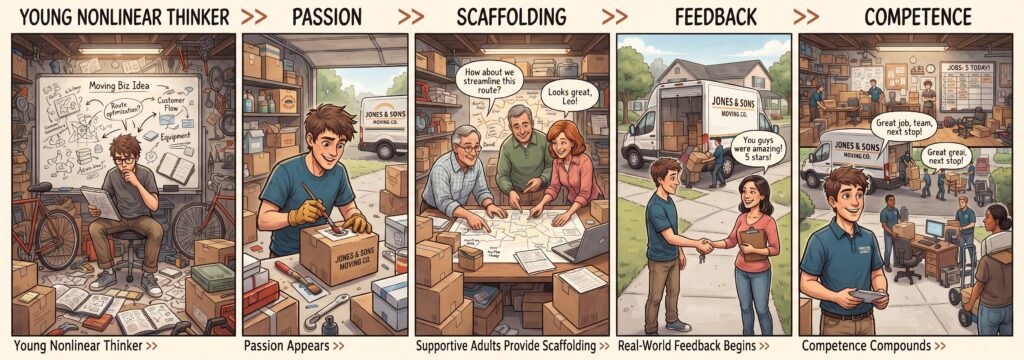
Once the truck started moving, executive function stopped being something adults were trying to teach him through an artificial system. It became something reality demanded from him. A customer had to be called back, a truck had to arrive on time, furniture had to fit through a doorway, employees had to be scheduled, routes had to be planned, and money had to be collected. Mistakes cost something. Better systems produced immediate rewards.
He was learning executive function in the real world, in real time.
Because he was intelligent, he kept adjusting. How can we load the truck faster? How can we schedule this better? How can we reduce wasted motion? How do I hire people and keep good ones? How do I get another truck? How do I turn one crew into several?
The business became the curriculum.
His parents remained intimately involved in his success, continuing to support him and keeping him meticulously scaffolded as the operation scaled up. They were the Tim Cook to his Steve Jobs—providing the operational ballast, steady organizational stability, and day-to-day execution that allowed a wildly creative, fast-moving entrepreneur to focus entirely on building the enterprise. He eventually paid them back and, crucially, hired them, keeping them beside him as the company grew into a nine-figure powerhouse.
But that is precisely where this story becomes dangerous if we tell it incorrectly.
He Was Lucky
The lesson is not that ADHD teenagers should drop out of high school and start businesses. He was lucky, but not merely because he found a passion singularity or because of credentials. His true advantage was structural and domestic: his home was not an escape room. His parents listened, backed him without reservation, and kept him scaffolded. Outside of school, he did not absorb the corrosive impact of childhood trauma; he wasn't carrying the weight of a hostile domestic front or fighting ghosts from his past.
That absence of trauma is the real hinge of the story.
Most sixteen-year-olds leaving a frustrating school environment do not land in a supportive garage with parents ready to act as operational anchors. When a young nonlinear thinker steps out of an incompatible classroom into a home that acts as a secure launchpad rather than a second theater of war, the energy required to build an enterprise isn't wasted on internal wreckage.
That is why his success is not an argument for simply dropping out. It is an argument for understanding what becomes possible when a brilliant, divergent mind is unburdened by domestic landmines and backed by people who refuse to treat neurodivergence as a moral defect.
Steve Jobs Saw His Door Too
This is where Steve Jobs belongs in the story—not merely as another famous dropout, but as another young nonlinear thinker who encountered something powerful at exactly the right developmental moment.
Jobs grew up with supportive parents, but school was hardly benign. He was badly bullied as a child, eventually pushing his family to move him to another school. Then something very different happened. As a young teenager interested in electronics, Jobs contacted Hewlett-Packard cofounder Bill Hewlett while looking for parts for a project. Hewlett helped him with the parts and connected him with summer work at HP.
Think about what that encounter represented to a kid like Jobs.
An adult at the summit of the technological world took him seriously.
The importance was larger than electronic components. Jobs received attention, legitimacy, access, and a glimpse of an adult world in which the strange things that fascinated him actually mattered. Years later, when Jobs encountered Steve Wozniak's early computer work, he could see something many other people could not: a business.
The developmental chain is strikingly familiar:
interest >> adult validation >> access >> competence >> opportunity >> obsession >> enterprise
The moving truck and the early personal computer could hardly be more different. The underlying developmental architecture is remarkably similar.
The Architecture of the Escape Room and the Shadow of Trauma
To understand why some brilliant, high-IQ ADHD minds launch into massive success while others fracture, we have to look closer at what the classroom actually does to a developing nervous system.
School is frequently an escape room. For a nonlinear mind, the sheer mismatch of the environment—the relentless demand for unnatural stillness, the policing of temporal pacing, and the constant friction of being told that your natural cognitive reflex is an error—can turn a classroom into a daily psychological trap. You do not need explicit, catastrophic trauma for a school to function as an escape room; the systemic invalidation alone is enough to exhaust a child's psychological reserves.
Yet, when structural incompatibility compounds with genuine childhood trauma—when the home environment alsooperates as an escape room of instability, criticism, conflict, or neglect—the developmental equation shatters entirely.
The common thread among Jennifer Lawrence, André Bormanis’s brother, the anonymous mover, and Steve Jobs is not merely that they found an open door. It is that they had a baseline of adult support and a home that acted as a launchpad rather than an additional theater of war. When a teenager has supportive parents who listen, who refuse to mistake institutional disengagement for laziness, and who provide a secure base, they are spared the compounding landmines of childhood trauma. They do not have to spend their early adulthood fighting ghosts or recovering from the collateral damage of a hostile domestic front.
By contrast, consider the brilliant, high-IQ ADHD student who faces the school-as-escape-room dynamic without that protective scaffolding.
When home offers no refuge, the energy that should be directed toward mastering a craft or building an enterprise is instead consumed by internal warfare. These individuals spend years—sometimes decades—wrestling with the debris of their past, unlearning the internalized belief that their cognitive divergence is a moral failing, and trying to heal in environments that offer zero margin for error. They are extraordinarily bright, yet they remain trapped in cycles of self-doubt because every institutional failure piled up on top of unmitigated domestic stress.
That is the population hidden by the glamorous dropout mythology.
We remember the icon who left school and built an empire because the wind was at their back and a safety net caught them when they stumbled. We rarely count the brilliant minds who left school, walked straight into a minefield of unhealed trauma with zero structural support, and spent their lives wandering through a maze they never designed.
The Real Educational Failure
The lesson isn't that school is unnecessary. It is that school cannot be allowed to convince a child that school performance measures the limits of that child's intelligence.
That mistake can be catastrophic for nonlinear ADHD minds.
Lawrence did not suddenly acquire intelligence when she opened a script. Bormanis's brother did not become intelligent when he started manipulating landscapes and wood instead of textbooks. The mover did not acquire executive function because someone handed him the keys to a truck. Jobs did not become creative because Bill Hewlett answered the telephone.
Their environments finally gave their existing capacities somewhere to go, anchored by the foundational safety that allowed them to step through without detonating the landmines behind them.
That distinction should fundamentally change what we mean when we say an ADHD student is "failing." Sometimes the student is failing the environment. Sometimes the environment is failing the student. And sometimes an extraordinarily fortunate sixteen-year-old sees an open door, walks through it, and never needs to come back.
The educational system cannot depend upon that kind of luck.
Reference & Source Notes
- Jennifer Lawrence: Background on her early struggles, family dynamic pivots, and her direct confirmation in her 60 Minutes interview with Bill Whitaker that she dropped out in middle school without a GED or diploma, finding her creative footing instead (with related thematic frameworks explored across media analyses, creator commentary, and author profiles such as those archived on community digital channels like ADHD Flow).
- André Bormanis: References to his scientific background, career path, and familial context draw from his professional trajectory in science communication and his expansive long-form discussions on interview programs such as The D-Con Chamber (formerly Shuttlepod Show), where guest retrospectives unpack early life milestones and divergent paths.
- Steve Jobs: Early life accounts, bullying hurdles, and his formative cold-call introduction to Bill Hewlett at Hewlett-Packard are well-documented across historical biographies detailing his adolescent transition into tech mentorship and enterprise.