
For over a decade, primary and secondary education underwent a quiet revolution: the wholesale replacing of paper, pens, and bound physical textbooks with 1-to-1 digital screen initiatives. Tablets and laptops were promised as the ultimate equalizers—interactive, infinitely customizable, and natively digital for a digital world.
Now, a major reversal is underway. Across Scandinavia, governments are spending hundreds of millions of dollars to yank devices off early-elementary desks, ban smartphone use during school hours, and buy millions of physical books.
This shift is often framed as a reaction to tumbling reading scores or viral complaints about short attention spans. But look under the hood, and the motivation is clear: we accidentally built an educational delivery system that ignores the fundamental computational architecture of the human neocortex.
The Neuroscience: Why the Screen Broke the Loop
The fundamental mistake of the early 2010s "ed-tech" wave was treating the brain like a passive computer screen—assuming that as long as visual data enters through the retina, the mind processes it identically regardless of the medium.
Cognitive neuroscience and theories of cortical function—most notably popularized by Jeff Hawkins in his work on cortical columns and reference frames—tell us the exact opposite. The neocortex doesn't passively absorb data; it is an active prediction machine.
1. The Loss of Motor Predictions (Efference Copies)
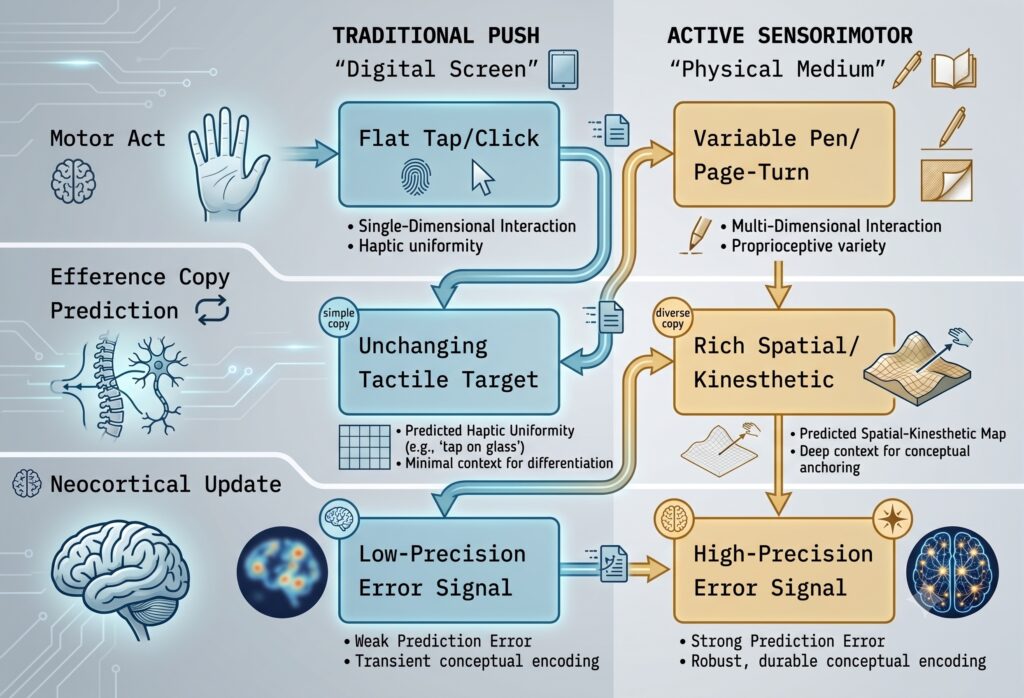
Whenever you move your body, your brain’s motor cortex generates an efference copy—an internal signal sent to your sensory processing centers predicting the exact kinesthetic and tactile feedback you should receive.
- On Paper: Writing a letter or solving an equation by hand requires a unique trajectory of fine motor commands. The micro-mismatches between predicted touch/resistance and actual touch/resistance create a high-fidelity prediction error signal that forces the neocortex to rapidly update its internal model.
- On Glass: Tapping an iPad screen delivers the exact same flat, static haptic feedback whether you are executing a geometric proof or tapping a game button. The sensorimotor loop is effectively severed—the motor command receives no unique tactile confirmation to bind the abstract concept into memory.
2. Reference Frames vs. "Floating" Pixels
Hawkins’ Thousand Brains Theory emphasizes that the neocortex learns by assigning information to spatial reference frames, similar to how grid cells in the hippocampus map physical locations.
When a student reads a physical textbook, the brain anchors concepts using tangible spatial coordinates: the left page versus the right page, the top margin, the tactile weight of the read pages in the left hand versus the unread pages in the right. When continuous scrolling on a tablet replaces this fixed physical medium, those spatial reference frames dissolve. The brain is forced into a state of shallow scanning rather than deep, analytic structural mapping.
Case Studies: How the Nordics are Pivoting
The recalibration is clearest in Scandinavian countries, where long-term data from early adoption is now fully driving national policy.
Denmark: The "Screen-Free" Early Childhood Mandate
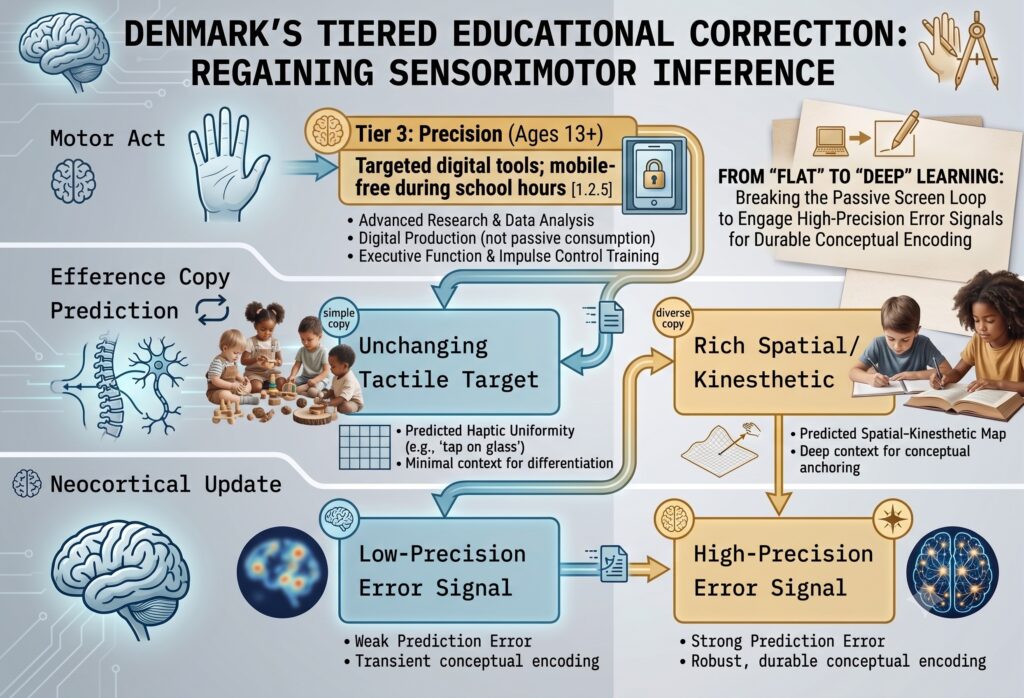
Denmark was once an international showcase for early classroom digitization. However, faced with dropping reading comprehension scores and mounting evidence of attention fragmentation, Danish Education Minister Mattias Tesfaye initiated a sweeping policy overhaul:
- Textbook Re-Investment: Denmark allocated 540 million DKK to replace classroom tablets and laptops with physical textbooks in primary schools.
- Preschool Device Bans: The Danish government put in place strict restrictions on screen usage in daycares (vuggestuer) and kindergartens, citing a lack of developmental benefit and clear risks to fine-motor development.
- Mobile-Free Learning Environments: Enforced legislation mandating that primary and lower-secondary students hand in personal devices at the start of the school day.
Sweden: Scrapping Mandatory Tech for Under-Sixes
In 2023–2024, Sweden’s Ministry of Education executed a dramatic U-turn after reading performance dropped significantly on international assessments like PIRLS. Sweden completely scrapped its national strategy for mandatory digital learning tools in early education.
The state funneled over $80 million USD into buying paper books so every student has a print textbook for every core subject, with prominent medical research bodies like the Karolinska Institute openly backing the move toward paper-based, fine-motor learning environments.
The Broader Implication
The Nordic pivot isn't a retreat into anti-technology nostalgia; it's a move toward neuro-developmental precision.
Digital devices are extraordinary tools for rapid information retrieval, data analysis, and production. But for the foundational stages of learning—where the neocortex relies on high-fidelity, closed-loop sensorimotor inference to build its initial reference frames—the physical world isn't an obsolete technology. It is the exact interface our brain evolved to learn from.
This video highlights Sweden's policy shift and the arguments driving their return to physical books and handwriting in the classroom.