
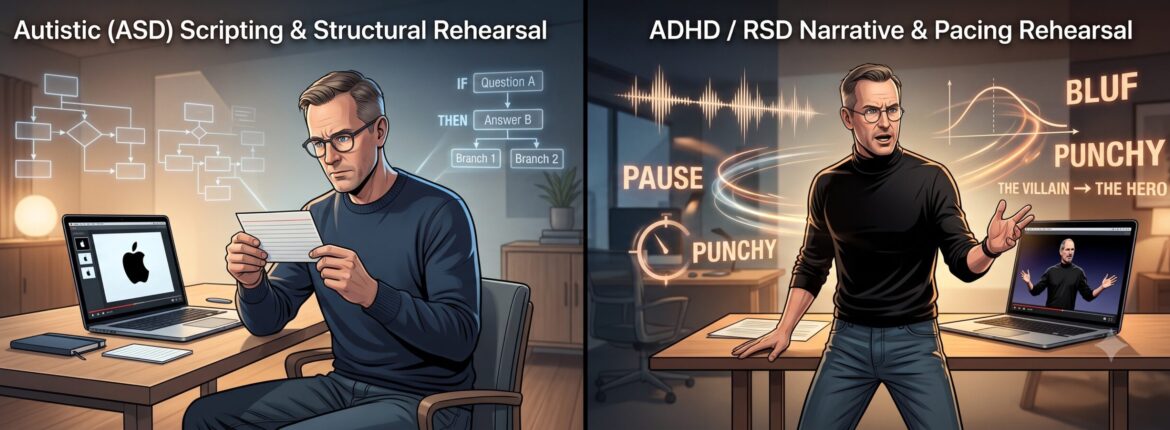
When someone watches a neurodivergent person rehearse a conversation, deliver a polished narrative, or use pre-loaded phrases, it all looks like the same thing on the surface: verbal masking.
But under the hood, the neurobiological engines running these two behaviors are fundamentally different.
When you look closely at Autistic verbal scripting versus ADHD/RSD-driven rehearsal, you discover two entirely separate survival strategies born from different cognitive needs, operating on different mechanics, and pursuing vastly different emotional goals.
Understanding where these two modes diverge—and where they overlap in an AuDHD brain—is essential to understanding how we navigate the social world.
1. The Core Engines: Translation vs. Protection
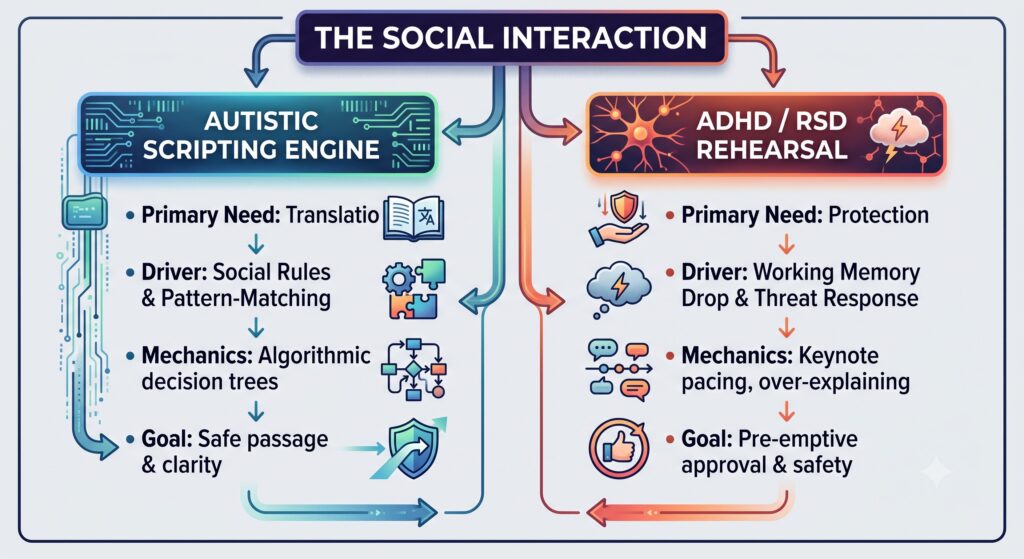
To understand the difference, you have to look at what the brain perceives as the primary "problem" it needs to solve before speaking.
The Autistic Engine: A Translation Layer
- The Root Cause: Differences in social cognition, non-verbal intuition, and information processing. Autistic communication often relies on explicit, logical structure rather than implicit social signaling.
- The Perceived Threat: Social unpredictability, double empathy friction, misinterpretation of context, and sensory/cognitive overload.
- The Primary Goal: Clarity, predictability, and social passage. The script acts as a translation bridge between the internal logical world of the autistic speaker and the implicit expectations of the neurotypical listener.
The ADHD/RSD Engine: An Emotional Armor
- The Root Cause: Executive dysfunction (specifically working memory drops under stress) combined with Rejection Sensitive Dysphoria (a dysregulated emotional threat-response to perceived judgment).
- The Perceived Threat: Painful emotional dysregulation caused by perceived failure, awkwardness, or blowing an impression.
- The Primary Goal: Approval, emotional protection, and pacing control. Rehearsal isn't about understanding the "rules" of the interaction—it’s about pre-emptively bulletproofing your delivery so there are no gaps for judgment to slip through.
2. The Structural Mechanics: Algorithms vs. Theater
The way these two strategies are constructed and executed in real time reveals their distinct cognitive roots.
| Dimension | Autistic Verbal Scripting | ADHD / RSD Rehearsal |
| Brain Architecture | Flowchart / Decision Tree: "If X is asked, say Y. If they react with Z, branch to Option 3." | Performance / Keynote Arc: "Set the scene, establish tension, deliver the resolution, control the rhythm." |
| Preparation Style | Collecting exact phrases, studying conversation rules, compiling literal response banks over years. | Practicing cadence out loud, running hypothetical scenarios in the car, adjusting tone and pacing. |
| When It Breaks Down | Sudden, off-script social variables cause a freeze or processing delay while searching for a new template. | Interruptions or unexpected questions trigger RSD panic or over-explaining to recapture narrative control. |
| Somatic / Internal Feel | High mental energy spent manually operating a social manual (like operating a manual transmission). | High nervous system arousal; adrenaline-fueled attempt to out-run working memory drops. |
3. The "Why": What Each Mask Is Trying to Achieve
If you ask someone mid-interaction why they are using their mask, the underlying motivation exposes the divide:
The Autistic Goal: "I need to construct the bridge."
Autistic scripting is fundamentally about functional navigation. It answers the question: "How do I participate in this social exchange correctly without causing a breakdown in communication?"
- It uses literal templates: greetings, standard turn-taking phrases, pre-planned transitions, and stored domain knowledge.
- Success looks like smooth transactional navigation: the interaction completed its goal without social friction or misinterpretation.
The ADHD/RSD Goal: "I need to shield the hero."
ADHD/RSD rehearsal is about impression management and cognitive anchoring. It answers the question: "How do I keep my brain focused while making sure they don't think I'm incompetent or messy?"
- It uses emotional pacing techniques: Steve Jobs-style dramatic pauses, rich context-building, declarative triads, and pre-loaded narrative arcs.
- Success looks like pre-emptive validation: the room was captivated, working memory held up, and no criticism was incurred.
4. The AuDHD Intersection: The Double-Engine Collision
In an AuDHD individual, these two engines don't operate in isolation—they constantly cross-wire, creating a complex, hyper-polished communication style:
- The Autistic side builds a massive, highly detailed structural library of how conversations should work (decision trees, logical frameworks, deep context).
- The ADHD side injects rapid lateral thinking, high-energy storytelling drives, and a need for novelty.
- The RSD engine acts as the hyper-vigilant supervisor, forcing the speaker to rehearse those autistic frameworks with intense, keynote-level presentation tactics to guarantee perfection.
The result is a verbal presenter who can appear extraordinarily articulate, commanding, and warm on stage or in structured settings—yet feels completely drained afterward because two massive cognitive engines were running at full throttle just to manage a 15-minute conversation.
5. Summary: Looking Beneath the Mask
| Feature | Autistic Verbal Scripting | ADHD / RSD Rehearsal |
| Primary Driver | Social processing differences & need for predictability | Working memory limits & fear of rejection/shame |
| Cognitive Tool | Structural templates & decision trees | Narrative arcs, pacing control, & BLUF statements |
| Vulnerability | Novel, unstructured, or ambiguous social demands | High-stress, rapid-fire, or skeptical environments |
| Core Desire | To be accurately understood | To be accepted and valued |
By distinguishing between the translation bridge of autistic scripting and the emotional armor of RSD rehearsal, we can stop treating verbal masking as a single monolith. We can honor scripting for the brilliant structural tool it is, while learning to gently unburden the RSD engine when it's driving us to perform when all the moment requires is presence.