
While Finland’s 2016 curriculum reform generated international buzz, the on-the-ground implementation of Phenomenon-Based Learning (PhenOBL) faced significant pushback from educators, researchers, and parents.
The primary critique wasn't against project-based learning itself, but rather against the assumption that unstructured, student-led inquiry works equally well for every student and every subject.
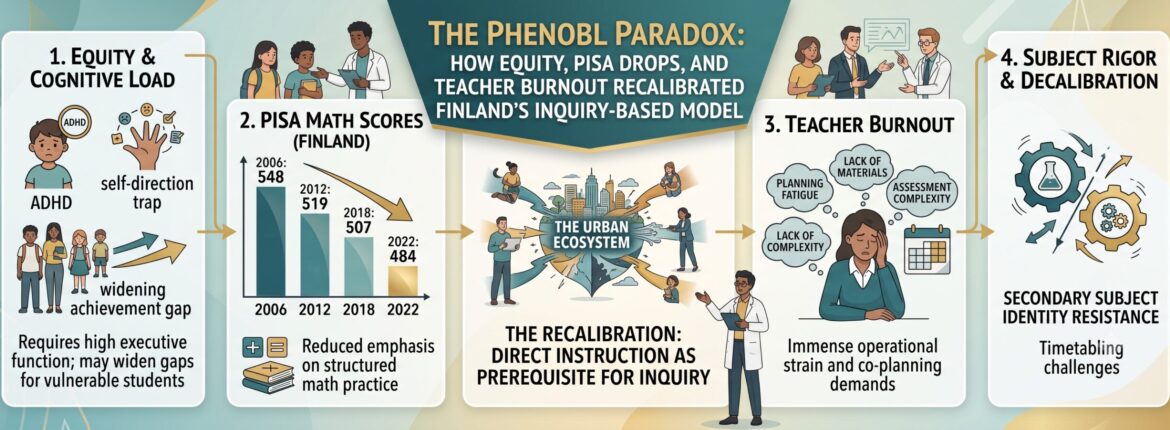
1. The Disadvantage to Struggling and Neurodivergent Students
The most urgent criticism centered on equity and cognitive load.
PhenOBL requires students to manage their own time, synthesize information across multiple fields, collaborate in groups, and direct their own learning.
- The Self-Direction Trap: Educational psychologists noted that highly self-directed learning places a massive burden on executive functioning skills. While high-performing or highly supported students thrived, students with learning differences (such as ADHD), those requiring clear structure, or children from lower socioeconomic backgrounds often struggled without explicit teacher-led direction.
- Widening Achievement Gaps: Critics argued that shifting away from direct instruction widened the gap between students who receive strong academic support at home and those who rely entirely on structured classroom time to acquire foundational skills.
2. PISA Score Drops and the "Foundational Math" Debate
Finland's historical fame in education was built on its stellar performance in international PISA (Programme for International Student Assessment) tests in the early 2000s. However, Finnish PISA scores in reading, science, and particularly mathematics began a steady decline throughout the 2010s and 2020s.
PISA Math Scores (Finland):
2006: 548  ████████████████████ (Top tier globally)
2012: 519  █████████████████
2018: 507  ████████████████
2022: 484  ██████████████
While correlation doesn't equal causation—factors like digital distraction and shifting demographics played big roles—many math educators and university professors explicitly blamed the reduced emphasis on structured, sequential practice in mathematics. They argued that abstract mathematical operations require systematic, scaffolded practice that doesn't always fit neatly into an open-ended "phenomenon."
3. Teacher Burnout & Administrative Workload
Despite Finnish teachers being highly qualified, the operational reality of PhenOBL created immense strain:
- Planning Fatigue: Designing genuinely interdisciplinary units requires extensive co-planning across subject departments. Teachers found themselves spending hours in coordination meetings trying to align distinct subjects like physics, art, and history into a cohesive theme.
- Lack of Standardized Materials: Traditional textbooks are organized by subject and sequence. Moving to open-ended phenomena meant teachers frequently had to curate, design, or create their own instructional materials from scratch.
- Assessment Complexity: Evaluating student work in a multidisciplinary, group-based project without relying on traditional tests proved difficult and time-consuming to standardize fairly.
4. Subject-Identity Resistance in Secondary Schools
In primary schools (where one teacher handles most subjects), integrating phenomena is relatively straightforward. In upper-level schools (ages 13–16), resistance was much stronger:
- Departmental Silos: Subject specialists (e.g., secondary school chemistry or history teachers) felt that PhenOBL diluted the depth and rigor of their specific disciplines in favor of broad, superficial themes.
- Timetabling Nightmares: Restructuring school schedules to allow block time for collaborative project work disrupted the traditional period grid, leading to scheduling friction and uneven pacing across the semester.
The Coordinated Shift Back Toward Balance
In response to these challenges, Finnish education authorities and municipalities did not abandon PhenOBL, but they re-calibrated its scope:
The Key Takeaway: Direct instruction and explicit skill-building are no longer treated as "outdated." Instead, Finnish schools increasingly view structured direct instruction as the essential prerequisite that gives students the foundational knowledge they need to succeed during project-based inquiry.