
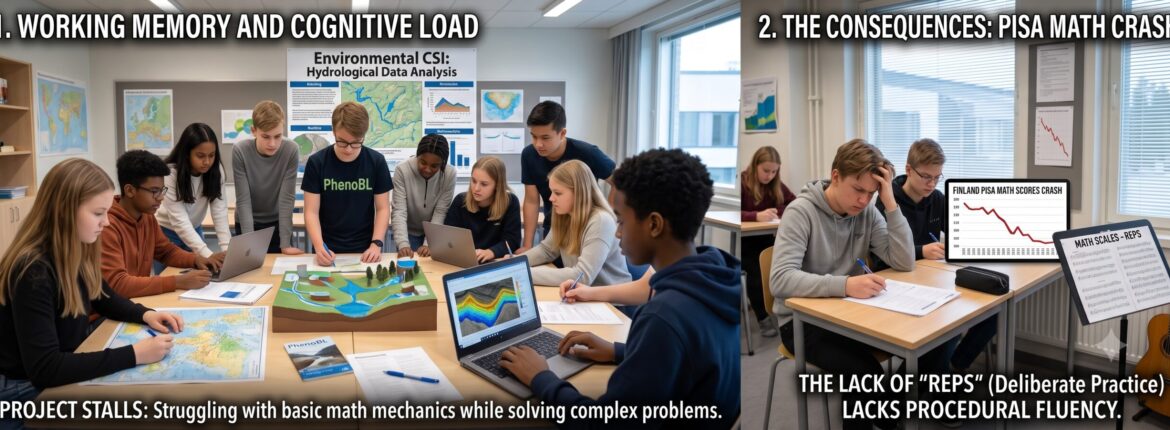
No matter how engaging, authentic, or real-world a project is, you cannot bypass the reps when it comes to math.
Mathematics is uniquely cumulative and hierarchical. While a student can jump into a complex historical or scientific phenomenon and analyze it conceptually, their ability to execute the underlying math depends on procedural fluency—and procedural fluency is built through intentional, deliberate practice.
Why "Reps" Can't Be Replaced by Projects Alone
1. Working Memory and Cognitive Load
When a student is trying to solve an open-ended, real-world problem (like analyzing hydrological data in a CSI Geology case or modeling climate trends), their working memory is already working at maximum capacity.
If they also have to struggle through basic algebraic manipulation, fractional operations, or unit conversions because they haven't automated those skills through reps, cognitive overload occurs. The project stalls out, not because the student lacks high-level problem-solving ability, but because the foundational mechanics aren't second nature.
2. The Difference Between Applying Math and Building Math
- Applying Math (Projects): Shows students why the math matters and how concepts connect to the real world.
- Building Math (Reps): Encodes procedural algorithms into long-term memory so they can be retrieved effortlessly without conscious thought.
Projects are fantastic for synthesis and motivation, but they rarely provide the high-volume, varied repetition required to achieve mathematical mastery. Trying to learn matrix operations or factoring polynomials only through a multi-week project is like trying to learn how to play an instrument by only playing full concerts without ever practicing scales.
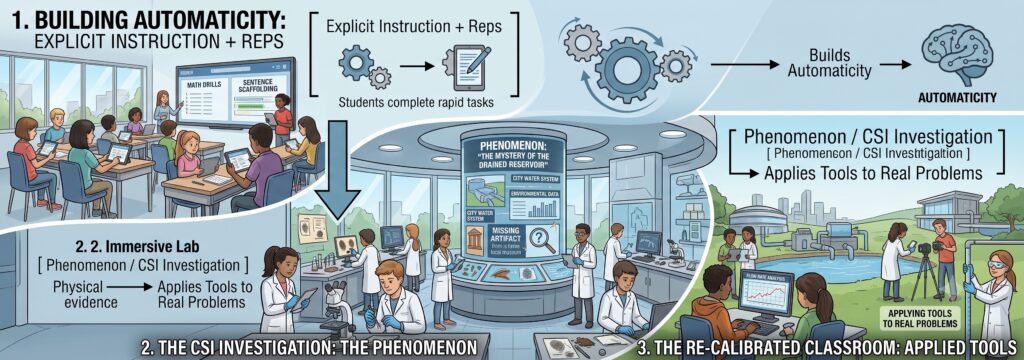
The Hybrid Fix: How the Best Systems Balance Both
The most successful implementations of project-based and phenomenon-based learning don't abandon drill-and-practice; they re-sequence it:
- Reps as "Target Practice": Skill-building drills are framed not as aimless work, but as calibrating the exact mathematical tools needed for the upcoming investigation or project.
- Short, Focused Sprints: Instead of long, passive homework sheets, reps are delivered in intense, targeted daily sprints (e.g., 10–15 minutes of dedicated procedural practice) separate from project blocks.
- Just-In-Time Skill Building: When a project hits a mathematical wall, the class pauses the main inquiry to run a quick "skills clinic" to get the necessary reps in before jumping back into the investigation.
Ultimately, open-ended inquiry gives students the desire to use the math, but targeted reps give them the craft to execute it.
References
1. Phenomenon-Based Learning & The Finnish PISA Math Shift
- Hautamäki, J., & Kupiainen, S. (2020). Learning to learn in Finland: Trends and outcomes. In H, Kupiainen & J. Hautamäki (Eds.), The Nordic education model in transition (pp. 45–68). Routledge.
- (Analyzes the longitudinal shift in Finnish educational policy, examining how the move toward open-ended, phenomenon-based curricula coincided with declines in national PISA mathematics rankings).
- OECD. (2023). PISA 2022 results (Volume I): The state of learning and equity in education. OECD Publishing. https://doi.org/10.1787/53f23881-en
- (Documents the multi-year decline in mathematical literacy across Nordic nations, highlighting the operational costs of reducing structured procedural instruction).
- Sahlberg, P. (2021). Finnish lessons 3.0: What can the world learn from educational change in Finland? (3rd ed.). Teachers College Press.
- (Provides an internal perspective on the implementation of Phenomenon-Based Learning [PhenoBL] in the 2016 Finnish National Core Curriculum).
2. Cognitive Load Theory & Working Memory Architecture
- Kirschner, P. A., Sweller, J., & Clark, R. E. (2006). Why minimal guidance during instruction does not work: An analysis of the failure of constructivist, discovery, problem-based, experiential, and inquiry-based teaching. Educational Psychologist, 41(2), 75–86. https://doi.org/10.1207/s15326985ep4102_1
- (The foundational critique of unguided/open-ended project models, demonstrating that unassisted problem-solving overloads working memory during initial skill acquisition).
- Sweller, J. (1988). Cognitive load during problem solving: Effects on learning. Cognitive Science, 12(2), 257–285. https://doi.org/10.1207/s15516709cog1202_4
- (Establishes the working memory limitations that cause cognitive overload when procedural mechanics are not automated into long-term memory).
3. Procedural Fluency, Deliberate Practice, & Schema Automation
- Ericsson, K. A., Krampe, R. T., & Tesch-Römer, C. (1993). The role of deliberate practice in the acquisition of expert performance. Psychological Review, 100(3), 363–406. https://doi.org/10.1037/0033-295X.100.3.363
- (Theoretical foundation for high-volume, intentional repetition ["reps"] in building domain-specific mastery).
- National Research Council. (2001). Adding it up: Helping children learn mathematics. J. Kilpatrick, J. Swafford, & B. Findell (Eds.). National Academy Press. https://doi.org/10.17226/9822
- (Defines the five strands of mathematical proficiency, proving that conceptual understanding and procedural fluency must be developed interdependently).
- Schneider, W., & Shiffrin, R. M. (1977). Controlled and automatic human information processing: I. Detection, search, and attention. Psychological Review, 84(1), 1–66. https://doi.org/10.1037/0033-295X.84.1.1
- (Neurocognitive framework explaining how intentional drill-and-practice transitions controlled cognitive tasks into automatic, low-effort retrieval).