
In the United States, youth sports have ballooned into a privatized, hyper-competitive $30 billion industry. Elite travel teams, expensive private academies, and year-round single-sport specialization dominate the landscape starting as early as age seven. Yet, despite this massive financial investment, America is facing an unprecedented crisis in youth physical health and social well-being: roughly 70% of American children drop out of organized sports by age 13.
While the U.S. filters out late-bloomers and squeezes lower-income families out of the game, Norway—a nation of just 5.6 million people—consistently tops global Olympic medal counts while keeping over 70% of its teenagers actively engaged in sports.
To repair its fractured youth athletic culture, reduce social isolation, and combat excessive screen time, the United States must replicate Norway's child-centered sports philosophy. And the most viable engine for this transformation is already sitting in every neighborhood: our public elementary schools, expanded with structured, extended-day play programs.
1. The American Crisis: The Privatization of Play
The decline of broad youth participation in America is not a mystery; it is the direct result of a structural shift that privatized after-school life.
Following budget cuts over the past two decades, many public school systems scaled back intramural sports, recess, and physical education. Private travel clubs quickly filled the void, introducing a "pay-to-play" pipeline that charges families thousands of dollars per child annually.
Privatized Travel Leagues (High Cost / Early Exclusion)
        │
        ├──> Socioeconomic Divide (Wealthy families play; low-income kids left out)
        ├──> Early Burnout & Injury (Year-round repetition at ages 8-12)
        └──> "Age-13 Cliff" (70% quit organized sports due to pressure and cost)
As a result:
- The Wealth Gap: Children from high-income households are nearly twice as likely to play organized sports compared to those from lower-income families.
- The Death of Pickup Games: Unstructured, neighborhood-based "sandlot" play has virtually vanished, replaced by screen time during the critical 3:00 PM to 6:00 PM window.
- Social Atrophy: Without spontaneous, peer-led games, kids miss out on early, low-stakes opportunities to practice conflict negotiation, self-regulation, and cross-age social bonding.
2. The Norwegian Blueprint: Joy Over Selection
Norway’s athletic success rests on a radical premise enshrined in its legal framework, Barneidrettens bestemmelser("Children’s Rights in Sport"): sports exist to serve the holistic development of the child, not adult competitive fantasies.
The Core Pillars of the Norwegian Model
| Feature | The American Model | The Norwegian Model |
| Early Competition | Scores, rankings, travel teams, and cuts start at ages 7–9. | No scores, league standings, or national rankings before age 13. |
| Cost & Access | High private fees ($1,000–$5,000+/year). | Highly subsidized, low-cost community-based clubs. |
| Specialization | Year-round commitment to one sport pushed early. | Multi-sport participation actively encouraged; no cuts permitted. |
| Philosophy | Scarcity & Selection (Filter out the weak early). | The Broad Funnel (Keep everyone playing as long as possible). |
By refusing to rank, cut, or stream children into "elite" versus "recreational" tracks before age 13, Norway keeps its talent pool massive. Late-maturing athletes aren't discarded, overuse injuries drop dramatically, and children build an intrinsic love for movement that carries into adulthood.
3. Why Extended Elementary School Hours Are the Solution
In the U.S., community sports clubs rarely have the infrastructure or municipal backing that Nordic countries enjoy. To scale Norway's principles nationwide, America needs a universal physical delivery system: public elementary schools operating on an extended-day schedule (e.g., 8:00 AM to 5:30 PM).
Current Reality: School ends at 3:00 PM ──> Private Travel Teams OR Screens / Isolation
Proposed Shift: School extended to 5:30 PM ──> Universal On-Site Multi-Sport Play (Norway Rules)
Integrating structured, non-competitive sports into an extended elementary school day solves America’s core structural bottlenecks:
A. It Erases the Transportation and Cost Barrier
For working parents, getting a 9-year-old to a 4:30 PM club practice across town is logistically impossible without significant flexibility and income. By embedding multi-sport play directly into an extended school day, every child—regardless of zip code or parental work schedule—gains equal access to daily coached and unscripted physical activity.
B. It Reclaims the Peak Screen-Time Window
The hours between 3:00 PM and 6:00 PM are ground zero for excessive adolescent screen time and sedentary behavior. Replacing those idle, isolated hours with structured movement, group play, and multi-sport rotation directly addresses sleep disruption, screen fatigue, and mental health decline.
C. It Recreates the "Sandlot" Environment
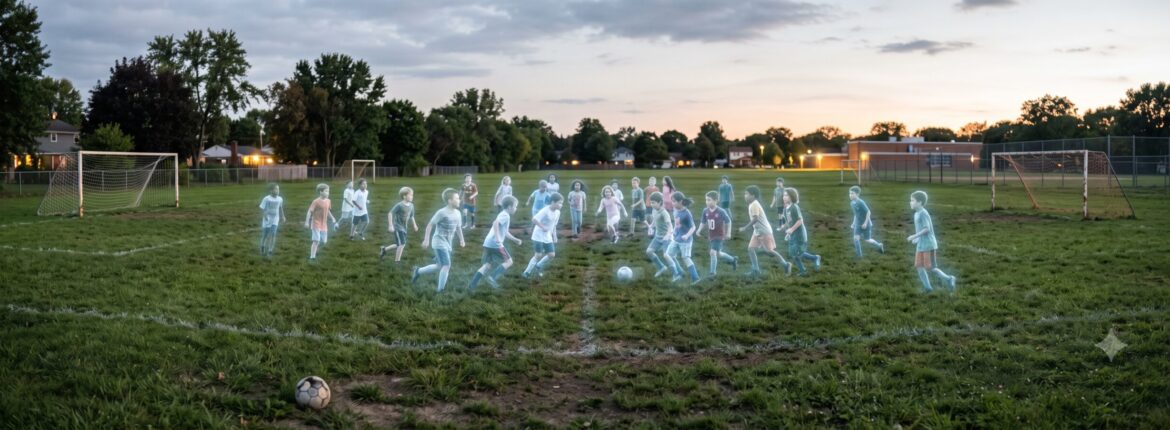
Elementary school yards provide a natural, safe setting for mixed-age, low-stakes games. Under an extended-day model governed by Norwegian principles—where coaches facilitate movement rather than strictly refereeing or tracking scores—students learn how to negotiate rules, handle minor disputes, and build genuine social stamina with peers.
4. What the Extended-Day School Model Looks Like in Practice
Transforming elementary schools into hubs for universal sport does not mean adding two extra hours of academic drills. Instead, the extended block (3:00 PM – 5:30 PM) is designed around physical movement, health, and community:
- 3:00 PM – 3:30 PM | Healthy Snack & Unstructured Outdoor Recess: Free play to burn off academic fatigue and engage in self-directed social interaction.
- 3:30 PM – 4:30 PM | Multi-Sport Rotations (No Scores): Seasonal sampling of soccer, floorball, track, basketball, gymnastics, and swimming. Every child plays; no tryouts, no cuts, no performance metrics.
- 4:30 PM – 5:30 PM | Cooperative Play & Homework Quiet Zones: A choice between low-intensity recreation (e.g., table tennis, outdoor exploration, martial arts basics) or guided academic support.
The Path Forward
The American experiment with hyper-privatized, hyper-competitive youth sports has failed our children. It has traded broad public health, literacy, and social cohesion for a multi-billion-dollar travel league ecosystem that leaves most kids on the sidelines by middle school.
By adopting Norway's commitment to joy, inclusion, and delay of early ranking—and anchoring that philosophy inside extended-day elementary schools—the United States can rebuild its youth culture. In doing so, we won't just foster the next generation of resilient athletes; we will raise healthier, more focused, and socially connected human beings.