
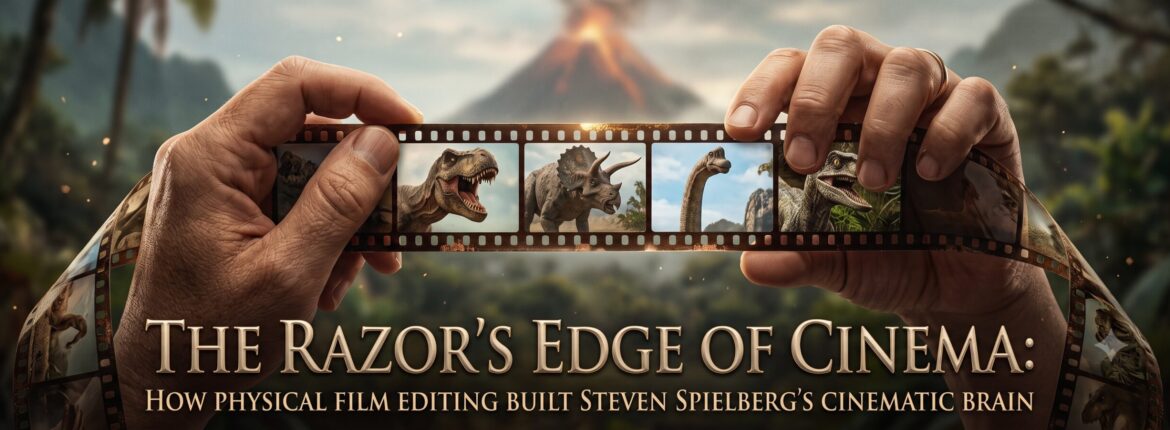
Long before he ever set foot on a Hollywood soundstage, a teenage Steven Spielberg sat at a small desk in his bedroom running 8mm and 16mm celluloid through his fingers. He held strips of film up to a light bulb, marked individual frames with grease pencils, scraped off emulsion, and physically spliced shots together using razor blades and tape.
To the casual observer, this was just the tedious, mechanical labor required to make movies in the mid-20th century. But to the neuroscientist, young Spielberg was doing something far more radical: he was using physical friction and real-time Sensorimotor Inference (SMI) to build a high-resolution 3D map of visual narrative in his neocortex.
In an era where modern cinema is edited on frictionless, digital software—where a cut is made with the click of a mouse and instantly reversed with a keystroke—Spielberg’s visual grammar remains distinct. His legendary camera blocking, razor-sharp pacing, and uncanny spatial geography were not born in a film theory classroom. They were forged through the physical, tactile resistance of cutting film by hand.
1. The Neurobiology of Tactile Pacing: Why High Friction Built Better Rhythm
In neuroscientist Jeff Hawkins’ Thousand Brains model, the neocortex learns by issuing motor commands, predicting sensory feedback, and recalibrating its internal reference frames based on prediction errors.
When an editor works digitally on a modern computer timeline, the feedback loop is fast, abstract, and virtually frictionless:
Because digital editing carries no physical cost, editors often cut by trial-and-error, slapping shots on a timeline and tweaking them endlessly.
Physical film editing offered zero cushion. A 35mm film frame moves past a projector lens at exactly 24 frames per second. To cut a shot three frames earlier, young Spielberg had to physically touch the celluloid, count the individual rectangular frames passing through his fingers, and physically slice the strip.
If he miscalculated, repairing the film meant re-splicing, adding tape, and creating a messy "jump" in the physical strip. The cost of a bad prediction was high.
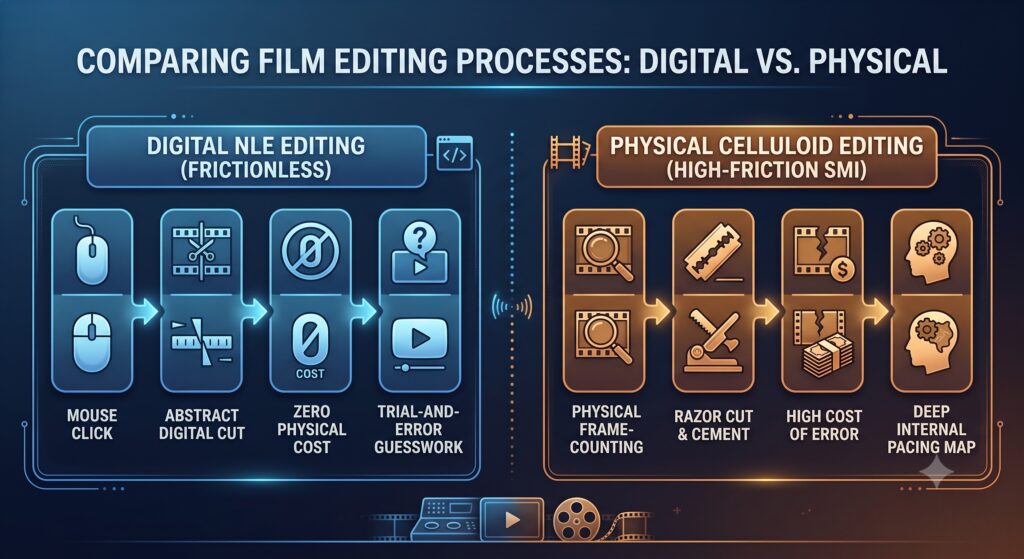
This high-friction environment forced Spielberg’s neocortex to construct an insanely precise internal clock. He learned to "feel" the length of a shot in his hands before he ever cut it. The physical resistance of the medium trained his prefrontal cortex to execute high-level temporal planning, building an internal reference frame for visual rhythm that makes his pacing feel effortless and invisible.
2. "Editing in the Camera": Physical Reference Frames on Set
Because Spielberg mastered the mechanics of the editing bench first, his brain entered the film set with a completely different spatial map than directors who shoot endlessly and "figure it out in the edit."
Spielberg is world-renowned for "editing in the camera"—directing long, fluid master shots that dynamically shift from wide shots to medium shots to tight close-ups without a single physical cut.
When Spielberg moves a camera through 3D space:
- Eye-Tracking Geometry: Having spent thousands of hours staring at tiny physical film frames, he knows precisely where the audience's gaze will land on screen when an actor moves across the frame.
- Spatial Continuity: Because his brain processes scene construction through spatial reference frames, his long takes never feel like gimmicks. The camera moves through a physical room much like a hand moves over an object—constantly updating the audience's internal map of the location.
3. The Last Holdouts: The Michael Kahn Partnership
Spielberg’s belief in the sensorimotor power of physical film was so absolute that he and his long-time editor, Michael Kahn, became the most famous digital holdouts in cinema history.
Through the 1990s and 2000s, while the rest of Hollywood embraced computer editing, Spielberg and Kahn continued to edit blockbusters like Jurassic Park, Schindler's List, and Saving Private Ryan on physical KEM flatbed editing machines, surrounded by physical bins overflowing with strips of celluloid.
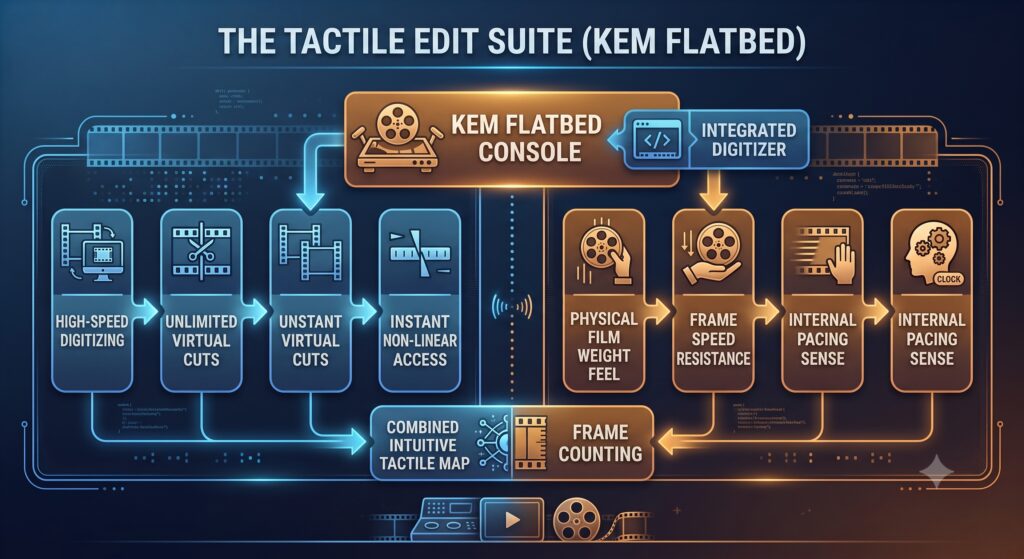
In a trim bin, scenes hung physically on hooks according to their length. Kahn and Spielberg could look across the room and see the spatial density of the movie hanging in air. To lengthen a scene, they physically reached for a longer strip of film.
Handling the physical rolls gave them a multi-sensory, 3D anchor for the narrative. It slowed down decision-making just enough to force deep reflection, preventing the impulsive, over-edited chaos that characterized many early digital films.
The Takeaway: Genius is Forged in Resistance
Modern tools prioritize ease, speed, and the removal of friction. But as Steven Spielberg’s career proves, removing friction often removes the very signals the human brain needs to achieve true mastery.
Just like an expert golfer choosing an unforgiving forged blade to sharpen their feel, or an auto mechanic diagnosing an engine through micro-vibration, Spielberg built his genius on a medium that talked back physically.
By mastering the craft of visual storytelling through the raw, unforgiving resistance of razor blades, photochemistry, and mechanical gears, his neocortex developed an unshakeable spatial and temporal grammar—proving that when you embrace physical friction, you don't just learn a skill; you change the way your brain sees the world.