
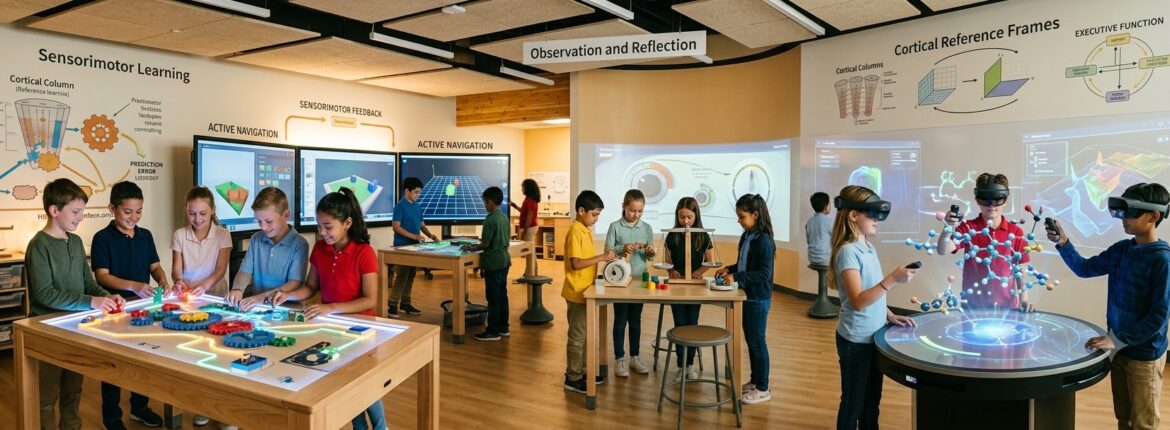
For decades, traditional pedagogy has operated on a foundational assumption: if a teacher presents information clearly enough, the student's brain will absorb it. We design classrooms around passive listening, abstract lectures, and symbolic worksheets, treating the mind like a empty vessel waiting to be filled with facts.
Neuroscience tells a radically different story.
In his groundbreaking work A Thousand Brains, neuroscientist Jeff Hawkins presented a fundamental shift in our understanding of human cognition: the brain does not passively record information like a computer—it learns continuously by moving sensors through space.
When we apply Hawkins' sensorimotor framework to classroom instruction, we don't just transform how academic content is learned—we fundamentally upgrade the neurobiological engine of learning itself: Executive Function (EF).
Part 1: The Hawkins Framework & Neocortical Reference Frames
To understand why active movement transforms learning, we have to look at the structure of the neocortex. In Hawkins' model, the brain's outer layer consists of roughly 150,000 cortical columns. Each column acts as an independent learning machine that constructs complete 3D models of objects and abstract concepts.
Crucially, these cortical columns do not store information as static facts. Instead, they anchor sensory inputs to reference frames—internal coordinate systems, similar to mental maps or GPS grids.
How Reference Frames Work
- Movement as Inquiry: The brain moves a sensor (a finger tracing a shape, eyes scanning a diagram, a hand adjusting a lever) through space.
- Location-Based Prediction: With every movement, the neocortex predicts what sensory feedback it should receive at that specific coordinate in the reference frame.
- Continuous Recalibration: If the feedback matches the prediction, the mental model is reinforced. If it differs, a prediction error fires, instantly recalibrating the internal map.
Knowledge is not abstract; it is built through continuous physical and mental exploration across structured coordinate systems.
Part 2: Upgrading Executive Function Through Sensorimotor Inference
Executive Function—the prefrontal cortex’s system for working memory, inhibitory control, and cognitive flexibility—is often treated as a fixed trait or a set of behavioral rules ("sit still," "pay attention").
However, when learning is anchored in real-time sensorimotor feedback, Executive Function development doesn't just increase passively—it is explicitly recruited, exercised, and strengthened.
Integrating real-time sensorimotor inference directly enhances the three core pillars of EF:
1. Working Memory: Offloading and Anchoring
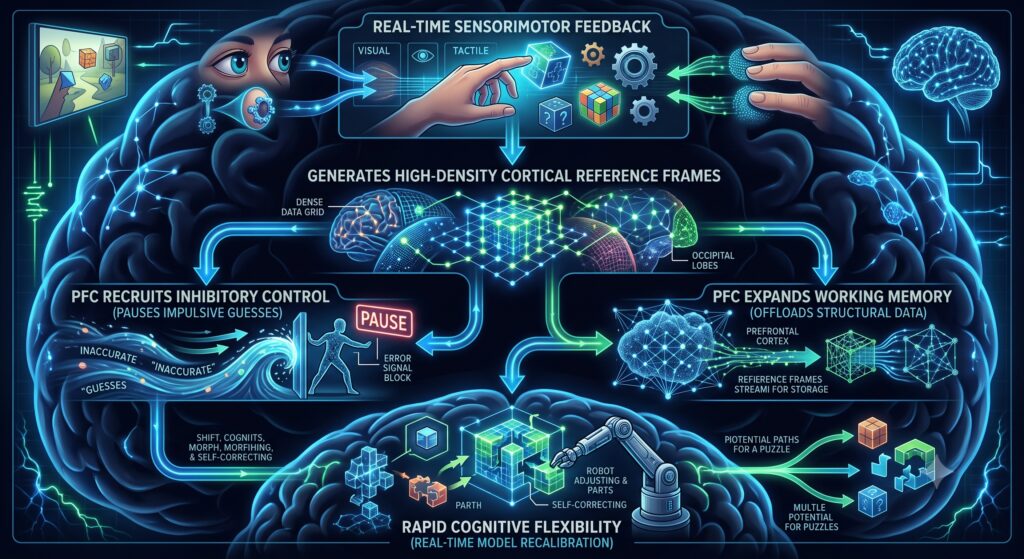
Working memory in a passive classroom is easily overwhelmed. A student trying to grasp algebraic equivalence must mentally hold abstract symbols in auditory short-term memory while simultaneously performing calculations.
When a student manipulates a physical balance scale or interacts with a dynamic spatial grid, the physical environment acts as an external anchor. By offloading raw structural data onto the physical reference frame, working memory is freed from maintenance tasks. The prefrontal cortex can now dedicate its limited bandwidth to higher-order strategy, pattern recognition, and deep analysis.
2. Inhibitory Control: The Prediction-Error Engine
Inhibitory control is the ability to suppress impulsive, knee-jerk reactions in favor of deliberate action. Passive environments encourage mindless guessing because there is no immediate consequence for an incorrect mental jump.
In a sensorimotor feedback loop, every action triggers an immediate prediction. If a student turns a dial or moves a manipulative, their neocortex instantly expects a specific output. When a mismatch occurs, the resulting prediction errorforces the prefrontal cortex to intercede. It pauses the impulsive behavior, stopping wild guessing in its tracks and forcing the brain to recalibrate before taking the next step.
3. Cognitive Flexibility: Multi-Frame Consensus
Cognitive flexibility is the ability to pivot when a strategy fails and view problems through multiple lenses. Hawkins demonstrated that hundreds of cortical columns build independent models of the same concept simultaneously, voting via lateral connections to reach consensus.
Single-modality learning (e.g., reading a textbook definition) builds a single, fragile reference frame. When the context shifts slightly, the student gets stuck. Multi-sensory feedback forces multiple cortical columns to synchronize across spatial, tactile, visual, and symbolic domains. The student realizes the core concept exists independently of any single representation, allowing them to fluidly switch problem-solving strategies on the fly.
Part 3: Access Routes vs. Execution Quality ("More Doors & Richer Execution")
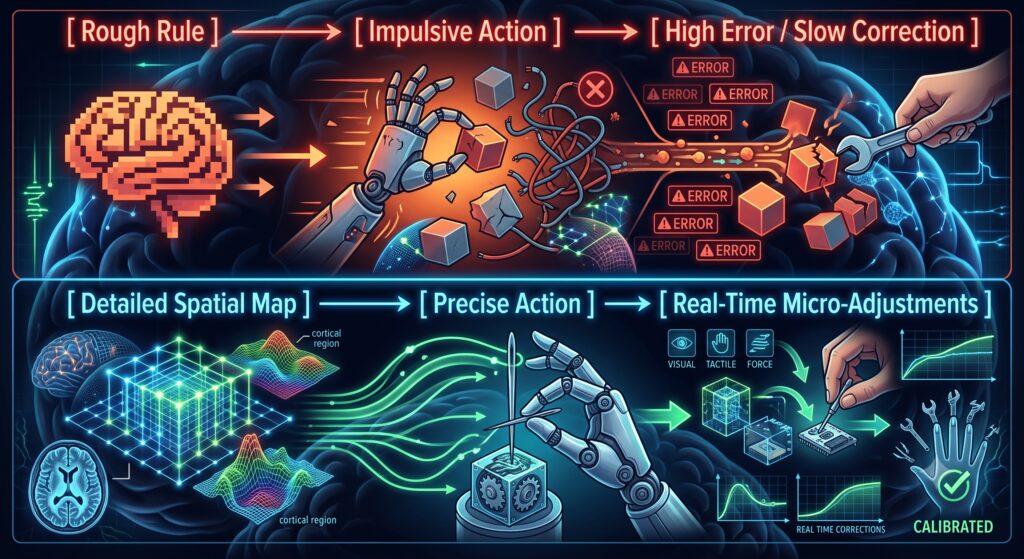
Using sensorimotor inference to build Executive Function achieves two distinct neurological upgrades: it expands the access routes to EF skills, and it elevates the fidelity of their execution.
1. More Doors: Multiple Anchor Points
When a concept is stored passively, it relies on a narrow, localized cluster of neurons. If that pathway is blocked by stress, fatigue, or an unfamiliar question format, access fails.
Sensorimotor inference constructs parallel reference frames across thousands of laterally connected columns:
- Tactile/Spatial: What the structure feels like and how it occupies space.
- Motor-Command: The physical actions required to alter the system.
- Visual-Predictive: The expected environmental changes during manipulation.
- Symbolic/Formal: The abstract rules or equations describing the state.
Because these frames are densely linked, triggering any single frame immediately activates the rest. You haven't built a single fragile footpath; you've created an interconnected highway network.
2. Richer Execution: High-Resolution Reference Frames
The quality of EF execution depends entirely on the resolution of the internal map guiding it:
- Precision over Brute Force: Inhibitory control in a passive classroom is blunt—like slamming on the brakes. Trained through real-time feedback, it becomes a system of fine-tuned micro-adjustments.
- Fluidity and Speed: Because spatial reference frames reduce working memory load, executive tasks are executed with lower cognitive fatigue and greater athletic fluidity.
Part 4: Translating Theory into Daily Lesson Design
To bring Hawkins' framework into day-to-day instruction, lesson design must shift from passive presentation to active coordinate exploration.
Traditional Pedagogy: "If I present the information clearly enough, students will absorb it."
Sensorimotor Pedagogy: "Unless the student actively moves through a reference frame to make and test predictions, their cortical columns cannot build a model."
The 4 Structural Shifts of Sensorimotor Lesson Design
- Establish the Reference Frame First: Provide an explicit structural grid (e.g., spatial matrix, coordinate plane, physical layout) before introducing raw facts or definitions.
- Embed Action-Prediction-Observation Loops: Structure every 10–15 minutes around a rapid micro-cycle: Act(manipulate a variable), Predict (commit to an outcome), and Observe (recalibrate based on real-time feedback).
- Build "Thousand Brains" Consensus: Present every concept across 3–4 distinct mediums within the same period (tactile, visual, symbolic, narrative) to force cross-column voting.
- Demand Instantaneous Feedback: Ensure sensorimotor feedback occurs within the neocortex's active timing window (milliseconds to seconds) so prediction loops close in real time.
Practical Blueprint: Traditional vs. Sensorimotor Lesson Plan
Here is how a standard 50-minute lesson on Photosynthesis & Cellular Respiration transforms under Hawkins’ framework:
| Lesson Phase | Traditional Model | Hawkins Sensorimotor Model |
| Hook & Orient (5-10 min) | Teacher defines chemical equations on the board. | Grid Construction: Students build a 2x2 physical matrix on their desks (Inputs vs. Outputs / Chloroplast vs. Mitochondrion) using tangible tokens. |
| Exploration(15-20 min) | Students read textbook diagrams and take notes. | Prediction Loops: Using an interactive simulation, students alter light/oxygen levels, predict biological outputs, and observe system adjustments in real time. |
| Synthesis (15 min) | Teacher conducts a Q&A session. | Consensus Voting: Groups present their models across three mediums (narrative story, balanced chemical equation, visual cycle diagram) to reconcile discrepancies. |
| Check for Understanding | Exit slip asking for definitions. | Reference Frame Transfer: Students place a new scenario (e.g., "a plant in a sealed dark box") onto their established matrix without teacher prompts. |
The Classroom as an Executive Function Accelerator
When we design lessons around sensorimotor inference, we do more than make academic content engaging. We align classroom instruction with the biological operating system of the human neocortex.
By forcing the brain to navigate structured reference frames, test predictions in real time, and reconcile multi-sensory feedback, we build dense cognitive networks. The result is a learning environment that doesn't just deliver curriculum—it actively builds stronger, more agile, and highly adaptable minds.