
Executive Summary
Modern educational technology operates on the implicit premise that digital interfaces—touchscreens, keyboards, and interactive software—are functional equivalents to physical, tactile interaction. However, advances in neocortical modeling (specifically Jeff Hawkins’ Thousand Brains Theory of Intelligence) and embodied cognitive neuroscience expose a fundamental flaw in this assumption: skill transfer between physical reality and digital simulation is strictly asymmetric.
Physical action creates dense sensorimotor reference frames in the neocortex that allow an individual to later utilize digital technology as a high-level visualization tool. Conversely, digital interaction alone fails to construct these foundational reference frames. When applied to mathematics, forcing digital tools onto novice learners strips the brain of the fine-grained motor-sensory feedback loops required to map spatial logic and abstract symbolic relationships.
1. Neocortical Modeling: Sensorimotor Inference & Reference Frames
Under traditional educational models, learning was viewed as a passive, input-only processing system—the brain receives visual information, processes it, and stores it as an abstract concept. Modern neuroscience upends this paradigm:
- Predictive Processing & Action: The neocortex consists of thousands of cortical columns, each continually predicting sensory input based on motor output. Learning is an active loop: the brain moves a sensory organ (e.g., hand, eyes) and predicts how the sensory stream will change as a result.
- Spatial Reference Frames: Cortical columns assign information to specific spatial reference frames—similar to $3\text{D}$ coordinate systems—regardless of whether the concept is physical (navigating a room) or abstract (solving an algebraic equation).
When motor action is decoupled from sensory feedback, these cortical reference frames fail to form or become severely degraded.
2. The Asymmetry Principle: Physical Mastery vs. Digital Interfaces
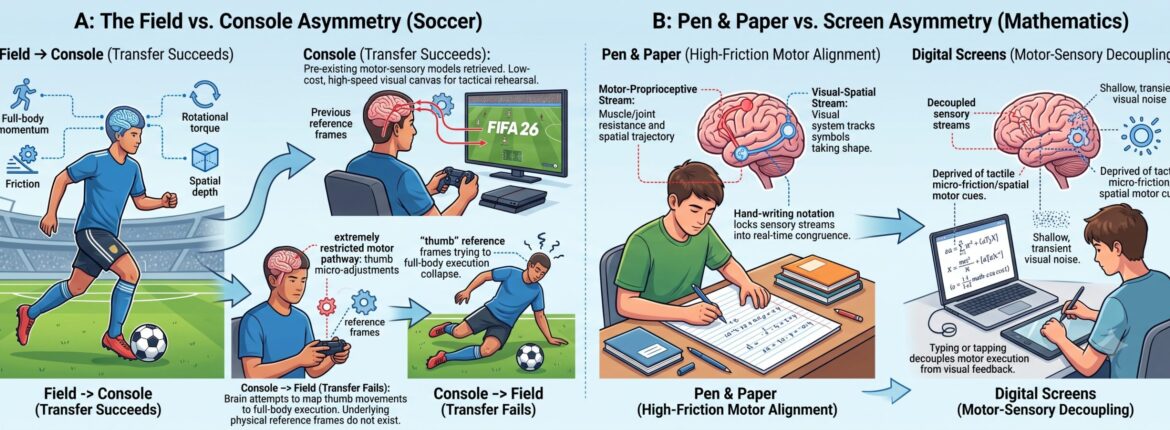
The neural mechanism governing this asymmetry can be mapped across both physical athletics and abstract mathematics.
Case Study A: The Field vs. Console Asymmetry (Soccer)
- Field Console (Transfer Succeeds): An athlete who plays soccer on a physical pitch constructs high-resolution neocortical reference frames representing full-body momentum, rotational torque, friction, and spatial depth. When playing a console simulation like FIFA 26, their brain retrieves these pre-existing motor-sensory models. The video game acts as a low-cost, high-speed visual canvas for tactical rehearsal and spatial visualization.
- Console Field (Transfer Fails): A gamer interacting solely with a console trains an extremely restricted motor pathway: thumb micro-adjustments on plastic joysticks. The motor cortex builds zero reference frames for full-body balance, momentum, or foot-eye coordination. Placed on an actual field, the brain’s attempt to map thumb movements to full-body execution collapses because the underlying physical reference frames do not exist.
Case Study B: Pen & Paper vs. Screen Asymmetry (Mathematics)
- Pen to Paper (High-Friction Motor Alignment): Hand-writing mathematical notation locks two sensory streams into real-time congruence:
- Motor-Proprioceptive Stream: Muscles and joints register the exact physical resistance, speed, and spatial trajectory required to sweep a fraction bar or draw a radical sign.
- Visual-Spatial Stream: The visual system tracks the symbol taking shape in the exact spatial coordinate where the hand placed it.This congruence builds durable spatial reference frames for relational concepts (e.g., numerator vs. denominator, equivalence, variable substitution).
- Digital Screens (Motor-Sensory Decoupling): Typing mathematical code (LaTeX) or tapping a flat glass screen decouples motor execution from visual feedback. Pressing a flat key in the corner of a keyboard bears zero spatial or structural relation to a fraction appearing on a screen. Deprived of tactile micro-friction and spatial motor cues, the neocortex processes the mathematical symbols as shallow, transient visual noise.
3. Structural Comparison Matrix
| Dimension | Physical / Analogue Foundation (Pen & Paper / Pitch) | Digital / Screen-First Interface (Tablets / Consoles) |
| Motor Output | High-dimensional: Fine motor control, micro-friction, multi-joint spatial positioning. | Low-dimensional: Uniform tapping, sliding on frictionless glass, thumb-flicks. |
| Sensorimotor Inference | Aligned: Motor prediction directly matches real-time visual and tactile sensory feedback. | Decoupled: Finger movement bears no structural relation to generated visual symbols. |
| Cortical Reference Frames | Dense, durable $3\text{D}$ spatial models built into neocortical cortical columns. | Transient, shallow visual cues lacking proprioceptive anchors. |
| Target Learner Utility | Essential for Novices: Builds the fundamental mental architecture from scratch. | Useful for Experts: Serves as a rapid visualization engine for pre-existing models. |
4. Educational Implications: Why the "Neo-Basics" Pivot is Scientifically Inevitable
The neurobiological asymmetry explains why international education policies are rapidly pivoting back to "neo-basics." When school systems attempt to skip the analogue phase—introducing digital screens to novice learners in early mathematics—they disrupt the natural cortical process of reference-frame construction.
Digital technology is a powerful tool for expert visualization, not novice construction. A mathematician or engineer can comfortably work in a digital CAD environment or write LaTeX because their neocortex already possesses rich, hand-drawn spatial models to project onto the screen. By forcing pen-and-paper mechanics in early mathematics, educators ensure that students construct those foundational reference frames first—allowing technology to eventually act as an amplifier of knowledge rather than a barrier to it.
References
- Hawkins, J. (2021). A Thousand Brains: A New Theory of Intelligence. Basic Books. (Cortical columns, grid-like reference frames, and sensorimotor inference).
- James, K. H., & Engelhardt, L. (2012). The effects of handwriting experience on functional brain development in pre-literate children. Trends in Neuroscience and Education, 1(1), 32–42.
- Mueller, P. A., & Oppenheimer, D. M. (2014). The pen is mightier than the keyboard: Advantages of longhand over laptop note taking. Psychological Science, 25(6), 1159–1168.
- Mangen, A., & Velay, J. L. (2010). Digitizing literacy: Reflections on the haptics of writing. Advances in Haptics, 385–401.
- Kiefer, M., & Velay, J. L. (2016). Writing in the digital age: The role of haptic feedback in handwriting acquisition. Frontiers in Psychology, 7, 990.
- Varela, F. J., Thompson, E., & Rosch, E. (2017). The Embodied Mind: Cognitive Science and Human Experience. MIT Press.