
In discussions of modern industrial titanhood, Steve Jobs and Elon Musk are frequently grouped together as singular tech visionaries who bent global industries to their will. Yet placing them in the same cognitive category fundamentally misunderstands how their minds process information, evaluate risk, and execute strategy.
While Musk operates as a first-principles optimizer, breaking complex physical systems down to their raw economic and material limits, Jobs operated through predictive empathy and spatial-narrative leverage—a capacity to project how millions of humans would emotionally respond to a cultural artifact, and then timing the market around that emotional payload.
Nowhere is this cognitive divide clearer than in the high-stakes financial gamble of Pixar’s 1995 Initial Public Offering (IPO).
The Backdrop: Steve Jobs and the Pixar IPO Gambit
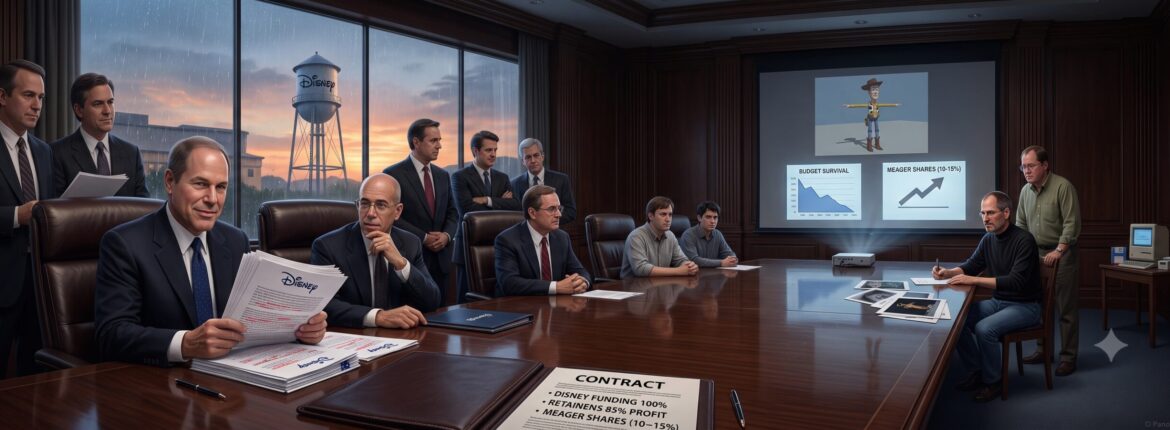
In 1991, Pixar was a cash-strapped computer hardware and software outfit bleeding money. To survive, Jobs negotiated a deal with Walt Disney Pictures and its CEO, Michael Eisner, to produce three computer-animated feature films. Because Pixar had no leverage, Disney extracted brutal terms: Disney fully financed the production, owned the characters and IP outright, and paid Pixar a meager 10% to 15% share of net profits. As Jobs later reflected, a single box-office flop under that contract would have annihilated Pixar financially.
The turning point came in late 1995 as Pixar prepared to release Toy Story. Jobs watched early cuts of the film—not as an engineer evaluating graphics pipelines or rendering algorithms, but as an audience member experiencing the emotional narrative of Woody and Buzz.
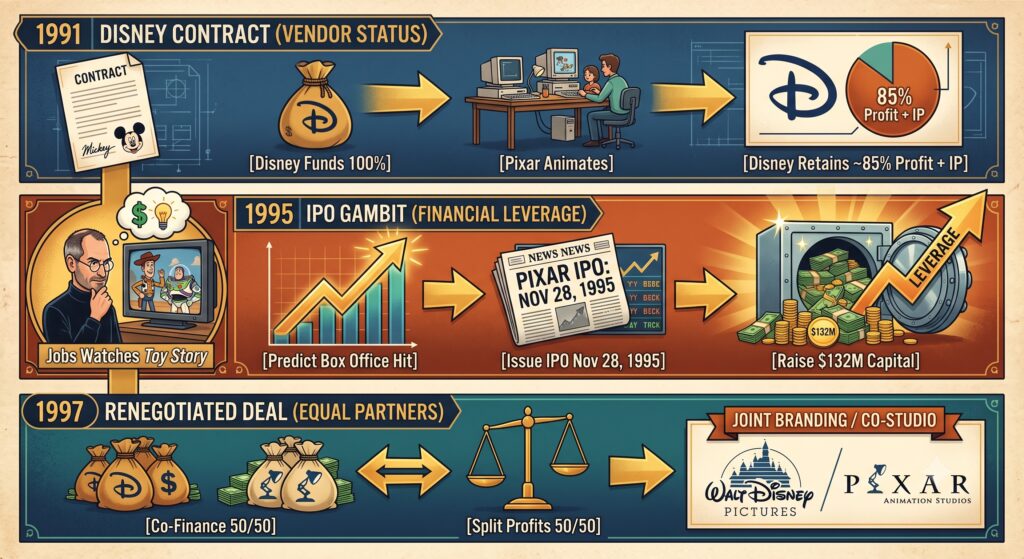
Jobs experienced a visceral realization: Toy Story was going to melt hearts, redefine animation, and dominate the global box office. He deduced that Michael Eisner did not yet grasp the magnitude of the cultural asset Disney was holding.
If Pixar waited until after Toy Story finished its theatrical run to raise capital, Disney would dictate terms for all future projects. Instead, alongside CFO Lawrence Levy, Jobs engineered a high-wire financial maneuver: he scheduled Pixar’s IPO for November 28, 1995—just six days after Toy Story opened in theaters over Thanksgiving weekend.
The gamble paid off spectacularly. Toy Story opened to a record-breaking $30 million weekend. Buoyed by the box-office euphoria, Pixar’s IPO became the largest tech offering of 1995, raising $132 million and valuing the company at $1.5 billion. With a fortified balance sheet, Jobs returned to Eisner with undeniable leverage: Pixar would now co-finance its films 50/50, claim 50% of all profits, and demand equal billing on every product.
Two Divergent Cognitive Engines
The Pixar IPO illustrates a form of strategic intuition that highlights the core cognitive differences between Jobs and Musk.
| Strategic Dimension | Steve Jobs (The Narrative Visualizer) | Elon Musk (The Systemic Optimizer) |
| Primary Lens | Emotional resonance, human experience, and narrative. | First-principles physics, unit economics, and material limits. |
| Core Question | "How will people feel when they experience this?" | "What do the physical laws dictate this machine should cost?" |
| Execution Method | Strategic leverage, cultural timing, and aesthetic synthesis. | Vertical integration, rapid iteration, and manufacturing scale. |
| Strategic Trigger | Experiencing a narrative shift and projecting collective reaction. | Deconstructing a bill of materials to eliminate friction and cost. |
1. Predictive Empathy vs. Physics-Based Logic
Jobs’ capacity to pull off the Pixar IPO relied on predictive empathy: the ability to use one’s own visceral, emotional reaction as an accurate proxy for millions of consumers. Jobs wasn't running focus groups or reviewing box-office algorithms; he trusted his personal response to the story. He recognized that emotional resonance creates cultural momentum, and cultural momentum can be converted into immense financial and contractual leverage.
Musk’s cognitive engine, by contrast, relies on reductionist, first-principles logic. When Musk evaluates an industry—whether aerospace or electric vehicles—he doesn't start with cultural feeling or brand narrative. He calculates the raw material cost of an asset (e.g., the raw aluminum, titanium, and carbon fiber in a rocket) against its final market price. Upon discovering that raw materials account for roughly 3% of a traditional rocket’s cost, he deduced that the remaining 97% was purely manufacturing friction, bureaucracy, and supply-chain markup—leading directly to the founding of SpaceX.
2. The Nature of the "Fundamental Leap"
Because Jobs operated through spatial-cinematic synthesis, his breakthroughs were frequently category-creating leaps. Looking at an early Apple I motherboard or a rough cut of Toy Story, Jobs ran an internal "movie" that projected a non-existent future—visualizing a desktop computer in every living room or a computer graphics unit transforming into a legendary animation studio.
Musk’s genius lies not in inventing brand-new categories, but in radical systemic optimization. Electric cars, AC induction motors, lithium-ion battery packs, liquid-fueled rockets, and tunnel-boring machines all existed long before Musk entered those sectors. His contribution is the relentless engineering optimization of "the machine that builds the machine"—stripping away overhead, vertically integrating suppliers, and driving costs down to the physical limits allowed by physics.
Conclusion
To evaluate Elon Musk through the lens of Steve Jobs—or to expect Musk to pull off a cultural maneuver like the Pixar IPO—is to confuse two distinct modes of human brilliance.
Musk is a master of physical systems, engineering velocity, and material scaling. Jobs was a master of narrative leverage, human emotion, and cultural timing. Musk forces industries to submit through the sheer force of physics and manufacturing execution; Jobs reshaped industries by sensing where human desire was moving, stepping into that future first, and forcing the rest of the corporate world to catch up.
References
- Catmull, Ed, and Amy Wallace. Creativity, Inc.: Overcoming the Unseen Forces That Stand in the Way of True Inspiration. Random House, 2014. (Details the internal culture of Pixar and Steve Jobs’ strategic evolution as a leader).
- Levy, Lawrence. To Pixar and Beyond: My Unlikely Journey with Steve Jobs to Make Entertainment History. Houghton Mifflin Harcourt, 2016. (Provides a first-hand account of the financial mechanics and strategic timing behind Pixar’s 1995 IPO).
- Isaacson, Walter. Steve Jobs. Simon & Schuster, 2011. (Examines Jobs’ negotiation tactics with Michael Eisner and Disney).
- Isaacson, Walter. Elon Musk. Simon & Schuster, 2023. (Outlines Musk’s first-principles framework, manufacturing philosophy, and approach to SpaceX and Tesla).
- Vance, Ashlee. Elon Musk: Tesla, SpaceX, and the Quest for a Fantastic Future. HarperCollins, 2015. (Analyzes the deconstruction of aerospace supply chains and unit economics).
- Pixar Animation Studios. "Our Story." Pixar.com, 1995/2025. (Confirms the historical dates of the Toy Story release on Nov 22, 1995, and the IPO on Nov 28, 1995).
- The Steve Jobs Archive. "Pixar: The Early Days." SteveJobsArchive.com, Nov. 2025. (Archival video and transcripts detailing Jobs' perspective on Pixar's studio model and renegotiation with Disney).