
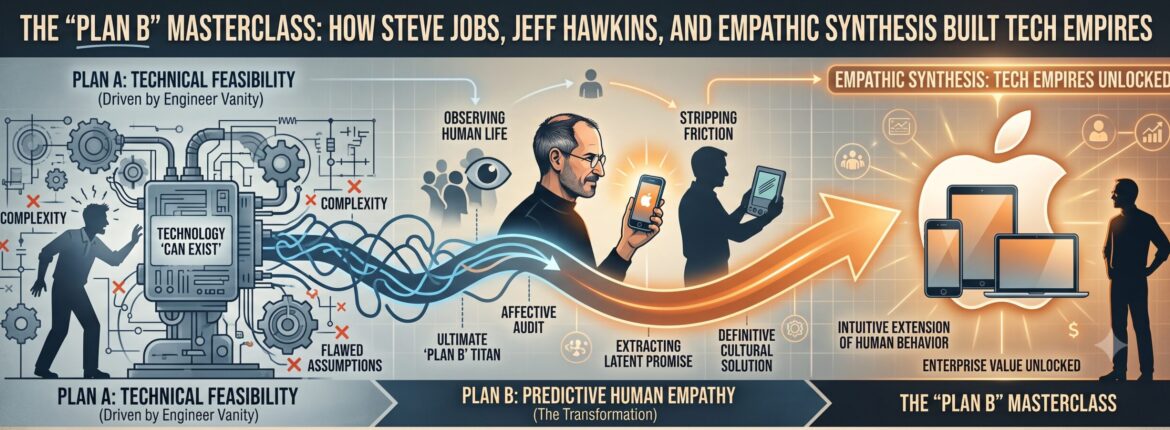
In Silicon Valley, there is a pervasive founding myth: a startup launches with a grand vision (Plan A), fails on its initial assumptions, preserves its remaining capital, and pivots to an unexpected alternative (Plan B)—where the real enterprise value is unlocked.
While commentators often attribute this phenomenon to luck or simple persistence, the structural reality is far more profound. Plan A is almost always driven by technological feasibility—engineers proving that a novel capability canexist. Plan B, when executed successfully, is driven by predictive human empathy—a founder stepping past technical vanity, observing how people actually live, and stripping away friction until the technology becomes an intuitive extension of human behavior.
No company embodied this transformation more radically than Apple. Under Steve Jobs, Apple evolved into the ultimate "Plan B" titan—a powerhouse that rarely invented raw underlying technology, but systematically audited the flawed, "sucky" Plan A attempts of competitors, extracted their latent promise, and delivered the definitive cultural solution.
The Genesis of the Pattern: From Apple Lisa to Macintosh
The archetype of the Plan A/Plan B dynamic was forged inside Apple itself during the development of the graphical user interface (GUI).
In 1979, after visiting Xerox PARC, Steve Jobs recognized that visual, mouse-driven computing represented the future of human-computer interaction. Apple’s original attempt to commercialize this insight was the Apple Lisa (Plan A). Introduced in 1983 at a staggering price tag of $9,995 (roughly $30,000 today), the Lisa was an engineering marvel packed with advanced features like cooperative multitasking, protected memory, and complex bundled office software.
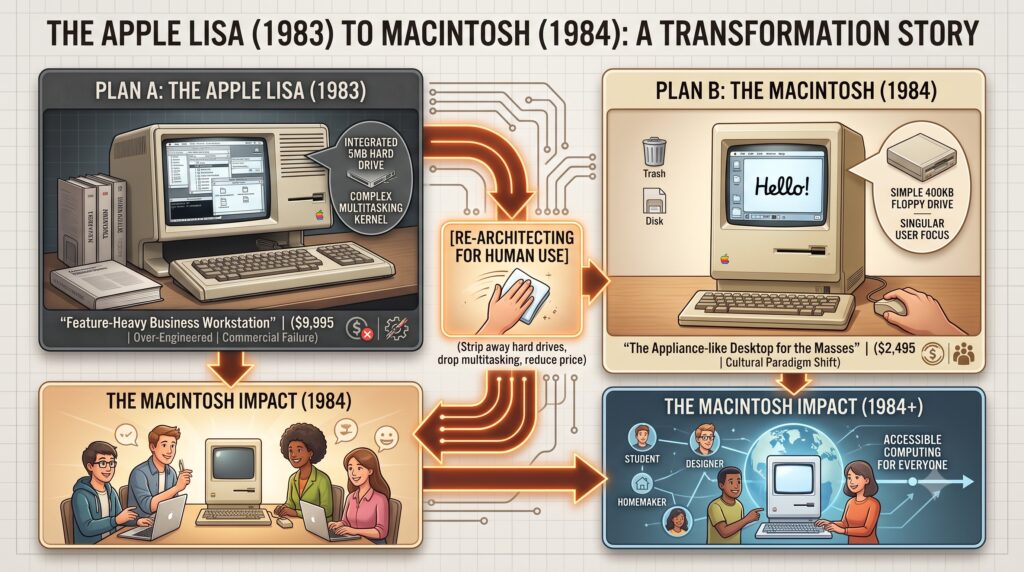
Yet, the Lisa was a commercial disaster. It was sluggish, prohibitively expensive, and aimed at corporate enterprise buyers who preferred IBM mainframes. After being ousted from the Lisa project by Apple management, Jobs seized control of Jef Raskin’s low-cost Macintosh initiative. He transformed the Macintosh into Plan B: a streamlined, stripped-down adaptation of Lisa’s core GUI ideas. By eliminating the expensive hard drive, dropping complex multitasking, and cutting the price to $2,495, Jobs delivered the consumer appliance that defined modern personal computing.
Jeff Hawkins, Palm, and the "Day-Timer" Epiphany
The necessity of capital runway and predictive empathy in executing Plan B is equally illustrated by Jeff Hawkins and Palm Computing.
In 1993, Palm released the Casio Zoomer (Plan A), attempting to build a miniature desktop computer that could decipher natural cursive handwriting. Like Apple’s Newton, the Zoomer failed because it tried to force desktop computing paradigms onto a tiny, slow handheld screen.
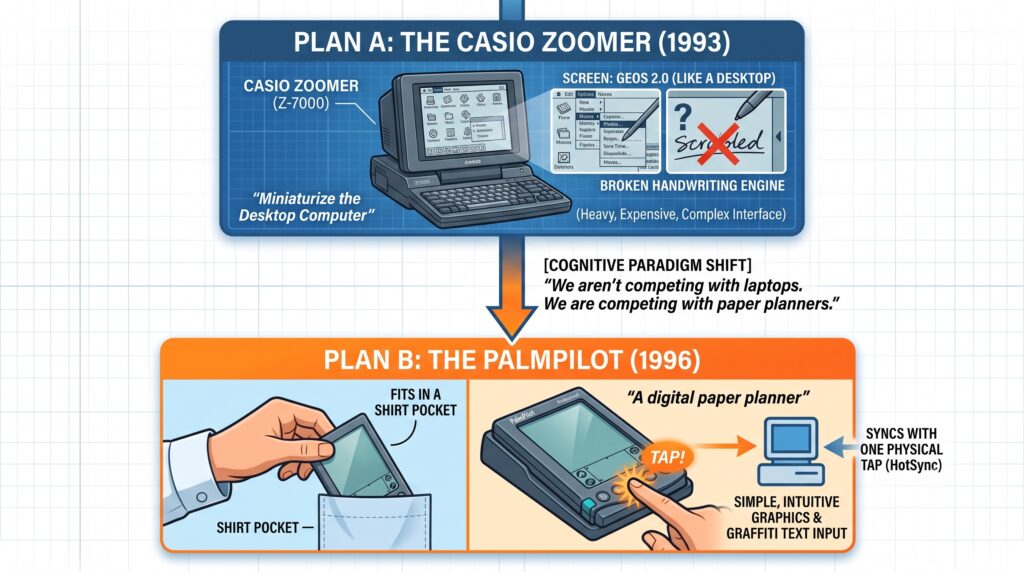
Instead of burning through capital trying to fix broken handwriting algorithms, Hawkins underwent an empathic shift. Carrying a carved block of wood in his shirt pocket to feel its physical dimensions, he realized Palm wasn't competing with laptops—it was competing with paper Day-Timers, address books, and leather calendars.
With Plan B—the PalmPilot (1996)—Hawkins made radical design choices:
- Graffiti: Rather than demanding the machine read human cursive, he met the computer halfway by introducing a single-stroke shorthand alphabet that yielded 100% recognition accuracy.
- HotSync: He replaced complex serial-port network protocols with a cradle featuring a single physical button that backed up data to a PC in two seconds.
Palm survived because it maintained low capital expenditure during Plan A, preserving the runway necessary to execute Plan B before its resources ran out.
The Master Class: Steve Jobs Turns Apple into the "Plan B" Company
When Steve Jobs returned to Apple in 1997, he codified this approach into a repeatable corporate strategy. Apple stopped trying to be the first-mover into raw categories. Instead, Jobs waited for incumbents to build clunky, uninspired "Plan A" versions of promising technology, and then applied predictive empathy to create the dominant "Plan B" product.
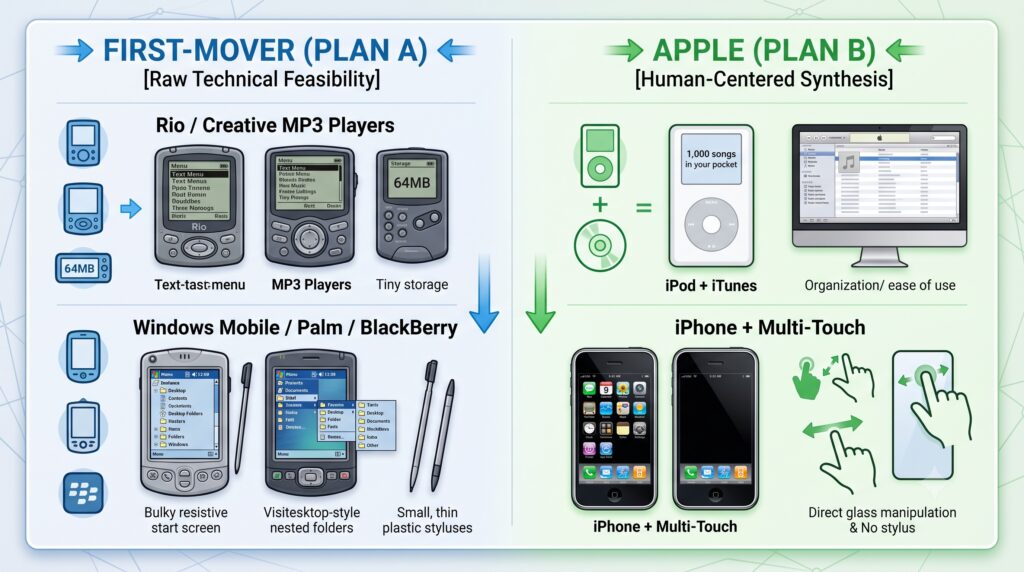
1. The MP3 Player: Rio vs. iPod
In the late 1990s, digital music players like the Rio and Creative Nomad existed, but they were user-experience nightmares—holding 15 to 30 songs on tiny flash drives or utilizing confusing file-tree structures. Jobs recognized that digital music was a fundamental shift, but the interface was broken. By combining Toshiba's tiny 5GB hard drive with a spatial click-wheel interface, Apple launched the iPod in 2001, marketing it not with technical specifications, but with a visceral emotional promise: "1,000 songs in your pocket."
2. The Smartphone: Windows Mobile, Palm, & BlackBerry vs. iPhone
Prior to 2007, the smartphone market was dominated by BlackBerry, Palm, and Microsoft's Windows Mobile. These devices were optimized around engineering constraints: physical QWERTY keyboards that permanently consumed half the device's real estate, tiny styluses, and miniature "Start" menus shrunk down from desktop operating systems.
Jobs looked at these devices and realized their core flaw: the physical buttons couldn't adapt to different applications. By replacing the keyboard with a capacitive multi-touch glass display, Apple launched the iPhone. Within three years, the entire competitive landscape of pre-2007 smartphone leaders was effectively wiped out:
- BlackBerry dismissed the iPhone as a toy with bad battery life, failing to adapt until its OS was obsolete.
- Palm was acquired by HP, mismanaged, and shut down.
- Microsoft abandoned Windows Mobile entirely, attempting a ground-up reset that never recovered lost market share.
The Pixar IPO: Narrative Leverage at the Highest Stakes
The engine behind Jobs’ ability to execute these Plan B leaps was predictive empathy—the capacity to use his own visceral emotional reaction as an accurate proxy for millions of consumers. This mechanism was demonstrated most clearly outside of hardware during the 1995 Pixar IPO.
In 1991, Pixar was trapped in a contract with Disney to produce three computer-animated films. Disney funded production, retained ownership of the IP, and granted Pixar a minor ~10-15% profit share.
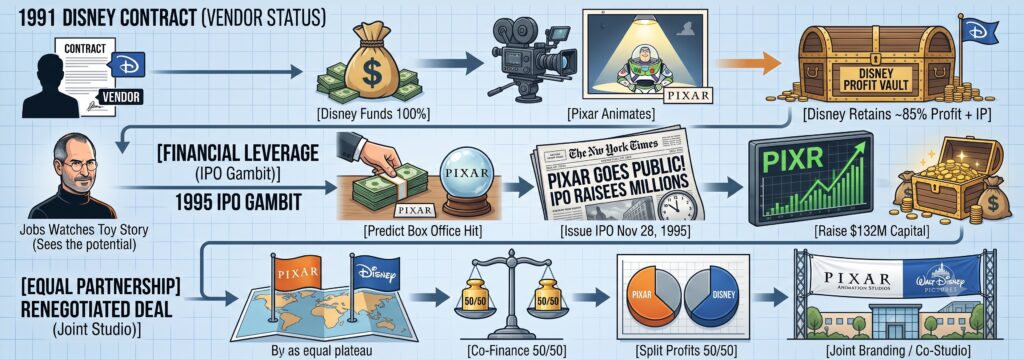
When Jobs watched early cuts of Toy Story in 1995, he didn't evaluate rendering software or poly counts. He had a visceral, emotional reaction to the narrative. Recognizing that audiences worldwide would experience that same payload, he realized Disney CEO Michael Eisner did not yet comprehend the cultural asset in his possession.
Instead of waiting for the film's theatrical run to conclude, Jobs scheduled Pixar's IPO for November 28, 1995—six days after Toy Story opened. Fueled by the film's record $30 million opening weekend, Pixar raised $132 million in the largest tech IPO of 1995. With a fortified balance sheet, Jobs forced Eisner back to the negotiating table, securing a 50/50 cost and profit split, equal co-branding, and shared ownership of future IP.
Comparative Analysis: Cognitive Frameworks of Tech Leaders
| Leadership Dimension | Steve Jobs (The Narrative Synthesizer) | Jeff Hawkins (The Empathic Systematizer) | Elon Musk (The First-Principles Optimizer) |
| Primary Engine | Predictive empathy, spatial-cinematic synthesis, cultural timing. | Cognitive empathy, biological brain modeling, spatial design. | Reductionist physics, unit economics, manufacturing scale. |
| Core Question | "How will people feel when using this?" | "How can we fit this tool into human behavioral habits?" | "What do the laws of physics say this should cost?" |
| Plan B Execution | Strip away friction, re-frame the narrative, launch the definitive paradigm. | Re-define the problem space (replace paper, not laptops), simplify input. | Re-engineer the manufacturing factory ("the machine that builds the machine"). |
Conclusion
The myth of Plan B in Silicon Valley is not merely about pivoting when a business plan fails; it is about the evolution of human understanding.
Plan A proves whether a technology can be built. Plan B determines whether that technology deserves to exist in the daily lives of human beings. While first-principles engineering optimizers like Elon Musk scale industries by beating physics constraints into submission, leaders like Steve Jobs and Jeff Hawkins transformed culture because they possessed the predictive empathy to see past the raw silicon, recognize where human desire was moving, and build tools that felt less like complex technology and more like a natural extension of the human body.
References
- Catmull, Ed, and Amy Wallace. Creativity, Inc.: Overcoming the Unseen Forces That Stand in the Way of True Inspiration. Random House, 2014. (Details Pixar's internal development and Steve Jobs' strategic leadership).
- Levy, Lawrence. To Pixar and Beyond: My Unlikely Journey with Steve Jobs to Make Entertainment History. Houghton Mifflin Harcourt, 2016. (Provides a detailed account of the financial mechanics behind Pixar’s 1995 IPO).
- Isaacson, Walter. Steve Jobs. Simon & Schuster, 2011. (Covers the Apple Lisa to Macintosh transition, the iPod, iPhone, and Jobs' negotiation tactics).
- Hawkins, Jeff, and Sandra Blakeslee. On Intelligence. Times Books, 2004. (Outlines Hawkins' neurological theories on human memory and predictive brain models).
- Computer History Museum. "The Lisa: Apple's Most Influential Failure." ComputerHistory.org, Jan. 2023. (Analyzes the structural and financial relationship between the Apple Lisa and the Macintosh).
- Lemelson-MIT Program. "Jeff Hawkins: Invention of the PalmPilot." Lemelson.mit.edu, 2022. (Details the transition from the Casio Zoomer to the PalmPilot and the creation of Graffiti).
For a deeper look into how Steve Jobs reshaped negotiations with Disney by capitalizing on the success of Toy Story, this discussion provides excellent context: