

For over a decade, Nordic education systems were held up as global benchmarks for digital integration. Laptops and tablets replaced paper, interactive apps supplanted physical textbooks, and classrooms became living laboratories for 1:1 screen-based learning.
However, as international literacy scores slipped and public health agencies reported rising rates of youth anxiety, sleep deprivation, and fragmented attention, a profound policy reversal took hold. Across Sweden, Denmark, Norway, and Finland, educational authorities have initiated a deliberate return to traditional foundations—a policy shift widely referred to as the "Neo-Basic" approach.
Crucially, this transition is not merely a nostalgia-driven rejection of technology. It represents an intentional, multi-layered strategy to address a growing structural issue: the psychological dependency of students on short-form digital media, notifications, and algorithmic feed designs.
1. The Neuro-Cognitive Reality: Why Willpower Fails
At the core of the Neo-Basic model is a recognition from cognitive science: expecting a child or adolescent with an undeveloped prefrontal cortex to exercise personal discipline against hyper-optimized, variable-reward algorithms is a design failure.
Platforms like TikTok, Snapchat, and Instagram operate on continuous dopamine loops. When introduced into learning environments, these platforms produce what cognitive psychologists term continuous partial attention. The brain remains in a perpetual state of hyper-vigilance, anticipating the next notification or visual novelty.
To counter this, Nordic policies focus on altering the physical environment rather than relying on student willpower:
- School-Wide Mobile Bans: Personal mobile phones are deposited into secure "phone lockers" or pouches at the beginning of the school day.
- Phase-Out of Early 1:1 Tablets: Sweden’s Ministry of Education allocated significant funding to pull tablets out of early childhood and primary classrooms, reallocating resources toward physical, printed textbooks.
- Analog Tactility: Writing by hand on paper engages distinct motor-sensory pathways that reinforce memory retention and slow down cognitive processing to match natural comprehension speeds.
2. Re-Building Attention "Stamina"
Reversing psychological reliance on high-frequency digital stimulation requires active cognitive retraining. Short-form video platforms train the brain to expect dynamic shifts in visual context every few seconds. When forced to sit with a static block of text, students habituated to rapid scrolling often experience severe restlessness—a withdrawal response from high-dopamine environments.
Nordic educators use structured daily interventions to rebuild focus capacity:
- Sustained Silent Reading (SSR): Dedicated, uninterrupted blocks for physical book reading are built into daily schedules to train deep reading capacity and linear narrative comprehension.
- Movement and Friluftsliv: Unstructured screen time during recess often fueled social evaluation anxiety and compulsive phone checking. Schools have replaced screen breaks with structured outdoor play, sports, and outdoors-focused social activities (friluftsliv), cultivating natural dopamine release through physical exertion and face-to-face interaction.
3. A Public Health, Not Just Pedagogical, Framework
Nordic governments treat digital over-consumption as a broad environmental public health issue akin to poor sleep hygiene or dietary imbalances.
- National Screen-Time Guidelines: Health agencies—such as Sweden’s Folkhälsomyndigheten and Denmark’s Sundhedsstyrelsen—issue clear daily screen exposure caps for youth outside of necessary schoolwork, emphasizing the impact of blue light and constant notifications on adolescent sleep cycles.
- Clinical Interventions: Youth mental health clinics in the region increasingly incorporate digital hygiene protocols when evaluating adolescent patients presenting with anxiety, body dysmorphia, or school refusal behaviors.
4. Parental Co-Regulation and Algorithmic Literacy
School policies only account for roughly eight hours of a student's day. To prevent a complete relapse into compulsive scrolling during evening hours, local municipalities work to build social pacts among communities.
Parent-teacher organizations facilitate collective agreements—such as delaying personal smartphone ownership until age 13 or 14, and establishing screen-free homework windows. Meanwhile, classroom digital instruction has pivoted away from operational tech skills (which digital-native youth already possess) toward critical algorithmic literacy: teaching students explicitly how persuasive design techniques, notification badges, and recommendation engines are engineered to captivate human attention.
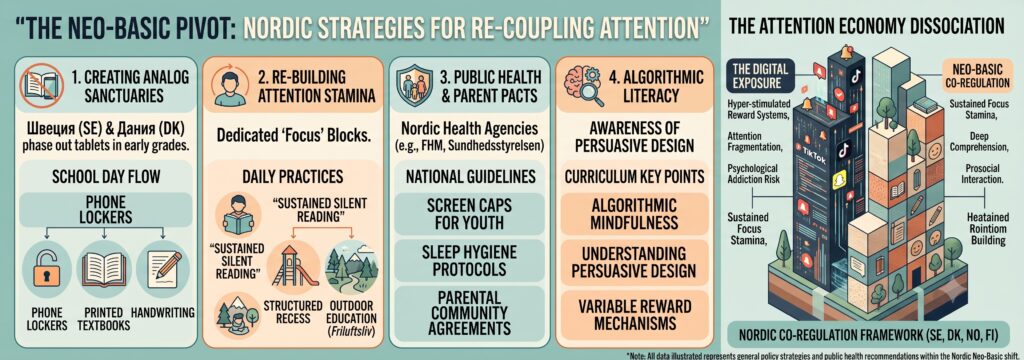
Framework Summary
| Strategy Area | Policy Action | Cognitive & Behavioral Objective |
| Classroom Environment | Phone lockers, print textbooks, handwritten work | Eliminates active dopamine triggers; restores focal depth. |
| Pedagogical Structure | Sustained Silent Reading & outdoor recess | Rebuilds attention stamina and natural social interaction. |
| Public Health Integration | National screen caps & health agency advisories | Establishes broader societal boundaries outside school walls. |
| Digital Literacy | Teaching persuasive design & algorithmic architecture | Demystifies platform mechanics to foster cognitive agency. |
Key References & Further Reading
- Swedish Ministry of Education (Utbildningsdepartementet)Official announcements regarding investments in physical textbooks and screen reduction in primary education (2023–2025).
- Public Health Agency of Sweden (Folkhälsomyndigheten)Guidelines on screen time, sleep hygiene, and mental health in children and adolescents.
- Danish Health Authority (Sundhedsstyrelsen)Recommendations on digital media usage and screen exposure for young people.
- Karolinska Institutet Research ReportsStudies examining cognitive development, digital media usage, and reading comprehension in Swedish schoolchildren.
- OECD / PISA ReportsLongitudinal assessments tracking international reading literacy scores alongside digital device density in schools.