
What an ADHD Mechanic’s Toolbox Can Teach Us About Hyperfocus, Scaffolding, and Executive Function
An auto mechanic begins an engine repair at nine in the morning. For the next four hours, the engine becomes his world. He isn't watching the clock or thinking about lunch. He is diagnosing, removing components, testing possibilities, choosing tools, discovering problems, revising his mental model, and following whatever clues the machine gives him.
He is hyperfocused.
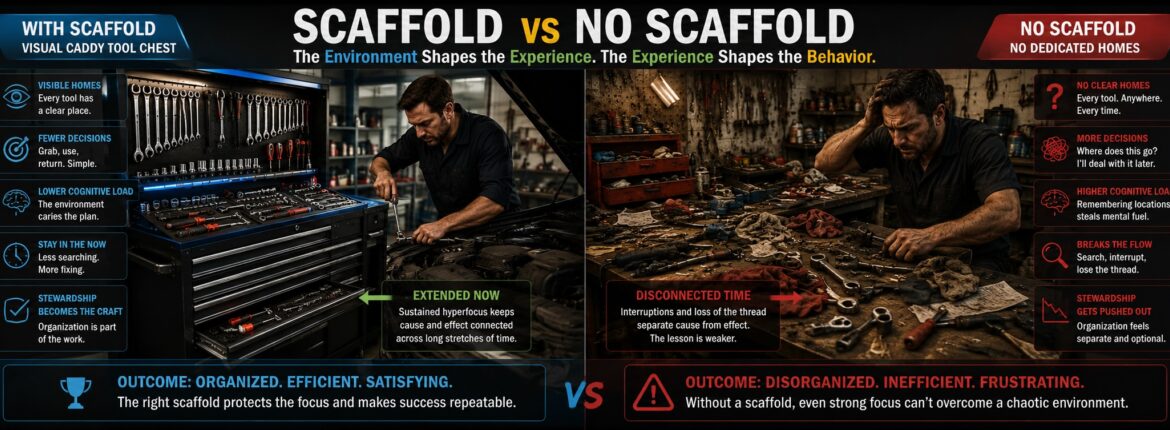
Around him is a tool chest designed for exactly this kind of work. Sockets sit on rails or in fitted positions. Wrenches occupy dedicated slots. Screwdrivers have visible homes. Frequently used tools are positioned within reach. The physical environment answers a question before the mechanic ever has to consciously ask it: Where does this go?
He grabs a ratchet, uses it, and puts it back. He grabs a 10mm socket, uses it, and returns it to its position. He reaches for the next tool and keeps working. From the perspective of casual behavioral-science observation, this is executive function at its finest.
The mechanic plans ahead, organizes his environment, maintains his tools, anticipates future need, and sustains an efficient workflow across a complicated multistage task. Check the behavioral boxes and it looks exemplary.
There is only one problem with stopping the analysis there.
We arrived after the learning happened.
The Visual Caddy
The immaculate tool chest shows us the finished behavior. It doesn't necessarily tell us how that behavior was acquired. To see the mechanism, rewind the tape.
Give the same mechanic several new specialty tools for which his existing tool chest has no dedicated locations. Nothing about his passion for repairing engines has changed. His mechanical expertise hasn't changed. He still knows that tools are expensive, that losing them wastes time, and that taking care of them matters.
What has changed is the geometry surrounding those tools.
He uses one and puts it on the workbench. Another ends up on the floor beside him. A third gets placed temporarily on the engine bay. Something else disappears beneath a shop rag. None of these placements is irrational in the moment. He needs his hands free, there is no obvious destination, and his attention has already moved to the next part of the repair.
Forty minutes later, he needs the first tool again. Now he is looking under rags, moving parts around the bench, checking the floor. Eventually he finds it, returns to the engine, and continues working. Twenty minutes later it happens with another tool.
The mechanic knows he should take care of his tools. That was never the problem.
Knowing is not a location. A dedicated slot is.
This is what I call a Visual Caddy. A golf caddy doesn't swing the club for the golfer. It organizes the conditions surrounding the shot. In the same way, the mechanic's tool chest doesn't diagnose an engine or turn a wrench. It organizes the conditions surrounding the work.
A socket rail, fitted drawer, magnetic holder, pegboard hook, or foam cutout takes an open-ended organizational problem and turns it into a physical target. Instead of asking the mechanic to decide where something belongs every time he finishes using it, the environment has already made the decision.
Without the scaffold:
tool >> possibilities >> temporary location >> remember location >> search >> retrieve
With the Visual Caddy:
tool >> target >> return
The mechanic hasn't suddenly become more disciplined. The task has become more linear.
There is already a broader cognitive-science foundation for this idea. David Kirsh's work on the intelligent use of space argued that spatial arrangements can simplify choice, perception, and internal computation. Research on cognitive offloading similarly describes the use of physical actions and external structures to reduce cognitive demands that otherwise would have to be handled internally.
The Visual Caddy hypothesis asks what happens when we apply those principles specifically to ADHD organization during highly engaging activity.
Passion Gets the Mechanic Under the Hood
There is another component that cannot be separated from the tool chest: the mechanic actually cares about fixing engines.
William Dodson's clinical model of the interest-based nervous system describes ADHD engagement in terms of interest, challenge, novelty, urgency, and passion rather than reliable activation by abstract importance alone. The model grew from clinical observation rather than a laboratory-established neurological taxonomy, but it captures something repeatedly recognizable in ADHD experience: enormous difficulty engaging with one task can coexist with extraordinary persistence in another when the activity becomes intrinsically compelling.
That distinction matters here because the mechanic isn't meticulously managing sockets out of an abstract commitment to organizational virtue. The sockets matter because the engine matters.
The engine provides challenge. Diagnosis continually produces novelty. Each discovery creates another problem to solve. Expertise makes increasingly sophisticated experimentation possible. Under the right circumstances, the entire repair can remain inside one intensely engaging activity.
Passion supplies the ignition, but passion alone doesn't organize the tools. For that, the mechanic needs somewhere to put them.
The Missing Socket Forty Minutes Later
This is where hyperfocus enters the model.
Suppose the mechanic grabs a socket at 9:20, uses it, and leaves it somewhere because it has no dedicated home. At 10:05, he needs it again. Forty-five minutes have passed, so the consequence is clearly not immediate in ordinary clock time.
Yet something important has remained constant: the mechanic never left the engine.
He has spent those forty-five minutes inside one continuous goal-directed activity. He removed a component, discovered another problem, tested something, changed tools, followed the problem deeper into the engine, and eventually arrived at the point where he needed that socket again.
When he cannot find it, the interruption is not some distant consequence arriving from an unrelated event earlier in the day. The misplaced socket and the frustrating search both belong to the same continuous experience.
He is still fixing the engine.
That raises an interesting possibility about ADHD hyperfocus.
The Extended Now Hypothesis
ADHD research has long examined temporal reward discounting: the decreasing subjective value of an outcome as the delay before receiving it increases. Research has found relationships between ADHD symptoms and steeper temporal discounting under some conditions, giving us good reason to take the timing of consequences seriously when thinking about ADHD motivation.
Hyperfocus may complicate that temporal picture.
Hupfeld, Abagis, and Shah found that adults with higher ADHD symptomology reported greater dispositional hyperfocus and more frequent hyperfocus across several real-world settings. Ashinoff and Abu-Akel subsequently described hyperfocus as intense task absorption accompanied by diminished attention to information outside the focal activity while emphasizing how much remains unknown about its cognitive and neural functioning.
That leaves open an intriguing question: What happens to cause and effect inside a prolonged hyperfocus state?
The hypothesis proposed here is that sustained hyperfocus can create an Extended Now: a continuous state of engagement in which the functional relationship between an action and its consequence may persist considerably longer than we would predict from clock time alone.
The important variable may therefore not simply be the number of minutes separating cause and effect. It may be whether the person remains inside the same continuous engagement state.
The mechanic's experience looks something like this:
[ use tool >> leave tool >> continue repair >> need tool >> search >> recover tool >> resume repair ]
All of those events occur beneath the same umbrella:
HYPERFOCUS: REPAIR THE ENGINE
Forty-five minutes may separate the mistake from its consequence. Conceivably, it could be two hours. If the mechanic remains deeply engaged in the same repair, however, both events may still belong to the same functional Now.
That is the hypothesis: hyperfocus may temporally stretch the functional meaning of immediate cause and effect.
The Length of the Runway
Think of hyperfocus as providing a runway. Sometimes the runway lasts twenty minutes. Sometimes it lasts an hour. For a mechanic absorbed in diagnosing and repairing an engine, it may last four or five hours.
The longer the uninterrupted runway, the farther apart an action and its consequence might potentially occur while remaining part of the same meaningful experience. The mechanic doesn't need someone to explain afterward why putting tools away is useful. He repeatedly encounters the consequences while doing the thing he cares about.
A misplaced socket interrupts the repair. A wrench buried under parts costs time. A tool left somewhere awkward forces him to break concentration and search. A properly returned tool, by contrast, is exactly where his hand expects it to be forty minutes later.
The engine supplies the lesson, and hyperfocus keeps that lesson inside the same experiential envelope. But neither one supplies the solution.
When Learning Has Nowhere to Go
Imagine that the mechanic has learned the lesson perfectly. After repeatedly playing pickup sticks with his new specialty tools, he knows exactly what is going wrong. He knows that leaving them on the floor and workbench interrupts his work. He wants them organized. He understands the benefit.
And tomorrow they can still end up scattered around the garage, because understanding that an object needs a home does not create the home.
He has twelve new tools and twelve new organizational problems. Every time he finishes using one, the environment asks him to make another decision about where to put it. In the middle of a hyperfocused engine repair, the repair wins that competition. The tool gets placed wherever his hand happens to find an available surface, and his attention immediately returns to the engine.
So he gets another tool chest. He adds a rail. He installs hooks. He cuts foam or buys a fitted insert. Whatever the particular solution, he creates visible destinations for previously unconstrained objects.
Now the lesson acquired during the Extended Now has somewhere physical to land.
Hyperfocus teaches the consequence. The scaffold captures the lesson.
That interaction is the heart of the model.
Turning Nonlinearity Into Linearity
An empty drawer contains possibilities. A tool could go here, there, underneath something, beside something else, or temporarily on the bench because the mechanic intends to deal with it later.
A fitted tool chest removes possibilities. The 10mm socket has a 10mm home. The wrench has a wrench-shaped destination. The specialty tool has its hook. An empty space provides information of its own: something isn't back yet.
The environment is doing something that would otherwise have to be generated and maintained internally. Kirsh's analysis is particularly relevant here because he examined how people arrange instruments, ingredients, and work in progress in ways that simplify the cognitive work of planning and action. Cognitive-offloading research provides a complementary framework: physical action can alter the information-processing requirements of the task itself.
That doesn't mean the tool chest is somehow performing executive function. We don't need to make that claim, because we don't know precisely what is occurring neurologically. What we can observe is simpler: the cognitive demands of the task have changed.
The unconstrained problem requires the mechanic to create and maintain an organizational architecture internally. He must decide where the tool belongs, remember the decision, remember to execute it, and retrieve the location when the tool is needed again. The scaffolded problem gives him visible physical targets.
With the scaffold:
Put the tool in the hole.
The spatial geometry of the environment has converted a nonlinear organizational problem into a much more linear physical action.
Executive Function at Its Finest—From Across the Garage
Now return to the psychologist who walks into the garage years later.
The mechanic's tools are immaculate. Sockets occupy their positions. Wrenches are arranged neatly. Specialty tools have dedicated locations. The mechanic finishes with one tool and returns it automatically before reaching for another.
From the perspective of casual behavioral-science observation, this really does look like executive function at its finest. Calling the behavior executive functioning isn't necessarily wrong. The mistake would be assuming that the label explains the mechanism.
Behavioral observation begins with what is visible now: an organized mechanic maintaining an organized system. But the finished behavior doesn't reveal the developmental pathway that produced it.
We arrived after the learning happened.
Rewind far enough and we may find a mechanic who once bought several new tools without anywhere to put them, scattered them around the garage during a four-hour repair, repeatedly lost them inside his own workflow, became irritated by the interruptions, and eventually created physical homes for them.
Something that looks like exemplary executive functioning may have emerged from the interaction of passion, experience, hyperfocus, and physical scaffolding. Behavioral observation tells us what the mechanic does. It does not necessarily tell us what makes the behavior possible.
When Stewardship Becomes Part of the Passion
Repeat this process hundreds or thousands of times and something else may happen. The mechanic no longer merely understands that organized tools are useful. He repeatedly experiences the relationship between stewardship and performance while engaged in something that already carries enormous motivational weight.
A returned tool is available when needed. An available tool keeps the repair moving. An uninterrupted repair preserves the engagement state. Preserving that state improves the experience of performing the craft he cares about.
Eventually, taking care of the tools can become absorbed into the passion itself.
The distinction between repairing engines and taking care of the things necessary to repair engines begins to disappear. Wiping a tool, returning a socket, organizing a drawer, and noticing a missing wrench are no longer unrelated housekeeping chores waiting at the edge of the activity. They become part of being a mechanic.
The socket returned at 9:20 is there at 10:05. The mechanic reaches for it, and there it is. The repair never stops.
Cause and effect have been separated by forty-five minutes of clock time but connected by one uninterrupted purpose.
Remove the Tool Chest
There is a simple thought experiment that exposes the difference between the behavior and the architecture supporting it.
Take that meticulous ADHD mechanic out of his own garage and put him into an unfamiliar shop. Give him unfamiliar tools. Remove the familiar socket rails, drawer layouts, hooks, magnetic trays, and fitted positions he has spent years using. Then give him a complicated engine problem and watch what happens over four hours.
His mechanical knowledge hasn't vanished. His passion hasn't vanished. His understanding of tool care hasn't vanished. His desire to work efficiently hasn't vanished.
But the Visual Caddy has.
If his organizational behavior deteriorates, that would suggest something important about what we had been calling his executive functioning. Some portion of the observed behavior may emerge from the stable interaction between the mechanic and the architecture surrounding him.
Same mechanic. Same expertise. Same passion. Different cognitive geometry.
Different behavior.
And unlike a metaphor, that prediction can be tested.
Epistemic Status & Testable Predictions
The Extended Now and Visual Caddy hypotheses grow out of repeatedly observed situations in which people with ADHD tend to thrive: deeply engaging skilled work, athletics, creative pursuits, technical problem-solving, hobbies, and other environments where interest is high, feedback is meaningful, and the physical world provides structure.
The purpose of these hypotheses is not to invent mechanisms disconnected from ADHD experience. It is to take recognizable patterns of ADHD performance and ask why they happen. Existing research gives us several pieces of the puzzle: hyperfocus is a documented phenomenon; temporal discounting has an established ADHD literature; external spatial organization can reduce cognitive demands; and Dodson's interest-based model describes a clinically familiar pattern of activation around interest, challenge, novelty, urgency, and passion.
The proposed interaction among those elements has not yet been directly tested. The Extended Now proposes a possible temporal mechanism: sustained hyperfocus may allow cause and effect to remain connected across a longer interval when both occur within the same uninterrupted state of engagement. The Visual Caddy proposes an environmental mechanism: physical scaffolds may convert an open-ended organizational problem into visible targets and repeatable linear actions.
These are testable extensions of observed ADHD experience. Their usefulness is that they produce specific predictions that can be examined experimentally, refined as evidence accumulates, or rejected if the evidence points somewhere else.
And because a theory about visual scaffolding deserves its own visual scaffold, here are the predictions in clearly labeled slots.
The Seven Testable Predictions
1. Engagement-State Continuity Should Matter More Than Clock Time Alone
A longer action-consequence delay occurring entirely within sustained hyperfocus should sometimes produce stronger learning than a shorter delay interrupted by genuine disengagement from the task.
continuous engagement + longer delay >> stronger association
interrupted engagement + shorter delay >> weaker association
If this occurs after controlling for elapsed time, the continuity of engagement itself becomes a candidate explanatory variable.
2. Breaking the Engagement State Should Shorten the Extended Now
Interrupting the original goal state with an unrelated activity should weaken the association between an earlier action and its later consequence, even when elapsed time is held constant.
This predicts something more specific than hyperfocus improves learning: the boundary of the engagement state should matter.
3. Visual Caddies Should Improve Organizational Performance
Dedicated physical targets—socket rails, fitted slots, shadow boards, hooks, or foam cutouts—should reduce misplaced objects, retrieval time, search episodes, task interruptions, and organizational errors compared with unconstrained storage.
The more structure the environment carries, the less organizational architecture the individual must generate and maintain internally.
4. Removing an Established Scaffold Should Degrade Performance
A person who appears highly organized in a familiar scaffolded environment should show measurable deterioration when that environmental architecture is removed or substantially rearranged, despite unchanged knowledge, motivation, and expertise.
This separates knowing the organizational rule from having an environment that makes the rule easy to execute.
The knowledge hasn't disappeared. The geometry has.
5. Passion and Scaffolding Should Interact Rather Than Substitute for One Another
High interest should increase engagement, but high interest without environmental scaffolding should not necessarily eliminate organizational failures.
This makes high passion without scaffolding an especially interesting experimental condition. The mechanic can desperately want the repair to succeed, remain fascinated by the engine for four hours, and understand perfectly well that losing tools slows him down—and still scatter twelve new tools around the garage if none of them has somewhere obvious to go.
Passion gets him underneath the hood. It doesn't manufacture another tool chest.
6. Stewardship Should Become Incorporated Into the Engaged Activity
Across repeated sessions, participants experiencing sustained engagement and effective physical scaffolding should begin performing maintenance behaviors with decreasing deliberation. Tool return should become faster, more consistent, and less disruptive to the primary activity.
Eventually, organization should stop behaving like a separate secondary task:
retrieve >> use >> return >> continue
Stewardship becomes part of the craft.
7. Distance From the End of Engagement May Predict Learning Independently of Raw Delay
Two consequences arriving after identical forty-five-minute delays should not necessarily have equivalent effects. One arrives while hyperfocus remains intact; the other arrives after the person has disengaged.
Same clock time. Different cognitive context. Potentially different learning.
If continuity of engagement reliably predicts the strength of the cause-and-effect association after controlling for elapsed time, then clock time alone would be an incomplete description of what “immediate” means during sustained ADHD engagement.
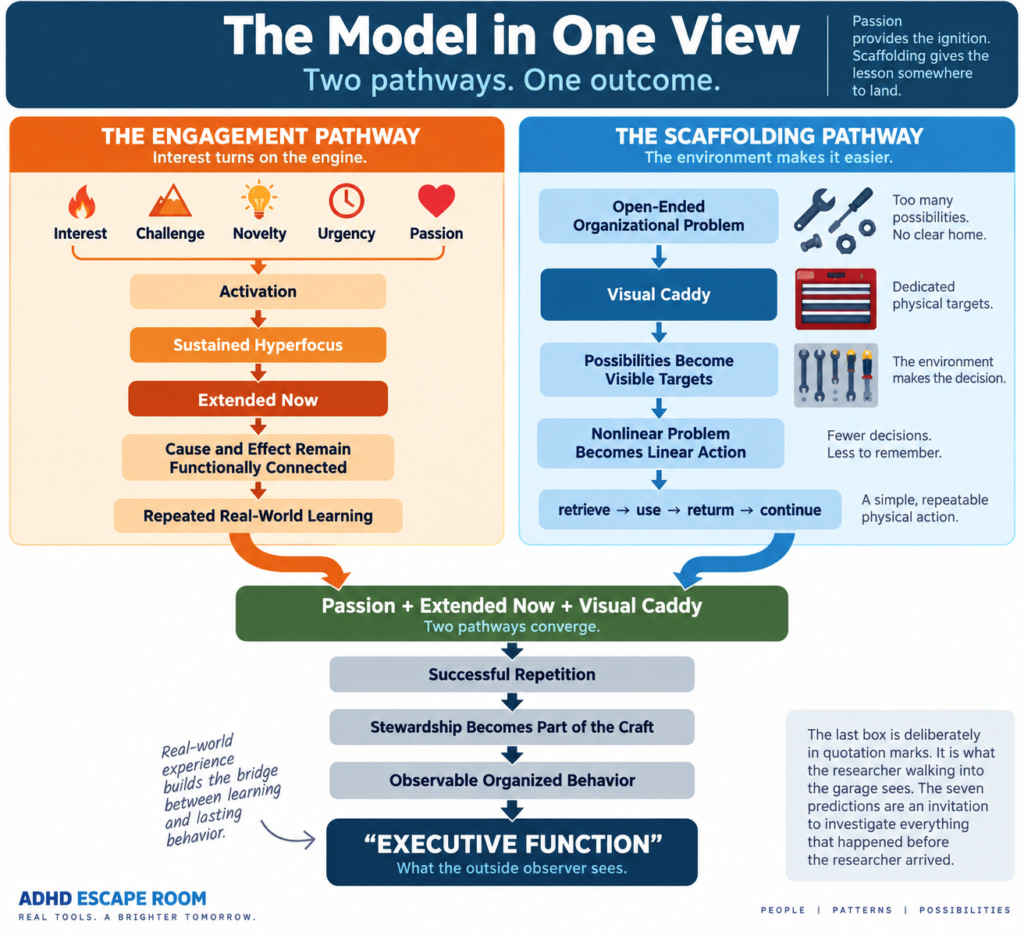
The Model in One View
[INSERT “THE MODEL IN ONE VIEW” GRAPHIC HERE]
The last box is deliberately in quotation marks. It is what the researcher walking into the garage sees. The seven predictions are an invitation to investigate everything that happened before the researcher arrived.
The Four-Hour Now
The garage may therefore be an unusually useful laboratory for studying hyperfocus because it contains something difficult to reproduce in a twenty-minute behavioral task: prolonged, meaningful, goal-directed activity with measurable consequences continuously unfolding over several hours.
Tools are used and reused. Decisions create consequences. Mistakes impose costs. Organizational choices alter performance. Cause and consequence can be separated by substantial amounts of clock time while remaining embedded in the same activity.
That allows us to ask a different question about hyperfocus. Perhaps the critical temporal variable isn't simply How many minutes separated the behavior from its consequence? Perhaps the better question is:
Did the consequence arrive before the engagement state ended?
If so, clock time alone may be an incomplete measure of what “immediate” means during ADHD hyperfocus. Twenty minutes, forty-five minutes, or several hours could function differently when the individual never exits the goal state connecting the events.
The existing literature gives us pieces of this model. Hyperfocus has been documented as a meaningful phenomenon associated with higher ADHD symptomology. Temporal-discounting research establishes that delay can matter in ADHD reward processing. Cognitive-offloading research demonstrates that people alter their environments to reduce internal cognitive demands. Kirsh showed decades ago that intelligently arranging physical space can simplify perception, choice, and internal computation.
What has not yet been established is the interaction proposed here: interest provides the ignition, hyperfocus provides the runway, the Extended Now may keep cause and effect connected along that runway, and the Visual Caddy gives the resulting learning somewhere physical to land.
The mechanic doesn't experience a disconnected collection of timestamps. He experiences the engine repair.
Inside that four-hour Now, he repeatedly discovers that tools with homes return to his hand when he needs them, while tools without homes disappear into the garage. Eventually he buys another tool chest. The new tools acquire visible destinations, and returning them becomes part of the repair itself.
Years later, someone walks into the garage, looks at the immaculate tool drawers, and sees executive function at its finest. Perhaps that's exactly what they're seeing. But if we want to understand how it got there, we have to look beyond the behavioral endpoint—to the mechanic, the engine, the hyperfocus runway, and the tool chest.
The executive behavior may exist in the relationship among all of them.
References
Ashinoff, B. K., & Abu-Akel, A. (2021). Hyperfocus: The forgotten frontier of attention. Psychological Research, 85, 1–19. Open-access article: https://pmc.ncbi.nlm.nih.gov/articles/PMC7851038/
Dodson, W. W. Clinical writings, lectures, and presentations on the ADHD interest-based nervous system, describing activation through interest, challenge, novelty, urgency, and passion. The framework is used here as a clinical model rather than an experimentally established neurological taxonomy. ADDA presentation with William Dodson: https://add.org/course/developing-an-owners-manual-for-your-adhd-mind-part-2-with-william-w-dodson-m-d-lf-apa/
Hupfeld, K. E., Abagis, T. R., & Shah, P. (2019). Living “in the zone”: Hyperfocus in adult ADHD. ADHD Attention Deficit and Hyperactivity Disorders, 11(2), 191–208. PubMed: https://pubmed.ncbi.nlm.nih.gov/30267329/
Kirsh, D. (1995). The intelligent use of space. Artificial Intelligence, 73(1–2), 31–68. Article record: https://www.sciencedirect.com/science/article/pii/000437029400017U
Risko, E. F., & Gilbert, S. J. (2016). Cognitive offloading. Trends in Cognitive Sciences, 20(9), 676–688. PubMed: https://pubmed.ncbi.nlm.nih.gov/27542527/
Scheres, A., Tontsch, C., Thoeny, A. L., & Kaczkurkin, A. (2010). Temporal reward discounting in attention-deficit/hyperactivity disorder: The contribution of symptom domains, reward magnitude, and session length. Biological Psychiatry, 67(7), 641–648. PubMed: https://pubmed.ncbi.nlm.nih.gov/20034616/