
The Case of Alton Brown: How Scaffolding, Friction Removal, and the Extended Now May Turn Executive Dysfunction Into Expertise
There is something fascinating about Alton Brown’s kitchen.
It is not simply organized. Plenty of kitchens are organized. Pots go in one cabinet, knives in another, spices in a rack, utensils in drawers. Everything can have a designated location while the cook still spends half the evening opening doors, digging through cabinets, moving one thing to reach another, and trying to remember where the hell the right pan went.
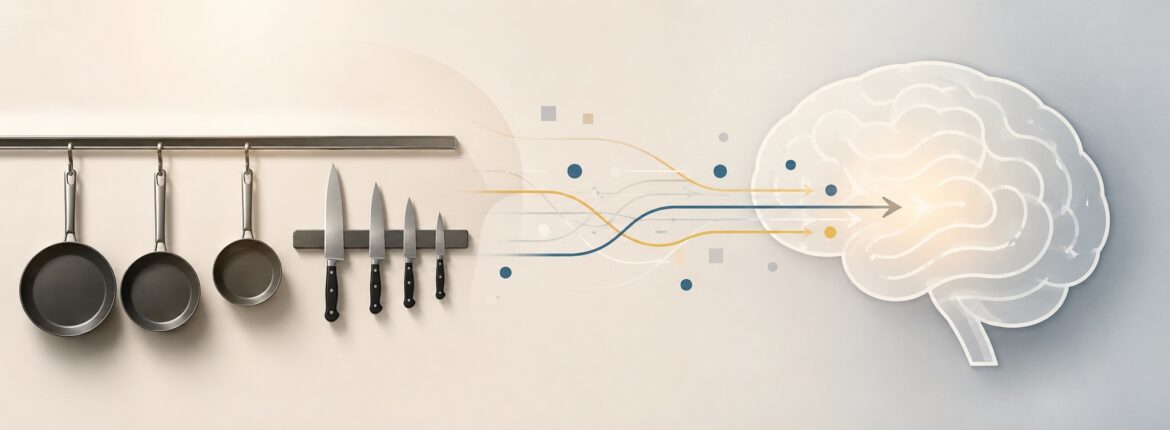
Brown’s approach is different. He has used magnetic steel surfaces and magnetic hooks to put cookware directly on the wall, where pots and pans remain visible and immediately accessible. His knives can live on magnetic strips rather than disappearing into drawers or blocks.
At first glance, this looks like the kitchen of an exceptionally organized person.
Look more closely and the interesting part is not the organization.
The interesting part is how much organization the kitchen makes unnecessary.
Brown has created an environment in which the right object can be easier to perceive, easier to identify, easier to retrieve, and easier to return. The architecture is doing cognitive work.
And it is doing more than one kind.
A Pot on the Wall
Imagine that you are cooking and suddenly need a sauté pan.
In a conventional kitchen, you may know exactly where that pan is. There is no memory failure. There is no uncertainty. The kitchen may be perfectly organized.
The pan is in the lower cabinet.
Unfortunately, another pan is sitting on top of it.
Now an apparently trivial intention has acquired a sequence:
need pan >> locate cabinet >> open cabinet >> move obstruction >> retrieve pan >> return to stove
Brown’s wall changes the geometry:
need pan >> see pan >> grab pan
Same cook. Same pan. Same intention.
Different number of steps.
That distinction matters because organization and accessibility are not the same cognitive problem. A perfectly organized environment can still contain enormous amounts of friction. Brown’s kitchen attacks both.
The pot has a place.
The place is visible.
The pot is accessible.
And almost nothing stands between intention and action.
Structured Visibility
There is another feature of Brown’s system that is easy to miss if we describe it simply as keeping things visible.
Visibility by itself is not necessarily helpful.
Cover a wall with enough pots, pans, knives, utensils, cables, lids, spatulas, strainers, and miscellaneous equipment and eventually you have not created a visual scaffold. You have created visual noise.
Brown’s magnetic knife strip and magnetic cookware hooks are useful precisely because they do not look alike. One is a long horizontal bar carrying knives. The other consists of separate attachment points holding cookware. Their geometry creates perceptually different categories before anyone has to consciously think about categorizing them.
Then there is the empty space around them.
That negative space matters.
The wall does not merely expose the objects. Provided it is not overloaded, it separates them sufficiently for the eye to lock onto a category and then a target.
The sequence becomes:
distinct visual form + negative space >> category recognition >> target
That is a more precise description of the visual scaffold.
It is not simply:
Put everything where you can see it.
It is:
Structure what you can see so the target remains obvious.
Scaffolding Reduces Possibilities
Consider the knife.
Without a designated location, putting it away creates an open-ended problem. It can go into a drawer. It can remain beside the cutting board. It can sit near the sink. It can end up somewhere else on the counter.
Each possibility is individually trivial.
Together they create a decision.
The magnetic strip removes most of that decision:
knife >> visible target >> return
The strip does not clean the knife. It does not dry the knife. It does not physically return the knife.
It changes the problem from Where should this go? to There.
This fits within a substantial body of research on cognitive offloading and the intelligent use of space. David Kirsh has described how people manipulate physical space to simplify cognitive operations, while Evan Risko and Sam Gilbert describe cognitive offloading more broadly as using external action to reduce internal cognitive demands.
Brown’s wall is a particularly vivid physical example.
But its effectiveness depends on structure. A knife strip buried inside a visually chaotic wall may require search. A clearly differentiated strip surrounded by sufficient negative space provides a target.
That gives us the first part of the architecture:
Structured visibility reduces possibilities.
Negative space preserves the target.
Friction Removal Reduces Steps
Now run the sequence in the opposite direction.
The magnetic strip that tells the knife where to go also makes the knife easier to retrieve.
Instead of opening a drawer, searching for the knife, removing it, closing the drawer, and returning to the cutting board, the cook sees the knife and reaches for it.
The difference sounds ridiculously small.
Cognition is filled with ridiculously small differences that become consequential when repeated hundreds of times.
Every additional action creates a transition. Every transition creates another opportunity for attention to move somewhere else. An obstruction, closed door, unnecessary decision, or additional retrieval step can insert friction between an intention and the action intended to follow it.
Brown’s system reduces that friction in both directions:
Visible Tool >> Easier Retrieval
Visible Destination >> Easier Return
The same architecture assists initiation and completion.
That gives us two mechanisms that frequently coexist but should not be confused.
Scaffolding reduces possibilities. Friction removal reduces steps.
And for ADHD, that distinction may be particularly important.
When Knowing What to Do Isn’t the Problem
Executive dysfunction is sometimes described as though the central problem were not knowing what needs to happen.
But there is a familiar ADHD experience in which the person knows exactly what needs to happen. They may know precisely how to do it. They may even want to do it.
The problem lies somewhere between intention and execution.
A task containing one action may be easy to initiate. Put four unrewarding preliminary actions in front of it and the subjective difficulty can change dramatically, even though the actual objective has barely changed.
The obstacle is not necessarily:
I don’t know what to do.
Sometimes it is:
There is too much crap between me and doing it.
Brown’s kitchen provides a physical demonstration of the difference. The pan is visible. The knife is visible. The destination is visible. The tool can be retrieved without dismantling half a cabinet.
The environment has shortened the distance between wanting to act and acting.
That is not merely organization.
It is friction engineering.
Mise en Place: Putting the Future on the Counter
Cooking gives us another version of the same architecture because the environment can scaffold not only objects but time.
Start cooking before everything is prepared and the future suddenly becomes a working-memory problem. Vegetables are already in the pan while garlic still needs chopping. Meat needs cubing. A sauce needs measuring. Something is beginning to burn while something else is still sitting in the refrigerator.
The cook is simultaneously managing the present and remembering the future.
Mise en place changes the problem:
vegetables >> bowl
meat >> bowl
garlic and ginger >> ramekin
spices >> ramekin
Now the future has been moved into the physical environment.
The cook does not have to remember whether the garlic has been prepared. The ramekin answers the question. The sequence that previously existed partly in working memory has become visible on the counter.
The cook can look at the workspace and determine whether the future is ready.
That may be one of the most elegant functions of environmental scaffolding:
It makes later visible now.
But Who Returns the Knife?
There is still a problem.
A magnetic strip can explain why returning a knife is easier. It cannot completely explain why someone reliably returns it.
A scaffold can create a destination. Negative space can preserve the perceptual target. Reduced friction can make reaching that destination inexpensive.
Something still has to teach the sequence.
Suppose an intensely engaged cook retrieves a knife, uses it, cleans it, dries it, and returns it to the magnetic strip. Twenty minutes later, that knife is needed again.
The entire sequence may remain inside one continuous cognitive event:
Cooking.
The cook has not necessarily stopped cooking to perform an unrelated executive-function exercise called Proper Tool Stewardship. Maintaining the knife remains part of the activity already holding attention.
That changes the learning environment.
And it brings us to the Extended Now.
The Extended Now
Research on hyperfocus suggests that adults with ADHD or elevated ADHD symptomology can experience unusually intense and sustained absorption in engaging activities. What remains much less understood is the functional architecture of that state.
One possibility is that hyperfocus has another dimension beyond intensity.
It may have functional length.
Not merely length measured by a clock, but the interval across which actions and consequences remain cognitively connected because both occur within the same sustained goal-directed activity.
Imagine that the cook uses a knife at 6:10, cleans and returns it, then reaches for it again at 6:35.
Clock time says twenty-five minutes have passed.
Cognitive time may say:
still cooking
If the earlier action and later consequence remain functionally connected, the learning environment changes. The consequence has not disappeared into an abstract future called later. It remains inside the activity currently holding attention.
That is what I mean by the Extended Now.
The hypothesis is not that hyperfocus magically repairs executive dysfunction. It is that sustained engagement may sometimes extend the interval across which cause and consequence remain behaviorally meaningful.
And Brown’s kitchen gives that Extended Now an unusually efficient physical environment in which to operate.
When the Wall and the Now Meet
Now the pieces can be assembled.
The magnetic strip reduces the number of possible destinations. Its distinctive shape and surrounding negative space preserve the visual target. Immediate accessibility reduces the number of steps required to retrieve the knife. Cooking provides the sustained engagement in which the sequence occurs.
The physical architecture supplies:
Structured Visibility >> Target >> Reduced Friction >> Repeatable Action
The engagement architecture supplies:
Passion >> Engagement >> Sustained Hyperfocus >> Extended Now
Put them together:
Extended Now + Repeatable Action + Experienced Consequence >> Learning
The knife comes off the wall. It is used. It is maintained. It goes back.
Again.
Again.
Again.
Eventually, returning the knife may stop feeling like organization.
Learned Executive Function
This is where environmental scaffolding may become more than compensation.
If the magnetic strip merely helped someone remember where to put the knife, we could describe it as an external executive aid and stop there. But repeated behavior creates the possibility of learning.
The scaffold makes the successful sequence easier to identify. Negative space keeps the target perceptually distinct. Friction removal makes the sequence less expensive to execute. Sustained engagement keeps the behavior inside an activity the person wants to continue, while the Extended Now may keep action and consequence functionally connected.
Over time, several separate executive demands can begin to collapse into a single procedural unit:
retrieve >> use >> maintain >> return
The cook may no longer experience those as four independent decisions.
They become using the knife correctly.
That produces a very different interpretation of what an outside observer sees. The observer sees someone who maintains tools, anticipates future needs, organizes equipment, completes sequences, and reliably returns objects to designated locations.
On an executive-function checklist, the performance looks excellent.
But perhaps the observer has arrived too late.
The observer sees the finished behavior. The interesting science is how it was built.
When Executive Function Becomes Part of Expertise
Expertise is full of behaviors that become psychologically invisible after they have been incorporated into the activity itself.
A beginning cook may have to think about selecting the knife, making the cut, cleaning the knife, returning it, and preparing for the next operation. An experienced cook does not necessarily experience the same collection of independent executive problems.
The sequence has been compressed.
This offers one possible explanation for a phenomenon that can otherwise look contradictory: exceptional executive competence inside a preferred domain can coexist with significant executive difficulty elsewhere.
The person may not have acquired a universally transferable ability to organize everything.
They may have built local executive architecture.
The environment scaffolds.
Friction falls.
The Extended Now connects consequences.
Repetition teaches.
Eventually, the behavior becomes part of expertise.
From the outside, we call it executive function.
From inside the activity, the person may simply call it knowing what the hell you’re doing.
The Executive Functions We Build Outside the Brain
Alton Brown’s kitchen therefore offers a useful way to think about executive function without assuming that everything we observe must originate entirely inside the skull.
Some executive work can be moved into space. Some choices can be eliminated through structured visibility. Negative space can preserve perceptual targets. Unnecessary actions can be eliminated by reducing friction. Future steps can be made visible in the present through mise en place. Repeated behaviors may eventually become incorporated into expertise until they no longer feel like executive behaviors at all.
The architecture can be compressed into four propositions:
Structured visibility reduces possibilities.
Negative space preserves the target.
Friction removal reduces steps.
The Extended Now keeps consequences connected.
Then comes the proposed learning mechanism:
Scaffolded Action + Reduced Friction + Extended Now + Repetition >> Learned Executive Function
None of this requires claiming that an environment cures ADHD. The more interesting possibility is that a person with persistent executive vulnerabilities can become extraordinarily good at constructing environments in which those vulnerabilities impose fewer costs.
Eventually, we stop noticing the architecture.
We notice the competence.
Then we risk making a fundamental attribution error: assuming the competence produced the system when, at least in part, the system may have helped produce the competence.
Epistemic Status & Testable Predictions
This model combines established findings, conceptual extensions, and hypotheses. Those categories need to remain separate.
Established research: Cognitive offloading is well documented. People alter their environments and use external actions to reduce internal cognitive demands. Research on the intelligent use of space similarly demonstrates that physical arrangement can simplify cognitive operations.
Established research: Visual search is affected by the number, similarity, arrangement, and perceptual salience of competing stimuli. The specific claim here about negative space in Brown’s kitchen is an application of those broader perceptual principles, not evidence that his particular wall has been experimentally studied.
Established but developing research: Hyperfocus has been documented in adults with ADHD and elevated ADHD symptomology. Its underlying mechanisms, boundaries, and relationship to other attentional phenomena remain incompletely characterized.
Proposed framework: Structured visibility describes an environment in which relevant objects are externally visible while remaining sufficiently perceptually differentiated to function as targets rather than clutter.
Proposed framework: Friction removal is distinguished from scaffolding. Scaffolding reduces the cognitive possibilities that must be evaluated; friction removal reduces the intermediate actions required to translate intention into behavior.
Hypothesis: The Extended Now proposes that sustained goal-directed engagement can increase the functional interval across which actions and their consequences remain behaviorally connected.
Hypothesis: Learned Executive Function proposes that executive-like behaviors repeatedly performed within stable scaffolds and sustained engagement can become incorporated into domain-specific expertise without necessarily producing equivalent executive competence across unrelated contexts.
These distinctions generate testable predictions.
- Structured visibility should outperform unstructured visibility. Making tools visible should improve retrieval only while sufficient perceptual differentiation remains. Increasing visual clutter should eventually increase search time and errors.
- Negative space should improve target acquisition. Holding the number and identity of objects constant while increasing perceptual separation should reduce search time and incorrect selections.
- Visually distinct storage systems should improve category recognition. Tools stored in geometrically different systems—such as a horizontal knife strip versus separated cookware hooks—should be identified and retrieved faster than tools displayed in visually similar arrangements.
- Reduced access friction should improve initiation even when memory demands are unchanged. A visible pan requiring one retrieval action should be accessed faster and more reliably than an equally well-remembered pan requiring several preliminary actions.
- Visible destinations should improve return behavior independently of retrieval convenience. Objects with obvious perceptual destinations should be returned more reliably than objects whose locations must be recalled internally.
- Structured visibility and friction reduction should interact. Systems providing both a clear perceptual target and a shortened action path should outperform systems providing either advantage alone.
- Mise en place should reduce prospective-memory and sequencing demands. Externalizing future cooking steps into visible containers should reduce omissions, sequence errors, and working-memory demands compared with equivalent preparation performed without those external states.
- Continuity should matter independently of elapsed time. An action and consequence separated by a longer period of uninterrupted engagement may produce stronger behavioral learning than the same pair separated by a shorter interval containing unrelated interruptions.
- Repeated scaffolded behavior should become increasingly compressed. With practice, participants should require fewer conscious decisions to execute a stable retrieve-use-maintain-return sequence.
- Domain-specific executive competence should track scaffold history. Strong organization inside an area of expertise should be associated with stable environmental structures and repeated domain-specific routines rather than necessarily predicting equivalent organization elsewhere.
- Removing a familiar scaffold should expose hidden executive costs. Rearranging an established workspace, increasing retrieval steps, reducing perceptual differentiation, or introducing clutter should impair performance even when the individual’s underlying knowledge and motivation remain unchanged.
- Experts may underestimate the contribution of their scaffolds. Once a system becomes habitual, people may attribute successful performance primarily to discipline or expertise while underestimating how much cognitive work the environment continues to perform.
The strongest version of the model therefore makes a straightforward prediction.
Keep the person constant.
Keep the knowledge constant.
Keep the motivation constant.
Change the cognitive architecture of the environment, and executive performance should change with it.
That is experimentally tractable.
And if repeated interaction with that architecture subsequently changes how the person performs even after portions of the scaffold are removed, we have moved from studying compensated executive function toward studying something considerably more interesting:
how executive behavior may be learned.
References
Ashinoff, B. K., & Abu-Akel, A. (2021). Hyperfocus: The forgotten frontier of attention. Psychological Research, 85, 1–19.
Hupfeld, K. E., Abagis, T. R., & Shah, P. (2019). Living “in the zone”: Hyperfocus in adult ADHD. ADHD Attention Deficit and Hyperactivity Disorders, 11(2), 191–208.
Kirsh, D. (1995). The intelligent use of space. Artificial Intelligence, 73(1–2), 31–68.
Risko, E. F., & Gilbert, S. J. (2016). Cognitive offloading. Trends in Cognitive Sciences, 20(9), 676–688.
Treisman, A. M., & Gelade, G. (1980). A feature-integration theory of attention. Cognitive Psychology, 12(1), 97–136.