
Why ADHD Plus Autistic Traits May Be the Definition We Actually Need
I think we may be defining AuDHD around the wrong boundary.
The common definition is straightforward: ADHD plus autism. If someone meets diagnostic criteria for ADHD and also meets diagnostic criteria for autism spectrum disorder, we call the combined presentation AuDHD. That definition is clean, clinically useful, and easy to understand if the purpose of the term is simply to describe two diagnoses occurring in the same person.
But I no longer think that is where the scientifically interesting boundary lies.
I think AuDHD should encompass ADHD plus one or more functionally meaningful autistic traits, without requiring any minimum number of those traits and without requiring the person to meet full diagnostic criteria for autism.That does not mean one autistic trait makes someone autistic, and it does not mean the diagnostic threshold for autism should be loosened. Autism diagnosis and the concept I am proposing for AuDHD answer fundamentally different questions.
An autism diagnosis asks whether a person has the constellation of characteristics required to diagnose autism.
I want AuDHD to ask something else:
What happens when an autistic trait enters an ADHD nervous system?
That question has followed me for years because, long before I had a hypothesis for it, I kept encountering people who lived between the categories.
I Saw the Gap in the Classroom
Years ago, after spending considerable time around children with ADHD in classrooms, I made an observation to Dr. Joseph Llinas. Based on the ADHD children I had seen, I told him that I thought roughly 30 to 40 percent had at least one autistic trait without having enough traits to qualify for a full autism diagnosis.
Dr. Llinas responded, “Yeah, that's about right.”
That conversation was not a prevalence study, and I am not presenting 30 to 40 percent as an established prevalence figure. But neither was I throwing the observation at someone unfamiliar with the population. Dr. Llinas had spent decades working with ADHD and autistic children, including substantial work with children from low-income and high-risk families.
What mattered to me was the population we were talking about. These were children who unquestionably had ADHD, who did not necessarily have autism, but who nevertheless displayed characteristics associated with autism. The diagnostic system could appropriately tell us whether those children crossed the threshold for ASD. It could not tell us what those individual autistic traits were doing in combination with ADHD.
That distinction became much more than an intellectual question when the child was my son.
The Diagnosis Told Me What Ben Didn't Have
Ben's diagnostic history crossed an important change in psychiatric diagnosis. Under the older DSM framework, ADHD and the pervasive developmental disorders that included Asperger's could not be diagnosed together in the way ADHD and ASD can under DSM-5. Asperger's had been considered with Ben under that older diagnostic landscape. Later, in 2017, autism was considered.
Ben did not have enough traits, so he did not receive an autism diagnosis. Fair enough. But the traits he did have did not disappear because he fell short of the diagnostic threshold.
One observation in particular changed the way I thought about him. My ex-wife described Ben as having difficulty reading social cues and difficulty distinguishing sarcasm from sincerity. Something about that formulation bothered me almost immediately because I had years of experiences with Ben stored away—those moments when your child does something and you think, Why the hell did he do that? Why did he interpret what I said that way? How did he possibly get from what I said to what he apparently heard?
My nonlinear brain started doing the math. Maybe social wasn't the important word in social cues. Maybe Ben had difficulty reading cues more generally. When I pulled the camera farther backward, the pattern suddenly looked simpler.
The Broader Pattern
He had trouble seeing nuance. He had trouble carrying implied meaning. He had trouble moving beyond what was explicitly presented.
Ben defaulted literal at a very high rate.
That was the moment the problem changed for me. Instead of treating sarcasm as an isolated social deficit, I began wondering whether it was one visible manifestation of something broader involving language, context, abstraction, and the way Ben constructed models of the world.
Golf would eventually give me a laboratory for figuring out what that might mean. But before I understood the problem, golf had already been giving me clues.
Before I Understood the Short-Game Problem
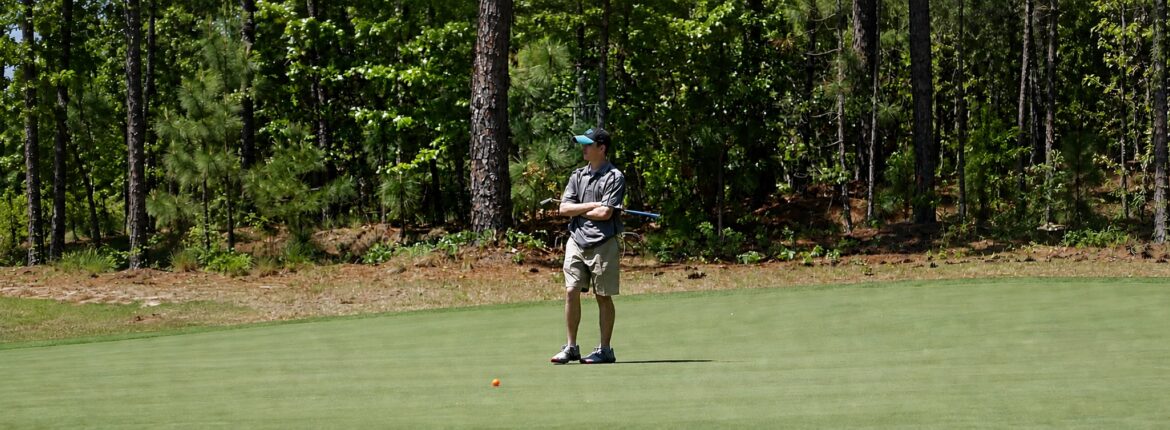
At the North Carolina State High School Golf Championship, I arrived a day early while Ben was playing his practice round. He was anxious, and his swing wasn't quite there. I joined him for the final four or five holes and took him back through the progression of drills I had adapted from Shawn Clement's teaching principles.
The individual drills weren't magic. The progression mattered. One movement led into another, timing began returning, rhythm returned with it, and eventually Ben stopped searching consciously for his golf swing and simply found it again.
The next morning, Ben arrived early enough that I could stand beside him on the driving range and take him through the same progression. The facility didn't have much of a short-game area, so we did what we could with putting and chipping, but most of our preparation was devoted to getting his full swing organized before he went to the first tee.
Then Ben started hitting drives.
Every once in a while, when his ADHD brain, rhythm, mechanics, and confidence all arrived in the same place at the same time, he could look almost absurdly good. He was only a sophomore, about 5'8½", with naturally strong glutes and forearms, but he was not some giant upperclassman overpowering the course through sheer size. His distance came from sequencing, leverage, timing, speed, and the ability to absolutely flush the golf ball when everything synchronized.

Hole Number Two
The tee shot required Ben to navigate a narrow chute, with the fairway pinching in as the hole moved toward the green. It was not a place where distance alone solved the problem. The farther you drove it, the more important the line became.
Ben pasted it down the right side of the middle. His orange ball finished roughly twenty or thirty yards beyond the other two players in his threesome, but the distance was only half the shot. He had generated that distance while threading the ball through the narrowing corridor and putting himself in position for an approach that presented a completely different problem.
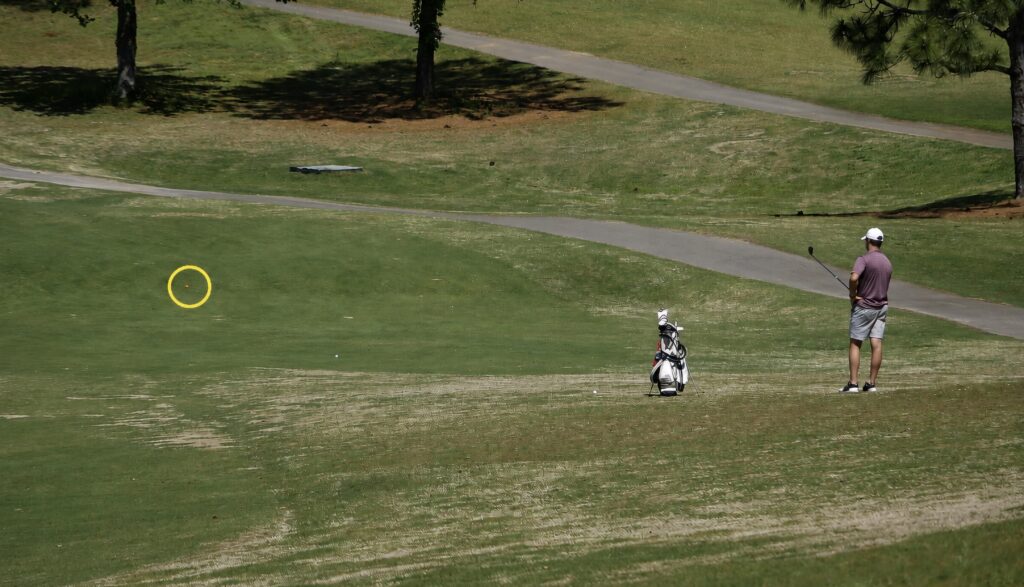
The second shot was uphill and angled toward the green, and Ben still had roughly 180 to 190 yards. He pulled a four hybrid and put the ball on the green in two.
The photographs from that hole preserve the sequence: the narrow chute Ben had to navigate from the tee, his orange ball well ahead after the drive, and the angle of the uphill approach with Ben's ball sitting on the green after the four hybrid.
Narrow chute. Twenty or thirty yards beyond the other two players. Four hybrid uphill. Green in two.
Then he two-putted for par. The scorecard records an ordinary par.
The golf that produced it was anything but ordinary.
The Coaches Started Noticing
That became the pattern of the first day. Ben hit 11 of 14 fairways, and the driving wasn't merely accurate. He was long.
The coaches who noticed him were not following Ben around the course. Each had five players scattered throughout the tournament, so they were driving from player to player and seeing pieces of the field as they moved around the course. Some happened to see Ben hit three or four drives, which gave them a basis for comparing what they were seeing from Ben with what they were seeing elsewhere.
As the round progressed, coaches started telling me how well my son was driving the ball. At one point, when Ben had hit something like seven of nine fairways, I mentioned the number and got the kind of reaction that told me this wasn't Dad seeing what Dad wanted to see.
Then, after the round, a couple of coaches approached Ben in the parking lot and told him:
“Hey, you outdrove everybody today.”
I broke down.
I had never needed Ben to win the state championship. He had struggled in cut sports, and I knew how important it was for him to experience being consequential somewhere. All I wanted was for him to have an opportunity to be impactful.
This wasn't pretty good considering. It wasn't nice job or you've really improved. A couple of people who had been moving around that tournament all day were telling him that, for one specific part of his game, he had been the best among all those competitors.
For the first time in his life in an athletic venue like that, Ben had that moment.
I cried because I knew what it could mean to him, and because in that moment I felt like the best father I knew how to be. Not a perfect father. The best version of his dad I could manage.
Ben's final tournament standing was nowhere near the top of the leaderboard. I don't remember the exact number accurately enough to print it as fact, but my recollection is that he finished somewhere in the 70s out of roughly 104 golfers. That was Ben's golf in miniature. There were stretches when he could look almost frighteningly good, followed by stretches when the wheels came off.
In that sense, he could sometimes be the Nick Foles of golf: when everything aligned, you could suddenly be watching something wildly out of proportion to his normal baseline.
Day two illustrated it perfectly. Ben and the team arrived later, and we didn't have enough time to work through the same driving-range progression. He still hit roughly eight of fourteen fairways, which was respectable, but the flow wasn't there.
The physical ability hadn't disappeared. Access to it had changed.
That distinction—having an ability versus being able to summon it reliably on demand—would become central to how I understood Ben and ADHD.
Even while all of that was happening off the tee, however, something very different was occurring around the green. Ben could hit shots that made people stare, yet he could struggle to determine which shot he should hit.
I didn't understand that yet.
Scotch Hall and the Seven-Iron Rule
Earlier that year, before the state championship and before the later AuDHD diagnosis, another episode had given me a clue I didn't yet know how to interpret.
It was a high-school conference tournament at what was then Scotch Hall Preserve on the Albemarle Sound. The weather was miserable—around 40 degrees, with roughly a 15-mile-per-hour wind coming off the sound. At one point it dropped to about 39 and we had snow squalls, with big, fat snowflakes blowing across a golf course in eastern North Carolina.
At one point I yelled across the course, “Ben, I really love you!”
The translation was obvious: Look at the weather I'm standing in for you.
But Ben had something much heavier than weather occupying his mind. His beloved Papa was in home hospice and could die at any time. Ben was playing competitive golf with what I can only describe as buzzing hornets in his head.
Seventeen
The seventeenth at Scotch Hall was a short par three, narrow from front to back, played across a small chasm toward the Albemarle Sound. That day it was directly into the wind. A normal high iron shot risked ballooning and disappearing into the chasm.
During warm-ups, I pulled Ben aside and told him he was going to need a knockdown shot.
He didn't really have one.
So we built one.
Gouge the Planet
Rather than begin with a complicated verbal description of impact, I wanted to give Ben a sensory preview of what impact was going to feel like. I had him take the club one-handed with his right hand and swing it directly into the ground.
Gouge the planet Earth.
The choice of the right hand was deliberate. When you drive the club into the turf that way, the right hand is where you really feel the vibrations of the strike. I wasn't asking Ben to reproduce a complete golf swing yet. I was giving his nervous system a preview of the sensation the eventual impact was supposed to create.
Feel the vibration. Feel the resistance. Feel the club entering the ground rather than trying to help the ball into the air and merely shaving the grass.
Then we put the ball farther back in his stance. Because contact occurred earlier in the swing arc, we adjusted the clubface so the ball would still start on the intended line. The follow-through stayed low. We had already done Shawn Clement-derived drills involving throwing the golf club down a slope, so Ben had another sensorimotor reference for releasing the club along that lower trajectory.
Only after those sensations existed did the verbal instruction have something physical to attach itself to:
sensation >> language >> movement >> feedback
I wasn't asking Ben to imagine what gouging the Earth ought to feel like. I let his right hand tell him.
Then we calibrated the shot. A seven iron at roughly an 80-percent swing would normally give Ben around 140 yards. The important part wasn't merely seven iron. It was maintaining enough swing speed to keep enough spin on the lower shot that it could still hold a green.
Ben picked it up remarkably quickly.
Eventually he reached seventeen. The wind was howling into him, and Ben hit the shot we had practiced: low, controlled, with enough spin. It hit the green and held. According to the people around us, Ben was the only player who hit that green that day. He made par. I don't know whether he was the only player who made par, so I won't claim that, but I was told nobody else had hit the green.
Here was a kid playing in brutal wind and cold, with his Papa dying in hospice, executing a shot he had essentially just learned because the situation demanded it.
If I had stopped observing there, I would have drawn exactly the wrong conclusion. I would have thought, Great. Ben learned a knockdown.
He had learned something else.
“Tell Ben to Stop Hitting Seven Irons”
About a week and a half later, I got a text from his coach:
You need to tell Ben to stop hitting seven irons into every green for short-game shots.
My reaction was basically: Whoa. What?
Then, at the North Carolina State High School Golf Championship, I saw the problem myself.
Ben was about 110 yards from the green. I watched him set up for a knockdown. Good swing, good contact, nice low trajectory. The ball landed and rolled off the back of the green.
I hadn't seen the number on the club, but I knew intuitively what he had done.
Seven iron.
Ah, fuck.
The distance, trajectory, and rollout told me what had happened, and in that instant the coach's text and the Scotch Hall lesson snapped together. I had thought I taught Ben how to hit a knockdown shot. Ben appeared to have learned:
knockdown = seven iron
That wasn't what I had said. The seven iron had been the club appropriate to one particular distance and one particular situation. The 80-percent swing—and the resulting spin—was part of the instruction.
I thought I had transmitted a relationship.
Ben had extracted a rule.
That was when I began to realize the problem wasn't necessarily Ben failing to understand what I had told him. The problem might be that I had failed to understand what Ben's brain did with what I told him.
The First Summer: Break the Singular Rule
The summer after Ben's junior-year high-school golf championship, while he was staying with me, I began attacking the problem of singular experience. I had not yet fully attacked the separate problems of visualizing and choosing shots. We paid some lip service to those things over the following winter, but the systematic work came the next summer.
This first summer was about something more fundamental. Where a singular experience seemed capable of creating a rigid rule, I deliberately gave Ben a spectrum of experiences.
“That's What You Told Me”
We were playing the second hole at my golf course when I dropped a couple of balls about 110 yards from the green and told him, “Ben, hit a knockdown for me.”
He immediately reached for the seven iron.
I stopped him and asked, “Why did you pull out a seven iron?”
“That's what you told me to.”
No, it wasn't what I thought I had told him. But increasingly I was learning that arguing about the original verbal instruction was beside the point.
What mattered wasn't what I transmitted. What mattered was what Ben encoded.
So I changed the experience. At 110 yards, pitching wedge. Move farther back and use a nine iron. Farther again and use an eight iron. Continue outward. The roughly 80-percent swing became the stable component while distance, club, feel, and ball flight changed.
Instead of one successful example producing one rigid association, I gave him a spectrum. The new rule could become something closer to:
knockdown = trajectory + swing pattern + appropriate club for the required distance
That summer I began applying the same principle elsewhere. A flop shot didn't have to mean lob wedge. We explored the same fundamental motion with a lob wedge, gap wedge, and eight iron. The family of motion remained recognizable while the club, trajectory, distance, and outcome changed.
I had stopped teaching him an answer. I was trying to teach him a space of possible answers.
Then Ben showed me that the space had expanded farther than anything I had explicitly taught.
The Four-Hybrid Flop Shot
We were playing a nine-hole stroke-play round. On one of the holes, a double-dogleg par five, I was in excellent position. After two shots I was about 120 yards from the green with a clear look.
Ben was in trouble. He had punched out of the woods and still had roughly 190 yards. Worse, he couldn't see the green.
Then I watched him pull a four hybrid.
My immediate reaction was, Ah, fuck. Why is he pulling a four hybrid? I thought he was about to send the thing straight through the dogleg.
Then I watched him set up.
Ball forward. Body tilted. Clubface open.
He's setting up for a flop shot.
With a four hybrid, from roughly 190 yards, over trees, to a green he couldn't see.
Nobody had taught him that shot. I certainly hadn't.
Ben opened the face, made the swing, and pured it. The ball went over the trees on a no-look line and finished roughly two and a half yards off the green.
The important thing wasn't merely that he pulled off a ridiculous golf shot. The important thing was that he chose it.
At Scotch Hall, one powerful experience had apparently become knockdown = seven iron. After the summer's variable practice, Ben had extracted something deeper: a shot is not necessarily a club. A flop shot was a way of manipulating a golf club to produce a trajectory. Once that abstraction existed, the club became a variable.
I had explicitly taken him only as far as an eight iron.
Ben supplied the four hybrid.
That was creativity.
It was also the nine-hole round when Ben beat me in stroke play for the first time. He had beaten me before in match play, where one catastrophic hole doesn't poison the entire scorecard. But in stroke play, every stroke follows you home.
The father remembers getting beaten. The mathematician remembers the mechanism:
singular experience >> rigid rule >> spectrum of experiences >> relational rule
relational rule >> spontaneous transfer >> novel solution
The model had generalized.
That was when I knew I had found something worth pursuing.
Creating a Shot Is Not Choosing a Shot
That first summer taught me that Ben could build flexible rules when I gave him a sufficiently differentiated spectrum of experiences. It did not solve his difficulty visualizing a golf situation and choosing the appropriate shot. Those are different cognitive operations.
Ben could now possess a larger and more flexible repertoire of shots while still struggling to determine which member of that repertoire belonged in a particular situation. We paid some attention to that over the winter, but I would be rewriting history if I claimed I solved it then.
I didn't.
The problem didn't fully galvanize until the following summer, before Ben's senior year. That was when I attacked visualization and shot selection directly.
The Second Summer: Teach the Eyes
This was when the three-club ladder became much more than a golf drill.
For myself, I use a five-club ladder from 100 yards, moving from seven iron through gap wedge and seeing how many pars I can make. The purpose is to differentiate the feel of those clubs and trajectories. If someday I have to punch a five iron out of the woods from 100 yards, the swing isn't an abstraction. My body already possesses a family of differentiated experiences.
For Ben, I built a three-club version around the green.
The Three-Club Ladder
Ben putted left-handed. Because the basic chipping motion can be built as a derivative of the putting stroke, his low-running club around the green was a left-handed eight iron. His other two clubs were right-handed: a gap wedge and a lob wedge.
The goal was two up-and-downs out of three. At the time, the PGA Tour benchmark I was using was roughly 50 percent. Two out of three is 66.7 percent, so the target was intentionally demanding, but it was deliberately not perfect.
That distinction mattered because of Ben's anxiety. One miss did not destroy the drill. He could make a mistake, remain inside the task, and still succeed. If he didn't get two out of three, nothing catastrophic happened; he simply repeated the progression.
The standard was difficult. The standard was not perfection. A miss was survivable. Perseverance was built into the architecture.
Excellence without perfection. Failure without catastrophe. Repetition without punishment.
That was the point.
Then we moved: different lie, different amount of green, different landing requirement, different club. Then another location.
The drill involved high repetition without identical repetition. Instead of telling Ben what all those variables meant and expecting language alone to create the internal picture, I let the golf course teach him through repeated contrasts.
The mathematical educator in me eventually recognized what I had built.
A Golf Manipulative
The learning architecture was essentially:
position >> visual information >> club choice >> feel >> shot >> ball flight >> landing >> release >> result
Then move somewhere else and run the experiment again.
The three clubs themselves made the experiment wonderfully strange. Because Ben putted left-handed, his eight-iron bump-and-run was left-handed. His gap wedge and lob wedge were right-handed. The drill wasn't simply varying clubs and trajectories; sometimes it was varying sides of the body.
Once Ben understood the shot as a manipulable family rather than a club-specific command, the ADHD novelty component occasionally went wild. A left-handed eight iron could become a left-handed bunker club or a left-handed flop-shot club. Put him behind a tree where he couldn't make a right-handed swing, give him an absurd problem he hadn't encountered before, and sometimes the very weirdness of the problem caused him to lock in.
Sometimes he chose the wrong shot but executed the wrong shot remarkably well. Give him a left-handed eight-iron flop shot and the novelty of figuring out something he wasn't supposed to be able to do could capture him completely. By the third attempt, sometimes I was standing there thinking, He shouldn't be getting this that quickly.
That was the strange interaction I kept seeing. The autistic trait seemed capable of producing a rigid rule from an insufficiently varied experience, while ADHD novelty could become an accelerator when the experience itself was transformed into a problem worth solving.
Neither label by itself explained the kid standing in front of me.
Let Your Eyes Be the Ball
Alongside the three-club ladder came our visualization work, including what I called Let your eyes be the ball. I wanted Ben's visual system to travel through the shot before the club moved: follow the imagined flight, see where the ball lands, watch the first bounce, follow the release.
I was teaching his eyes how to visualize for his pre shot routines. Let your eyes be the ball and seel the ball land and release. The short game shots that would land at the hole and roll ten feet past went away within a week.
By the summer before his senior year, those pieces began coming together, and Ben became an up-and-down master. Unfortunately, development doesn't care about satisfying narrative arcs. Ben strained his rotator cuff his junior year, which affected his golf game.
But the cognitive change I had been looking for was there and he started to beat me more regularly.
Only after that second summer did I take the entire architecture to Dr. Joseph Llinas.
The Question That Galvanized Real Empathy
Before I showed Dr. Llinas the finished collection of golf drills, another conversation with him had already changed the way I was thinking about Ben. It occurred somewhere between the beginning of Ben's junior year and the summer before his senior year.
I had spent years watching adults struggle with ADHD children—in classrooms and in my own experience as a parent. Increasingly, I suspected that many of these conflicts were beginning not with the child's ADHD but with the adult's model of the child.
So I asked Dr. Llinas what percentage of failed parent-ADHD-child dynamics he thought came from the parent being unable to see beyond what they recognized of themselves in their child. The parent sees something familiar, constructs expectations from that familiarity, and then the child cannot neurologically meet those expectations.
His initial answer startled me:
“Almost all of it.”
Naturally, I pressed him. How much is almost all?
His estimate was roughly 95 to 98 percent.
Then I asked:
“What about the classroom? Same thing?”
“Yep.”
“Same percentage?”
“Absolutely.”
That 95-to-98-percent figure was not the result of a controlled study, and I am not presenting it as one. But neither was this a casual opinion from somebody standing outside the field. Dr. Llinas had spent decades working with ADHD and autistic children and had substantial research and clinical experience with children from low-income and high-risk families.
There are two epistemic mistakes available here. One is turning an expert's judgment into a published statistic when it isn't one. The other is stripping the expert's judgment of significance because it wasn't produced by a controlled trial.
I don't want to make either mistake.
His answer represented expert judgment grounded in decades of clinical observation and research experience with precisely the kinds of children I was asking about. More important, his answer gave me a framework for something I had been observing for years:
adult recognizes something >> relates it to personal experience >> constructs an expectation >> child's neurology cannot reliably meet it >> mismatch becomes “behavior”
That is where expectations become accusations: I know you can do this. You did it yesterday. You're not trying. You're being difficult.
The adult may sincerely believe they are being empathetic because they recognize something of themselves in the child.
Sometimes recognition is empathy.
Sometimes recognition is exactly what prevents it.
The Relatability Trap
The conventional idea of empathy often begins with finding something relatable: I was disorganized at your age. I hated homework too. I got distracted in school. I procrastinate sometimes.
That can be useful when the neurological machinery producing those experiences is sufficiently similar. But it becomes dangerous when the similarity is superficial.
The parent thinks, I procrastinated too. Eventually I learned to make myself do it, and therefore concludes, you can make yourself do it. The teacher thinks, I sometimes find this lesson boring and I still pay attention, and therefore assumes the child can do the same thing.
The adult has found something relatable and unknowingly made themselves the neurological control group.
That is the mistake.
The relevant question isn't What would I do in this situation? It is What is this situation like inside this child's nervous system?
Those are radically different questions.
Real Empathy Begins Where Relatability Ends
Relatable empathy is comparatively inexpensive. Something happens to you, I search my own history, find something similar, and use my experience as an approximation of yours.
Real empathy becomes necessary when that shortcut fails.
Now I cannot simply look inward. I have to observe, listen, notice where my predictions repeatedly fail, and entertain the possibility that something obvious to me genuinely isn't obvious to the person in front of me—not because that person is lazy, oppositional, careless, or insufficiently motivated, but because the machinery doing the processing may be different.
Then comes the difficult part: I have to modify my model rather than demanding that the other person conform to it.
That takes time, effort, and perseverance. Sometimes it takes years.
The golf work with Ben became my laboratory for learning exactly how difficult that can be.
The Intervention Worked. The Environment Could Still Win.
There was another painful limitation to almost everything Ben and I discovered together: he would rarely carry these drills into practice with his golf coach.
His coach was a wonderful guy. Ben had my complete permission to use the drills, and I was willing to work with his coach. The problem wasn't coaching.
The problem was visibility.
Ben had experienced severe bullying when he was eleven, with consequences serious enough that what followed could not be dismissed as ordinary adolescent self-consciousness. He had learned that being visibly different could put a target on his back.
Some of our drills looked different from what everybody else was doing. During high-school practice, that changed the calculation. The drill could work, the warm-up could work, the progression could work, and none of that mattered if doing it publicly made Ben feel exposed.
He would do those things with me. During tournament warm-ups, he would often do them if I stood beside him, because my presence gave him social cover: My dad is making me do this. Remove me, and the same accommodation could make him the kid doing something weird.
That meant some of the most effective interventions we discovered were never reinforced with the frequency they needed.
We had solved part of the learning problem. We had not solved the environmental problem that determined whether he felt safe enough to use the solution.
This is why I refuse to silo trauma out of discussions of ADHD and autistic traits simply because trauma is acquired. Etiologically, the distinction matters. Functionally, Ben had one nervous system. An intervention could be cognitively perfect for him and socially unusable at exactly the same time.
The Golf Course Was Showing Me the Whole System
Looking backward, the pieces were sitting in front of me. ADHD novelty could help Ben lock onto an unusual challenge and acquire a difficult motor solution remarkably quickly. An autistic trait appeared to contribute to narrow rule formation from singular experiences and difficulty integrating contextual cues when choosing among shots. Anxiety meant the learning architecture needed to tolerate mistakes rather than demand perfection. Trauma from bullying could make the very accommodation that helped him learn feel socially dangerous to use.
Put those together and the model looks nothing like a list of symptoms:
ADHD novelty >> engagement >> rapid experimentation
autistic trait >> rigid singular rule >> spectrum of experiences >> flexible abstraction
anxiety >> perfection risk >> failure-tolerant criterion + perseverance
bullying trauma >> fear of visibility >> avoidance of effective accommodation
Same kid. Same nervous system. Same environment. Same history.
The traits do not take turns. They interact.
That is exactly why AuDHD interests me.
What Dr. Llinas Gave Me
After the second summer—the summer before Ben's senior year—I finally showed Dr. Llinas the drills I had developed and explained why I believed they worked.
By then, I wasn't showing him a cute collection of golf exercises. I was showing him the product of a multiyear process. I had watched a singular experience become an excessively rigid rule, so I created spectra of experiences. The rule became more flexible. Then I realized flexible shot creation didn't automatically produce good shot selection, so I attacked visualization and selection through variable physical experience, the three-club ladder, and exercises such as letting his eyes become the ball.
Then I watched Ben change.
I also knew there wasn't a research literature waiting to tell me whether the model underneath what I was doing was correct. Dr. Llinas told me, in substance, “You do realize there's nobody doing research on this, right?”
I responded by saying "Yeah, I know. I know this is a thing and I know that my solutions are within a certain vector of where the optimal solutions lie, correct?"
He responded “Yeah. Absolutely.”
My internal reaction was basically: Really? You? The GOAT? Wow.
That mattered enormously to me. I wasn't asking him to declare that I had proven anything. I needed somebody whose judgment I respected at that level to tell me I wasn't chasing noise.
He did, and I kept going.
Why This Is One of My Proudest Accomplishments
I don't have Ben's autistic trait. That matters.
When I taught the seven-iron knockdown, my brain automatically treated the seven iron as one example of a general principle. I didn't have to teach myself that the same architecture could migrate to other clubs.
Ben apparently did.
So I couldn't understand him merely by looking inward. I had to cross a cognitive distance, and that required observation, failure, revision, more observation, more failure, another hypothesis, another intervention—and years.
In my case, I also had an unusual analytical tool available to me. I have very high measured intelligence and an unusually nonlinear style of reasoning. Dr. Llinas had remarked on how quickly I made connections that he rarely saw other people make.
That doesn't make me a better father.
It gave me a tool.
And for once in my life, that tool found a problem worthy of everything I could throw at it: my son.
I was largely out in the wilderness trying to figure this shit out because nobody had done the research that could tell me what to do next. That is why this remains one of the things in my life I am proudest of.
Not because I solved Ben. Ben was never the problem to solve.
The problem was my inability to understand what Ben needed, and I kept working on that problem.
Pinky, Brain, and the Distance Between Ideas
The same architecture appeared outside golf.
Ben had an extraordinary ability to mimic. He could reproduce voices, cadence, and dialogue with remarkable fidelity. Pinky and the Brain became one place where I could see the difference between reproduction, local improvisation, and something more distant.
If I stayed within the conceptual neighborhood of the show and improvised, Ben could follow me. I could make him laugh to the point where he once actually wet himself.
But if I imported something from a completely different conceptual neighborhood—being me, sometimes something deliberately sexual and inappropriate—Ben had no idea where to go with it. The characters were familiar, and the concepts themselves weren't necessarily unfamiliar. What seemed difficult was the bridge between distant models.
That suggested a more precise distinction:
local improvisation worked >> distant cross-domain remapping was harder
That is much more interesting than saying Ben couldn't improvise.
Maybe Creativity Has a Distance Variable
We often treat mimicry and creativity as opposites. That may be wrong.
A more useful model might contain several partially independent capabilities:
acquisition speed · reproduction fidelity · local improvisation · distant associative transfer
Those abilities don't necessarily travel together. A person might acquire an existing model extraordinarily quickly, reproduce it with remarkable precision, and improvise beautifully within its neighborhood while being less likely to import something spontaneously from a distant conceptual domain. Another person might reproduce less faithfully but constantly connect conceptual neighborhoods everyone else experiences as unrelated.
Neither architecture is simply “more creative.” They may produce different forms of creativity.
Ben's drumming made that distinction particularly visible.
Ben, Bruford, and Roundabout
Ben learned drums at a ridiculous rate. When engagement was there, ADHD could become an accelerator. Repetition attached to genuine interest could become a strength. He could learn complicated existing material extraordinarily quickly.
But learning an unexpected musical transition and inventing one are different cognitive operations.
Consider Yes's Roundabout. The song travels through its progressive-rock architecture and then enters a passage with a strikingly Caribbean- or Latin-flavored rhythmic character. It feels as though something has been imported from another musical neighborhood and somehow made to belong.
That is what fascinates me about Bill Bruford. The remarkable cognitive act isn't merely being able to play that transition. Ben could learn a transition like that. The interesting question is whether, while constructing music through rehearsal, he would spontaneously think to import something from that distant rhythmic neighborhood in the first place.
There is a difference between learning something, reproducing it, modifying it, and being the person who first thinks:
What if we bring that over here?
That fourth capability is the one that interests me.
Then a Columbus Blue Jackets golf bag gave me an even cleaner example.
Lightning Can't Hit That
One summer after the Tampa Bay Lightning had been swept out of the first round of the NHL playoffs by the Columbus Blue Jackets, I was merciless about it.
An assistant principal I knew, Terry McConomy, was a huge Lightning fan. During one of Tampa's inevitable summer thunderstorms, there was a huge flash and bang and she said she didn't want to go outside and get hit by lightning.
I couldn't leave that alone.
“Ms. McConomy, I saw the playoffs. You're okay. The Lightning can't hit anything.”
She laughed and rolled her eyes.
Later, when Ben needed a new golf stand bag because one of the legs on his old bag was locking up, I found a Columbus Blue Jackets bag on sale.
Ben looked at it and said, “Dad, why'd you get me this? I'm a Carolina Hurricanes fan. I'm not a Columbus Blue Jackets fan.”
I reminded him what had happened between Columbus and Tampa and told him the bag had another advantage:
“Yeah, Ben, but if you're using that bag and there's inclement weather coming, that bag will protect you because lightning can't hit that.”
Ben stared at me and told me it was a bad joke—a really bad joke—and that I should never say it again.
Three months later, he came back to me.
“Dad. I got the joke.”
That delay fascinated me because Ben could understand the joke. He just didn't understand it when I originally told it.
Hit Versus Strike
At first I thought the difficulty was simply the enormous associative distance. The joke requires NHL history, weather, a team name, a physical golf bag, and the idea of protection from lightning to collapse into one representation.
Eventually I noticed something smaller. The linguistic bridge itself might have been the problem.
What is the dominant verb in sports when someone makes forceful contact? Hit. What does lightning conventionally do? Strike.
A hockey player hits. Lightning strikes. Hit and strike overlap substantially in meaning, but they live in different linguistic neighborhoods and carry different connotations. My joke quietly requires the brain to bridge hit ≈ strike while simultaneously allowing Lightning to migrate from the Tampa Bay hockey team to atmospheric lightning and allowing the Columbus Blue Jackets identity to migrate from a hockey team to the physical object Ben is holding.
Only then does “Lightning can't hit that” work.
For my brain, those semantic boundaries are extraordinarily porous. Alternate meanings collide almost automatically. For Ben, the models appeared more resistant.
He knew what hit meant. He knew what strike meant. He knew the hockey history. He knew exactly what object he was holding.
He had the nouns. He had the verbs. He had the history. He had every piece.
What he didn't immediately have was the bridge.
Three months later, the bridge existed.
That raises a question I desperately want somebody to investigate: What looks like inability may sometimes be latency.
Perhaps some people aren't incapable of making distant semantic or conceptual connections. Perhaps increasing associative distance dramatically increases the amount of time, experience, or scaffolding required for the connection to form.
That possibility would have enormous implications for how we measure learning, abstraction, and generalization.
Then my friend Neil did something remarkably similar.
Michael Vick and the Puppy
I once sent my friend Neal a picture of my beautiful puppy Lila wearing an Atlanta Falcons Michael Vick toddler jersey.
Neil recognizes autistic traits in himself but does not have enough traits for a full autism diagnosis. He responded essentially at face value: Michael Vick, Falcons, football, great player. That was the model that activated.
My brain couldn't possibly see a puppy wearing a Michael Vick jersey without the other Michael Vick association crashing into it. Eventually I asked him what Michael Vick had been arrested for.
Dogfighting.
Then I supplied the missing bridge:
All puppies are dogs, but not all dogs are puppies.
The puppy was wearing a Michael Vick jersey.
Then Neal laughed.
Again, the necessary information had already been there. He knew Michael Vick, he knew about dogfighting, and he knew that a puppy is a dog. Once the relationship was explicitly bridged, the humor appeared.
The interesting thing was not that an autistic trait made somebody unable to understand humor. It didn't. The interesting thing was what had to be connected before the humor emerged.
Neal is precisely the kind of person who makes me question where we draw the AuDHD boundary.
What If “Literal” Is an Outcome Rather Than the Mechanism?
“Literal thinking” describes what we observe. It does not necessarily explain why we observe it.
My hypothesis is that at least some autistic cognitive or language traits may involve unusually strong context-dependent representations. Information can be acquired extraordinarily well and retrieved extraordinarily well within the model or neighborhood in which it was acquired, while spontaneous transfer across models becomes progressively more difficult as conceptual distance increases.
That could potentially connect several phenomena that otherwise appear unrelated: sarcasm, distant improvisational humor, mimicry, cross-context semantic transfer, verbal golf instruction, and delayed comprehension of a joke. Those could still be unrelated phenomena, but if they are manifestations of some common mechanism, the mechanism may be far more interesting than simply labeling the outcome “literal thinking.”
It could also explain why more verbal detail sometimes doesn't solve the problem. If the difficulty is not insufficient information inside the model but insufficient bridging between models, adding more information to the original model does not build the missing bridge.
That is precisely what I discovered accidentally with golf.
More words didn't solve the problem. Changing the experience did.
Jeff Hawkins Gave Me a Possible Architecture
Later, Jeff Hawkins's Thousand Brains theory gave me a conceptual framework for thinking about what I had already observed. Hawkins and colleagues have proposed an architecture in which cortical columns construct models using reference frames and multiple models contribute to our representation of objects and the world.
The epistemic boundary here needs to be unmistakable. Hawkins has not demonstrated my hypothesis about autistic cognition. Thousand Brains does not establish that Ben's representations were siloed, that autistic traits produce stronger contextual boundaries, or that my proposed mechanism explains sarcasm, humor, or golf learning.
The chronology went the other direction:
Ben >> observation >> pattern >> hypothesis
Hawkins >> possible theoretical architecture
I did not read Hawkins and then retrofit my son into the theory. I had already spent years trying to understand what I was seeing. Hawkins gave me a vocabulary that made me wonder whether the important variable might not be the quality of the models at all.
Maybe the models are excellent.
Maybe the interesting variable is their permeability.
Maybe the Silos Aren't Silos
The three-month joke tells me that silo may actually be the wrong metaphor. If Ben's models were sealed, he never would have gotten the joke.
He did.
Imagine conceptual neighborhoods instead, connected by roads whose resistance changes with distance. Some brains may build extraordinarily detailed neighborhoods with efficient local transportation. Knowledge within the neighborhood is precise, stable, and rapidly available, and nearby improvisation works beautifully. But as conceptual distance increases, travel becomes progressively more expensive.
Another brain may have remarkably permissive highways between neighborhoods. Information from distant domains constantly collides. That can produce abstraction, humor, and unusual creativity, but it can probably also produce distraction, irrelevant associations, cognitive noise, and ideas arriving faster than they can be organized.
The tradeoff might therefore look something like:
strong local models >> high-fidelity retrieval >> efficient local improvisation >> more expensive distant transfer
versus:
porous model boundaries >> rapid distant association >> unusual recombination >> greater cognitive noise
Neither architecture is inherently superior. Different architectures can produce different kinds of excellence—and different kinds of impairment depending upon the environment.
Now return to AuDHD.
The Diagnostic Threshold Is Not a Biological Wall
Suppose someone with ADHD has one autistic trait. Another person has three. Another has five. Another has enough to satisfy the diagnostic criteria for ASD.
At what point do those traits suddenly begin interacting with ADHD?
Why would we assume the interaction starts only when a clinician checks the final box necessary to cross a diagnostic threshold?
Diagnostic thresholds are necessary. Medicine needs operational definitions, researchers need reproducible inclusion criteria, and clinicians need standards for deciding who qualifies for a diagnosis and often for services. But a diagnostic threshold is not necessarily a mechanistic threshold.
That distinction is the center of my argument.
If an individual autistic trait changes how language is processed, how experience is generalized, how cues are integrated, how rules are constructed, how sensory information is weighted, or how models are transferred across contexts, then the scientifically interesting question is not merely whether that person has autism.
The scientifically interesting question is:
What happens when this particular trait interacts with this particular ADHD architecture?
The answer could be impairing, complementary, situational, or unexpectedly advantageous. It could be all four in different environments.
We don't know.
And we don't know is exactly where the research question begins.
AuDHD Should Be About Interaction, Not Addition
This is why I think the common shorthand—ADHD + ASD—is too restrictive for the phenomenon we actually need to investigate.
The model I am proposing is:
AuDHD = ADHD + one or more functionally meaningful autistic traits
That does not mean:
one autistic trait = autism
Those statements are completely different.
Autism remains autism. ADHD remains ADHD. But AuDHD, as a research and explanatory construct, could describe the interaction space between ADHD characteristics and autistic characteristics regardless of whether enough autistic traits accumulate in one individual to cross the ASD diagnostic threshold.
Then we can finally ask the interesting questions. Does ADHD novelty loosen an otherwise rigid rule system in some circumstances? Can an autistic tendency toward precise or narrow encoding sometimes stabilize an ADHD learning system? Can ADHD associative thinking help bridge models that otherwise remain relatively resistant to transfer? Can autistic traits constrain that associative movement in some domains while improving fidelity in others?
Can sensorimotor experience create bridges that verbal explanation cannot? Can anxiety change the expression of those interactions? Can acquired trauma determine whether a neurologically appropriate accommodation is usable at all?
Most importantly:
Which trait combinations produce which outcomes in which environments?
That is the research program I want.
Trauma Cannot Be Siloed Out of the Model
This is also why trauma has to remain inside the discussion even though it is acquired rather than neurodevelopmental.
Ben's history made that impossible for me to ignore. An intervention could work beautifully. We could know it worked. His coach could be supportive. Ben could have complete permission to use it. And he still might not use it when I wasn't standing beside him because the history of bullying had taught him that visibly doing something different could put a target on his back.
The eventual model therefore cannot stop at:
ADHD traits × autistic traits
It has to widen:
ADHD traits × autistic traits × development × environment × learning history × trauma >> observed phenotype
The child does not experience those systems separately. The parent doesn't parent them separately. The teacher doesn't teach them separately.
The person arrives whole.
A Hypothesis That Generates Testable Predictions
Everything I have described here requires a clear epistemic boundary. This is not an established scientific model of AuDHD. It is a hypothesis built from frontline observation, parenting, teaching, repeated behavioral patterns, and expert clinical conversations with Dr. Llinas.
But a hypothesis becomes scientifically interesting when it does more than explain the past.
It must make predictions about what we should observe next.
If my model is even approximately right, then people with ADHD plus particular autistic traits should show measurable differences in how they generalize from singular experiences, transfer knowledge across contexts, respond to variable examples, bridge semantically distant concepts, and use sensorimotor experience to construct flexible internal models.
Prediction One: Singular Experience Versus Variable Experience
Ben's golf experience produces a straightforward prediction. If some autistic traits promote narrow rule extraction from salient singular examples, then a group displaying those traits should generalize less broadly after one highly salient example than an appropriately matched comparison group.
Give both groups a deliberately varied spectrum of examples, however, and the gap should narrow if variability helps construct the broader relational rule.
That is testable.
Prediction Two: Sensorimotor Bridges
The golf intervention produces another prediction. If sensorimotor experience can provide bridges that verbal explanation alone sometimes cannot, then performance and cross-context transfer should improve more after variable embodied instruction than after additional verbal explanation in at least some ADHD-plus-autistic-trait profiles.
That is testable.
Prediction Three: Associative Distance and Latency
The Lightning and Michael Vick examples produce another. If the problem involves associative distance rather than absolute inability, then comprehension latency should increase systematically as semantic or conceptual distance increases.
Explicitly supplying an intermediate bridge should reduce that latency.
That is testable.
Prediction Four: ADHD Novelty and Recombination
The interaction with ADHD generates perhaps the most interesting prediction of all. If ADHD novelty can sometimes promote recombination after a sufficiently flexible relational model has been established, then novelty should not simply increase distraction.
Under the right conditions, it should increase the probability of spontaneous novel transfer.
The four-hybrid flop shot becomes more than a family golf story. It suggests an experimental question.
The model therefore predicts:
singular salient experience >> narrower rule
variable experience >> broader relational rule
broader relational rule + novelty >> increased opportunity for spontaneous recombination
The language model predicts:
greater conceptual distance >> greater integration latency
while:
explicit bridging + repeated cross-context exposure >> reduced integration latency
These predictions can fail. They can be partially supported. They can reveal that I have identified a real phenomenon while being completely wrong about the mechanism producing it.
Good.
I don't want researchers to prove me right.
I want them to try to break the hypothesis.
If the predicted effects do not appear, modify the model or throw it away. If they appear only with particular autistic traits, identify those traits. If they appear only with certain ADHD presentations, identify those. If anxiety, intelligence, trauma, language ability, or developmental history changes the result, put those variables into the model.
That is how an observation becomes a research program rather than a belief.
The Research Design Almost Writes Itself
Take a large population of people with ADHD and stop dividing them only into ASD-positive and ASD-negative groups. Keep those diagnoses because they contain useful information, but then go underneath them.
Measure autistic traits dimensionally alongside ADHD traits. Measure sensory processing, language pragmatics, cognitive flexibility, repetition tolerance, acquisition speed, reproduction fidelity, local improvisation, distant associative transfer, and the speed with which learned relationships generalize into unfamiliar contexts.
Then manipulate the bridges.
If somebody cannot transfer a concept from A to C, introduce B. If verbal instruction fails, introduce sensorimotor experience. If a distant semantic relationship is missed, explicitly identify an intermediate connection and measure what happens afterward.
Then examine the interactions rather than merely the diagnoses. Which ADHD traits amplify which autistic traits? Which combinations compensate for each other? Which combinations create unexpected impairments? Which combinations create unexpected capabilities?
Does repetition tolerance sometimes stabilize ADHD engagement long enough to produce exceptional mastery? Does cognitive rigidity sometimes constrain ADHD novelty productively and sometimes create debilitating conflict? Does sensory sensitivity alter what we interpret as distractibility? Does associative distance predict integration latency? Does explicit bridging reduce it?
Then put development, environment, intelligence, learning history, anxiety, and trauma back into the model.
I don't want researchers to prove me right.
I want somebody to ask the damned questions.
The Child Below the Threshold Still Has the Trait
This is ultimately why the diagnostic boundary bothers me so much.
Imagine a child with ADHD who has one autistic trait that profoundly changes how that child interprets language. The child doesn't meet criteria for ASD.
Fine.
Monday morning still arrives. The parent still gives instructions. The teacher still explains the assignment. The child still receives language through whatever processing architecture that trait contributes to, and the interaction with ADHD still occurs.
Then the misunderstanding occurs. The adult constructs an expectation. The child fails to meet it. And if nobody recognizes the neurological mismatch, the interpretation becomes moral rather than mechanistic:
Lazy. Doesn't listen. Doesn't care. Knows better.
The diagnostic system may be completely correct that the child doesn't have autism.
That does not make the autistic trait neurologically irrelevant.
And it certainly doesn't make its interaction with ADHD irrelevant.
The Definition I Want
So yes, I want to broaden AuDHD.
Not by weakening the definition of autism, not by diagnosing everyone, and not by pretending a single trait constitutes a disorder. I want to broaden the question.
AuDHD should give us language for studying and supporting people with ADHD whose functioning is meaningfully shaped by one or more autistic traits, whether or not those traits add up to an ASD diagnosis.
Because traits do not wait for diagnostic permission to interact.
Ben didn't suddenly acquire his processing differences when somebody considered autism. The seven-iron rule didn't care whether he crossed a DSM threshold. The four-hybrid flop shot didn't either. Neil's difficulty bridging the Michael Vick joke did not become scientifically uninteresting because he did not have enough traits for an autism diagnosis.
A diagnostic threshold tells us something important about diagnosis.
It does not necessarily tell us where interaction begins.
The better question is not simply Does this person have autism? It is What is this particular nervous system doing?From there, we can ask what mechanism might explain it, what predictions follow from that mechanism, and whether those predictions survive controlled testing.
That progression matters:
observation >> pattern >> hypothesis >> prediction
experiment >> evidence >> revision >> better model
My experiences with Ben do not prove the hypothesis. My classroom observations do not prove it. Dr. Llinas's clinical judgment does not prove it. Jeff Hawkins's theoretical architecture does not prove it.
They do something different.
They tell us where it may be worth digging.
For me, that digging began with trying to understand a son whose mind sometimes worked very differently from mine. I could not rely on relatability because the very thing I needed to understand was something I did not experience myself. I had to observe him, fail, change my assumptions, try something different, watch what happened, and revise the model again.
That process changed the way I think about parenting, teaching, empathy, ADHD, autistic traits, and eventually AuDHD itself.
Real empathy does not require me to see myself in another person. In the most difficult cases, seeing too much of myself may be precisely what gets in the way. Real empathy begins when another person's response makes no sense inside my own neurological model and, instead of concluding that something is wrong with them, I become curious about the model I am missing.
That curiosity is not science by itself. But observation can generate a hypothesis, a good hypothesis generates predictions, and those predictions can be tested, challenged, broken, refined, or replaced.
If broadening AuDHD from ADHD + an autism diagnosis to ADHD + functionally meaningful autistic traitsproduces better predictions about how real people learn, communicate, generalize, create, struggle, and adapt, then we will have a scientific reason to reconsider where we drew the boundary in the first place.
Not because the diagnostic line was wrong.
Because the biology may never have cared where we drew it.
Cognitive Architecture and Neuroscience
- Frith, U., & Happé, F. (1994). Autism: Beyond "theory of mind." Cognition, 50(1–3), 115–132.(Provides foundational context regarding local processing biases, detail-focused cognitive styles, and alternative models of information integration in autism.)
- Hawkins, J. (2021). A Thousand Brains: A New Theory of Intelligence. Basic Books.(Explores cortical columns, reference frames, and the idea that the brain builds multiple predictive models of the world, referenced in the text regarding model permeability and relational frameworks.)
- Pellicano, E., & Burr, D. (2012). When the world becomes "too real": A Bayesian explanation of autistic perception. Trends in Cognitive Sciences, 16(10), 504–510.(Discusses predictive coding frameworks in autism, examining how sensory weighting and prior expectations shape perception and generalization.)
Autism, ADHD, and Diagnostic Dimensionality
- Karalunas, S. L., et al. (2014). Do attention deficit/hyperactivity disorder and autism spectrum disorder share a common etiological core? Journal of Abnormal Child Psychology, 42(3), 391–402.(Examines the overlap, co-occurrence, and shared underlying mechanisms between ADHD and autistic traits beyond strict categorical diagnostic boundaries.)
- Rommelse, N. N., Franke, B., Geurts, H. M., Hartman, C. A., & Buitelaar, J. K. (2010). Are ADHD and autism spectrum disorders independent conditions or manifestations of the same etiology? European Child & Adolescent Psychiatry, 19(4), 285–301.(Explores the complex phenotypic and neurocognitive overlap between ADHD and ASD spectrum conditions.)
- Singer, J. (1999). "Why can't you be normal for once in your life?" From a "problem child" to the neurodiversity movement. In M. Corker & S. French (Eds.), Disability Discourse (pp. 59–67). Open University Press.(Provides historical and conceptual grounding for the neurodiversity paradigm and moving away from deficit-only models of neurodivergence.)
Motor Learning and Sensorimotor Pedagogy
- Masters, R. S. W. (1992). Knowledge, kinesis, and control in the acquisition of motor skills. British Journal of Psychology, 83(3), 323–341.(Investigates implicit motor learning, explicit rule acquisition, and how verbal instructions versus physical/sensorimotor experiences impact skill execution under pressure.)
- Schmidt, R. A., & Lee, T. D. (2011). Motor Control and Learning: A Behavioral Emphasis (5th ed.). Human Kinetics.(Covers schema theory, variable practice, and the cognitive architecture of motor skill generalization across varying conditions.)
- Clement, S. (2006–present). Wisdom in Golf [Instructional methodology and media archives].(Practitioner framework focusing on ground reaction forces, kinetic linking, and sensorimotor cueing in golf swing mechanics.)
Clinical Dynamics, Emotion, and Relational Psychology
- Dodson, W. (2024). Regulation of Emotions in ADHD (Version 2.0). Personal communication and working document.
- Dodson, W. (2026). Personal communication regarding RSD, empathy, and the role of the advocate in adult and youth ADHD [PDF document].
- Greene, R. W. (2014). The Explosive Child: A New Approach for Understanding Easily Frustrated, Chronically Inflexible Children. HarperCollins.(Discusses the diagnostic and relational shift from viewing child behavior as a motivational failure ("won't") to a developmental lag or skill mismatch ("can't").)