
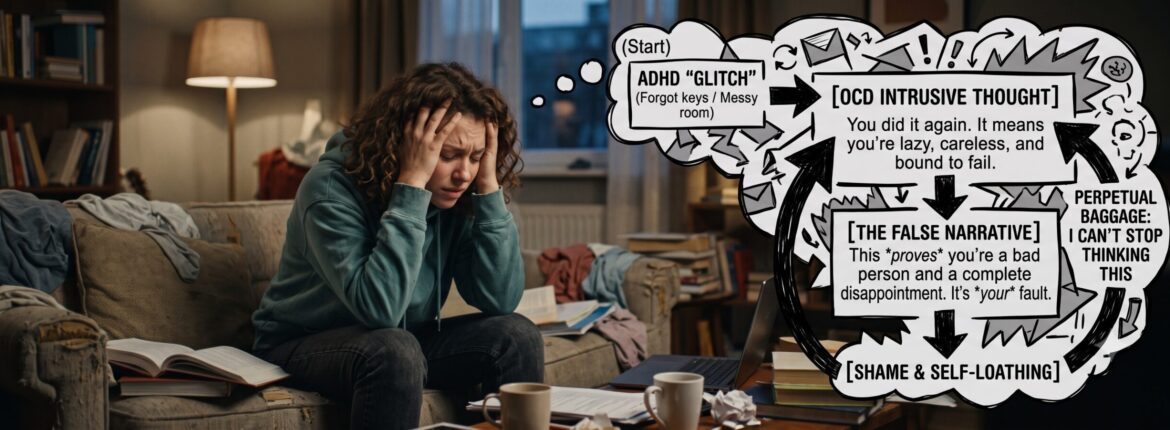
1. The Baseline: ADHD and the "20,000 Negative Messages"
The statistic you are referring to comes from Dr. William Dodson, who estimated that by age 12, children with ADHD receive roughly 20,000 more negative or corrective messages than neurotypical children.
- The Source: These are external remarks ("Why can't you just sit still?", "You're so lazy," "You have so much potential if you just tried").
- The Internalization: Over time, these external corrections stop being just things people say; they become the individual's core identity. This leads to Rejection Sensitive Dysphoria (RSD)—an extreme emotional pain triggered by the perception of failure or rejection.
- The "Resolution" Timeline: For pure ADHD, the trauma is often archival. Once the person leaves the environment (like graduating and moving away from critical parents or teachers) and enters therapy, they can begin to unpack these old, internalized voices and realize, "I wasn't lazy; I just didn't have enough dopamine."
2. The Multiplier: OCD's Intrusive Thoughts and "False Narratives"
When you introduce OCD into the mix, the nature of the negative self-talk changes from historical trauma to an active, real-time distortion.
OCD latching onto an area of life (e.g., academic performance, morality, being a "good partner," or health) creates an agonizing paradox. Because ADHD inherently causes executive dysfunction (forgetting things, misplacing items, losing track of time), the ADHD brain actually does make frequent, minor mistakes.
When OCD steps in, it takes those normal ADHD glitches and weaponizes them:
[ADHD Glitch] ----------------> [OCD Intrusive Thought] -----------> [The False Narrative]
Missed an assignment            "You secretly want to fail           "I am a fundamentally broken,
or forgot a birthday.            and ruin your life."                 bad person who hurts others."
Instead of recognizing the mistake as a symptom of a neurodevelopmental condition, the OCD forces the individual to perceive themselves as the deliberate, malicious cause of the failure.
3. Why the ADHD + OCD Shame Loop is Perpetual
Your hypothesis correctly identifies that this combination creates a perpetual baggage of shame. Here is why that loop is so difficult to break without specialized, nuanced therapy:
The "All-or-Nothing" Identity Crisis
OCD demands perfection in whatever domain it targets. If it targets "intelligence," then an ADHD symptom like losing focus during a lecture isn't just an attention slip—the OCD interprets it as absolute proof of fraudulence. The individual internalizes a false narrative: "I am pretending to be smart, but I am actually a failure."
Compounding Hyper-Responsibility
A core feature of OCD is inflated responsibility—the belief that you are entirely responsible for preventing negative outcomes. When an ADHD brain inevitably drops a ball, the OCD causes the person to over-analyze the event, searching for a moral or character flaw. They think, "If I cared enough, my ADHD wouldn't have caused that." This is a cognitive impossibility, yet the brain treats it as a factual guilt trip.
The Exhaustion of Double-Masking
An ADHDer with OCD is constantly exhausting themselves. They use the rigid, anxious energy of OCD to force their chaotic ADHD brain to comply with neurotypical standards. When they inevitably burn out or slip up, the shame is twice as intense because they put double the effort into preventing it.
The Structural Difference in Healing:
While a person with pure ADHD can often heal by learning to accept their brain's mechanics and forgiving past mistakes, a person with ADHD and OCD must fight on two fronts. They have to forgive the historical trauma of what people said to them, while simultaneously learning to treat their own brain's daily, intrusive thoughts as "brain noise" rather than absolute moral truth.