
Trades

The Fallacy of the Deficit: How the ADHD Brain Weaponizes Executive Function “Under Fire”
In the landscape of modern neuropsychology, Dr. Russell Barkley’s model of Attention Deficit Hyperactivity Disorder stands as a dominant paradigm. Barkley defines ADHD not as a knowledge deficit, but as a chronic, pervasive failure of executive functioning (EF) and self-regulation. In his view, the ADHD brain is biologically incapable of reliably holding onto working memory, […]
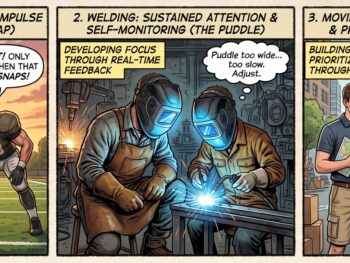
The Ancestral Engine: Why the ADHD Brain Thrives in Craft, Trade, and Action
For decades, modern education and corporate culture have treated ADHD as a deficit of attention and executive function. Individuals with ADHD are frequently diagnosed as having "broken" internal wiring because they struggle to sit still for six hours, absorb abstract lectures, or organize their day using traditional planners and spreadsheets. However, when you strip away […]
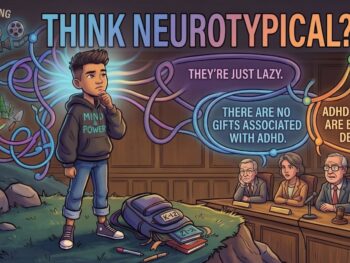
The Neuro-ESOL Imperative: Translating the Nonlinear Lattice of the ADHD Brain
When the American Psychiatric Association’s DSM formally clarified that ADHD is not a specific learning disability but a neurodevelopmental disorder affecting executive functioning, it accidentally triggered a systemic loophole in K-12 education. Because schools primarily measure eligibility for special education by narrow academic metrics—like a student falling behind several grade levels in reading or math—they began […]

The Freedom of the Trade: Why Nonlinear ADHD Brains Outgrow the K-12 Classroom
Traditional school systems are fundamentally built on a structural model that rewards sequential processing, conformity, and uniform paces. For a student with a highly active, nonlinear brain, the rigid environment of primary and secondary education often acts as a friction point rather than a catalyst for learning. When a high-IQ, hyperactive thinker checks out of […]