
For decades, modern education and corporate culture have treated ADHD as a deficit of attention and executive function. Individuals with ADHD are frequently diagnosed as having "broken" internal wiring because they struggle to sit still for six hours, absorb abstract lectures, or organize their day using traditional planners and spreadsheets.
However, when you strip away the artificial constraints of the modern classroom and look at human learning through the lens of neuroscience and evolutionary mechanics, a completely different narrative emerges. The ADHD brain isn't broken; it is simply dialed directly into a highly efficient learning engine that kept humans alive for two million years.
By synthesizing Jeff Hawkins’ memory-prediction framework with Shawn Clement’s task-focused golf philosophy, we can understand why the ADHD brain naturally gravitates toward tangible, tool-based experiences—and how these environments organically build the exact executive function skills the traditional world claims they lack.
1. The Hawkins Framework: Prediction vs. Abstract Processing
In his groundbreaking work on the neocortex, neuroscientist Jeff Hawkins explains that the human brain is essentially a prediction machine. It builds a continuous, hierarchical model of the world, constantly guessing what will happen next based on sensory feedback and updating its database when those predictions are proven right or wrong.
- The Abstract Bottleneck: A neurotypical brain often possesses the regulatory tolerance to hold abstract, top-down instruction (like reading a manual or memorizing formulas) in place until it eventually gets to test that data.
- The ADHD Reality: The ADHD brain operates on a lower baseline of dopamine, the chemical responsible for signaling "salience"—telling the brain this matters right now. Abstract symbols on a page or passive lectures fail to trigger the dopamine necessary to keep the neocortex engaged.
However, direct sensory feedback changes everything. When an individual physically manipulates an object, the prediction loop closes instantly. The brain gets an immediate "yes" or "no" from reality. Tangible experience acts as a high-bandwidth dopamine delivery system, meaning the ADHD brain doesn't lack the ability to learn; it lacks the patience for inefficient, unnatural learning models.
2. Shawn Clement and the Evolution of Tool-Using Focus
Golf instructor Shawn Clement revolutionized athletic coaching by shifting the brain's focus away from internal mechanics ("turn your hips 45 degrees," "keep your wrist locked") and directing it toward an external, task-led goal("use the weight of the club to cut the grass").
This methodology perfectly aligns with what Hawkins describes as the brain's innate capacity to seamlessly integrate tools into its body schema. For two million years, human survival relied entirely on tool use—axes, spears, hammers, and knives. Our ancestors did not survive by calculating the precise degree of their elbow flexion when throwing a spear; they survived because the neocortex mapped the spear as an extension of the arm to achieve an external objective (hit the target).
When given an abstract mechanical instruction, the ADHD neocortex gets jammed up with too many competing predictions, resulting in paralysis by analysis. But when given a physical task where a tool is used to achieve an external goal, the executive function bottleneck is bypassed, and the brain taps directly into its ancient, deeply hardwired motor-prediction loops.
3. The Grand Realignment: Craving the "Trade"
This convergence perfectly explains a classic phenomenon: why so many individuals with ADHD "check out" of traditional schools, barely graduate, and then suddenly skyrocket to mastery when they enter a trade, a craft, or an action-oriented field.
We often narrow the definition of a "trade" to blue-collar labor, but from an evolutionary perspective, a trade is any discipline defined by the mastery of a craft through a tool and a physical objective. This includes chefs, musicians, mechanics, athletes, welders, and landscapers. These are all modern arenas that perfectly mimic the high-stakes, hyper-tangible environments our brains evolved to master.
[Clear External Goal] (Clement)
       │
       ▼
[Instant Sensory Feedback / Tool Integration] (Hawkins)
       │
       ▼
[Immediate Prediction Update] = High Dopamine & Deep Learning
In a traditional classroom, feedback is delayed, subjective, and abstract (a letter grade weeks later). In a craft, feedback is immediate, objective, and dictated by the laws of physics. If a chef's heat is too high, the butter burns. If a guitarist's finger placement is off by a millimeter, the note is dissonant. If a table tennis player misreads the spin, the ball flies out of bounds. The physical reality corrects the brain in real-time, keeping engagement locked and focus absolute.
4. Building Executive Function From the Bottom Up
The ultimate payoff of this evolutionary model is that Executive Function (EF)—working memory, emotional regulation, prioritization, and cognitive flexibility—is built organically within the context of the craft.
Instead of trying to force these skills through artificial tools like timers or planners, the physical environment itself takes over the heavy lifting of organization:
The Kitchen (The Chef)
- Working Memory via Mise en Place: A chef cannot survive a chaotic dinner rush without physically organizing their station. The layout of ingredients and tools acts as an externalized checklist, mapping out the precise sequence of steps required.
- Prioritization: The food itself dictates the timeline. The steak takes twelve minutes, the salmon takes six, the garnish takes two. The brain learns to rank urgency effortlessly because the physical reality demands it.
Football Practice (The Athlete)
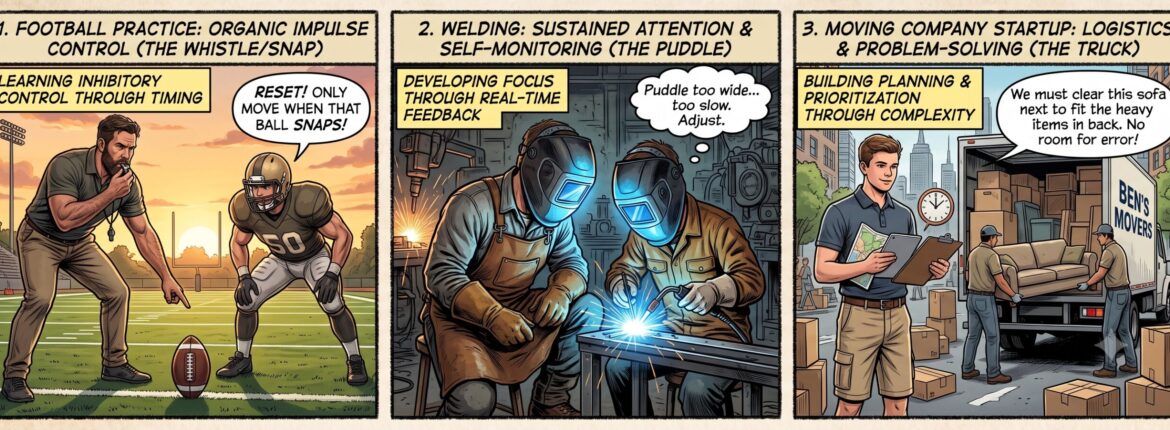
- Emotional Regulation: Football is a game of immediate, physical failure—getting blocked or dropping a pass. Because the game moves rapidly, dwelling on a mistake means getting beaten on the next snap. The physical momentum forces the athlete to immediately flush frustration, reset, and focus on the current play.
- Impulse Control: An offensive lineman must wait for the exact snap of the ball. Jumping offside carries immediate, team-wide consequences. This intense physical stakes build bottom-up impulse control that a classroom seat can never replicate.
The Golf Course (The Golfer)
- Cognitive Flexibility: No two golf shots are identical. A golfer steps up to the ball facing a unique matrix of wind, slope, and turf dampness. If the wind suddenly gusts, the brain is forced to dynamically pivot its strategy, stripping away mental rigidity through physical troubleshooting.
Welding (The Welder)
- Sustained Attention: Welding requires extreme, micro-focused attention. If the mind wanders, the arc breaks or the metal burns through. The bright flash of the arc and the melting steel act as an intense sensory anchor, locking the brain into a flow state.
- Self-Monitoring: The welder must constantly monitor the width and depth of the puddle beneath the hood. The material itself acts as the ultimate self-monitoring tool, correcting hand speed and angle in real-time.
Landscaping (The Landscaper)
- Spatial Planning: Transforming a yard requires breaking a project down into highly tangible stages (grading, burying irrigation lines, planting sod). Because the physical steps rely entirely on one another, the brain naturally learns project mapping through dirt, stone, and muscle.
The Moving Company Startup (The Entrepreneur)
- Problem-Solving & Logistics: Managing a moving startup is a giant, real-world puzzle. Packing a moving truck requires advanced spatial reasoning: heavy appliances must form the base, fragile items must be secured on top, and everything must be strapped down tight to prevent shifting. If the packing logic is flawed, items break. The physical stakes force highly efficient, logical problem-solving.
- Organizing and Time Management: In a startup service business, time is literally money. An ADHD founder quickly learns the tangible impact of scheduling, routing, and estimating jobs. Missing a window means an angry client and a lost contract. Because the feedback loop is tied directly to their business survival and financial independence, the brain treats time management not as an arbitrary rule, but as a crucial tool for victory
Conclusion: The Sandbox of the Mind
The magic of discovering executive function within a craft is that it eventually generalizes. Once an ADHD individual experiences what it feels like to successfully plan, organize, execute, and troubleshoot a complex task within their passion, their brain finally understands the mechanics of its own success.
They realize they aren't broken. They don't need to be cured of their executive deficits; they simply need to be placed in arenas that respect human evolution. By stepping out of the abstract text and picking up the tools of a trade, they stop fighting their biochemistry and let the two-million-year-old prediction engine do exactly what it was designed to do: master the world.