
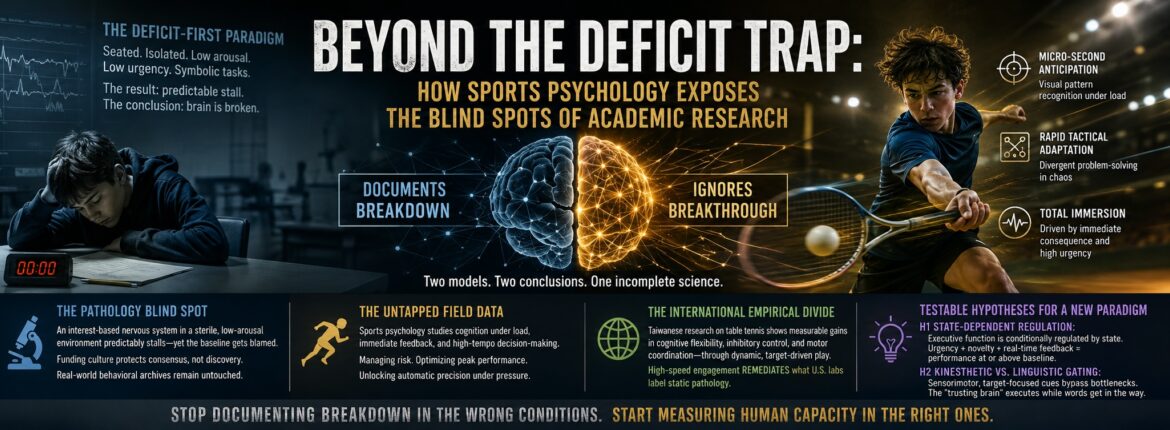
American neurodevelopmental research remains fundamentally locked in a deficit-first paradigm. By evaluating cognitive function primarily through seated compliance, isolated laboratory variables, and endurance for low-urgency symbolic tasks, institutional psychiatry documents the mechanics of behavioral breHow Sports Psychology Exposes the Blind Spots of Academic ADHD Research
A Science of Pathology Without a Science of Potential
American neurodevelopmental research remains fundamentally deficit-first. It evaluates cognitive function primarily through seated compliance, isolated laboratory variables, endurance for low-urgency symbolic tasks, and the consequences of dysfunction. As a result, institutional psychiatry has become extraordinarily good at documenting the mechanics of behavioral breakdown while remaining remarkably incurious about the mechanics of high performance.
That does not make the pathology research wrong. ADHD creates real impairment. Executive dysfunction is real. Emotional dysregulation is real. Inconsistent access to attention, difficulty initiating tasks, working-memory failures, time blindness, and the maddening inability to reliably perform something you demonstrably know how to do can be devastating.
The problem is not that academia studied the first column. The problem is that it started treating the first column as the whole page.
There is another side of the ADHD nervous system operating in hockey arenas, swimming pools, gymnastics facilities, recording studios, film sets, concert halls, kitchens, workshops, emergency rooms, entrepreneurial companies, and thousands of other environments where human beings are not merely being asked to function adequately. They are being developed toward the outer limits of what they can do.
Behavioral science has spent enormous resources asking how ADHD people break down. It is time to become equally curious about how they become extraordinary.
The Pathology Blind Spot
The traditional medical model understandably begins with impairment. People generally do not enter clinical systems because everything is going wonderfully. Researchers therefore inherit populations defined by difficulty and questions defined by difficulty: Why can't this child sustain attention? Why can't this adult organize behavior? Why does working memory collapse? Why does emotional regulation fail?
Those are legitimate questions. But repeatedly asking questions about failure eventually produces an enormous scientific literature about failure, and that literature can begin masquerading as a comprehensive description of the human beings being studied.
It isn't.
Dr. William Dodson provides a particularly revealing example from inside ADHD itself. In a 2024 draft chapter on emotional regulation, he argues that emotional dysregulation has been particularly difficult to investigate because it refuses to behave like a convenient laboratory variable. It is intermittent, changes with sleep, stress, coexisting conditions and hormonal state, and often requires researchers to rely upon self-report about experiences people may be embarrassed to disclose.
The history he describes exposes a methodological trap. Dodson notes that emotional features were intentionally excluded from early ADHD definitions partly in an effort to simplify the condition around behavioral features that were easier to research.
Think about what happened there:
difficult to measure >> difficult to research >> poorly represented in the model
That is not evidence that science failed. It is evidence that what science can conveniently measure can influence what science comes to believe is important.
The same caution should apply when we study ADHD performance. An interest-based nervous system placed in a sterile, low-arousal environment may stall, and researchers can precisely measure the stall. But if the same nervous system behaves radically differently when urgency, movement, novelty, competition, immediate feedback, personal meaning, or intense interest enters the environment, the scientific problem becomes larger than documenting the original deficit.
same brain >> different environment >> radically different performance
The crucial scientific question becomes: What changed?
What If the Variability Is the Signal?
Researchers understandably dislike uncontrolled variability. Sleep changes. Stress changes. Emotional state changes. Motivation changes. Interest changes. Environment changes. Human beings are messy, and controlled experiments attempt to remove that mess so individual variables can be isolated.
But ADHD may present a peculiar problem for that strategy: what if some of the variables being controlled away are part of the phenomenon?
Dodson's emotional-regulation discussion describes a phenomenon whose expression changes with state and context. The same possibility should be investigated across ADHD performance more broadly. If cognitive access changes dramatically with urgency, novelty, movement, feedback, personal meaning, perceived evaluation, emotional state, or another person's presence, then averaging those states together can conceal the very mechanism we should be trying to understand.
Variability is usually treated as noise around the measurement.
What if the variability is the signal?
That question leads directly into sports psychology.
Sports Psychology Has Been Studying the Other Side
Clinical psychology frequently encounters a human being after something has gone wrong. Sports psychology often encounters a human being because something can go better.
Sports psychologists certainly study vulnerability. Performance anxiety matters. Choking matters. Emotional volatility matters. Confidence collapses. Athletes become trapped in conscious mechanical thought, fail to recover from errors, become overwhelmed by expectations, or suddenly lose access to movements they have successfully performed tens of thousands of times.
But sports psychology cannot stop after documenting the breakdown because somebody still has to perform. That creates a different sequence of questions: What happened? What changed? How do we restore access to the capability we already know exists? Then, once it has returned, how do we develop it further?
Pathology research asks how to move someone from dysfunction toward normal.
Performance research asks how to move someone from normal toward exceptional.
A systematic review of 30 sport-psychology meta-analyses found an overall moderate beneficial effect for constructs expected to enhance athletic performance. The underlying literature includes confidence, anxiety, imagery, goal setting, mindfulness, cohesion, pressure training, attentional control and other performance variables. The strength of the evidence varies across constructs, but the larger point is clear: sports psychology has built an empirical literature around the optimization of human performance.
ADHD science should raid its intellectual pantry.
Bob Rotella and the Science of Getting Out of Your Own Way
Bob Rotella provides an almost embarrassingly direct example of what ADHD researchers could find there.
Rotella is not an ADHD researcher. His domain is performance, and that is precisely why his work is useful here.
In Golf Is a Game of Confidence, Rotella describes the confident athlete as visually locking onto the objective and allowing the trained brain and body to execute. His examples move across sports: a basketball player does not consciously lecture herself through every component of shooting, and a pitcher does not mentally rehearse the individual movements of shoulder, arm, elbow, wrist, and fingers before throwing. The skills have already been developed. Conscious mechanical intervention can now become interference.
Rotella returns to the distinction in The Golfer's Mind. During practice, conscious analysis has a job. Mechanics can be examined, corrected, repeated, and learned. During competition, however, he wants the athlete increasingly trusting the trained system and directing conscious attention toward the target rather than micromanaging the movement.
That gives us a remarkably clean architecture:
conscious brain >> decide
attentional system >> target
automatic motor system >> execute
conscious brain >> stay the hell out of the way
This is not an argument against cognition. Rotella wants substantial cognitive work done before execution: choose the target, evaluate the conditions, select the shot, establish the routine, commit to the decision. Once the movement begins, however, the job changes.
His formulation for putting is beautifully paradoxical: “you gain control by giving up control.”
That should sound alarms all over executive-function research. We may be treating more executive control as universally better when skilled human performance sometimes requires the executive system to know when to relinquish control.
The Hockey Goalie Problem
Rotella gives us another comparison that may be even more important for ADHD.
Golf contains enormous stretches of low urgency. The golfer hits a shot and then walks. Waits. Thinks. Remembers the last shot. Imagines the next one. Looks at the leaderboard. Wonders what everybody else is doing. The golfer must repeatedly regulate attention during periods in which the environment places almost no immediate demand upon it.
A hockey goalie inhabits almost the opposite attentional world. When the puck is in play, and particularly when it enters the defensive zone, the goalie exists in a nearly continuous state of externally generated urgency. The puck can change direction in an instant. A pass can cross the slot. A screen can appear. A deflection can completely alter the trajectory. The goalie must track the puck while simultaneously processing bodies, sticks, passing lanes, spatial relationships, rebounds, potential shooters, and rapidly changing threats.
There is very little opportunity to say, I'll pay attention in a minute.
The environment keeps creating now.
That distinction is enormous from an ADHD perspective. The golfer must repeatedly generate engagement internally during long periods of low external urgency. The goalie is immersed in an environment that continually generates urgency for him.
low urgency >> internally sustain engagement >> vulnerability
continuous urgency >> externally captured engagement >> potential advantage
And here the research literature has already wandered surprisingly close to the door. Sports scientists distinguish between closed-skill activities, performed in relatively predictable environments, and open-skill activities requiring continual responses to dynamically changing, externally paced environments. Recent meta-analyses of exercise interventions in ADHD have reported executive-function benefits from both types, with open-skill exercise showing particularly promising effects.
None of that establishes that ADHD makes someone a better hockey goalie. But now we have a serious research question rather than a cute sports analogy:
Could ADHD traits become advantageous in a position whose attentional architecture continuously supplies one of the strongest triggers for ADHD engagement—urgency?
That is the experiment I want someone to run.
Do not merely ask whether ADHD goalies can compensate for an attentional deficit sufficiently to succeed. Compare ADHD and non-ADHD goalies. Manipulate periods of externally generated urgency. Examine reaction time, target tracking, anticipatory movement, attentional lapses, cognitive flexibility, recovery after unexpected deflections, and performance as the tempo changes.
If the hypothesis is correct, we should find something much more interesting than compensation. We should find conditions under which a characteristic described as a liability in one environment becomes a performance advantage in another.
The nervous system didn't change.
The value of its characteristics changed when the environment changed.
Practice Is Not Performance
Rotella also makes a distinction that should be familiar to anyone who has watched an ADHD child perform something beautifully in one environment and seemingly lose the ability in another.
Golfers repeatedly tell him that they hit beautifully on the practice range and become different players on the course. Rotella's explanation is environmental: there are no meaningful consequences for a bad shot on the range. Competitive golf changes the psychological state. His response is to make practice more closely resemble competition—specific targets, realistic situations, routines, imagined competitive circumstances, consequences.
Sports psychology does not respond, "But we already established his ability on the driving range." It asks why established ability became inaccessible when the environment changed.
That distinction between capacity and access to capacity may be one of the most important underdeveloped ideas in ADHD research.
Rick Ankiel and the Difference Between Capacity and Access
Rick Ankiel provides an extraordinary natural experiment in exactly that distinction.
There is no reliable basis for claiming Ankiel has ADHD, and none is necessary. His documented pitching collapse is useful because it makes state-dependent access almost impossible to ignore.
Ankiel possessed an extraordinary major-league arm. Then the yips devastated his ability to reliably throw from the pitcher's mound. Eventually he abandoned pitching and accomplished something almost absurd: he returned to Major League Baseball as an outfielder.
Consider what changed. A major-league pitcher stands at the center of every play. The batter waits for him. His teammates wait for him. The stadium waits for him. The television camera is pointed at him. Nothing happens until the baseball leaves his hand.
All eyes are on the pitcher.
A center fielder possesses essentially the same throwing arm while occupying a radically different psychological environment. For much of the game, nobody is looking at him. Then the ball is hit and there is no prolonged ceremonial moment during which an entire stadium waits for Rick Ankiel to demonstrate whether Rick Ankiel can still throw a baseball.
The play happens. He sees the ball, tracks it, moves, fields it, identifies the target, and throws. The motor capability did not reappear because Ankiel grew another arm.
mound >> anticipation >> evaluation >> self-monitoring >> interference
outfield >> moving play >> immediate target >> reaction >> throw
Same athlete. Same arm. Different access.
That should be irresistible to behavioral scientists.
The Mound Exists Outside Sports
The same phenomenon becomes visible outside athletics.
Benedict Cumberbatch can walk onto a stage in front of a packed theater with every eye in the building pointed directly toward him and perform brilliantly. That immediately tells us that simply being watched cannot be the entire variable.
When Cumberbatch is playing Hamlet, the audience is looking at Hamlet.
The character is a mask, but the mask does something more interesting than simply hide the actor. Performance gives Cumberbatch a mechanism for controlling the audience's judgment. He knows the words, the character, the blocking, and what the scene requires. He has rehearsed the performance and spent a lifetime developing the tools required to influence exactly what the audience experiences. He is being evaluated, but he has a highly developed control surface for shaping what is being evaluated.
Then give him an award. Take away the character, the script, and the blocking. Put Benedict Cumberbatch behind a podium as Benedict Cumberbatch, surrounded by colleagues, peers, and mentors whose opinions may matter enormously to him.
Now they're not looking at Hamlet.
They're looking at him.
And one of the finest actors of his generation can become a deer-in-the-headlights, stammering idiot dropping F-bombs while trying to assemble a coherent acceptance speech.
Nothing happened to his intelligence, vocabulary, memory, creativity, or verbal ability during the walk from his seat to the podium. The psychological architecture changed.
The interesting variable therefore may not be simply all eyes on me. It may be the interaction between evaluation, attentional target, practiced role, uncertainty, self-consciousness, and perceived control over what the audience is about to judge.
evaluation + practiced role + external target + perceived control >> performance
versus
evaluation + exposed self + uncertainty + reduced control >> self-monitoring >> interference
That is Rick Ankiel walking from center field back onto the pitcher's mound.
Neither example proves the mechanism. Together, they scream for someone to test it.
From Observation to Hypothesis
Here is where another part of Dodson's chapter becomes directly relevant.
Dodson describes what he calls practice-based evidence: clinicians repeatedly observe a pattern in real patients, develop an idea from those observations, and then hand the question to researchers for formal investigation. He explicitly accepts the importance of controlled research while arguing that repeated clinical observations should not be discarded merely because the formal study has not happened yet.
That distinction matters enormously. The choice is not anecdote OR science. It can be:
observation >> recurring pattern >> hypothesis >> experiment >> evidence
That is how I am proposing we use Ankiel, Cumberbatch, Rotella, elite ADHD athletes, coaching practices, sports film, and the experiences repeatedly reported by ADHD people. Do not declare the mechanism proven, but do not throw away the observation either.
Study it.
The Scaffolding Around Extraordinary Performance
There is another lesson sitting in plain sight throughout professional sports.
Elite athletes do not maximize themselves alone. Around them sits an extraordinary architecture of coaches, strength trainers, sports psychologists, physicians, physical therapists, nutritionists, video analysts, teammates, practice schedules, recovery protocols, immediate feedback systems, external accountability, measurable goals, competition calendars, carefully calibrated challenges, and people whose careers depend upon noticing when something in the system stops working.
Look at that environment through an ADHD lens. Structure is externalized. Time is externalized. Goals are visible. Feedback is rapid. Movement is intrinsic. Progress is measurable. Challenge continually changes. Other human beings participate in preparation, scheduling, emotional regulation, recovery, accountability, and performance.
Nobody tells an Olympic athlete, "You really need to learn to organize all of this yourself."
They build the scaffolding because performance matters more than proving independence.
Perhaps the relevant scientific unit is not always the isolated individual. Perhaps sometimes it is:
person + task + environment + other human beings
The Human Being Can Be Part of the Executive System
We continue treating executive function as though it resides entirely inside one skull.
Real human beings rarely operate that way. Coaches regulate athletes. Editors regulate writers. Conductors regulate musicians. Directors regulate actors. Teachers regulate students. Teams regulate one another. Another person can provide temporal structure, emotional regulation, prioritization, accountability, feedback, initiation, perspective after failure, or simply the external signal that cuts through everything else and says:
This. Now.
Sports understands this intuitively because the scoreboard does not care where the executive function came from.
If the system produces performance, the system matters.
For ADHD researchers, that opens an enormous question: What happens when executive function is studied not merely as an internal possession but partly as an emergent property of the interaction between a nervous system and the architecture surrounding it?
That does not erase neurological difference. It gives us a larger unit of analysis.
Stop Studying Successful ADHD People as Curiosities
There is a strange habit in discussions of neurodivergence. Successful ADHD people become anecdotes.
An Olympic champion has ADHD. An actor has ADHD. A musician, entrepreneur, artist, director, programmer, chef, mathematician, or surgeon has ADHD. The person gets added to a list of famous people with ADHD, everybody feels better for thirty seconds, and almost nobody asks the scientifically interesting question:
How did that nervous system get there?
If an ADHD musician develops astonishing musical fluency, reconstruct the developmental architecture. If an actor can memorize enormous quantities of material, respond instantaneously to another performer, regulate timing, inhabit a character, and reproduce that performance under pressure, investigate it. If an athlete can perform rapid spatial prediction, inhibit premature action, continuously update moving information, recover from errors, and execute trained behavior under extreme time pressure, stop treating that performance as anecdotal noise surrounding the "real" executive-function data.
It is executive-function data.
The developmental machinery is what we should be studying: engagement, mentors, repetition, feedback, external structure, anxiety management, automation, physical movement, environmental design, accountability, failure, recovery, and the gradual transfer of functions from deliberate thought into practiced automaticity.
Do not study successful ADHD people because they make us feel better about ADHD.
Study them because they contain data about development.
The Tape Is Data
Professional sports have accidentally constructed one of the largest naturalistic longitudinal archives of human performance under pressure ever assembled.
Thousands upon thousands of hours preserve the same athletes repeatedly performing under changing conditions of confidence, fatigue, pressure, injury, public scrutiny, success, failure, recovery, and adaptation. The same athlete, underlying skill, and nervous system can be observed across radically different states and radically different performances.
The purpose is not to retrospectively diagnose athletes from television footage. It is to use documented state transitions to generate hypotheses that can then be tested prospectively.
Film can be combined with performance statistics, interviews, biographies, coaching histories, documented psychological interventions, and eventually controlled experimentation. Instead of asking merely how good an athlete was, researchers can ask something much more revealing:
Under what conditions could this human being reliably access what we already know they possessed?
The tape is data.
Someone Has Already Walked Through the Door
This research direction is no longer merely hypothetical.
The table-tennis studies we have already discussed moved ADHD executive-function research into a dynamic sensorimotor environment. Since then, the evidence base has become considerably larger.
A 2024 meta-analysis specifically comparing open- and closed-skill exercise in ADHD synthesized 578 participants across 11 randomized trials and three non-randomized studies. Both forms of exercise were associated with executive-function improvements, while open-skill exercise showed the stronger overall effect in that analysis.
A broader network meta-analysis published in 2023 examined 59 studies, with 44 studies and 1,757 participants entering its meta-analysis. It described open-skill activities as requiring participants to react within dynamically changing, externally paced environments and found them particularly promising for executive-function outcomes.
That definition should stop us in our tracks:
dynamically changing >> externally paced
That is table tennis. That is hockey. That is the goalie crease.
These environments do not simply add exercise to an otherwise conventional cognitive task. They change the attentional architecture of the task itself.
movement >> tracking >> anticipation >> inhibition
decision >> immediate feedback >> correction >> repeat
external change >> renewed urgency >> renewed engagement
Someone already opened the door.
Walk through it.
From Deficit Measurement to Performance Mapping
Imagine redirecting even a fraction of ADHD research toward performance maximization.
Take the same participant and systematically manipulate urgency, novelty, movement, competition, feedback latency, target salience, linguistic load, personal interest, social accountability, perceived control, and challenge.
Then stop asking only whether:
ADHD group < control group
Map the performance surface. Find where the gap widens, where it narrows, where it disappears, and whether there are conditions under which it reverses. Then study the transitions:
capacity demonstrated >> capacity becomes inaccessible >> conditions change >> capacity reappears
That sequence may tell us more about an individual nervous system than another static average ever could.
Rotella's work suggests another experimental manipulation: vary the amount and timing of conscious control. Teach the task consciously, practice it deliberately, and allow it to become automated. Then, during performance, systematically vary whether participants receive mechanical self-instructions or external target-oriented cues.
linguistic monitoring >> working-memory load >> mechanical interference
versus
target selection >> sensorimotor organization >> committed execution
Perhaps the problem is not always insufficient executive control.
Sometimes the executive system may be refusing to shut the hell up.
The Selection Effect of Researchability
Dodson's chapter raises one more uncomfortable possibility.
Scientific methods do not merely determine how we answer questions. They inevitably influence which questions get asked.
He describes the practical problems of researching phenomena that are intermittent, subjective, difficult to quantify, difficult to provoke ethically, or dependent upon states that fluctuate across time. He also describes the gap between clinicians who encounter patterns repeatedly in real people and academic researchers who must turn those patterns into variables that can survive formal study.
That does not make controlled research the enemy. Dodson explicitly defends rigorous evidence as protection against bias, placebo effects, mistakes, and quackery. The problem appears one step earlier:
What happens to important questions that are difficult to operationalize?
If a phenomenon is easy to count, reproduce, isolate, and publish, science has a natural pathway for investigating it. If a phenomenon is intermittent, state-dependent, highly contextual, socially sensitive, or dependent upon complex interactions among person, environment, and other people, the pathway becomes harder.
That creates a selection effect:
researchability >> research attention >> accumulated literature >> apparent scientific importance
Something may dominate the literature because it is important. Something may also dominate the literature because it is measurable.
Those are not the same thing.
The Stigma of Half-Truths
This is where the deficit-first paradigm becomes more than an academic problem.
If virtually everything a scientific discipline chooses to measure about a population concerns where its members struggle, eventually the scientific vocabulary describing those people becomes a vocabulary of struggle: deficit, impairment, failure, dysfunction, disorder.
Every individual observation can be legitimate.
The composite portrait can still be grotesquely incomplete.
Imagine describing professional athletes using only injury reports. Researchers could construct an extraordinarily rigorous database of torn ACLs, concussions, rotator-cuff injuries, fractures, chronic pain, performance anxiety, depression, substance misuse, choking, and career collapse. Every entry could be true. The methodology could be immaculate. The statistics could be unimpeachable.
And the resulting literature would still be an absurd description of athletes.
Nobody would confuse the injury report with the science of athletic performance.
Yet we repeatedly do something