

Disclaimer: While the research highlighted in this article illustrates systemic trends and the disproportionately high rates of harsh discipline in these regions, these data points reflect regional averages—not the reality of every home. Countless parents and caregivers across Latin America, the Caribbean, and around the world reject physical and verbal abuse, navigate parenting with deep empathy, and proactively seek to support their neurodivergent children. This overview is intended to illuminate broad structural and cultural challenges, rather than diminish the efforts of the many families actively fostering safe, affirming environments.
In Florida’s Title I public schools, educators frequently work at the intersection of high socio-economic stress, cultural complexity, and neurodevelopmental diversity. Among the most vulnerable student populations in these classrooms are ADHD (Attention-Deficit/Hyperactivity Disorder) and AuDHD (co-occurring Autism and ADHD) youth raised in Caribbean Hispanic (Cuban, Puerto Rican, Dominican) and Caribbean Creole (Haitian, Jamaican) households.
When the internal mechanics of neurodivergence—specifically Rejection Sensitive Dysphoria (RSD), sensory processing differences, and executive dysfunction—meet traditional, high-intensity Caribbean disciplinary practices, these students enter the classroom with overloaded nervous systems. Without empathetic, trauma-informed intervention from educators, these students are routinely mislabeled as defiant, leading to punitive discipline rather than necessary support.
1. The Clinical & Cultural Pressure Cooker
Clinical Foundations of RSD (Dr. William Dodson)
Dr. William Dodson defines Rejection Sensitive Dysphoria (RSD) as an extreme, unbearable emotional vulnerability to the perception of rejection, teasing, criticism, or self-perceived failure.
- Universal Prevalence in ADHD: Over 95% of ADHD individuals report experiencing RSD, with roughly 30%identifying it as the most impairing aspect of their life.
- Greek Root (Dysphoria): Translates to "difficult to bear" or "unbearable". For ADHD individuals, RSD is experienced as physical pain, akin to a physical wound or being stabbed in the chest.
- Instantaneous Onset: Unlike Major Depression, which develops over weeks or months, an RSD shift is instantaneous, fully formed, and directly triggered by a perceived event.
- The Emotional Feedback Loop: Dr. Michael Jellinek estimates that the average child with ADHD hears 20,000 additional negative or corrective messages by age 10. Coupled with RSD, one negative comment can erase a thousand positive ones, drowning out encouragement and distorting self-worth.
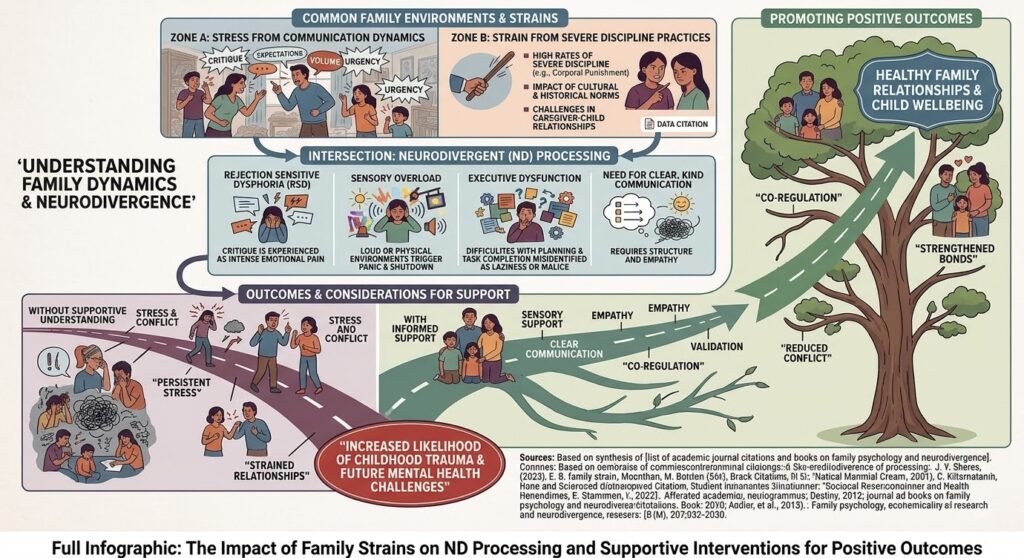
Caribbean Hispanic Households: The Weight of Verbal Critique
In traditional Hispanic Caribbean homes, parenting relies heavily on respeto (absolute deferential respect) and continuous verbal correction. Parents frame relentless critique regarding academic performance or behavior as consejos (guidance) intended to protect the child. For an ADHD or AuDHD child with RSD, this high-volume correction is amplified exponentially. Rather than building resilience, it inundates their nervous system with perceived rejection.
Caribbean Creole Households: Severe Physical Discipline
Global public health surveys indicate that the Caribbean region exhibits some of the highest rates of physical child discipline globally.
- Haiti: UNICEF Multiple Indicator Cluster Surveys (MICS) reveal that over 80% of children experience violent discipline in the home, often involving implements such as belts or switches (Flynn-O'Brien et al., 2016; UNICEF, 2014).
- Jamaica: Over 70% to 84% of children experience violent physical discipline, rooted in post-colonial control structures and religious beliefs around absolute obedience (Landon et al., 2023; UNICEF, 2021).
In these homes, executive dysfunction (forgetting tasks, struggling to sit still, sensory meltdowns) is frequently interpreted as willful disobedience (malcriado or bad manners), triggering immediate physical punishment.
2. Dodson’s Three Personality Outcomes & Pseudo-ODD
Dr. Dodson notes that children struggling with severe, untreated RSD typically adapt through one of three personality patterns:
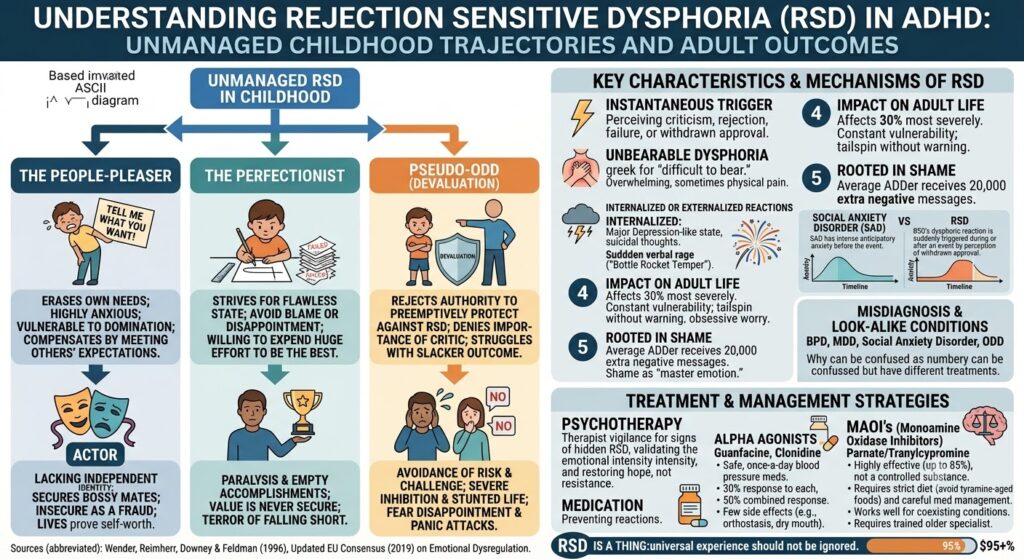
- The People-Pleaser: These children become hyper-aware of others' expectations, erasing their own wishes to avoid disappointing anyone. They often grow into adults who struggle with identity and feel like "frauds" or actors.
- The Perfectionist: Driven by fear, these students strive for flawless excellence so they can never be criticized or blamed. This severe perfectionism can mimic Obsessive-Compulsive Disorder (OCD) and leads to burnout, as their self-worth remains permanently contingent on immediate success.
- Pseudo-Oppositional Defiant Disorder (Pseudo-ODD): Dodson emphasizes that this presentation is the exact opposite of people-pleasing. When a child realizes that no matter what they do, it is never enough—and they are constantly judged as "lazy" or "not trying"—the wounds of RSD become unbearable. To survive, the child adopts an "F.U." shield. They devalue the authority figure (parent or teacher), deciding their opinion no longer matters to prevent being wounded further. They put up a belligerent armor to preemptively reject authority figures before they can be judged. While it looks like true ODD, it is actually protective armor built out of necessity against the agony of rejection.
3. Internalized vs. Externalized RSD & The Hyper-Vigilance Threat Spike
Dr. Dodson outlines two main ways an RSD reaction manifests when triggered by an authority figure's redirection or academic stress:
- Internalized RSD (Sudden Crash): The student instantaneously drops into an intense, depression-like state. They may slump over, put their head on their desk, or display suicidal thoughts. Unlike clinical depression, this shift happens in seconds and is tied directly to a specific trigger.
- Externalized RSD (Bottle-Rocket Temper): The student experiences a flash of sudden, intense rage. Dr. Tim Wilens describes this as a "bottle rocket temper"—a rapid verbal explosion that passes quickly for the student but leaves the classroom shocked. Dodson highlights that over 50% of court-mandated anger management attendees have undiagnosed ADHD, as impulsivity mixed with RSD creates sudden, violent reactions before the individual can avert them.
Tone, Body Language, and Preemptive Escalation
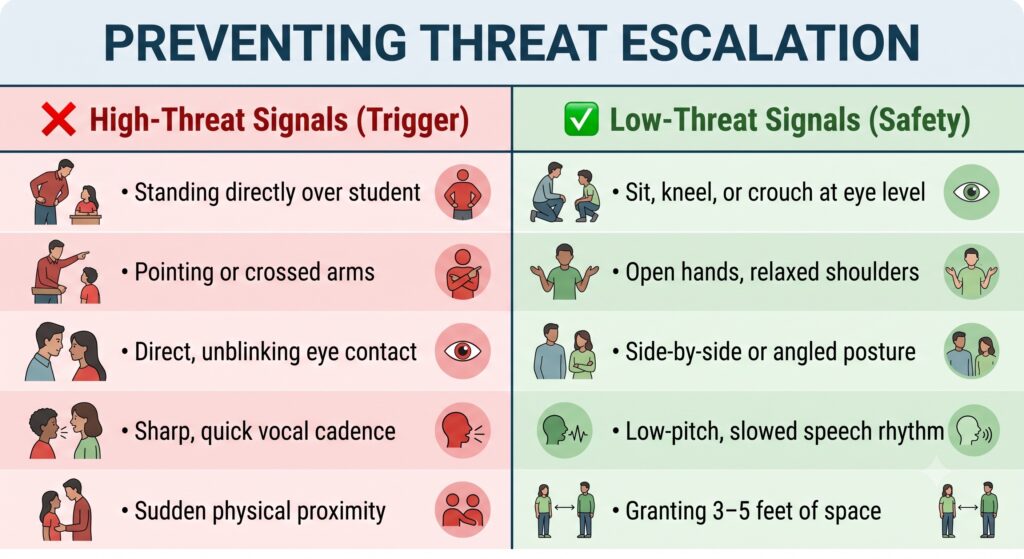
For an ADHDer raised in a highly critical environment, tone of voice, a sharp intake of breath, crossed arms, or a micro-expression of impatience is not processed as mere body language—it is registered as an immediate physical threat. Before an educator even finishes a sentence, the student's hyper-vigilant nervous system fills in the ending: "I am being judged, and I am about to be hurt." The student escalates preemptively (either via a "bottle rocket" explosion or a Pseudo-ODD attack) to push the adult away before the perceived emotional blow lands.
4. "Master Doodling" as a Self-Soothing Tell & Coping Mechanism
In Title I math and STEM classrooms, educators often observe a high prevalence of elaborate, continuous mark-making—what can be termed "Master Doodling." While traditional classroom management often misinterprets doodling as off-task defiance (malcriado) or Pseudo-ODD pushback, in neurodivergent students (ADHD, AuDHD, ASD), it serves as a critical self-regulation tool.
- Bypassing the "Master Emotion" (Shame): Dodson highlights shame as the master emotion driving RSD—the painful belief that one's very existence is flawed. Master doodling acts as a cognitive shield. By anchoring visual and motor processing in low-stakes mark-making, it quiets the internal monologue of negative self-talk before it triggers an RSD plunge or a Pseudo-ODD defense.
- Soft Engagement vs. Emotionally Jarring Disconnects: Forcing a neurodivergent student to abruptly stop a self-soothing rhythm and jump straight into high-stakes academic work acts as a cold-water shock to an already hyper-vigilant nervous system. This hard disconnect triggers an immediate RSD threat response. Master doodling provides a low-arousal "holding pattern" that keeps the brain safe from the pain of potential failure.
5. Why Florida Title I Schools Must Pay Special Attention
Title I schools in Florida serve high concentrations of immigrant families navigating acculturation stress, language barriers, and trauma.
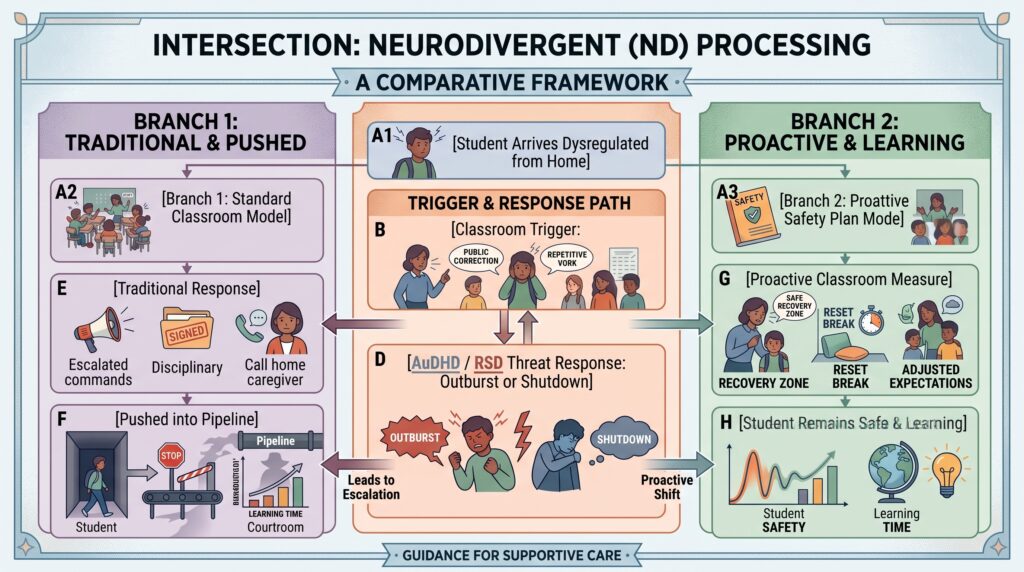
When educators rely on confrontational discipline, it creates a dangerous escalation cycle:
- The Trigger: A teacher publicly calls out an AuDHD student or displays impatient body language.
- The RSD Threat Spike: The student experiences the correction as severe physical pain or public shaming. They react with a "bottle rocket" explosion, a complete shutdown, or a Pseudo-ODD attack on the teacher's authority to protect themselves.
- The Unintended Consequences of Calls Home: Calling a parent who utilizes severe physical or verbal discipline to report "defiance" often results in severe domestic punishment. The student learns that school staff are unsafe, destroying trust and accelerating disengagement.
6. Actionable Strategies & Clinical Interventions
Low-Threat Body Language & De-Escalation Alignment
When approaching a dysregulated student, how an educator stands and speaks matters far more than what is said:
The "Soft Landing" Transition Protocol
To prevent the emotionally jarring disconnect between self-soothing behaviors (like master doodling) and academic engagement, educators can implement a 3-step transition protocol:
Pedagogical Modifications for Teachers
- Praise in Public, Correct in Private: Never correct an RSD student publicly, as public exposure amplifies RSD shame and triggers Pseudo-ODD posturing. Deliver feedback quietly at their desk using neutral, task-focused language.
- Establish Non-Verbal Exit Ramps: Provide pre-agreed "Reset Passes" allowing AuDHD/ADHD students a 3-minute walk or sensory break without public questioning.
- Differentiate Pseudo-ODD from True Defiance: Recognize that "I don't care" or aggressive posturing is not malicious defiance, but rather defensive armor designed to mask deep fear of failure and unbearable RSD pain.
Clinical & Pharmacological Awareness (Dr. Dodson)
Dr. Dodson emphasizes that because RSD shifts occur instantaneously, traditional psychological reflection cannot stop an active emotional storm once triggered. Prevention via pharmacological treatment is often key:
- Alpha-Agonists (Clonidine & Guanfacine): These non-stimulant medications provide robust RSD relief for about 50% of patients when both are tried. They take roughly 5 days to take effect and help prevent the neurological cascade of RSD[cite: 1, 2].
- Monoamine Oxidase Inhibitors (MAOIs): For severe, treatment-resistant RSD, MAOIs like tranylcypromine (Parnate) have been shown to work for up to 85% of patients, offering a non-stimulant option that addresses both ADHD and severe emotional dysphoria[cite: 1, 2].
Academic & Clinical References
- Bedrossian, L. (2021). Understand and address rejection sensitive dysphoria in students with ADHD. Disability Compliance for Higher Education, 26(10), 10–11.
- Dawson, P., & Guare, R. (2016). Smart but scattered: The revolutionary "executive skills" approach to helping kids reach their potential. Guilford Press.
- Delahooke, M. (2019). Beyond behaviors: Using brain science and compassion to understand and solve children's behavioral challenges. PESI Publishing & Media.
- Desautels, L. L. (2020). Connections over compliance: Rewiring our perceptions of discipline. Revelations In Education Publishers.
- Dodson, W. (2021). Rejection sensitive dysphoria and ADHD. ADDitude Magazine[cite: 1, 2].
- Flynn-O’Brien, K. T., Rivara, F. P., Weiss, N. S., Lea, V. A., Marcelin, L. H., Vertefeuille, J., & Mercy, J. A.(2016). Prevalence of physical violence against children in Haiti: A national population-based cross-sectional survey. Child Abuse & Neglect, 51, 154–162. https://doi.org/10.1016/j.chiabu.2015.10.021
- Greene, R. W. (2014). The explosive child: A new approach for understanding and parenting easily frustrated, chronically inflexible children. Harper Paperbacks.
- Landon, B., Thomas, E. D., Orlando, L., Evans, R., Murray, T., Mohammed, L., Noel, J., Isaac, R., & Waechter, R. (2023). Spare the rod, spoil the child: Measurement and learning from an intervention to shift corporal punishment attitudes and behaviors in Grenada, West Indies. Frontiers in Public Health, 11, Article 1127687. https://doi.org/10.3389/fpubh.2023.1127687
- Minahan, J. (2012). The behavior code: A practical guide to understanding and teaching the most challenging students. Harvard Education Press.
- UNICEF. (2014). Hidden in plain sight: A statistical analysis of violence against children. United Nations Children’s Fund.
- UNICEF. (2021). UNICEF renews call for ban on corporal punishment in Jamaica. United Nations Children's Fund Press Release. https://www.unicef.org/jamaica/press-releases/unicef-renews-call-ban-corporal-punishment
- UNICEF. (2022). A statistical profile of violence against children in Latin America and the Caribbean. United Nations Children’s Fund Regional Office for Latin America and the Caribbean.