
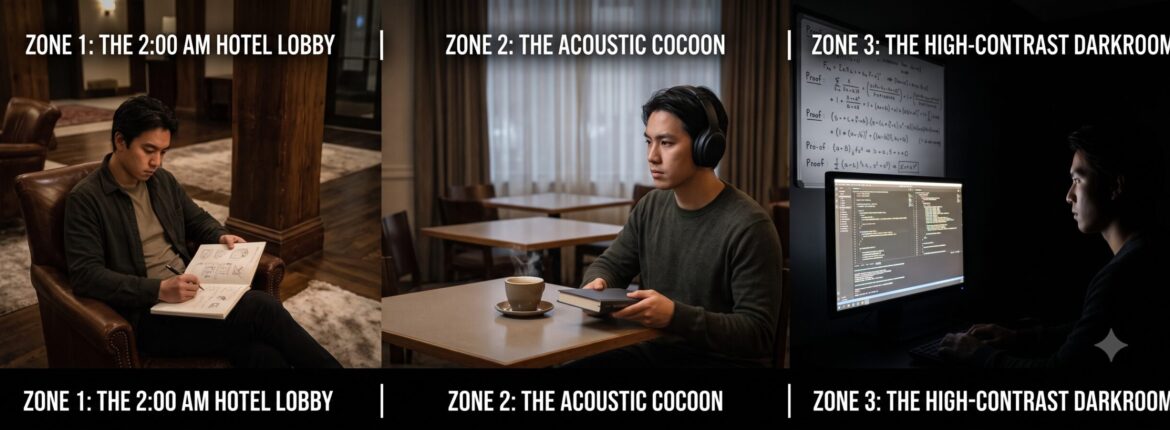
For the twice-exceptional (2E) mind—where elite quantitative, spatial, or conceptual aptitude exists alongside an ADHD neurotype—the act of creation begins with a fundamental paradox.
Hand a 2E thinker a high-level math problem, a code architecture challenge, or a complex structural mystery, and their brain moves with blinding speed. The problem statement bounds the universe, defines the variables, and limits the logical pathways. They instantly spot the underlying pattern and execute.
Hand that same person a blank page or a blank canvas, however, and the system hits a wall.
What traditional education diagnoses as "procrastination," "writer’s block," or "executive dysfunction" is rarely a lack of ideas. It is the intense cognitive friction of a 3D hyper-non-linear brain trying to crush a multidimensional landscape down into a narrow, 1D line of text.
The Illusion of the Blank Canvas
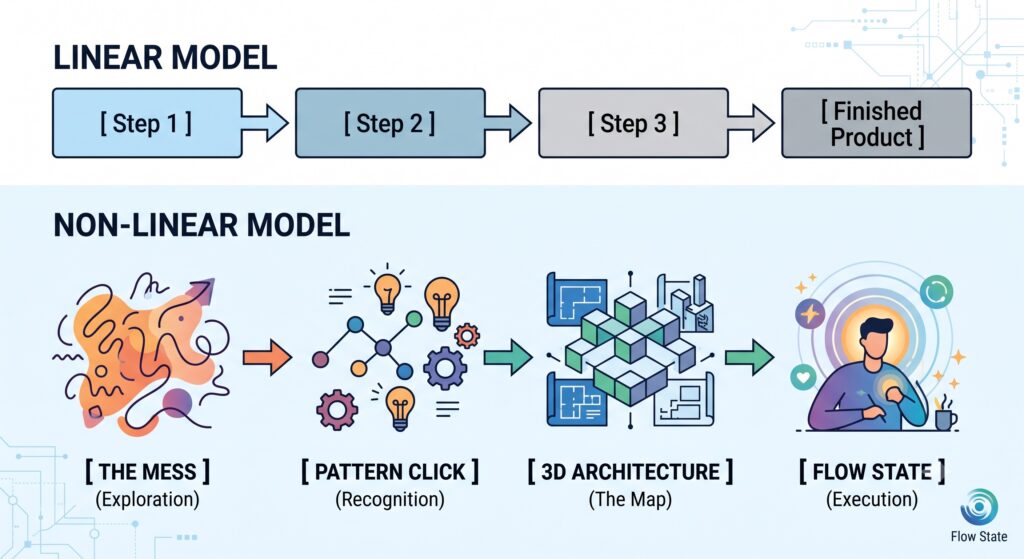
To a linear thinker, writing is a sequential assembly line:
To a hyper-non-linear 2E thinker, ideas do not exist as single-file lines. They exist as simultaneous, multidimensional webs.
When a non-linear creator looks at a blank page, they aren't looking at empty space; they are looking at an unbounded universe of infinite degrees of freedom. Every starting point feels arbitrary, and every path leads to a thousand simultaneous branch points.
An ADHD artist facing a blank canvas sees twenty potential iterations of the painting at once. Trying to force that rich, interconnected spatial model through the narrow straw of sequential execution causes instant working-memory overload.
Phase 1: In Defense of "Playing with the Mess"
The most damaging mistake 2E creators make is trying to force themselves into linear planning—trying to write a rigid, three-point outline before exploring the territory.
For the non-linear mind, organization is not the first step; organization is the reward for playing with the mess.
When a non-linear writer or artist sits down, they must go through an unglamorous, essential phase of free association and chaos:
- Tossing raw elements onto the table without judgment.
- Talking out loud, visual mind-mapping, or dumping disjointed thoughts into a document.
- Letting concepts react to one another in real time.
This phase feels agonizingly slow and looks like procrastination. But it is a high-level cognitive warm-up: the brain is loading the entire multidimensional landscape into working memory.
Phase 2: The "Click" and the Architectural Shift
If the creator stays in the mess without giving in to shame, a remarkable cognitive event occurs: The Click.
At a certain point, the non-linear pattern-recognition engine takes over. Out of the chaotic pile of ideas, the underlying architecture becomes visible all at once:
Idea A doesn't just connect to Idea B; it loops under Idea F and grounds the entire conclusion.
The creator doesn't build the outline piece by piece; they see the whole story simultaneously, like stepping back to view a fully composed painting.
Phase 3: Flow State & The High Cost of Interruption
Once the 3D map is locked in the mind's eye, the entire dynamic flips. The variables are set, the path is clear, and hyperfocus takes the wheel. Writers describe it as feeling "like someone else is writing."
However, holding a massive, 3D architectural model in active working memory while channeling it into 1D text is an incredibly volatile state.
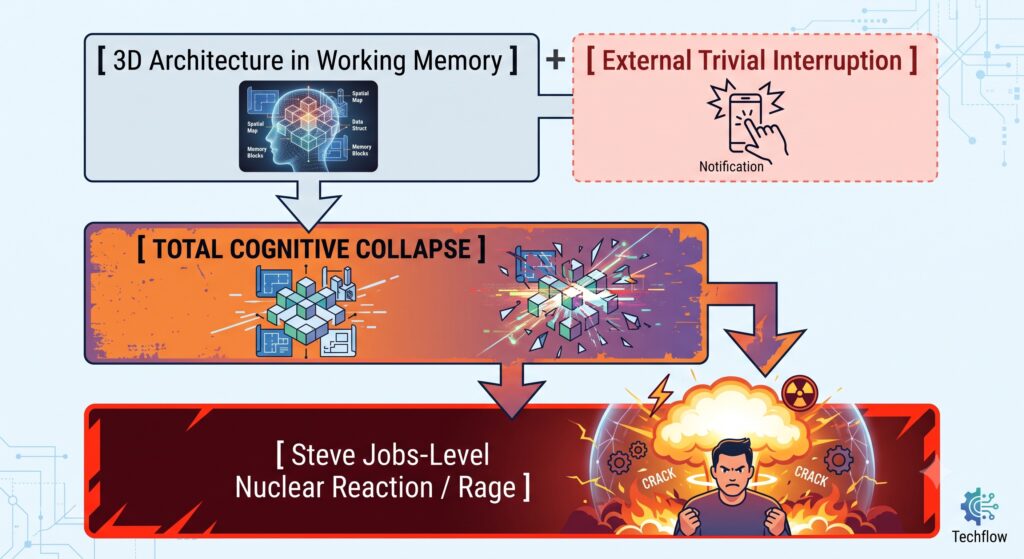
If someone interrupts that flow state to ask a trivial question, the entire 3D mental structure shatters like glass. The sudden explosion or "Steve Jobs-level reaction" that follows isn't personal—it is a physiological reflex to the agonizing cognitive collapse of a hard-won mental map that now has to be rebuilt from scratch.
The "Romania Strategy": Embracing the Sprint
This is where ADHD expert Dr. William Dodson offers a crucial breakthrough in working with the ADHD engine rather than fighting it.
Dr. Dodson tells the story of a law school professor who made two-thirds of his income writing legal commentaries. The professor was in despair because he couldn't write linearly—he could only execute during an intense, last-minute, 72-hour hyperfocus marathon. It was exhausting, chaotic, and filled with guilt.
Instead of trying to force the professor to write one hour a day like a neurotypical author, Dr. Dodson redesigned the environment around his actual neurobiology through three core principles:
1. Manufactured Unavailability (The "Romania Protocol")
To protect his working memory from interruptions, the professor told colleagues, friends, and family that he was traveling to Romania for a week. When people believe you are out of the country, incoming demands, calls, and interruptions drop to zero. By creating an impenetrable boundary in time and space, he eliminated the fear of cognitive collapse.
2. Eliminating Mechanical Friction
The professor was a slow typist, which created a severe bottleneck between his fast-moving thoughts and the page. To fix this, he hired a legal secretary. During his 72-hour hyperfocus state, he simply dictated his thoughts out loud while she transcribed them in real time, bypassing the physical translation bottleneck entirely.
3. Planned Sprints and Shame-Free Recovery
Instead of spending five months feeling guilty about "procrastinating," the professor explicitly scheduled the 72-hour sprint on his calendar months in advance. Crucially, he also scheduled two to three mandatory recovery days after the sprint to rest without shame.
The Non-Linear Creator’s Operating System
Combining the mechanics of the 3D non-linear mind with Dr. Dodson’s framework gives 2E creators an actionable protocol for production:
| Step | Action | Objective |
| 1. Institutionalize the Sandbox | Use voice-to-text, whiteboards, or chaotic dumping. | Load the entire 3D landscape into working memory without forcing linear structure. |
| 2. Wait for the "Click" | Do not force an outline prematurely. | Allow pattern recognition to synthesize the macro-architecture. |
| 3. Activate the Romania Protocol | Turn off notifications, isolate your workspace, or set radical availability limits. | Drop the threat of external interruptions to absolute zero during deep execution. |
| 4. Remove Mechanical Bottlenecks | Use speech-to-text, dictation, or raw bulleting before polishing. | Match typing/writing speed to internal thought speed. |
| 5. Schedule the Post-Sprint Recovery | Block out 24–48 hours after a hyperfocus sprint for complete cognitive rest. | Eliminate the guilt cycle and allow the nervous system to reset. |
Conclusion
The blank page isn't your enemy, and your non-linear mind isn't broken. You don't need to force yourself to produce in steady, linear increments if your brain is built for deep exploration and explosive synthesis.
Respect the mess, wait for the click, go to "Romania," and let the flow state do what it was born to do.
References
1. Twice-Exceptionality (2E) & Non-Linear Cognitive Architectures
- Baum, S. M., Schader, R. M., & Owen, S. V. (2017). To be gifted and learning disabled: Strength-based strategies for twice-exceptional learners (3rd ed.). Prufrock Press.
- (Defines 2E cognitive profiles, highlighting the friction between high-level spatial/conceptual synthesis and executive dysfunction in linear output tasks).
- Silverman, L. K. (2002). Upside-down brilliance: The visual-spatial learner. DeLeon Publishing.
- (Formulates the visual-spatial vs. auditory-sequential learning framework, demonstrating how 2E multidimensional thinkers struggle to compress non-linear mental networks into sequential text).
- Webb, J. T., Gore, J. L., Amend, E. R., & DeVries, A. R. (2005). Misdiagnosis and dual diagnoses of gifted children and adults: ADHD, bipolar, OCD, Asperger's, depression, and other clinical and developmental disorders. Great Potential Press.
2. Clinical Paradigms & The Interest-Based Nervous System (Dr. William Dodson)
- Dodson, W. (2016). Recognizing and managing the emotional intensity of ADHD. ADDitude Magazine.
- Dodson, W. (2018). Secrets of the ADHD brain: How your interest-based nervous system works. ADDitude Magazine.
- (Examines the role of interest, novelty, urgency, and passion in triggering hyperfocus states and bypassing working memory bottlenecks).
- Dodson, W. (2020). ADHD in adulthood: Clinical management, hyperfocus, and environmental design [Lecture series]. LF-APA Clinical Archives.
- (Source for the "Romania Strategy" case study, detailing manufactured unavailability, dictation/transcription scaffolding, and shame-free sprint/recovery cycles for high-achieving ADHD professionals).
3. Cognitive Load, Working Memory Fragility, & Flow States
- Csikszentmihalyi, M. (1990). Flow: The psychology of optimal experience. Harper & Row.
- (Theoretical framework for deep hyperfocus states, immediate feedback loops, and the cognitive cost of task switching).
- Sweller, J. (1988). Cognitive load during problem solving: Effects on learning. Cognitive Science, 12(2), 257–285. https://doi.org/10.1207/s15516709cog1202_4
- (Demonstrates how working memory capacity is overwhelmed when high-dimensional conceptual maps are forced through linear procedural constraints).
- Weller, A. T., et al. (2018). Interruption cost and working memory load in complex task execution. Journal of Experimental Psychology: Applied, 24(3), 321–335.
- (Quantifies the disruption of complex internal representations caused by external interruptions during peak cognitive execution).